


Orlando International Airport is one of the busiest leisure gateways in the United States, serving travelers headed to Walt Disney World, Universal Orlando, cruises, conventions, and more. That popularity means long security lines, full parking lots, and a terminal that can feel overwhelming, especially for families. This guide walks you through exactly how to navigate departures at Orlando International Airport, from when to arrive and where to check in, to what to expect at security, where to eat, and how to keep kids happy before boarding.
Get the latest updates straight to your inbox!
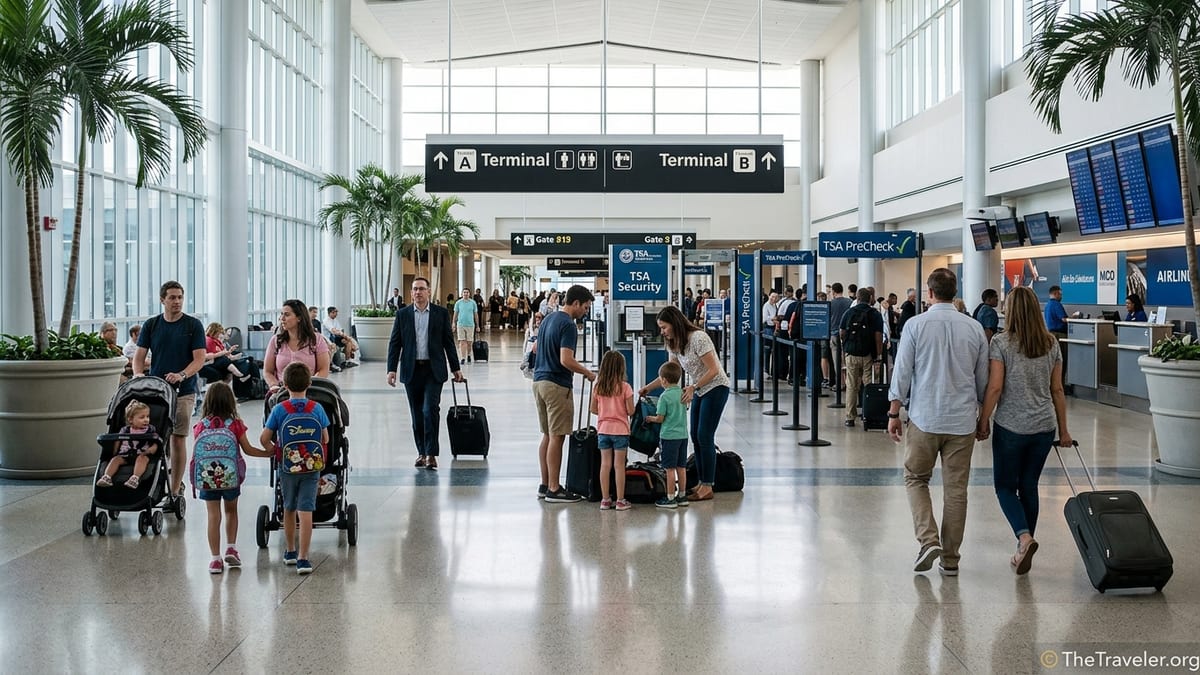
Understanding MCO’s Terminals, Airsides and Airline Locations
Orlando International Airport (MCO) is organized into a central terminal complex and separate gate areas called airsides. The North Terminal Complex contains Terminals A and B, which share a main building with ticketing and security on different levels, and connect to four gate concourses known as Airsides 1, 2, 3, and 4. Across the airfield is the newer South Terminal Complex, Terminal C, with its own check-in hall and gates for a growing list of domestic and international airlines.
Terminals A and B are mirror images of each other in the main building. Airlines such as Southwest and Frontier typically use Terminal A, while big legacy carriers like Delta and United check in on Terminal B, though assignments can change and some carriers use multiple terminals. Once you check in and pass security on either the A or B side, you will board an automated people mover out to your assigned airside. For example, many Southwest flights depart from Airside 2 (gates in the 100s), while some international carriers use Airside 4 (gates in the 70–90 range).
Terminal C is a separate complex connected to the rest of the airport by the Terminal Link automated people mover. It handles many international airlines plus some domestic flights, with check-in and departures located on its own upper levels. If you are flying carriers like British Airways or Aer Lingus, your departure is likely from Terminal C, meaning you will follow different roadway signs and park in Garage C or arrive directly at the South Terminal drop-off rather than the older A/B departures curb.
Because airline locations at MCO can and do shift, the safest approach is to confirm your terminal and gate the day before travel using your airline’s app, then compare that with the airport’s terminal map. For example, a family flying Spirit to San Juan may find they are checking in on Terminal B but departing from an airside reachable via the B-side security, while a couple on JetBlue to London may be directed entirely through Terminal C. Knowing this in advance saves last-minute stress and long walks.
How Early to Arrive and What Departure Timing Really Looks Like
For Orlando departures, a conservative and realistic rule of thumb is to arrive at the airport 2 hours before a domestic flight and about 3 hours before an international flight, particularly during school holidays, spring break, or major events in Central Florida. That means being physically at the terminal curb or parking garage, not leaving your hotel. On peak Saturdays in March or around Christmas, many travelers choose to add another 30 minutes as a buffer because security lines can be unpredictable.
Consider a typical family of four flying a domestic low-cost carrier to Chicago on a Saturday in June. If the flight departs at 10:30 a.m., aim to be dropped off or parked by about 8:00 a.m. That schedule gives 10–15 minutes to walk from Garage A or B into the terminal, 10–20 minutes for check-in and bag drop if you have luggage, and anywhere from 20–45 minutes to clear security if lines are heavy. You then have about 30–40 minutes at the gate, enough time to grab snacks, take kids to the restroom, and board without rushing.
Travelers with TSA PreCheck or CLEAR, or those flying very early in the morning, can sometimes cut that timing slightly, but it is best not to assume consistently short lines at MCO. A business traveler flying Delta at 6:00 a.m. with only a carry-on and TSA PreCheck could plausibly arrive around 4:45–5:00 a.m. and still feel comfortable. On the other hand, a once-a-year traveler bringing multiple checked bags for a cruise should build in extra time because bag drop lines and security can be much longer when large groups and families are traveling together.
Also factor in your starting point in the Orlando area. From the International Drive resort corridor, the drive to MCO often takes 20–30 minutes in light traffic but can run 40 minutes or more on weekday mornings. From Walt Disney World, plan on 25–35 minutes via SR-417 or SR-528 in normal conditions, plus potential delays at toll booths or when returning a rental car. Many travelers underestimate this segment and arrive later than intended even though they left their hotel on time.
Check-In, Bag Drop and Curbside Options
At Terminals A and B, airline check-in counters are generally located on Level 3 of the main building. The roadway above the parking garages leads directly to the departures curb for each side, with overhead signs indicating “Ticketing A” or “Ticketing B.” For example, if you are flying Southwest, you will follow signs to Terminal A and pull up near the section labeled with the airline’s name. Inside, counters are arranged in numbered zones, and overhead boards show which airlines use each zone, which helps if your ride-share drops you slightly away from your airline.
Several airlines operating at MCO offer curbside check-in during the day, usually for domestic flights and often for a per-bag service fee in addition to any baggage charges. On a busy summer morning, a family flying on American Airlines might find that the curbside desk on the B side is shorter than the main indoor line, allowing them to check two big suitcases and a stroller in under 10 minutes. Curbside staff can print boarding passes, tag luggage, and handle basic seat or party issues, but more complex problems such as weather rebookings still require visiting the indoor counter or using the airline app.
In Terminal C, the departures area is laid out more like a newer international hub, with a large, bright check-in hall and self-service kiosks for many carriers. Lines can be long in the early evening when multiple eastbound transatlantic flights depart within a short window. For instance, passengers flying on a 7:45 p.m. departure to London or Dublin may find the check-in lines for those airlines stretching well beyond the stanchions between 4:30 and 6:30 p.m., which is another reason international travelers should honor the recommended 3-hour early arrival.
Regardless of terminal, you can reduce your time at the counter by checking in online or via your airline’s app as soon as it opens, usually 24 hours before departure. If you are traveling with only carry-on bags, this allows you to skip the check-in desk entirely and head straight to security. For those checking baggage, especially oversized items like golf clubs or baby equipment, online check-in still speeds things up: you can use a kiosk to print tags, then use a dedicated bag-drop lane, which is often shorter than the full-service queue.
Security Screening, TSA PreCheck, CLEAR and Family Lanes
Security at MCO has a reputation for variability. Some mornings, general screening can move briskly; on other days, lines can snake through the terminal and down the escalators, especially during peak family travel periods. Terminals A and B each have their own large security checkpoint on Level 3, and those checkpoints funnel passengers to the separate airsides. Terminal C has its own checkpoint integrated into the departures level. All of them use standard TSA screening procedures, including ID checks, X-ray scanning of carry-ons, and, increasingly, computed tomography scanners that allow some passengers to leave electronics in their bags.
TSA PreCheck is widely available at MCO and can make a noticeable difference in wait times. With PreCheck, most passengers can keep on light jackets and belts, keep laptops and travel-size liquids inside their bags, and pass through dedicated lanes that are typically shorter than the standard ones. Frequent travelers from Orlando often report clearing security in under 15 minutes with PreCheck even at busy times, although there are no guarantees. Families with children 12 and under can accompany a parent or guardian in the PreCheck lane if the adult has the designation on their boarding pass, which is particularly valuable at MCO where many passengers are traveling with young kids and strollers.
CLEAR, a private identity verification service available at MCO, offers another level of speed by moving members to the front of the TSA document check. At Orlando, CLEAR stations are present in Terminals A, B, and C during most of the day, though operating hours can be more limited late in the evening. For example, a traveler with both CLEAR and PreCheck may be escorted directly from a CLEAR pod to the PreCheck physical screening lane, bypassing a long ID line, then enjoy the faster PreCheck process. This can shrink a 40-minute general line to closer to 10 minutes in practice, especially on peak weekends.
Families and travelers with extra needs should also look out for special lanes. TSA has increasingly experimented with family-friendly lanes at busy leisure airports such as Orlando, where agents may direct parents with strollers to a separate queue to avoid holding up business travelers. If you are traveling with items that need extra screening, such as baby formula or breast milk, mention this proactively at the start of the lane so officers can guide you to the right process. At MCO, officers are accustomed to large numbers of theme park visitors bringing souvenirs, wands, and toy lightsabers, so it helps to keep novelty items organized in your bag to avoid repacking everything at the end of the belt.
Food, Shops and Lounges Before You Fly
One of the quirks of Orlando International Airport is that many of the most recognizable dining and retail options are located past security in the airsides rather than in the main terminal. This means your top priority should be to clear security first, then look for meals and last-minute purchases near your gate. Airsides at MCO typically feature fast-casual chains, grab-and-go markets, coffee shops, and a mix of national and local-branded outlets, often with a strong theme park or Florida flavor.
For example, at Airside 2, which often serves Southwest flights, you might find a familiar coffee chain near the escalators, a quick-service burger or sandwich option, and a sit-down bar and grill overlooking the ramp where kids can watch aircraft push back while adults enjoy a meal. Airside 4, which handles many international flights, tends to have more substantial dining, such as full-service restaurants and larger duty-free shops where travelers can pick up perfumes, chocolates, or local rum before flying home. In Terminal C’s gate area, the food court incorporates light-filled spaces and more modern fast-casual outlets, reflecting its newer design.
Travelers looking for a quieter space or a guaranteed power outlet may want to consider one of the lounges at MCO. Pay-in lounges such as The Club MCO operate in both the A/B airsides and in Terminal C, offering comfortable seating, complimentary snacks and beverages, Wi-Fi, and often showers. These lounges are generally accessible through certain credit card programs or day passes purchased on the spot, subject to capacity. A family facing a long delay on an international flight might find the cost worthwhile for access to a kid-friendly corner, a variety of food, and a place to rest away from the crowded concourse.
Even outside lounges, Orlando’s departures areas have been gradually upgraded with more charging stations and seating, though it can still be challenging to find four adjacent seats with outlets during peak times. A practical strategy is for one adult to scout a gate area a few doors away from your flight; many travelers cluster directly at their own gate even when nearby ones are nearly empty. As long as you stay informed about boarding announcements via your airline app or the overhead monitors, sitting at a quieter gate can make a big difference in preflight stress levels.
Parking, Drop-Offs and Ground Transport for Departures
MCO offers a mix of parking garages, economy lots, and off-site private lots, and during busy travel weeks, the choice you make can significantly affect your total departure time. Garages A and B serve Terminals A and B and are attached directly to the terminal via bridges, which makes them the most convenient for many travelers. Garage C, near Terminal C, connects directly to the South Terminal and also to the intermodal station that serves the Brightline train and other ground transport. Daily parking prices in the terminal garages are higher than in economy lots, but the trade-off is a much shorter walk and no shuttle ride.
For budget-conscious travelers, MCO’s economy parking lots typically cost noticeably less per day and include shuttle service to the terminals. However, travelers should build in at least 20–30 extra minutes for parking, waiting for a shuttle, and the ride to the terminal, especially if lots are nearly full. A family leaving their car in an economy lot for a week-long cruise might pay significantly less overall than in a terminal garage, but they should plan to be in the lot 3 to 3.5 hours before an international departure or at least 2.5 hours before a domestic one to stay within safe timing guidelines.
Many visitors use ride-share services, taxis, or hotel shuttles instead of parking. Departing passengers are typically dropped on Level 3 at Terminals A and B or the corresponding departures level at Terminal C. For instance, a ride-share from a Walt Disney World hotel may drop you on the A side outside your airline’s zone; if the line is heavy at that door, you can walk inside and move down the check-in hall to a less crowded area serving the same carrier. Some on-site hotels, such as the Hyatt Regency located inside the A/B terminal complex, effectively turn the airport into your hotel lobby; guests can ride an elevator down from their room to the ticketing level and be at security within minutes.
Travelers connecting from the Brightline train or regional buses will arrive at the intermodal center that links to Terminal C and, via the Terminal Link people mover, to the A/B complex. If you are taking Brightline from Miami or Fort Lauderdale and then flying out, factor in transfer time from the station to your airline’s check-in area. While the people mover ride is short, walking between levels, using elevators with luggage, and navigating crowds can easily add 10–15 minutes, especially for families or those with mobility needs.
Family Travel and Special Tips for Departing with Kids
Orlando International is heavily oriented toward families headed to theme parks and cruises, and the airport has adapted with several family-friendly features. Terminals A and B include nursing rooms and “Mamava” pods in select locations where parents can feed or pump in private, as well as pet relief areas that can double as a brief outdoor break for restless kids if supervised carefully. Inside the airsides, some gate areas incorporate small play zones or colorful seating areas, though these are not uniform throughout the airport. Parents often improvise play space near windows where children can watch aircraft and ground vehicles.
One practical strategy for families is to complete as much organization as possible before reaching the security line. At a bench or seating area in the ticketing hall, parents can repack bags so that tablets, small toys, and comfort items are easily accessible in one carry-on, while snacks and baby supplies are grouped in another. When it is time for screening, collapse strollers and remove loose items into bins early to avoid scrambling at the conveyor belt. In TSA PreCheck lanes, children and parents typically keep shoes on, which makes the process far smoother; in standard lanes, explain to kids in advance that shoes, jackets, and stuffed animals may briefly go through the X-ray machine and then come right back.
Food and bathroom planning can also reduce stress. Because some security lines at MCO can be long, it is wise to use restrooms on the check-in level before entering the queue, especially with younger children. Once past security, families can look for quick-service options that offer kid-friendly meals such as pizza, chicken tenders, or simple sandwiches. Many Orlando-area chains familiar from the theme parks have outlets in the airport, which can be reassuring to kids who recognize a favorite brand. Consider buying a couple of extra water bottles or juice boxes once through security, since in-flight beverage service may be delayed on short or bumpy flights.
Finally, build in mental buffers along with time buffers. For instance, agree as a family that everyone will meet at a specific spot near the gate if anyone becomes separated in the crowded concourse. Take photos of boarding passes and passports on your phone for backup, and keep a small file or pouch containing all necessary documents. For parents traveling solo with children, it can be worth aiming to arrive even 15–20 minutes earlier than the usual guidelines, simply to allow for bathroom breaks, meltdowns, or a last-minute dash to a store without adding pressure.
The Takeaway
Departing from Orlando International Airport does not have to be chaotic, even during the busiest school holidays and theme park seasons. The key is understanding MCO’s layout, respecting realistic arrival times, and planning around the variables you can control. Knowing which terminal and airside your airline uses, checking in online, and giving yourself enough time to handle parking, bag drop, and security will eliminate most of the avoidable stress.
For many travelers, investing in TSA PreCheck or combining it with CLEAR can provide a valuable time cushion at an airport where security lines can vary widely throughout the day. Once past screening, focus on finding a comfortable gate area, grabbing food and drinks without straying too far, and setting up a calm preflight routine, especially if you are traveling with children. With a bit of preparation and realistic expectations, your departure from Orlando can become just another smooth step in your Florida trip rather than a last-minute scramble that overshadows the memories you came to create.
FAQ
Q1. How early should I arrive at Orlando International Airport for a domestic flight?
For most domestic departures from MCO, plan to arrive at the terminal 2 hours before your scheduled departure, and consider 2.5 hours during peak holiday or school break periods.
Q2. How early should I arrive at MCO for an international flight?
For international flights, aim to be at the airport 3 hours before departure, and add extra time if you need to park in an economy lot or return a rental car.
Q3. Which terminal do Southwest, Delta, and United use at MCO?
Southwest generally checks in on Terminal A, while Delta and United use Terminal B in the North Terminal Complex. Always confirm with your airline close to departure as assignments can change.
Q4. Is TSA PreCheck available at Orlando International Airport?
Yes, TSA PreCheck operates in Terminals A, B, and C, with dedicated lanes that usually move faster and allow you to keep laptops and small liquids in your bag.
Q5. Does MCO have CLEAR, and does it really save time?
Orlando offers CLEAR in its main terminals, and combining CLEAR with TSA PreCheck can significantly reduce your time in security lines during busy travel periods.
Q6. Are there family or kid-friendly lanes at security?
TSA sometimes designates family-friendly lanes at MCO, and children 12 and under can accompany an adult with PreCheck in the expedited lane, which helps families move through security more smoothly.
Q7. What are the parking options for departing passengers?
MCO has terminal garages A, B, and C for convenient but more expensive parking, plus lower-cost economy lots with shuttle service that require additional time to reach the terminal.
Q8. Are there good food options after security, or should I eat before?
Most of the better dining and coffee options are located past security in the airsides, so it is usually best to clear security first, then look for food near your gate.
Q9. Does Orlando airport have lounges I can pay to use?
Yes, pay-in lounges such as The Club MCO operate in multiple concourses and Terminal C, offering quieter seating, snacks, drinks, and Wi-Fi for eligible cardholders or day-pass buyers.
Q10. What special facilities are available for families with infants or young children?
MCO provides nursing rooms or pods, family restrooms, and scattered play-friendly areas near gates, and many restaurants offer kid-friendly menu items suitable for younger travelers.