


Choosing between Ostia Antica and Pompeii can shape your entire Italy itinerary. Both archaeological sites offer an extraordinary walk through an ancient Roman city, but they deliver very different experiences in terms of travel time, atmosphere, crowds and sheer emotional impact. This guide breaks down the real-world pros and cons of each so you can decide which ancient Roman adventure is better for your trip.
Get the latest updates straight to your inbox!
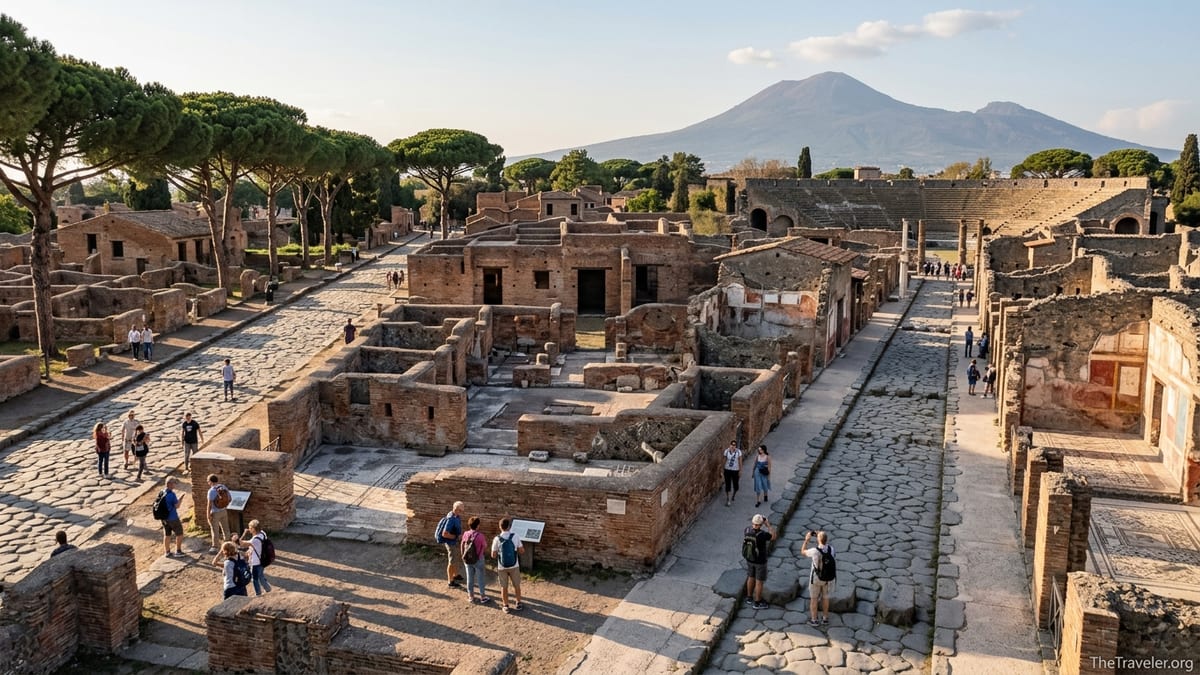
Ostia Antica and Pompeii at a Glance
Ostia Antica was once the bustling port of ancient Rome, handling grain, wine and goods arriving from across the Mediterranean. Today, it is a vast archaeological park just southwest of Rome, where visitors wander largely intact streets, apartment blocks, warehouses and bath complexes with comparatively modest crowds. Many travelers describe it as a “mini-Rome” in ruins, easier to reach and to digest in a single visit.
Pompeii, by contrast, is the global icon of Roman archaeology. The city was buried by the eruption of Mount Vesuvius in 79 AD, preserving homes, frescoes, shops and even some human forms frozen in ash. The site is larger than many first-time visitors expect and can feel overwhelming. It also receives many more visitors, especially in peak season, and is typically paired with a longer journey from Rome or an overnight in Naples or Sorrento.
In purely practical terms, Ostia Antica is the simpler, lower-stress day trip from Rome. Travel is shorter and cheaper, and it is easier to wander without a fixed plan. Pompeii, however, offers a more dramatic, emotionally charged look at ancient life, especially if you are already staying in southern Italy. The better choice depends on where you are based, how much time you have, and whether you prioritize convenience or impact.
For many visitors focusing on Rome and central Italy, Ostia Antica delivers most of what they hope to see at Pompeii with far fewer logistical headaches. For travelers specifically exploring Naples, the Amalfi Coast and Vesuvius, Pompeii becomes an essential stop, often paired with other nearby sites such as Herculaneum or the crater of Vesuvius itself.
Getting There: Travel Time, Cost and Effort
From central Rome, reaching Ostia Antica is straightforward and inexpensive. Typical routes involve taking Line B of the Rome Metro to Piramide station, then transferring to the suburban Roma–Lido line toward Lido di Ostia. You alight at Ostia Antica station and walk roughly ten minutes over a pedestrian bridge to the site entrance. In practice, many visitors report door-to-gate travel times of about 30 to 45 minutes from stations like Termini or Colosseo, depending on connection times and walking speed.
Tickets on the metro and Roma–Lido line are usually covered by Rome’s standard public transport passes or single tickets, making the entire round trip to Ostia Antica one of the cheapest significant excursions you can take from the capital. For a couple or family, the overall transport cost can be less than the price of a single fast train ticket to Naples, leaving more budget for guided tours or a relaxed lunch near the ruins.
Pompeii is more demanding in both time and planning if you are starting from Rome. Many independent travelers take a high-speed Frecciarossa or Italo train from Roma Termini to Napoli Centrale, a journey of about 70 to 80 minutes in typical conditions. From there, you connect to a local service to reach Pompeii, such as the Circumvesuviana train toward Sorrento, regional rail services to nearby stations, or a dedicated tourist train. Door-to-gate travel time often reaches 2.5 to 3 hours each way when you factor in transfers, ticket buying and walking between stations and entrances.
Costs scale accordingly. A same-day return on high-speed trains between Rome and Naples can fluctuate significantly depending on how far in advance you book, while the local train to Pompeii adds a modest but noticeable extra cost. Many travelers opt for organized bus tours from Rome that bundle transport and a guided visit to Pompeii. These can simplify logistics, but days typically last 12 to 13 hours, with a large portion spent in transit. If you are already staying in Naples, Sorrento, or Salerno, the logistics reverse, and Pompeii becomes the easy half-day trip, while Ostia Antica would require a dedicated journey north.
Opening Hours, Tickets and On-Site Services
Ostia Antica’s archaeological area generally opens at 8:30 in the morning from Tuesday to Sunday, with closing times changing seasonally. In the long summer days from early April through September, closing is typically around 19:00, while winter hours are shorter, often ending around 16:30. Last entry is usually one hour before closing. The adjacent Ostiense Museum has slightly shorter hours and is closed on Mondays, as is the archaeological park itself on certain holidays.
Ticket prices at Ostia Antica are typically lower than at Pompeii, and there are often reduced rates and free entries on specific days or for certain age groups and EU residents. Audio guides and guided tours with archaeologists are regularly available at the entrance or through licensed operators, and shaded picnic areas make it easy to pause for snacks you have brought from Rome. On-site cafes and vending machines may operate seasonally; many frequent visitors still prefer to pack water and a simple lunch, especially in hotter months.
At Pompeii, opening hours are slightly later but also seasonal. Current schedules generally list a 9:00 opening, with summer closing around 19:00 and winter closing closer to 17:00, and last entry 1.5 to 2 hours before closure. Tickets are now sold through an official platform, with timed entry during busy periods to control the daily flow of visitors. In high season, especially on weekends and public holidays, advance booking is strongly recommended to avoid queues and disappointment.
Pompeii’s scale and visitor numbers mean more services on site. Multiple entrances, staffed ticket windows, staffed information points, restrooms scattered around the park and at least one main cafeteria-style restaurant allow for a full day on the grounds without leaving for supplies. Guided tours can be arranged at the main gates, and there are several official walking routes marked on free maps handed out at the entrance. Because summer heat can be intense and shade is limited in some districts, many travelers choose to visit early in the morning or after mid-afternoon, when large group tours begin to thin out.
Atmosphere: Crowds, Space and Sense of Discovery
One of the main reasons many Rome-based travelers choose Ostia Antica over Pompeii is the difference in crowd levels. Even in peak season, Ostia Antica rarely feels packed. You might encounter a handful of school groups near the entrance or in the theater, but move a few streets deeper into the grid, and you often find yourself walking alone under pine trees or along quiet, weed-fringed cobblestones. This solitude makes it easier to pause, read interpretive signs and imagine daily life without constantly yielding space to tour groups.
The layout of Ostia Antica enhances that impression of immersion. Rather than a single dramatic main street, the site spreads out in a logical grid of residential blocks, bath complexes, warehouses and taverns, many of them rising to second or even third stories. It is relatively easy to follow one of the main decumanus roads and make detours to see mosaicked bathhouses, communal toilets, or an insula apartment building still standing to its upper stories. Many visitors comment that the experience feels like exploring a lived-in Roman suburb rather than a museum set piece.
Pompeii, in contrast, can feel intensely busy, especially between roughly 10:00 and 15:00 when day-tour buses from Rome, Sorrento and cruise ships disgorge hundreds of visitors. Key sights such as the Forum, the House of the Faun, and the Villa of the Mysteries often develop bottlenecks where groups pause for explanations and photographs. In hot weather, the combination of crowds and exposed streets can be physically draining, especially for families with small children or older travelers.
That said, Pompeii is still large enough that parts of it remain relatively quiet. Visitors who push beyond the main circuit and into less heralded neighborhoods or back streets often find themselves alone among roofless homes and workshop ruins. If you enter early, break for a long lunch during peak hours, then explore again later in the day, you can experience both the iconic highlights and the more contemplative, off-route corners that evoke what life felt like before the eruption.
History and What You Actually See on the Ground
Both sites deliver a vivid sense of Roman urban life, but they do so through different historical narratives. Ostia Antica grew gradually as a commercial harbor city from the Republic through the Imperial period, then declined after the main port facilities shifted and river silting changed trade patterns. Wandering through its streets, you see the rhythms of an economically vital but ordinary town: grain warehouses, guild offices with mosaic floors advertising their trade, bakeries with grinding stones, and apartment blocks with small shops on the ground floors.
Standing in Ostia’s theater, which still hosts occasional performances, you can look back at the stage buildings and imagine audiences of thousands attending plays or political speeches. In the nearby baths, black-and-white mosaics depict sea creatures and athletes, emphasizing the city’s relationship with both commerce and leisure. In some residential areas, painted walls and floor mosaics remain, though they are generally more modest than the most famous frescoes of Pompeii.
Pompeii’s story is defined by catastrophe. The city was effectively frozen in time under volcanic ash from Vesuvius. As you walk along its stepped sidewalks and worn cart ruts, you encounter bakeries with carbonized loaves, taverns with marble counters and amphorae set into the stone, and wealthy homes whose frescoed dining rooms and gardens were preserved when the roofs collapsed and sealed them. The casts of some of the victims, created in the nineteenth century by filling voids in the ash with plaster, remain one of the most sobering elements of any visit.
Visually, Pompeii can feel more theatrical than Ostia Antica. Its broad Via dell’Abbondanza, the massive amphitheater, and the grand forum framed by temples have all become cultural reference points, appearing in documentaries, history books and films. For many visitors, finally walking through these spaces satisfies a long-held curiosity. However, those same iconic views can make parts of Pompeii feel less like a lived-in city and more like an open-air stage, particularly when packed with visitors and tour flags.
Ease of Exploration, Accessibility and Family-Friendliness
Ostia Antica is relatively compact and forgiving to explore in a half day, even at a leisurely pace. Paths are generally flat, and though many streets remain paved in ancient stone, there are modern dirt or gravel walkways that offer smoother alternatives. Families with children often appreciate the shaded picnic spots and low density of visitors, which makes it easier to let kids roam a bit, climb low walls or peer into ruins without constant worry about getting separated in a crowd.
Accessibility has improved at Ostia Antica in recent years, with designated routes designed to support visitors with mobility challenges or those using wheelchairs. These routes do not cover every corner of the site, but they make it possible to see a coherent selection of key structures without navigating stairs or very uneven ground. Restrooms near the entrance and along main paths are straightforward to reach.
Pompeii, by its nature and scale, is more demanding. The ancient paving stones are deeply rutted from cart wheels, and stepping up and down from sidewalks to crossings can be tiring over several hours. The archaeological park has introduced an “accessible route” that offers smoother surfaces and ramps to some of the main monuments, but large portions of the city remain challenging for visitors with mobility limitations or joint issues. Good walking shoes and sun protection are essential, and many travelers plan breaks in the on-site restaurant or shaded gardens to manage fatigue.
Families with school-age children often find Pompeii fascinating if expectations are set carefully. The dramatic story of the eruption, plus the amphitheater, baths and colorful frescoes, can hold attention for several hours. However, very young children may tire quickly, and in peak season heat, a long day on stone streets can be testing for both kids and adults. In contrast, Ostia Antica’s quieter atmosphere and easier escape back to Rome make it appealing for families who want flexibility to cut the day short if energy fades.
Costs, Value and Combining Sites With Other Destinations
From a purely financial perspective, Ostia Antica is often the better value for travelers based in Rome. Entry tickets are moderately priced, and transport costs on Rome’s public network are low and predictable. This makes Ostia a strong option for budget-conscious visitors, long-term travelers and students who want a deep dive into Roman daily life without committing to an expensive and long-distance excursion.
Because the round-trip travel time is short, you can comfortably combine Ostia Antica with time at the modern beach in Lido di Ostia, a relaxed evening back in the city, or a leisurely dinner in the Trastevere or Testaccio neighborhoods. Many visitors structure their day with a morning among the ruins, a simple lunch near the site or on the train, then a late afternoon swim or aperitivo on the seafront before returning to central Rome.
Pompeii often makes most sense as part of a wider southern Italy itinerary. Travelers who are already spending nights in Naples, Sorrento or Salerno can reach the ruins cheaply on local trains, then pair their visit with a stroll through central Naples, a pizza dinner, or a ferry ride along the Amalfi Coast. Some tour operators bundle Pompeii with a walk on the crater rim of Vesuvius or a wine tasting at vineyards on the volcano’s slopes, making for a memorable but long day.
If you are determined to see Pompeii from Rome in one day, consider the trade-offs. A typical independent day might start with a high-speed train between 7:00 and 8:00, a local train down to the site, and five to six hours inside the archaeological park before reversing the journey. You will likely return to Rome in the evening, tired but satisfied. For some travelers, especially history enthusiasts and repeat visitors to Italy, that investment of time and money feels absolutely worth it. Others conclude that with just a few days in Rome, the opportunity cost is too high and that Ostia Antica delivers a more balanced day.
The Takeaway
Choosing between Ostia Antica and Pompeii is less about which site is objectively “better” and more about matching the experience to your itinerary, energy and interests. If Rome is the hub of your trip, you have limited days, or you prefer a low-pressure outing that still delivers a powerful sense of Roman urban life, Ostia Antica is likely the wiser choice. It is close, relatively quiet, budget-friendly and deeply atmospheric, especially if you wander off the main paths and let the grid of streets guide you.
If you are fascinated by volcanic history, have dreamed of walking through the streets of Pompeii since childhood, or are already staying in Naples, Sorrento or nearby coastal towns, then Pompeii remains a compelling and often unforgettable destination. Its scale, frescoes and dramatic backstory offer something no other site can fully match, even if crowds and logistics demand more patience and planning.
For travelers with ample time, the ideal solution may be to see both, but on separate legs of a longer journey: Ostia Antica as part of your days in Rome, and Pompeii when you head south toward Naples and the Amalfi Coast. Experiencing the two back-to-back reveals just how diverse ancient Roman cities could be, from a working harbor town on the Tiber to a provincial center on the slopes of a restless volcano.
Whichever site you choose, focusing on a realistic schedule, good footwear, hydration and a basic understanding of what you want to see will help you get the most from your visit. With thoughtful planning, your day among the ruins can become one of the most vivid and lasting memories of your time in Italy.
FAQ
Q1. Is Ostia Antica or Pompeii better as a day trip from Rome?
Ostia Antica is usually better as a day trip from Rome because it is much closer, cheaper to reach on public transport and less tiring. Pompeii is feasible in a long day but involves multiple trains or an organized bus tour and significantly more travel time.
Q2. How long do I need to visit Ostia Antica compared with Pompeii?
Most visitors feel three to four hours is enough to see the highlights of Ostia Antica at a relaxed pace. Pompeii often requires at least five to six hours inside the site to cover the major areas, and many enthusiasts could easily spend a full day there without seeing everything.
Q3. Which site is less crowded, Ostia Antica or Pompeii?
Ostia Antica is generally much less crowded, even in peak season, and you can often find yourself alone in many parts of the site. Pompeii attracts far more visitors and can be very busy around the Forum and main streets, especially between late morning and mid-afternoon.
Q4. Is Pompeii too intense or sad for children?
Many families visit Pompeii with school-age children and find the story of the eruption engaging rather than overwhelming, especially when explained in age-appropriate terms. Sensitive children may find the casts of victims distressing, so parents may wish to skip those areas or prepare them in advance.
Q5. Can I visit both Ostia Antica and Pompeii on the same trip to Italy?
Yes, many travelers visit both, but usually on different days and often while staying in different bases. A common pattern is to see Ostia Antica during a stay in Rome, then visit Pompeii while based in Naples, Sorrento or another town in Campania.
Q6. Which site gives a better sense of everyday Roman life?
Both do, but in different ways. Ostia Antica feels like a working harbor town with warehouses, guild offices and apartment blocks that suggest normal urban life. Pompeii shows a broader range of homes, shops and public buildings, plus the drama of the eruption, offering a more intense but also more curated-feeling snapshot.
Q7. How physically demanding are Ostia Antica and Pompeii?
Ostia Antica is generally easier, with flatter routes and more shade, and can be comfortably explored in a half day. Pompeii is larger, hotter and has rougher stone streets, so good footwear, sun protection and regular breaks are important, especially for visitors with mobility issues or in hot weather.
Q8. Is a guided tour necessary, or can I explore on my own?
You can explore both sites independently using maps and audio guides, but many travelers feel a half-day guided tour greatly enriches the experience. At Ostia Antica, a guide helps bring the commercial and social life of the port to life, while in Pompeii, a guide can efficiently lead you to key houses and explain the eruption and ongoing excavations.
Q9. What is the best time of year to visit Ostia Antica or Pompeii?
Spring and autumn are usually ideal for both sites, with milder temperatures and somewhat lighter crowds. Summer can be very hot and busy, especially at Pompeii, while winter offers fewer crowds but shorter opening hours and a higher chance of rain or wind.
Q10. If I only have three full days in Rome, is Pompeii still worth it?
With just three full days in Rome, many travelers find that a long day trip to Pompeii leaves them rushed in both places. In that scenario, Ostia Antica is often the more balanced choice, allowing you to experience a major Roman archaeological site without sacrificing a full day of exploring Rome itself.