


I had seen Rome on every screen available. Gladiators in the Colosseum, senators in togas, merchants shouting in the Forum. But it was only when I stepped into the quiet, sun‑washed streets of Ostia Antica, a half hour from central Rome, that the city of marble and myth turned into somewhere ordinary Romans actually lived. Walking through this abandoned port town, I could suddenly hear the clatter of dishes in a tavern, feel the heat of bathhouse steam, and imagine the smell of fish and olive oil in a bustling riverside market. Ostia Antica, more than any monument in the capital, made ancient Rome feel startlingly real.
Get the latest updates straight to your inbox!
Why Ostia Antica Feels More “Real” Than Central Rome
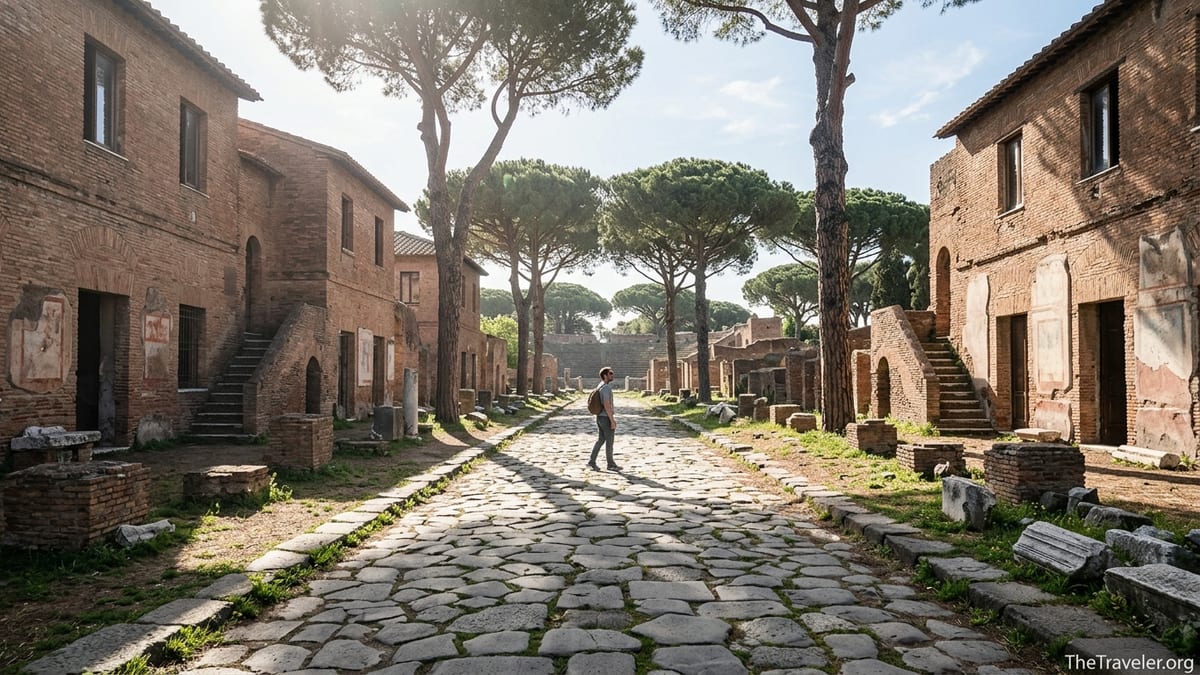
Rome’s historic center is spectacular, but it can feel more like a series of set pieces than a city. At the Colosseum, you queue with thousands of other visitors beneath scaffolding and security scanners. Around the Forum, modern traffic roars a few meters away. In contrast, Ostia Antica stretches for roughly 150 hectares of ruins at the edge of modern Rome, one of the largest archaeological sites in Europe, yet it absorbs visitors so well that you can often wander whole streets almost alone. The scale is impressive, but the atmosphere is intimate.
Ostia began as Rome’s harbor at the mouth of the Tiber, feeding the capital with grain and goods from across the Mediterranean. Today the sea has retreated and the river changed course, but the town remains frozen in its late Imperial layout. Unlike many parts of central Rome where medieval and Baroque layers sit on top of ancient foundations, here you walk through a coherent Roman town plan: a long decumanus running like a spine, side streets of apartment blocks, bakeries, baths, taverns, warehouses and temples. It feels less like a ruin and more like a city that closed for the day and never quite opened again.
That intact urban fabric is what makes Ostia so evocative. You are not looking up at an isolated temple podium or a single triumphal arch. You are turning corners from a bar straight into a set of apartment staircases, then coming out by a theater where port workers once listened to comedies and political speeches. The connection between spaces is visible and physical in a way that many sites around the Forum can only suggest with signs and reconstructions.
Stepping Into a Roman Street: First Impressions on Arrival
Reaching Ostia Antica from central Rome is logistically simple but psychologically profound. From Piramide station on Metro line B, you ride the suburban Metromare train toward Lido, stepping off at Ostia Antica after about 25 minutes. A standard Rome urban ticket, which costs a little over 1.5 euro, is enough for the journey because Ostia is considered part of the metropolitan area. From the station, a pedestrian bridge carries you over a modern road and within ten minutes of walking you are at the archaeological park entrance, buying a ticket that is typically under 15 euro for adults, with various reductions and free entries on designated days.
Inside the gate, the noise of trains and traffic fades quickly. You follow a straight Roman road flanked by pines toward the ancient city gate. The ground underfoot is still paved with large basalt blocks, polished by centuries of cart wheels. Grass pushes up in the cracks. On either side you see low walls and foundation lines, the remains of the necropolis, where tomb after tomb of merchants, sailors and freedmen lined the approach to the town. Their inscriptions are fragmentary but human: names, professions, ages. It is one of the first reminders that this was not an abstract empire but a community of individuals.
Past the gate, the decumanus maximus runs arrow-straight into the heart of Ostia. Within minutes you pass the semicircular theater on your left, still used in summer for concerts that fill the night air with music much as shows did two millennia ago. Behind it lies the old Piazzale delle Corporazioni, once lined with offices of shipping agents advertising their routes with mosaic panels showing ships, dolphins and place names from across the Mediterranean. Standing here, looking at black-and-white mosaics of grain ships and anchors, you can imagine the babble of accents and the negotiation of freight costs as clearly as any modern logistics hub.
Baths, Bars and Apartments: Meeting Everyday Romans
The most uncanny part of Ostia Antica is how easy it is to picture the ordinary routines of life. One of the best places to start is the Baths of Neptune, a second or third century complex with a spacious central courtyard and a floor of mosaics that seem almost too modern in their graphic clarity. In the main hall, Neptune strides through the waves in black tesserae against a white background, surrounded by sea creatures. Archaeologists have identified at least two dozen baths across Ostia, but here the layout is particularly clear: changing rooms, cold and hot pools, furnaces and service corridors where slaves and workers stoked fires. Standing under the shade of the surrounding columns, with cicadas buzzing, you can imagine arriving sweaty from the warehouses and pausing to gossip in the tepidarium before heading home.
Just as striking are the insulae, the multi-story apartment blocks that housed the bulk of Ostia’s population. In one restored section near the western part of town, you can actually climb a staircase to the second level of an insula and look down into the street, as residents once did. From up there the town looks less like ruins and more like a film still paused mid-scene: a thermopolium, or snack bar, across the way; fragments of painted plaster on the walls; a narrow lane running toward the river. Modern visitors often comment that it feels like standing at a window in a lived-in neighborhood, except the neighbors have been gone for 1,700 years.
Those thermopolia are another way Ostia collapses the distance between then and now. In one well-preserved tavern, a horseshoe-shaped counter still holds embedded terracotta jars where stews and wine once stood, kept warm by hot coals beneath. Archaeologists have identified decorative panels depicting the god Pan in one such inn, discovered during modern excavations along one of the side streets. You can stand at the counter and imagine ordering a bowl of lentils or a piece of salted fish, much as you might grab a slice of pizza al taglio at a Roman bar today. The line between ancient street food and a rushed modern lunch blurs in an almost comical way.
Hidden Corners: Synagogues, Shrines and Workplaces
Beyond the major sights, Ostia rewards anyone willing to wander down side streets. One of the most evocative detours leads beyond the main grid toward the edge of the ancient shoreline, where you find the remains of the synagogue of Ostia. This community space, originally built in the first century and remodeled multiple times up to the fourth, is one of the oldest known synagogues in the western diaspora. Here you can still see the foundations of a hall, a niche that once held Torah scrolls and a courtyard where banquets were probably held after religious gatherings. Knowing that Jewish merchants and families carved out a space for their traditions in the heart of Rome’s port makes the city feel recognizably multicultural and complex.
Closer to the center, smaller temples and shrines dot the streets. A modest Mithraeum, dedicated to the mystery cult of Mithras popular among soldiers and merchants, sits tucked beneath a building. You reach it via a narrow staircase that drops into a long hall with a central aisle and benches on either side where initiates once reclined for ritual meals. Light filters dimly through gaps in the ceiling, emphasizing how secretive and intimate worship must have been. A short walk away, the remains of the Capitolium, a temple dedicated to Jupiter, Juno and Minerva, rise over the forum with a monumental stairway that today leads up to an empty podium and a sweeping view.
Industry and commerce are also preserved in stone. In one fullonica, or fulling workshop, you can see the basins where cloth was washed and treated with chemicals, sometimes including ammonia from urine, to whiten and soften garments. Nearby warehouses along the old riverfront, known as horrea, show rows of storage rooms where amphorae of olive oil from Spain or grain from North Africa were stacked high. The combination of sacred spaces, apartments and workplaces all within a short walk drives home how tightly interwoven religion, labor and domestic life were in a Roman port.
Practicalities: Costs, Tickets and When to Visit
For modern travelers, part of Ostia Antica’s appeal is that it offers this immersive experience without requiring the time or expense of a long excursion. From central Rome, you can treat it as a half-day or full-day trip with minimal planning. The Metromare line trains run at least twice an hour in daytime, and even accounting for connections from Metro lines A or B, total travel time from Termini station is usually around 40 to 50 minutes. Since Ostia is within the city transport zone, a regular public transport ticket or day pass covers your journey, which keeps costs low if you are traveling as a family or small group.
The archaeological park itself usually opens around 8:30 in the morning, with closing times that vary seasonally and are typically in the late afternoon or early evening. It is sensible to double-check current hours before you travel because special events or summer performances in the theater can affect access to some areas. Ticket prices are relatively modest compared with headline Roman attractions. A standard adult ticket is often just under 15 euro, with concessions for European Union youth, teachers and free entry on selected national culture days. Audioguides are available at the entrance for a small extra fee, and many visitors find them worthwhile in a site where signage can be sparse in some zones.
Comfort is as important as logistics. Ostia offers large stretches of open ground with little shade, so visiting during the cooler part of the day can transform your experience. In summer, aim to arrive at opening time and plan a long lunch break or a return to Rome before the mid-afternoon heat. Spring and autumn provide milder temperatures and softer light, which brings out the textures of brick and mosaic beautifully. There is a café inside the site that serves simple meals, espresso and cold drinks, but many seasoned visitors bring their own picnic to enjoy under the pine trees in quieter corners.
Walking Strategies: How to Make the Ruins Come Alive
Given the size of Ostia Antica, it pays to approach your visit with a light structure rather than trying to “see everything.” On my own walk, I found that following a narrative made the ruins more vivid. I began at the necropolis and city gate, imagining the journey of a sailor arriving from North Africa. From there I followed the decumanus past shops and shrines to the forum, where public announcements and markets once took place, then cut across to the Baths of Neptune and the surrounding insulae where that sailor might have rented a room.
You can do something similar. Choose a theme that interests you: perhaps “a day in the life of a dockworker,” “religious diversity in the port,” or “a family’s errands on market day.” Then pick 8 to 10 places that fit that theme: the theater, a thermopolium, an apartment block with a visible staircase, the forum, a bathhouse, the synagogue or a Mithraeum, a fullonica and the river warehouses. Walking between them, pause to notice the small details: grooves worn in thresholds by doors, fragments of fresco with still-visible reds and blues, reused columns that show how Romans recycled material from older buildings. These details anchor the imaginative leap to a living city.
Resist the urge to rush. One quiet moment on my visit came when I turned down what looked like a dead-end alley and found myself beside a courtyard filled with wildflowers, broken columns lying like scattered bones. The silence was complete except for birds and the distant rumble of a train. I realized that this “empty” space had once been someone’s backyard, perhaps shared by several families. Giving yourself the time to sit on a low wall, close your eyes and listen can be more powerful than ticking another monument off your list.
Ostia or Pompeii: Which Feels Closer to Real Life?
Many travelers planning a Roman holiday ask whether they should visit Ostia Antica or make the longer journey to Pompeii. Both are extraordinary, but they offer slightly different windows into the ancient world. Pompeii, buried by the eruption of Vesuvius in 79 CE, preserves wall paintings, household objects and even casts of victims in haunting detail. It is, however, a longer and more expensive day trip from Rome, typically involving a high-speed or regional train to Naples, a local train onward and higher entry fees. Crowds at peak times can be intense.
Ostia Antica, by contrast, was not sealed in a single catastrophic moment but slowly abandoned over centuries as the harbor silted up and trade routes shifted. This means some materials, especially wood and delicate frescoes, have vanished or been moved to museums such as the nearby Museo Archeologico Ostiense. What you gain instead is a sense of continuity and everyday ordinariness. Because the ruins are closer to Rome and less pressured by mass tourism, you are more likely to find yourself alone on a side street, hearing your own footsteps and the wind in the pines.
If your priority is to feel what it was like to live in a Roman apartment block, to step into a nearly empty bath complex and imagine steam rising from the pools, or to lean on a tavern counter without jostling tour groups, Ostia may give you a more immediate sense of reality. Many visitors who have seen both sites remark that they left Pompeii awed and saddened, but they left Ostia feeling as though they had briefly moved into an ancient neighborhood.
The Takeaway
Walking through Ostia Antica is one of the most effective antidotes to the idea of Rome as a city of marble statues and imperial slogans. Here, among the brick walls, mosaic floors and worn thresholds of an almost-forgotten port, the empire shrinks back to human scale. You see where bakers fired their ovens, where cloth workers trod garments in vats, where worshipers sat in small, secretive shrines, where children might have leaned over balconies to watch parades heading to the forum.
Practicalities help this magic along. The site is close enough to Rome to fit into a relaxed day, the cost is modest, and the crowds are rarely overwhelming. That means you can spend your time not in lines but in lingering, experimenting with different routes through the streets and letting your imagination work. Ostia Antica does not demand specialist knowledge. It asks only that you walk, look and pay attention.
By the time you cross back over the modern bridge to the train station, the contrast between the quiet ghost town behind you and the bustling capital ahead is striking. Yet something of Ostia travels with you: the knowledge that behind today’s apartment blocks and metro lines there are always older layers of ordinary lives. In making ancient Rome feel tangible, Ostia Antica also makes the modern city easier to read, a reminder that every metropolis is just a temporary version of itself.
FAQ
Q1. How do I get to Ostia Antica from central Rome?
From Piramide station on Metro line B, take the Metromare suburban train toward Lido and get off at Ostia Antica. Walk over the pedestrian bridge and follow signs to the archaeological park.
Q2. How much time should I allow for a visit?
A focused visit can be done in three to four hours, but many travelers prefer to spend most of the day, especially if they want to explore side streets and take breaks.
Q3. What does it cost to visit Ostia Antica?
Standard adult tickets are usually under 15 euro, with discounts for certain age groups and categories. Public transport from central Rome is covered by regular city tickets or passes.
Q4. Is Ostia Antica suitable for children?
Yes. Open spaces, visible mosaics and climbable staircases in some insulae often appeal to children, though parents should bring water, sun protection and snacks.
Q5. Are there guided tours available on site?
Guided tours can be booked through licensed tour operators, and audioguides are usually available for rent at the entrance, offering structured routes and historical commentary.
Q6. Can I visit Ostia Antica and the nearby beach on the same day?
Yes. Many visitors spend the morning at the ruins and then continue by train to Lido di Ostia for a few hours by the sea before returning to Rome in the evening.
Q7. Is the site accessible for people with limited mobility?
Some main routes and key monuments are on relatively even ground, but many streets are paved with uneven stones. It is best to check the latest accessibility information before visiting.
Q8. What should I wear and bring?
Wear comfortable walking shoes, a hat and light clothing in warm months. Bring water, sunscreen and perhaps a small picnic, as shade and services are limited in some areas.
Q9. How does Ostia Antica compare with Pompeii?
Pompeii offers dramatic preservation and is further from Rome, often requiring a full-day trip. Ostia is closer, quieter and gives a strong sense of everyday urban life in the Imperial period.
Q10. Are there places to eat inside or near the ruins?
There is usually a café inside the archaeological park serving simple meals and drinks. Outside the entrance and near the train station you can also find bars and small restaurants.