


Ostia Antica is one of Italy’s most atmospheric archaeological parks, a remarkably well preserved Roman port city less than an hour from central Rome. For first-time visitors, it offers an immersive alternative to the crowds at the Colosseum and Roman Forum, but it also requires a bit of planning. From understanding opening hours and tickets to navigating the Roma–Lido train and choosing what to see among the ruins, a little preparation will make the difference between a tiring excursion and a memorable step back in time.
Get the latest updates straight to your inbox!
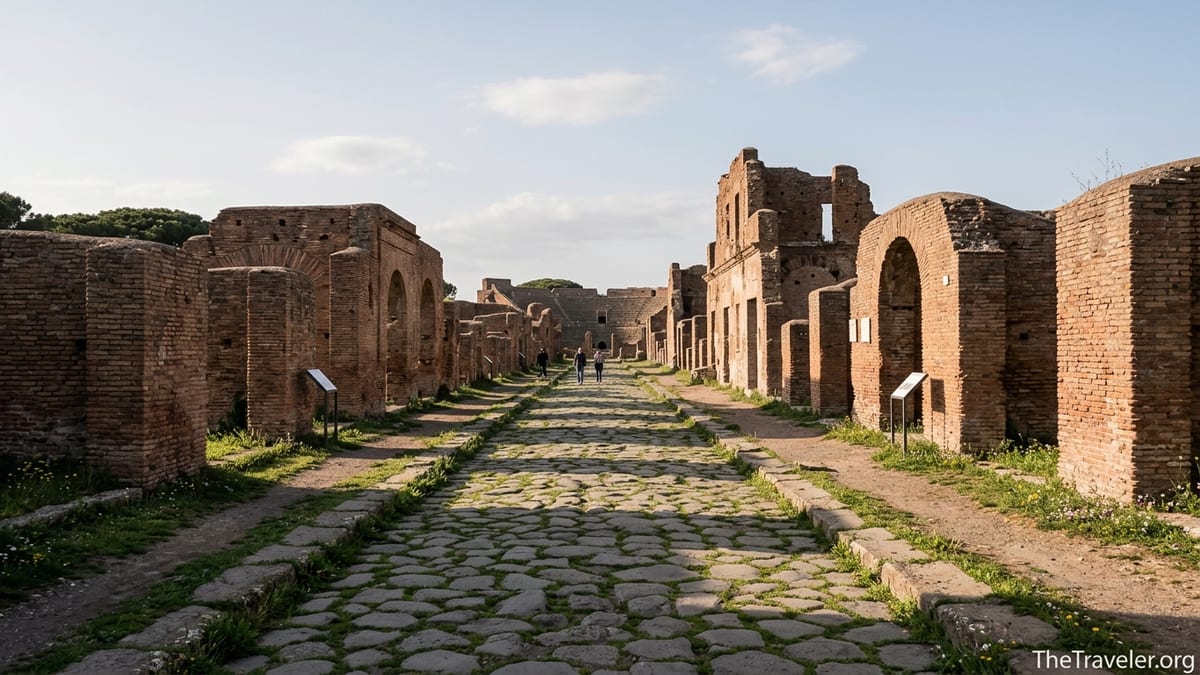
Understanding What Ostia Antica Really Is
Before you go, it helps to reframe Ostia Antica not as a single monument, but as an entire Roman town you can wander through. The archaeological park covers around 150 hectares, making it one of the largest sites of its kind in Europe, with streets, apartment blocks, warehouses, temples, baths and even a theater and public latrines still clearly visible. Walking here feels much closer to exploring a ghost town than touring a single ruin or museum.
Historically, Ostia was the port of ancient Rome, sitting at the mouth of the Tiber River and serving as a hub for grain imports from across the empire. Today the sea has retreated several kilometers due to sediment, and the Tiber has shifted course, so you will not see waves lapping at the ancient docks. What you will find instead are remarkably intact mosaics, fresco fragments and everyday details, such as shop counters and bakery mills, that give a vivid sense of daily life.
Most first-time visitors underestimate both the scale and the variety of the site. You can easily spend four to five hours walking the main decumanus (the central east–west street) and exploring side roads that lead to residential insulae, bath complexes and the forum. Many travelers who arrive planning a quick two-hour stop wish they had allowed more time once they realize how much there is to see.
It is also important to understand that Ostia Antica is less curated than major city-center museums. There are information panels near key buildings and a small archaeological museum on site, but much of your experience will come from simply wandering, reading a map and using a guidebook or audio guide. If you like the idea of piecing together the story of a city from its remains, this will be a highlight of your time near Rome.
Tickets, Opening Hours and When to Go
The Archaeological Park of Ostia Antica has variable opening hours that follow a typical Italian seasonal pattern. The site generally opens in the morning around 8:30, with last entry about one hour before closing. Closing time shifts across the year, typically late afternoon in winter and early evening in late spring and summer. Check the official Ostia Antica archaeological park website shortly before your visit for the exact schedule for your dates, as hours can change for maintenance, events or extreme weather.
Standard ticket prices for the archaeological area have in recent years hovered in the mid-teens in euro for adults, with reduced fares for certain age groups and categories, and occasional combined or promotional tickets tied to local cultural events. For instance, in 2025 the park offered a discounted rate to holders of tickets for the Ostia Antica Festival summer performances. Concessions for EU and Italian students, teachers and other eligible groups are available, but the rules can be specific, so bring documentation if you think you qualify.
You do not usually need to reserve far in advance for a standard daytime visit. Unlike the Colosseum, entry is not capped at a low number of visitors per time slot, and on many weekdays it is possible to buy tickets directly at the entrance without any queue at all. Nonetheless, in peak holiday periods such as Easter week or during Italian national holidays, arriving earlier in the morning still helps you avoid lines and the hottest part of the day.
Season and timing strongly shape your experience. From late June through August, the combination of heat and limited shade can be challenging, especially around midday. Many visitors find April, May, late September and October ideal, when the light is soft and temperatures are more comfortable for long walks. In winter, you may have gray skies and occasional rain, but you will often share the ruins with only a handful of other people, which can be magical if you dress warmly and accept shorter daylight hours.
How to Get to Ostia Antica from Rome
Reaching Ostia Antica by public transport from central Rome is straightforward and inexpensive compared with many day trips. The key is the suburban rail line commonly known as the Roma–Lido or Metromare line, which connects central Rome with the coastal district of Ostia. You can board this line at Roma Porta San Paolo station, which is adjacent to the Piramide stop on Metro Line B and close to the Roma Ostiense mainline station. From there, the train ride to Ostia Antica station typically takes around 25 to 35 minutes, depending on the specific service.
For most travelers, the simplest approach is to take Metro Line B to Piramide, follow signs for the Metromare line, and then ride in the direction of Lido di Ostia, getting off at Ostia Antica. Once you leave the Ostia Antica station, it is about a 10-minute walk to the site entrance: follow the pedestrian bridge over the busy road, continue straight past a small cluster of cafes and shops, and you will reach the main gate on Viale dei Romagnoli.
As of 2026, Ostia Antica is still considered part of Rome’s metropolitan public transport network. This means that standard Rome transit tickets and passes, including single BIT tickets, day passes and multi-day passes, are accepted on the Metromare line within the city zone. Many visitors simply use the same integrated ticket or Tap & Go payment they use on the metro and buses to ride to Ostia Antica, though you should double-check the current conditions when you buy or validate your ticket, as tariffs and validity rules can change.
If you prefer not to navigate public transport, several tour companies in Rome offer half-day or full-day excursions to Ostia Antica that include transport in a minibus or coach, often combined with a guided tour. These are significantly more expensive than taking the train on your own, but can be worth considering if mobility is a concern or you value the simplicity of hotel pickup and a structured itinerary.
What to See Once You Are Inside the Ruins
Ostia Antica’s layout is logical once you understand the basic axes. Most visits begin near the ancient city gate and follow the Decumanus Maximus, the main paved street running roughly east to west. Early along this route you will pass the necropolis with tombs lining the road, a powerful reminder that Roman law required burials to be outside city walls. Many travelers pause here for their first photographs, as the tomb inscriptions and niches are particularly evocative.
Continuing along the decumanus, you soon reach the theater and the adjacent Piazzale delle Corporazioni. The semicircular theater, reconstructed in the late 19th and early 20th centuries, still hosts occasional performances today. Climb to the upper rows for a panoramic view over the ruins and toward the modern district of Ostia in the distance. Behind the stage, the Piazzale delle Corporazioni is lined with black-and-white marble mosaics depicting ships, grain measures and animals that represented different trade guilds and merchants active in Ostia’s port.
Farther into the site, highlights include the Terme di Nettuno, a bath complex famous for its floor mosaics of Neptune and sea creatures, and the Caseggiato del Serapide, a former apartment block that illustrates how multi-story urban housing functioned in the Roman world. The forum area, with its temple podiums and remains of administrative buildings, offers space to sit and imagine the bustle of civic life. Many visitors also seek out the well-preserved communal latrines, where stone seats arranged in a row illustrate the very social nature of Roman sanitation.
Do not overlook the small but important Museo Archeologico Ostiense, usually simply called the Ostia Archaeological Museum. It contains sculptures, inscriptions and decorative elements removed from the site for protection, including finely carved sarcophagi and portrait busts. On a hot day, the museum also provides a welcome break from the sun. Plan at least 30 to 45 minutes here if you are interested in sculpture and want to connect the art with the spaces you have just walked through.
Practical Tips: Clothing, Food, Facilities and Accessibility
Visiting Ostia Antica is physically closer to a light hike than to strolling through an indoor museum. The ground is uneven, with original basalt paving stones, dirt paths and some grassy areas. Wear sturdy, closed-toe walking shoes rather than sandals or dress shoes, and consider light hiking shoes if you have ankle issues. In summer, a wide-brimmed hat, sunglasses and high-SPF sunscreen are essential, as there are long stretches with limited shade.
Within the park, you will find toilets near the entrance and at a few points deeper inside, but they are more sparse than in a city-center attraction. Carry a reusable water bottle and refill it at the public fountains fed by the Roman aqueduct system, recognizable by their metal spouts. Water from these fountains is generally considered safe to drink, as in the rest of Rome, and on a hot day you will likely refill several times while exploring.
Food options directly inside the ruins are limited. There is typically a café or snack bar near the entrance that sells simple panini, coffee, soft drinks and packaged snacks, but the selection is not extensive and may not remain open all day in low season. Many experienced visitors buy sandwiches or pizza al taglio in Rome or in the modern village just outside the park, then enjoy them on one of the benches scattered through the site. Picnicking directly on top of ancient remains is discouraged, so look for designated seating areas or low walls away from fragile structures.
Accessibility at Ostia Antica has improved in recent years but is still mixed. Some main routes and key monuments are reachable via relatively flat paths, and staff at the ticket office can provide information about the most accessible routes on the day of your visit. However, many side streets, staircases and interiors involve uneven steps and narrow passages. If you are traveling with a stroller or wheelchair, be prepared to focus on a smaller portion of the site rather than trying to cover everything.
Guided Tours, Audio Guides and How Much Time You Need
Because Ostia Antica is extensive and only partially signposted, many first-time visitors benefit from some form of guiding. You can book a small-group or private tour through companies based in Rome that include both transport and a licensed guide, or meet a guide directly at the Ostia Antica entrance if you prefer to travel on your own by train. A typical guided visit lasts around two to three hours and focuses on the main highlights: the entrance road and necropolis, theater, Piazzale delle Corporazioni, baths, a few residential blocks and the forum.
If you prefer exploring independently, consider renting an audio guide at the ticket office if it is available during your visit. These usually provide curated routes with commentary in multiple languages, offering context that the on-site panels alone cannot provide. Another common strategy is to download a reputable digital guide or app covering Ostia Antica and bring a printed map. Some travelers use detailed guidebooks to Roman archaeology that include suggested itineraries through the site.
As for timing, think in half days rather than hours. Many visitors arrive around 9:30, explore until early afternoon, then either return to Rome or continue two stops further on the train to the Lido di Ostia beaches for a late lunch and a swim in summer. If you are particularly interested in Roman history, urban planning or archaeology, you could spend a full day at Ostia Antica without exhausting the possibilities, especially if you include time for the museum and quieter back streets off the main route.
Families with children often find that three to four hours on site is ideal. Kids enjoy climbing theater steps, peering into ancient shops and imagining what life was like in a Roman port, but they may tire quickly in hot weather. Plan breaks in shaded spots and bring snacks to keep energy levels up. Because the site is spacious, children generally have more room to roam than at crowded city monuments, which many parents appreciate.
Safety, Weather and Common Mistakes to Avoid
Ostia Antica is generally considered a safe place to visit during opening hours. Security staff patrol the park, and the atmosphere is peaceful, particularly on weekday mornings. Usual city precautions still apply on the train between Rome and Ostia Antica, where pickpocketing can be an issue on crowded services, particularly around rush hour. Keep valuables secure, avoid displaying large amounts of cash and be especially aware when boarding or exiting trains.
Weather is a much more significant factor than crime in shaping your day. In July and August, daytime temperatures commonly climb above 30 degrees Celsius, and the sun can be intense on the open stone streets. To avoid heat stress, start early, rest frequently in shaded areas and avoid long stretches of midday exposure if you are sensitive to heat. Winter brings lower temperatures and occasional rain, which can make some paths muddy and some stones slippery. In the case of extreme weather, strong winds or flooding risk, parts of the park may temporarily close or restrict access, so it is wise to check official announcements on the morning of your visit.
Several common mistakes can reduce your enjoyment. A frequent one is underestimating distances and wearing inappropriate shoes; fashionable city sneakers with thin soles may leave your feet sore after hours on rough paving. Another is failing to bring water and sun protection, then cutting the visit short due to discomfort. Finally, some visitors rush through the site without a plan, missing key areas or doubling back unnecessarily. Spending ten minutes at the entrance studying a map or listening to the start of an audio guide will pay off later in a more coherent experience.
It is also easy to forget that Ostia Antica sits very close to both modern Ostia and Rome Fiumicino Airport. If you have a late flight from Fiumicino, you might be tempted to squeeze in a visit on the same day. This can work if you travel light and keep a generous time buffer, but do not underestimate potential delays on public transport or at airport security. When in doubt, plan Ostia Antica on a day without fixed onward travel to avoid unnecessary stress.
FAQ
Q1. How long should I plan for a first visit to Ostia Antica?
For most first-time visitors, three to five hours inside the archaeological site is a good starting point. That allows time to walk the main street, see major highlights like the theater, baths and forum, visit the small museum and take rest breaks, without feeling rushed.
Q2. Is Ostia Antica suitable for children and families?
Yes. Children often find Ostia Antica more engaging than indoor museums because they can walk along ancient streets, climb theater steps and explore open spaces. Just be prepared for uneven ground, bring water and snacks, and plan extra breaks in hot weather.
Q3. Do I need to book tickets to Ostia Antica in advance?
In most cases you can simply buy tickets at the entrance on the day of your visit, especially on weekdays. During peak holiday periods, arriving early in the morning is the best way to avoid possible queues and the heat, but advance booking is usually not compulsory for standard entry.
Q4. What is the easiest way to get to Ostia Antica from central Rome?
The most straightforward route is to take Metro Line B to Piramide station, transfer to the Roma–Lido or Metromare suburban line at Porta San Paolo, and ride to Ostia Antica station. From there it is about a 10-minute walk across a pedestrian bridge and along a short road to the park entrance.
Q5. Are Rome public transport tickets valid on the train to Ostia Antica?
As of 2026, Ostia Antica is within Rome’s integrated public transport area, and standard city tickets and passes generally cover the Metromare line to Ostia Antica. However, ticketing rules can change, so confirm validity when you purchase or validate your ticket or pass.
Q6. Is there food available inside Ostia Antica?
Basic food and drink are usually available at a café or snack bar near the entrance, typically offering sandwiches, coffee and soft drinks. Selection can be limited, especially in low season, so many visitors bring their own packed lunch or snacks and use the park’s benches for a simple picnic.
Q7. How demanding is the walk around the ruins?
The visit involves several hours of walking on uneven stone streets and dirt paths, with some gentle inclines and occasional steps. Most reasonably fit visitors manage without difficulty, but supportive walking shoes are essential. Those with mobility issues may prefer to focus on the central area near the main street and forum, which is relatively more accessible.
Q8. Can I combine Ostia Antica with a visit to the beach in one day?
Yes. Many travelers visit the ruins in the morning, then continue two stops further by train to Lido di Ostia for a late lunch and time by the sea in the afternoon. This works especially well in late spring and early autumn, when temperatures are warm but not extreme.
Q9. Are guided tours worth it for a first visit?
A guided tour can greatly enhance a first visit by providing historical context, pointing out details you might miss and following an efficient route through the site. If you prefer independence, an audio guide or detailed printed guidebook is a good compromise, but complete first-time visits without any commentary can feel a bit disorienting.
Q10. Is it safe to visit Ostia Antica on my own?
Visiting Ostia Antica during official opening hours is generally safe. The main risks are pickpockets on crowded trains and discomfort from heat or uneven terrain. Keep an eye on your belongings on public transport, use common-sense city precautions and prepare for the weather, and you can confidently explore on your own.