


Most travelers step through the gates of Ostia Antica, snap a few photos of the theater and the main street, then leave thinking they have seen a smaller Pompeii. What they rarely realize is that Ostia’s survival is the result of geography, disease, engineering and some very modern conservation choices that have quietly shaped what they see today. Understanding these hidden factors changes the way you walk through Rome’s ancient port: suddenly the bricks, mosaics and weeds underfoot tell a much richer story of why so much is still standing.
Get the latest updates straight to your inbox!
A City Saved by Mud, Malaria and Moving Water
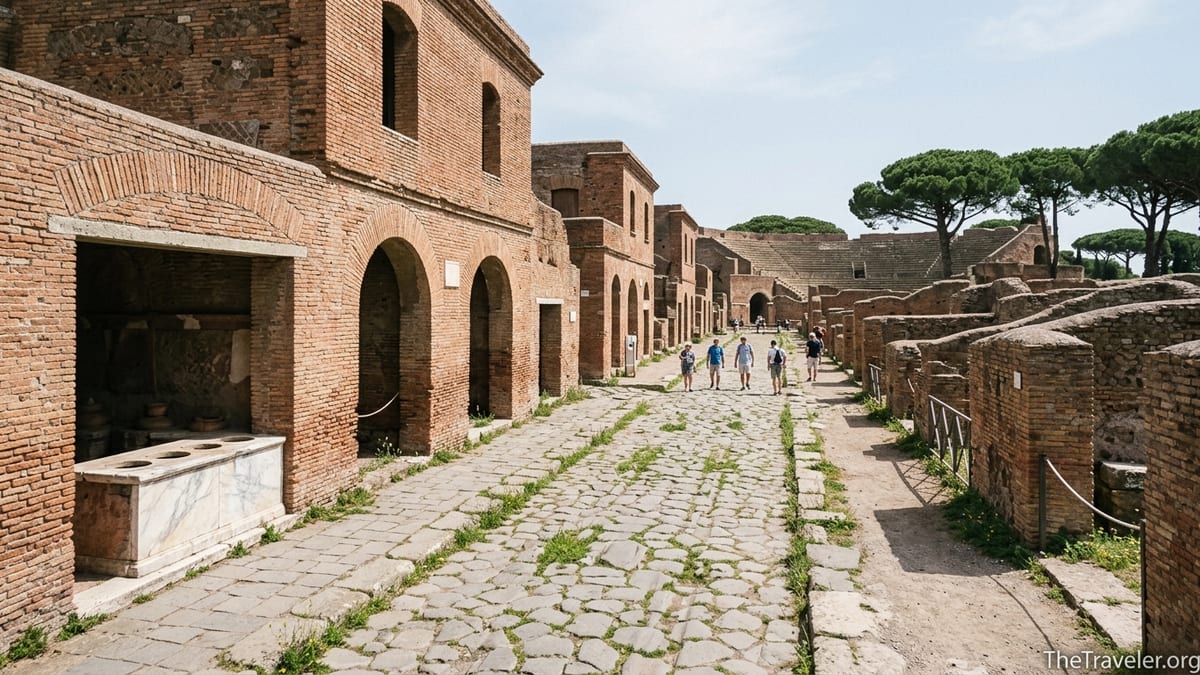
At first glance, Ostia Antica looks like it has been waiting patiently for visitors since the days of the emperors. In reality, the town nearly vanished under several meters of silt after the Tiber River changed course and the coastline gradually moved away. Over centuries, floods deposited layers of mud that sealed buildings, mosaics and everyday objects in place. Today, when you walk along the Decumanus Maximus, the main east to west street, you are literally walking on top of what used to be riverine marshland that buried parts of the town rather than eroding them.
Another unlikely guardian of Ostia was disease. As the river shifted and stagnant water collected in the low-lying areas, the region became notorious for malaria. By the Middle Ages, the area around Ostia was so unhealthy that permanent settlement dwindled. Instead of being quarried as heavily as sites closer to Rome, large sections of the port were simply abandoned to the mosquitoes. That meant fewer medieval and Renaissance builders carted away marble and brick. Much of the urban fabric that you see today, from apartment blocks to bath complexes, survived precisely because almost nobody wanted to live here.
The Tiber’s ancient bed once ran much closer to the city walls than it does today. Maps at the visitor center show how the shoreline has retreated, leaving Ostia several kilometers inland. For modern visitors this means you stroll through a port city that no longer has a port, but for preservation it was a gift: the sea’s erosive power and storm surges could no longer reach the structures. The combination of fresh and salt water flooding, silt and eventual abandonment created a kind of natural time capsule, very different from Pompeii’s sudden destruction by volcanic ash.
All of this becomes visible if you pay attention to subtle level changes under your feet. In some insulae and warehouses, archaeologists have cut cross sections that reveal strata of river mud hugging ancient floors. Most visitors pass these by without a second glance, not realizing they are looking at the very material that kept centuries of history intact.
Brickwork That Still Stands: The Quiet Strength of Roman Construction
One of the most striking things about Ostia Antica is how high its buildings still rise. In several insulae, or apartment blocks, walls reach three and even four stories. While the top levels usually had timber elements that disappeared long ago, the brick and concrete cores look robust enough that you can easily imagine tenants leaning out of upper windows. This vertical survival is not common in many Roman sites, and it owes a lot to disciplined building techniques that Ostia showcases especially well.
Look closely at the facades along the Decumanus or near the Baths of Neptune and you will see regular bands of brick known as opus latericium, laid with remarkably thin joints of mortar. The precision of these courses made the walls more stable and resistant to cracking as the ground settled or shook. In several buildings, such as the Caseggiato dei Dolii, you can see how brick piers alternate with filled panels, creating a kind of built in reinforcement. Modern conservation teams often point out that this attention to structure is one reason why so many walls still stand shoulder high or more after nearly two millennia.
In some spots, archaeologists have left patches of different masonry types visible to show phases of repair. You might see older tufa blocks at the base of a wall, then higher courses of later brickwork that date to the second century. This palimpsest of materials gives a real time diagram of how Romans maintained their buildings. Most visitors barely notice these changes in color and texture, yet they tell a story of long term upkeep that helped the town survive even before it was buried.
Modern restoration work along the Decumanus, completed on dozens of rooms on the left side of the road, is deliberately subtle. Conservation teams tuck stainless steel pins inside cracked walls and use lime based mortars colored to match ancient materials. From a distance, you simply see solid buildings. Only up close does it become clear where the modern interventions begin. The fact that these techniques are nearly invisible is itself part of Ostia’s preservation story: new work is designed not to shout over the old.
Shadows of Ancient Color: Frescoes and Mosaics in Situ
Ostia is famous for its black and white floor mosaics, but many visitors assume that what they see are durable stone images that have simply lasted by luck. In reality, their survival has required a blend of original craftsmanship and meticulous modern care. In the Baths of Neptune, for example, the sprawling sea god mosaic has survived thanks to a combination of deep bedding layers under the tesserae and careful drainage that keeps water from pooling on the surface. Today, you may notice that low fences limit how close you can step and that certain sections are shaded at midday: these are simple, modern measures that protect ancient workmanship.
In several apartment houses, such as the so called House of the Painted Vaults, faint frescoes still cling to upper walls and ceilings. Their mere existence outdoors near the coast is extraordinary. Part of the reason they survive is that many were sealed in dark, airtight rooms when the buildings collapsed or were filled with silt. When excavators opened them in the twentieth century, conservationists quickly applied consolidants and, in some cases, partial shelters. To the casual eye, these may just look like random bits of plaster, but for specialists they are among the best preserved domestic paintings from a working port town.
One detail that few people notice is the slightly raised edges of mosaics along ancient thresholds. Roman builders often gave doorway mosaics a subtle lip or installed them on very compact subfloors so they would resist wear from feet and carts. Today, those same construction choices help keep water from running directly into the tesserae when it rains. Where those original protections are missing, you will see modern drains and gravel bands discreetly installed nearby to do the same job.
In some buildings, damaged floors have been intentionally reburied under protective layers of sand and fabric, or covered with removable platforms. When you peer into a room and see just clean gravel instead of an intricate pattern, it is not because nothing was found there. It is often because sensitive mosaics or painted plaster have been put back to sleep to save them from sun, salt laden breezes and the slow abrasion of airborne dust.
Urban Planning That Helped the City Outlast Time
Ostia’s survival is also linked to its original layout. The city was designed with a grid of broad stone streets, smaller side lanes and carefully engineered drainage. Today, you walk along the same basalt slabs that carts once rumbled over, but the real preservation story lies just beneath them. Roman engineers laid these roads with gentle camber so water would run into side channels. Those channels, some still clearly visible, carried runoff away from building foundations and into larger drains. By preventing constant waterlogging, they reduced the decay that destroys many ancient structures from below.
The widespread use of multi story insulae also created dense blocks that buttress each other even today. In several neighborhoods, you can stand at a crossroads and see rows of buildings interlocked like teeth. When one wall started to tilt, neighboring walls helped hold it in place. This interconnected design meant that, when abandonment came, the town settled rather than collapsing in dramatic fashion. As layers of silt accumulated, whole blocks remained basically intact beneath the mud.
The distribution of public buildings also played a role. Large bath complexes and warehouses were often built on slightly raised or better drained ground, using thick concrete foundations. The Baths of Neptune and the Forum area, for example, still present impressive facades not only because they were important monuments, but because they were structurally overbuilt. Their mass helped them resist both ancient subsidence and modern vibrations from nearby roads and rail lines.
When the archaeologists of the early twentieth century began large scale excavations, they benefited from this resilient urban skeleton. They could remove many tons of overburden without seeing whole districts collapse. The result is that today, instead of isolated ruins, visitors can walk through continuous streetscapes that feel like a true town. That sense of completeness is one of Ostia’s most striking, and least understood, forms of preservation.
Everyday Life Frozen in Place: Shops, Bars and Toilets
Most Roman sites offer fragments of daily life. Ostia offers entire streets of it. One of the best preserved examples is the Caseggiato del Termopolio, often described as a Roman bar or snack counter. When you step into this modest corner shop, the marble topped counter with its round storage jars still embedded in place looks as if the staff just left for a break. Above the counter, traces of painted scenes showing food and drink are still visible. The survival of this space, from masonry to decoration, is remarkable and gives a rare, three dimensional sense of how an ordinary business operated.
Elsewhere, you can wander through bakeries with large circular mills and bread ovens still anchored to the floor, or peek into workshops where amphorae were stored in rows of cut out niches. In the Caseggiato dei Dolii, giant storage jars remain half buried in the floor of a courtyard, a layout that kept their contents cool and protected. These dolia were built into the building fabric, and that tight integration is one reason they were not looted or removed in later centuries. They were simply too awkward to extract without destroying the surrounding masonry.
Even the public toilets tell a preservation story. Near the forum and in several bath complexes, communal latrines still preserve their stone benches with keyhole openings and the water channels that flushed beneath them. The channels were built with durable waterproof mortar and covered by stone slabs. Once silted up, these structures became stable, sealed voids. Today, when you step inside, you are seeing original Roman sanitary engineering largely untouched apart from basic cleaning and occasional consolidation.
What most visitors never realize is that the sheer ordinariness of these spaces helped save them. Grand marble statues and decorative stonework were attractive targets for reuse. A humble bar counter or a line of toilet seats was not. By being too practical and too integrated into the architecture, many elements of daily life at Ostia slipped under the radar of stone robbers and later builders, and so remained almost exactly where the last Romans left them.
Modern Conservation You Are Not Meant to Notice
Ostia’s apparent authenticity, the feeling that you are exploring untouched ruins, is carefully curated. Conservation efforts over the last century have focused on stabilizing what exists while keeping modern interventions almost invisible. Along the Decumanus and in the insulae near the ancient Porta Romana, recent projects have opened more than a hundred restored rooms to the public. Here, brickwork has been reinforced from the inside, rooflines have been partially rebuilt with discreet materials and vulnerable wall tops have been capped with compatible mortars to shed water.
If you look carefully at the tops of many walls, you will see thin protective layers that differ slightly in color or texture from the bricks beneath. These are modern cappings designed to keep rain from penetrating and freezing inside the ancient masonry. In some courtyards, low metal rails gently direct foot traffic away from fragile areas, while small signs request that visitors avoid climbing. None of this is dramatic, but it is precisely this quiet management that prevents gradual damage from millions of footsteps each decade.
Lighting and vegetation control are also part of the preservation story. Trees are allowed to grow in some areas to maintain the site’s atmosphere, but roots near key structures are monitored and, when necessary, cut or redirected. Grass is kept low around mosaics to reduce moisture, and certain especially delicate areas are seasonally closed when weather conditions make damage more likely. Information panels rarely advertise these decisions, so most travelers are unaware that the opening of a doorway or the closure of a side street reflects active conservation planning.
When new discoveries are made, such as additional bath structures near the ancient shoreline, excavations proceed carefully and are often followed by periods of reburial or partial covering. What you see on a visit is therefore just the tip of a much larger archaeological landscape that is being managed for the long term, not just for immediate display. This philosophy, favoring stability over spectacle, is one of the main reasons Ostia retains such an unusually coherent ancient townscape.
How to See Ostia’s Preservation Story on Your Own Visit
For many travelers, Ostia Antica is a half day side trip from Rome, often squeezed in between the Vatican Museums and dinner in the city center. To appreciate what makes its preservation special, it helps to slow down and walk with a more observant eye. After entering the site and crossing the ancient Porta Romana, pause along the first stretch of the Decumanus. Look down at the paving stones for signs of wheel ruts and repairs. Then glance up at the restored shop fronts on the left. Try to pick out where the original Roman brick ends and newer conservation work begins. This simple exercise tunes your eye to the dialogue between ancient structure and modern care.
Continue toward the theater and stand at the top rows of seats. From here, you can see the regular street grid and the solid masses of insulae behind the stage building. Notice how many walls rise to roughly the same height. This is not accidental. It reflects the original multi story planning and the way the city’s overall structure has settled as a unit over time. From this vantage point, you can also spot patches of greenery and trees pushing into the ruins, a reminder that preservation is a constant balancing act with nature.
When you visit specific monuments, such as the Baths of Neptune or the bar at the Caseggiato del Termopolio, take an extra minute to study details that usually escape attention. In the baths, look for drains along the edges of the mosaic floors and for traces of waterproof plaster along the walls of former pools. In the bar, note how the storage jars are sunken into the counter, and how the painted decorations hug the upper walls where smoke and splashes would have had less impact. These are small design choices that helped these spaces endure and that modern conservators take into account when planning interventions.
Finally, remember that what you do on site also affects preservation. Walking only on marked paths, avoiding the temptation to climb for better photos and respecting roped off areas are not just rules, they are part of the same long story that began with Roman engineers and continued through centuries of abandonment. By treating Ostia as a living, fragile organism rather than just a backdrop for pictures, visitors become the latest stewards in a chain that has already lasted far longer than anyone in the ancient port could have imagined.
The Takeaway
Ostia Antica’s remarkable state of preservation is not a simple miracle of survival. It is the product of natural forces that buried rather than destroyed, of Roman building practices that favored sturdy, practical construction, of centuries of neglect that spared it from intense quarrying and of modern conservation choices designed to be almost invisible. The result is a site where streets, shops, apartments, baths and toilets form a nearly complete Roman townscape, one that feels uncannily familiar yet deeply ancient.
Most visitors will continue to remember Ostia for its photogenic theater, shady streets and quiet contrast to central Rome. Those who take the time to notice how the bricks meet, how the mosaics are framed, how the ground subtly rises and dips, and how certain doors are open while others are not, will leave with a different impression. They will understand that what survives at Ostia is not just the shell of a city, but a carefully preserved conversation between past and present. That awareness can turn a pleasant excursion into one of the most meaningful archaeological experiences in Italy.
FAQ
Q1. Is Ostia Antica really better preserved than Pompeii?
Pompeii preserves a sudden moment of destruction, while Ostia preserves a more complete urban layout with many multi story buildings and everyday spaces still in place.
Q2. Why are so many buildings at Ostia Antica still standing so high?
The combination of strong Roman brick and concrete construction, dense interlocking blocks of insulae and gradual burial by silt allowed many walls to remain several stories high.
Q3. How did malaria help preserve Ostia Antica?
As the area became malarial, long term settlement declined, which reduced stone robbing and large scale rebuilding that might otherwise have dismantled much of the ancient fabric.
Q4. Are the mosaics and frescoes at Ostia original?
Yes, many floor mosaics and wall paintings are original Roman works, though they have often been cleaned, consolidated and sometimes partially sheltered by modern conservators.
Q5. Why are some rooms at Ostia covered with sand or gravel?
In sensitive areas, delicate floors or painted plaster have been intentionally reburied or covered to protect them from sun, rain and foot traffic while still allowing visitors to move through the site.
Q6. Can visitors enter upper floors of buildings at Ostia Antica?
In most cases, access is limited to ground level for safety and conservation reasons, even where upper stories once existed or partial stairways still survive.
Q7. What makes the Caseggiato del Termopolio special?
This small bar preserves its original counter with built in storage jars and traces of wall painting, offering an unusually complete glimpse of an everyday Roman business.
Q8. Why are some walls capped with a different looking material on top?
The slightly different capping you see on many walls is modern mortar designed to keep water from seeping into the ancient masonry and causing long term damage.
Q9. How much of Ostia Antica has actually been excavated?
Roughly two thirds of the ancient town has been uncovered, while significant areas remain unexcavated or only partially explored to protect buried remains for the future.
Q10. What can visitors do to help preserve Ostia Antica?
Sticking to marked paths, avoiding climbing on walls or monuments, following staff instructions and not touching frescoes or mosaics all help reduce wear and tear on the site.