


More news on this day
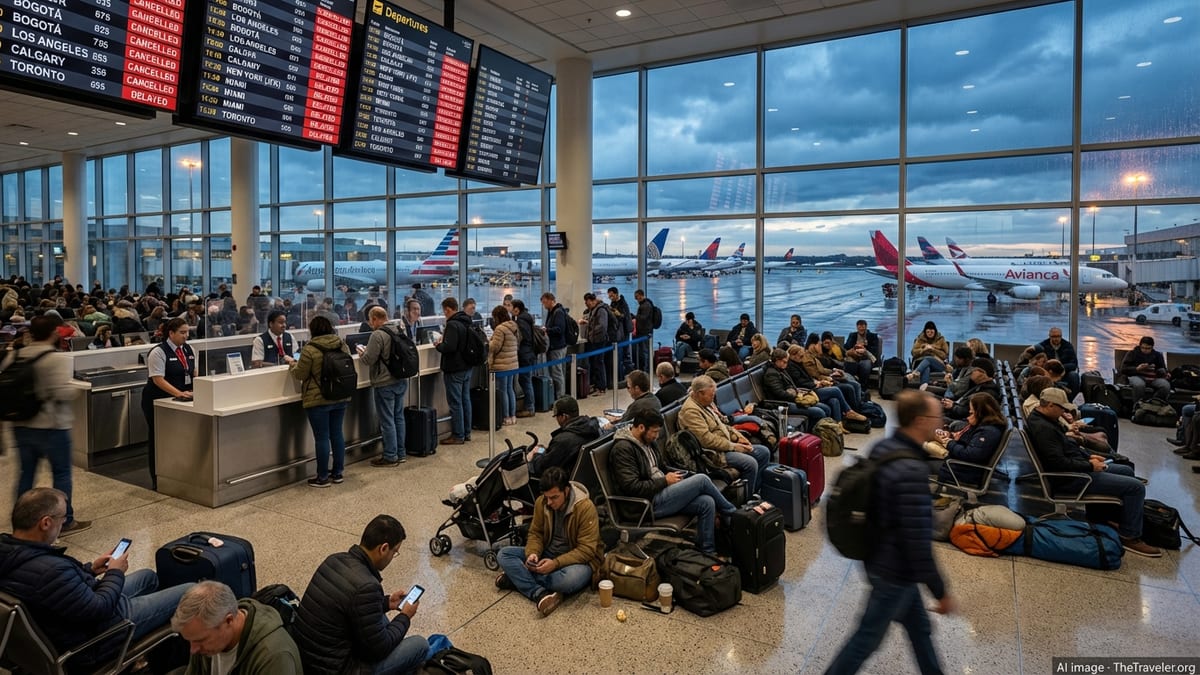
More than 1,469 flights within, into or out of the United States were delayed in a single day as the busy 2026 summer travel season enters its most turbulent stretch, highlighting how weather, chronic congestion and tighter operational limits are converging to disrupt passenger plans nationwide.
Get the latest news straight to your inbox!
Live Data Show Mounting Same-Day Delays
Real-time tracking from aviation data providers points to a sharp build-up of disruptions across the U.S. air network as the summer peak progresses. Flight monitoring platforms that aggregate Federal Aviation Administration data show well over a thousand delays on a typical busy August day, with publicly available dashboards listing more than 1,400 delays worldwide and over 1,200 delays affecting flights within, into, or out of the U.S. alone. These statistics update throughout the day, often climbing quickly during afternoon thunderstorm cycles and prime departure banks.
One widely used tracking site that publishes live delay and cancellation figures reported more than 14,000 total global delays for the current 24-hour period, with nearly 1,300 of those tied specifically to the U.S. market. Another independent delay map, which visualizes FAA status information, showed clusters of congested or holding traffic across several key U.S. regions, underscoring how even a handful of constrained hubs can ripple across the national network.
Airport-level tools further confirm the pattern. While some large airports may show relatively smooth operations, disruption logs compiled by third-party platforms document repeated short-lived ground stops and ground delay programs at major U.S. hubs, including New York and Phoenix, over recent days. Even when those restrictions last less than two hours, knock-on effects can persist into later banks as aircraft and crews fall out of position.
For travelers, the numbers translate into long lines at departure gates, delayed boarding, missed connections and scrambled rebooking efforts, particularly during weekend peaks. With aircraft scheduled tightly to maximize summer demand, every delay reduces slack in the system, raising the risk that localized issues will cascade nationwide.
Weather, Heat and Airspace Constraints Collide
Published coverage of recent weekends points to thunderstorms and severe weather as leading triggers for the current wave of delays. Reports from Atlantic and Gulf regions describe strong storm cells forcing temporary ground stops at coastal and island airports, with lightning protocols halting fueling, baggage handling and aircraft movements until conditions improve. Those same thunderstorms often disrupt East Coast traffic flows, cascading into misconnects across the broader U.S. network as long-haul and transatlantic flights miss their planned arrival and departure windows.
Higher summer temperatures are adding another operational stressor. Aviation research highlighted in recent analysis indicates that hotter air reduces aircraft performance, particularly at higher-elevation airports or those with shorter runways. On peak-heat afternoons, airlines sometimes must impose weight restrictions, delay departures into cooler periods or shift traffic to different time bands. Each of those measures may be minor in isolation, but applied across dozens of departures, they can amplify congestion.
Air traffic management constraints compound the problem. Temporary flight restrictions related to wildfire activity and other hazards remain in effect across parts of the Western U.S., narrowing available routing options and sometimes forcing airborne holding. At busy hubs, FAA-managed ground delay programs have been introduced at times to meter arrivals when thunderstorms, runway work or staffing issues strain capacity. Notices and formal orders from regulators acknowledge that overscheduling at some airports, particularly Chicago O’Hare and New York–area hubs, would likely generate significant delays without these caps.
The interplay of these factors means disruptions are no longer confined to obvious hotspots. A localized storm in the Northeast or a short ground stop in the Southwest may still cause late arrivals and missed departures in cities thousands of miles away as aircraft miss assigned slots and crews exceed duty time limits. The result is a fragile equilibrium where seemingly modest weather or airspace events can culminate in hundreds of additional delayed flights.
Structural Scheduling Pressures at Major U.S. Hubs
Beyond day-to-day weather, structural limits in the U.S. aviation system are adding to the summer strain. In formal scheduling notices and Federal Register filings, regulators have flagged the risk that airlines’ ambitious summer timetables would outstrip what key airports can reliably handle, particularly during construction or when air traffic control resources are stretched. In response, caps and voluntary reductions have been applied at some hubs for the 2026 summer season.
One major U.S. carrier, for example, has filed plans indicating an average reduction of nearly 7 percent in its domestic flights during the peak summer window, a move tied directly to slot and capacity limits. According to route-planning analysis, regulators have also implemented daily flight caps at select high-density airports through the end of the summer scheduling period. Even with these adjustments, demand remains elevated, leaving limited room for recovery when irregular operations develop.
Regulatory documents emphasize that delays at a single constrained hub can send disruptions across the country. Chicago O’Hare, in particular, is frequently cited as a node where additional scheduled flights beyond a certain threshold are expected to cause “inevitable delay and operational disruption,” with knock-on effects at dozens of connected airports. Similar dynamics have been documented at Newark and other capacity-critical hubs serving dense metropolitan regions.
For passengers, the structural nature of these constraints means that some level of delay risk is effectively built into the schedule during the busiest months. Even days without headline-grabbing storms can see elevated disruption as tight turnaround times, congested taxiways and minor technical issues rob the system of resilience. When that baseline is combined with pop-up thunderstorms or temporary ground stops, total delays can climb rapidly into the four-figure range.
Passenger Impact and What Travelers Are Seeing on the Ground
Accounts shared publicly over recent weeks paint a picture of crowded concourses, long tarmac waits and increasingly complex rebooking journeys. Travelers using congested East Coast hubs report evenings where departure boards show long columns of “delayed” tags, created by a mix of weather impacts, crew timing constraints and volume-related air traffic control programs. Some describe overnight disruptions in which luggage handling and onward connections fail to keep pace with rapidly changing flight plans.
Similar experiences have been reported at other major U.S. airports, where late-arriving crews or aircraft can lead to rolling delays and, in some cases, cancellations late in the day. On social and community platforms, passengers describe multiple-hours-long delays that begin with a weather or ground stop notice and then evolve into aircraft swaps, crew timing issues or missed curfews. While such anecdotal reports do not capture the full breadth of operations, they align with the elevated delay statistics recorded by tracking services.
Advisories compiled by corporate travel and risk firms have begun to flag specific airports and dates where disruptions are likely, drawing on FAA ground delay program information and real-time monitoring tools. Recent notes highlight New York John F. Kennedy International, for example, where a formal ground delay program was scheduled to run into the early hours of August 23. Other alerts point to recurring storms across the East Coast and South, signaling heightened risk across several days rather than a single weather event.
For travelers, the mounting disruptions translate into practical decisions: building longer connection buffers, favoring morning departures that are less exposed to knock-on delays, and monitoring live-status dashboards before leaving for the airport. Travel advisories consistently recommend reconfirming itineraries directly with airlines on the day of departure, as conditions and schedules can change quickly during peak summer periods.
Risk Outlook for the Remainder of the Summer Season
With the peak summer season extending into early September, aviation analysts and academic research suggest that disruption risk is unlikely to ease immediately. Studies of post-pandemic travel patterns indicate that operational disruptions have become more frequent since 2010 and have remained elevated in recent years as traffic has rebounded faster than infrastructure and staffing in some parts of the system. A July 2026 study in the Journal of Air Transportation, summarized in recent coverage, points to a persistent upward trend in the incidence of significant flight disruptions across U.S. aviation.
Regulatory and scheduling notices make clear that key capacity-management tools, including caps at congested hubs, are slated to remain in force through at least late October, reinforcing the view that structural pressure will persist beyond the northern hemisphere summer. In parallel, seasonal weather patterns, including late-summer thunderstorms and the Atlantic hurricane season, continue to pose risks to flight operations, particularly along the East and Gulf coasts.
Monitoring services that aggregate disruption events worldwide are currently tracking hundreds of active travel alerts across multiple categories, from weather and airport delays to security and infrastructure issues. Within that landscape, the U.S. commercial aviation system remains one of the most closely watched, both because of its scale and because disruptions in U.S. hubs often affect long-haul networks in Europe, Latin America and the Asia-Pacific region.
For now, travelers planning U.S. trips in the coming weeks can expect elevated, if uneven, disruption risk. On some days, a combination of favorable weather and well-managed schedules will keep operations close to normal. On others, a few hours of storms or an isolated ground stop may be enough to push daily delay counts back toward or beyond the 1,469 mark, as airlines and airports navigate a summer defined by tight margins and limited room for error.
FlightAware live delays and cancellations
FAA-derived U.S. delay status
United States airport delay map
Axios: air travel’s summer of disruption
FareRadar global travel alerts