


More news on this day
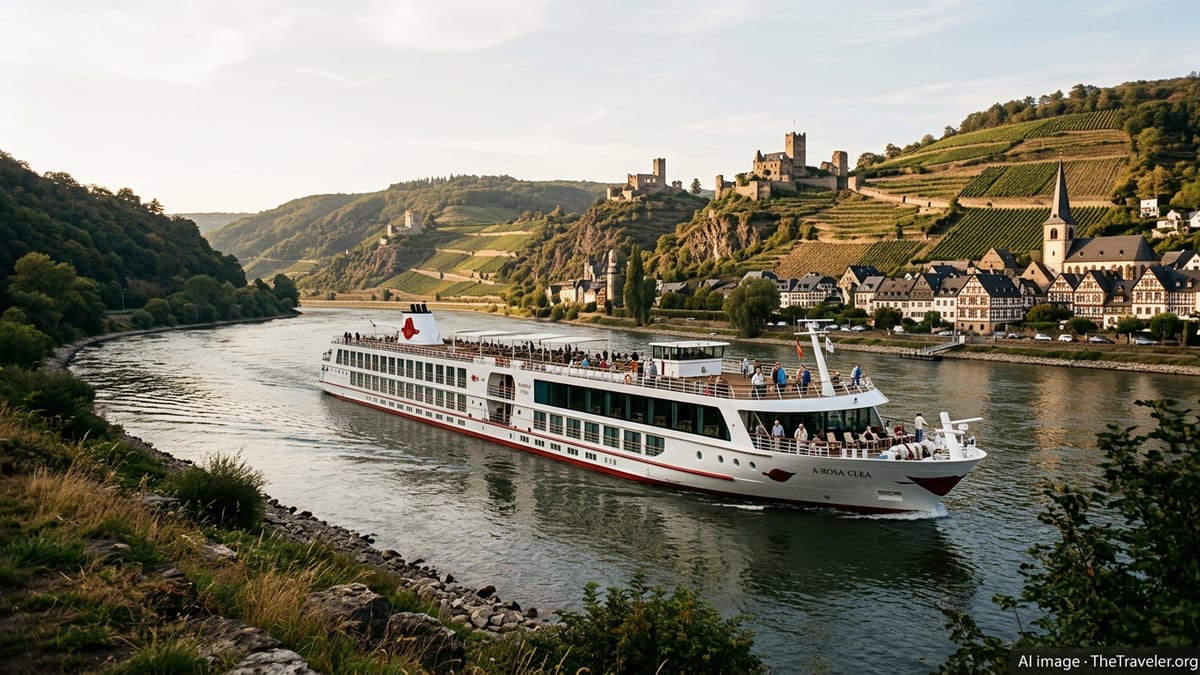
A passenger ship on Germany’s Rhine River was temporarily stranded this week after plummeting water levels forced navigation to a halt along a key stretch of the waterway, underscoring how recurring low water episodes are increasingly disrupting both tourism and trade on one of Europe’s busiest rivers.
Get the latest news straight to your inbox!
Sudden Grounding Highlights Fragile Conditions
According to regional media and industry reports, the vessel became stuck near a shallow section of the Middle Rhine where depths dropped sharply following a prolonged spell of hot, dry weather. The ship was unable to safely continue its journey until water levels stabilized, leaving passengers on board while river authorities and company planners evaluated options.
Initial indications point to critically low readings at traditional bottlenecks such as Kaub, a narrow point between Koblenz and Wiesbaden that often dictates how much traffic the river can carry. Historical data and recent market coverage describe Kaub as a key gauge station where even small changes in water level can quickly translate into draft restrictions for both cargo and passenger ships.
The latest incident did not involve damage or reported injuries, but it added to a growing list of low water disruptions that have forced passenger vessels to shorten itineraries, swap ships or, in the most extreme cases, bus guests over affected sections. Publicly available travel accounts from recent seasons describe days of slow going on the Rhine as captains adjust speed and loading to avoid grounding in shallow stretches.
While the stranded vessel was eventually able to move again once conditions improved, the episode reinforced how rapidly a scenic cruise can turn into an unplanned layover when river levels fall below safe navigational thresholds.
Rhine Water Levels Under Mounting Climate Strain
The grounding comes as new data show that low water on the Rhine is no longer an occasional anomaly but a recurring seasonal challenge. Market reports from May 2026 noted that cargo vessels on the river south of Duisburg and Cologne were forced to sail only partially loaded because dry weather had pushed levels down at Kaub and other key points, triggering low-water surcharges and higher transport costs.
Analyses by European inland navigation bodies describe a clearer trend toward more frequent low water episodes over the past decade, with 2018 and 2022 standing out as particularly disruptive years. In those seasons, water at Kaub sank to some of the lowest readings on record, at times approaching levels where commercial traffic was nearly impossible on certain stretches.
Hydrologists and shipping specialists increasingly link these patterns to climate change, citing hotter summers, shifting precipitation and longer dry spells across the Rhine basin. More recently, insurance and energy market briefings have warned that heatwaves can compress water levels in a matter of days, narrowing the window in which river operators can plan around safe drafts.
For passenger shipping companies, these climatic pressures translate into a constant balancing act between selling peak-season itineraries and preserving enough flexibility to cope with sudden depth restrictions, detours and extended port calls.
Tourism Season Disrupted for River Cruise Passengers
Summer on the Rhine is typically high season for river cruises, with ships weaving between castles, vineyards and medieval towns. Low water events, however, are increasingly intruding on this picture. Travel industry coverage this year has already described reduced speeds, altered docking points and longer-than-planned bus transfers for guests on both the Rhine and nearby Danube.
Passenger experiences from recent seasons illustrate how low water can reshape a holiday. Instead of cruising seamlessly between cities, some travelers have reported being bussed over dry or shallow sections to rejoin a sister ship further downstream, or spending additional nights in a single port while captains wait for river levels to rise.
In the case of the latest Rhine incident, passengers faced delays while the stranded vessel waited for clearance. Operators typically respond by adjusting shore excursion timings, providing additional onboard activities or arranging alternative transport, but such measures only partly offset the disappointment for guests expecting uninterrupted sailing.
Tour operators emphasize in their booking conditions that river levels are beyond their control and reserve the right to modify routes, substitute ships or change embarkation and disembarkation points. Recent brochures and terms of carriage for European river cruises specifically mention unusually low water as a factor that may require significant on-the-fly changes.
Economic Stakes for Germany’s Inland Shipping Corridor
The Rhine is not only a backdrop for leisure cruises but also one of Europe’s critical commercial arteries, serving industrial hubs in Germany, Switzerland, France and the Netherlands. Reports from commodity traders this spring highlighted how low water conditions forced cargo barges to reduce loads, especially south of Cologne and at Kaub, raising freight rates and complicating logistics for fuel, ores, chemicals and agricultural products.
When depths drop, barge operators either sail with lighter loads or deploy more vessels to move the same volume of cargo, driving up costs that can ripple through supply chains. Previous periods of extreme low water have coincided with production slowdowns at German industrial plants that rely on the Rhine for raw materials and fuel deliveries.
The latest passenger stranding therefore resonates beyond tourism, serving as a visible sign of how sensitive the broader economy is to the river’s fluctuations. Even temporary groundings or draft restrictions can disrupt tightly planned just-in-time supply schedules, particularly during heatwaves when power demand and energy transport needs are already elevated.
Industry observers note that a series of short, sharp low water episodes within a single season can prove more challenging than one long drought, as companies must repeatedly adjust operations and inventories with limited forecasting certainty.
Planning, Adaptation and What Travelers Can Expect
In response to recurring low water challenges, river authorities and shipping companies are exploring a mix of infrastructure and operational adaptations. Sector studies discuss options such as channel improvements in critical bottlenecks, more accurate forecasting tools for river levels, and new vessel designs with shallower drafts that can navigate safely at lower depths.
Some cargo and passenger operators are already experimenting with fleets optimized for low water conditions, while others rely more heavily on flexible deployment of ships along interconnected river networks to keep itineraries running despite local disruptions.
For travelers eyeing a Rhine cruise, the latest stranding is a reminder to read booking conditions closely and remain prepared for changes. Travel advisers often recommend building in time before and after a voyage, maintaining flexible expectations about exact ports of call, and considering travel insurance policies that clearly state how schedule alterations tied to water levels are handled.
While passenger groundings remain relatively rare events, the convergence of hotter summers, rising tourism demand and intense use of the Rhine for freight suggests that occasional route changes, bus transfers and slower sailing days are likely to remain part of the river cruise experience in the years ahead.