


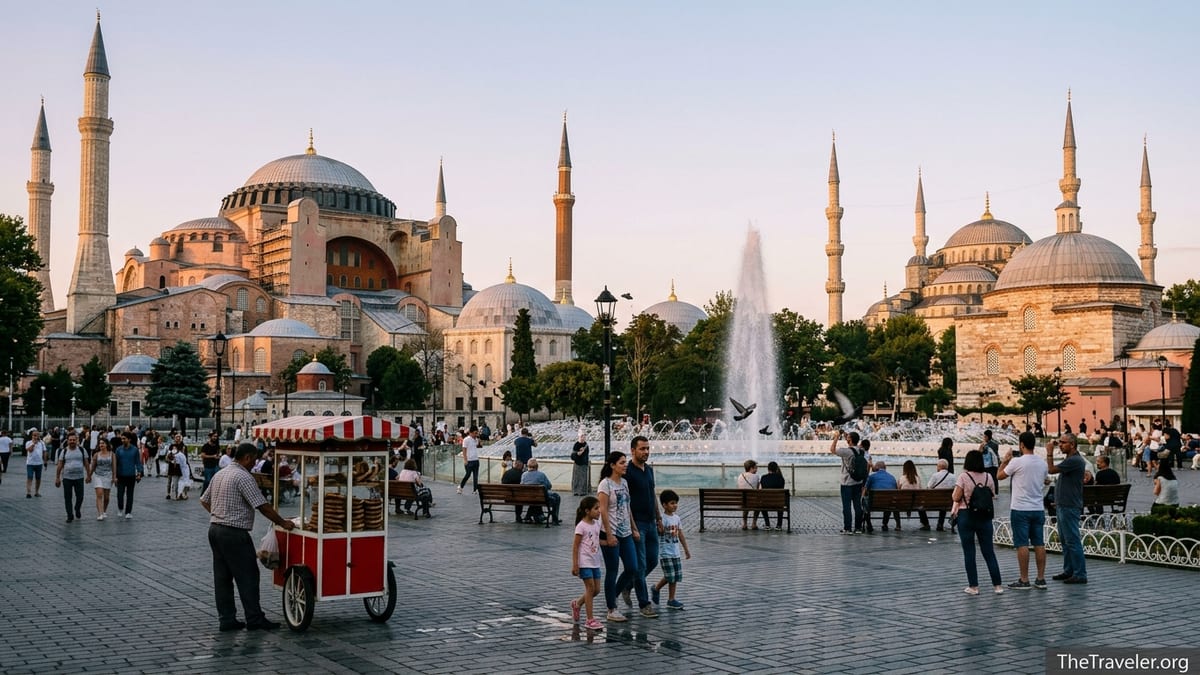
Stand in Sultanahmet Square at dusk and it is hard to believe that the modern city of Istanbul sprawls far beyond the peninsula. The call to prayer rolls from Hagia Sophia and the Blue Mosque, ferries slide across the Bosphorus in the distance, and families wander between ancient obelisks and Ottoman fountains. Trams rattle past souvenir stalls while locals cut through the crowds on their way home. Despite changing visitor rules, renovations and rising ticket prices, Sultanahmet still feels like the city’s historic soul because it remains, above all, a place where everyday life, faith and global tourism are tightly interwoven.
Get the latest updates straight to your inbox!
Where Empires Overlap In A Single View
Nowhere else in Istanbul compresses so much history into a few city blocks as Sultanahmet. On one side of the square, Hagia Sophia’s massive brick dome rises from the 6th century, built by Emperor Justinian when this was Constantinople. Directly opposite, the 17th century Sultanahmet Mosque, widely known as the Blue Mosque, reflects the height of Ottoman power with its cascade of domes and six minarets. Between them, you walk across what used to be the Hippodrome of Constantinople, once packed with chariots, factions and emperors.
That overlap is not theoretical. You can trace it with your feet in under ten minutes. One common itinerary begins at the German Fountain on the northern edge of Sultanahmet Square, a late 19th century monument from Kaiser Wilhelm II’s visit. From there you stroll past Egyptian obelisks and the Serpent Column, relics of the old Hippodrome, and end up at the steps of the Blue Mosque or the security line at Hagia Sophia. This density of monuments, still used daily for worship and civic life, gives the area a sense of continuity that many historic districts lose to museums and souvenir shops.
The practical experience of visiting also underlines how living this heritage remains. In 2026, Hagia Sophia functions as an active mosque with a ticketed tourist route that leads to the upper gallery, while the ground floor is largely kept for worshippers. Visitor hours for non‑worshippers are typically framed around prayer times and often pause on Friday midday. The Blue Mosque, also an active mosque, welcomes visitors free of charge outside prayer times; on Fridays, non‑Muslim tourists are usually asked to wait until early afternoon before entering. The constant balancing act between access and worship is part of what makes Sultanahmet feel alive rather than preserved behind glass.
A Neighborhood, Not Just An Open-Air Museum
For all the iconic architecture, Sultanahmet is first and foremost a neighborhood. Step a block away from the main square and the tone shifts quickly from monumental to domestic. On Soğukçeşme Street, squeezed between Hagia Sophia and Topkapı Palace, restored wooden houses with bay windows lean over a narrow cobbled lane. Some operate as small hotels or guesthouses, others as cafes or cultural venues, and you still see residents hanging laundry or chatting on doorsteps in the late afternoon.
Walk uphill behind the Blue Mosque toward Küçük Ayasofya and you find residential streets lined with small grocery shops, barbers and neighborhood bakeries. Syrian, Afghan and Anatolian families share sidewalks with tour groups hurrying between sights. Children weave through the crowd with footballs, and on summer evenings, parents sit on low plastic stools in front of their buildings, tea glasses resting on parked cars. It is a jarring but revealing contrast: the same street can host a coach unloading day‑trippers at 10 a.m. and a wedding convoy honking its way to a local ceremony by nightfall.
Accommodation here reflects that blend of tourism and community. Streets like Kutlugün, Akbıyık and Peykhane are lined with small hotels and family‑run pensions that might charge a moderate nightly rate compared with boutique properties closer to the Bosphorus. Many are converted Ottoman houses with tiny roof terraces overlooking the Sea of Marmara. From those rooftops you can look down onto schoolyards, mosque courtyards and vegetable gardens as easily as domes and minarets. Staying in Sultanahmet means accepting tour‑bus traffic and souvenir stands, but it also offers a front‑row seat to daily life on the historic peninsula.
Living Faith At The Heart Of The Skyline
The soundscape of Sultanahmet does as much as the skyline to define its character. Five times a day, the ezan, or call to prayer, rises from the minarets of Hagia Sophia, the Blue Mosque and dozens of smaller neighborhood mosques. At dawn, the overlapping calls echo across the old city walls toward the Marmara; at sunset they mingle with ship horns and the clatter of the tram. For residents, this is the rhythm of life. For visitors, it is a constant reminder that these monuments are not frozen relics but active religious spaces.
Inside the Blue Mosque, that reality is immediately visible. Visitors remove their shoes, women cover their hair with scarves and shoulders and knees should be covered for all. Entry remains free, although modest clothing is enforced and shawls are sometimes loaned or rented at the door. When a prayer time approaches, volunteers form a soft barrier and gently direct tourists to exit while worshippers line up shoulder to shoulder on the carpet. Ten or fifteen minutes later, as prayers conclude, the space slowly reopens to sightseers. It is an everyday choreography that plays out hundreds of times a year, and it gives the building a sense of purpose that no interpretive panel could replace.
Hagia Sophia has seen more dramatic change in recent years. After nearly a century as a museum, it was reconverted into a mosque, and by 2025 a system of paid access for tourists to the upper gallery was introduced. Recent travelers report prices in the low thousands of Turkish lira for various gallery and guided options, with separate tickets marketed for nearby “experience” exhibitions telling the building’s history. Scaffolding currently covers portions of the interior due to long‑term restoration, and security and dress‑code checks are stricter than they were a decade ago. Many visitors find the process confusing, particularly around ticket categories and access restrictions, and some leave frustrated.
Yet even these complications underscore why Sultanahmet still feels central to Istanbul’s identity. Decisions about Hagia Sophia’s management, from who can enter to what they pay, are debated not only in travel forums but also in Turkish media and politics. The building is a touchstone in ongoing conversations about secularism, heritage, tourism revenue and religious practice. Standing in its shadow, you are literally in the middle of that debate, not just gazing at a UNESCO site in isolation.
Strolling Between Monuments, Squares And Small Markets
If you slow down enough to wander, Sultanahmet reveals hundreds of micro‑spaces where the city’s soul shows through. Sultanahmet Park, the landscaped area between Hagia Sophia and the Blue Mosque, is the district’s living room. In the morning, tour groups cluster by the fountains as guides lift colored umbrellas. By late afternoon, Istanbul families spread picnic cloths, teenagers take graduation photos with the domes in the background, and simit sellers circulate with sesame‑covered bread rings for the equivalent of a few local currency units. At night, colored lighting on the mosques and fountains draws strolling couples and street photographers.
Beyond the main square, the atmosphere changes with every corner. Behind the Blue Mosque, the Arasta Bazaar runs like a quiet spine along the back of the complex. Historically linked to the mosque’s foundation, it remains a small open‑air market of carpet shops, ceramic stalls and textile boutiques. Prices are not the lowest in the city, but the scale is intimate and the pace calmer than the sprawling Grand Bazaar about a fifteen‑minute walk away. Shopkeepers here are used to curious, price‑sensitive travelers and will often offer tea and a chat even if you walk away without buying that kilim cushion.
Near the Hippodrome, the Museum of Turkish and Islamic Arts occupies a former Ottoman palace with a courtyard where you can step away from the crowds for an hour and trace how calligraphy, carpets and religious manuscripts evolved across centuries. Downhill toward Gülhane Park, the Istanbul Archaeology Museums display everything from sarcophagi brought from Sidon to fragments of ancient city walls. As of mid‑2026, standard adult tickets cost in the mid‑hundreds of Turkish lira and are also included in some multi‑day museum passes for Istanbul. For travelers on a budget, these passes can offer better value than buying individual tickets for each site on the peninsula.
Even quick practical choices contribute to the feel of the district. The modern tram line that runs through Sultanahmet connects the neighborhood directly to Sirkeci, Eminönü’s ferry piers and the more commercial areas around the Grand Bazaar. Many locals rely on it for commuting, so at rush hour you will be pressed shoulder to shoulder with office workers and students carrying backpacks, not just tourists with cameras. Stepping off the tram into Sultanahmet Square, you feel the city’s full spectrum of users in a single electric‑bell ring.
Everyday Rituals: Tea, Tiles And Views Of The Marmara
For many visitors, the most lasting memories of Sultanahmet are not of queueing or ticket booths but of quiet, ordinary rituals. One such ritual is tea. Small tea gardens and cafes dot the slopes that run down from Sultanahmet toward the Sea of Marmara. A typical visit might involve climbing to a hotel rooftop terrace in late afternoon, ordering a glass of strong black tea or Turkish coffee for a modest sum and watching the sun slide behind the old city’s dome‑studded ridge. Freighters line up in the sea lanes, planes trace paths above, and the muezzin’s voice floats over it all.
Another is the slow appreciation of craftsmanship. Inside the Blue Mosque, the famous blue Iznik tiles still draw the eye to floral arabesques and calligraphic bands, although some sections remain under restoration. In Arasta Bazaar, modern ceramic studios sell plates and bowls inspired by the same designs, often alongside workshops where you can watch artisans at work. A traveler might spend half an hour chatting with a shop owner about glazes, only to realize that the pattern on a plate echoes one seen earlier on a mosque wall. That tangible continuity between high art and everyday objects is part of what anchors Sultanahmet in the present.
Food also grounds the area in daily life. Around Divanyolu Street and the side lanes leading toward Çemberlitaş, small lokantas serve homestyle dishes such as lentil soup, stuffed eggplant and stewed beans from steam tables, priced per plate. Office workers from nearby government buildings queue up beside backpackers for a quick lunch. In the evenings, families linger over grilled fish or meat skewers at simple restaurants where plastic‑covered menus list prices in Turkish lira first, with other currencies in smaller type. You are unlikely to find the most experimental dining in the city here, but you will see how a wide swath of Istanbul actually eats.
Even the tourist cliches have a human side. Carpet shops around Sultanahmet often offer free tea and long explanations of weaving techniques; some are pushy, others genuinely proud of village traditions. Sweet shops along the tram line stack Turkish delight and baklava in neon‑lit windows, but behind the counters, workers cut trays with the quick precision of people who do this all day, not just for show. Saying a polite no when you are not interested is part of the local dance, and learning to do so confidently makes the neighborhood more enjoyable.
Tourism, Tension And The Question Of Authenticity
Any discussion of Sultanahmet’s “soul” has to acknowledge its pressures. Visitor numbers surged strongly in the mid‑2020s, and the district feels busier than it did a decade ago. Scams crop up around major mosques, from unsolicited “guides” striking up friendly chats and then steering people into carpet shops, to overpriced, confusing ticket packages for popular sites. Reports in recent years describe visitors being sold combinations of mosque access and separate “experience” museums that did not match their expectations, especially around Hagia Sophia. Some travelers have left feeling that they paid too much for too little access.
Local authorities and tourism bodies respond with mixed success. Tourist police have a visible presence near Hagia Sophia and Sultanahmet Square, and official information boards and call centers aim to help visitors distinguish legitimate services from opportunistic offers. Yet the very density of businesses in the area, from licensed guides to unlicensed touts, makes it easy for confusion to flourish. For independent travelers, simple precautions help: verify prices at official ticket booths, be wary of anyone who approaches uninvited offering “free guiding,” and remember that most major mosques in Istanbul, including the Blue Mosque and Süleymaniye, are free to enter outside prayer times.
Critics sometimes argue that Sultanahmet has become too touristy and that the “real” Istanbul now resides in neighborhoods such as Kadıköy, Balat or Beşiktaş. There is truth in the sense that rents and shop mix in Sultanahmet have shifted heavily toward short‑term visitors. Yet to dismiss the area as inauthentic is to ignore the many people who still live, work, study and worship here. Schoolchildren on a class outing to the Hippodrome, imams greeting regulars by name at small side‑street mosques, municipal gardeners tending the flower beds in Sultanahmet Park, and tram conductors managing crowds at the stop are all part of today’s city, not a stage set.
In fact, the tensions around access, commercialization and preservation are themselves deeply authentic to Istanbul. This has always been a city negotiated between empires, religions and economic interests. Whether it was Byzantine chariot factions jostling for influence, Ottoman guilds regulating markets, or modern planners threading tram lines past ancient walls, compromise has been the rule. Sultanahmet today is simply the latest chapter in that story, and the debates you hear in its cafes and newspapers about ticket prices, dress codes and restoration choices are part of what gives the district its contemporary relevance.
The Takeaway
Sultanahmet still feels like the soul of historic Istanbul because it remains the place where the city’s deepest layers are most visibly stacked: Byzantine, Ottoman and Republican, mosque and museum, local and global. Within a radius of a short walk you can stand under the dome of Hagia Sophia, listen to afternoon prayers in the Blue Mosque, sip tea over the roofs of wooden houses, and browse tiles at Arasta Bazaar while school groups stream past on their own field trips. The area is crowded, sometimes frustrating and far from untouched, yet it continues to host real lives alongside visitor itineraries.
For travelers, approaching Sultanahmet with realistic expectations and a slower pace helps reveal its quieter truths. Accept that there will be queues and that some sites are under scaffolding, learn basic dress and etiquette for visiting mosques, and treat unsolicited offers with healthy skepticism. Then focus on watching how Istanbulites themselves use the space: families picnicking in Sultanahmet Park, worshippers slipping into side doors at prayer times, workers catching the tram home at dusk. In those unscripted moments, beyond the postcard views, Sultanahmet’s enduring spirit is easiest to feel.
FAQ
Q1. Is it still worth staying in Sultanahmet rather than in newer parts of Istanbul?
Yes, if your main focus is historic sights. You can walk to Hagia Sophia, the Blue Mosque, Topkapı Palace and several museums in minutes, which saves time and transport costs. Travelers who prefer nightlife, shopping malls and a more contemporary vibe may prefer areas such as Beyoğlu or Kadıköy, but many visitors split their stay between Sultanahmet and another district to experience both.
Q2. How have recent changes at Hagia Sophia affected the visitor experience?
Hagia Sophia now operates primarily as a mosque, with ticketed access for tourists to the upper gallery and more limited access to the ground floor. There are separate tickets for nearby history or “experience” exhibits, which can confuse visitors. Some travelers feel the current system is expensive and restrictive compared with the old museum days, but many still find the interior awe‑inspiring despite scaffolding and crowds.
Q3. Is the Blue Mosque free to visit and are there any restrictions?
Entry to the Blue Mosque remains free, but it is an active place of worship, so visiting pauses during prayer times, especially on Friday midday. Modest clothing is required: shoulders and knees should be covered, and women are expected to cover their hair. Simple shawls or wraps are often available at the entrance if needed, but bringing your own scarf and dressing conservatively makes the process smoother.
Q4. How crowded is Sultanahmet these days and when is the best time to visit?
Sultanahmet is busy for much of the year, with peak crowds in spring and early autumn when tour groups are most numerous. Within a day, late morning and late afternoon are usually the most congested around the main sights. Early mornings, especially just after sites open, and evenings after most tours have left offer a calmer experience. Winter can be quieter overall, though weather is less predictable.
Q5. Are there still genuine local experiences in such a touristy area?
Yes. While many businesses cater to visitors, Sultanahmet is still home to residents, schools, small mosques and everyday shops. You can watch children playing in backstreets near Küçük Ayasofya, join locals in lokantas along Divanyolu for a quick lunch, or sip tea beside families in Sultanahmet Park. Choosing smaller side‑street cafes, visiting neighborhood bakeries and walking beyond the main square reveal a more local rhythm.
Q6. How expensive are the major sights in and around Sultanahmet?
Costs change with inflation, but as of mid‑2026, many museums on the peninsula charge mid‑range ticket prices in Turkish lira, while key mosques like the Blue Mosque remain free. Hagia Sophia uses a paid system for its upper gallery and some combined experiences that many visitors describe as relatively pricey by local standards. Multi‑day city museum passes can offer better value if you plan to visit several paid attractions such as the Istanbul Archaeology Museums and nearby palaces.
Q7. What are the main scams or annoyances to watch for in Sultanahmet?
Common issues include unsolicited “guides” who start with friendly small talk, then lead you to shops or offer overpriced tours, and confusing ticket offers around popular sites, especially Hagia Sophia. Some visitors also report being steered into carpet or souvenir shops after accepting “free” help. To avoid problems, decline uninvited offers politely but firmly, confirm prices at official ticket counters, and use licensed guides arranged through reputable channels if you want a tour.
Q8. Is Sultanahmet a good base for exploring the rest of Istanbul?
Yes, thanks to the tram line that connects Sultanahmet to Eminönü, the Grand Bazaar area and across the Golden Horn via transfer points. From Eminönü or nearby piers you can board ferries to Kadıköy, Üsküdar and the Bosphorus. Travel times can stretch at rush hours, but for first‑time visitors who want easy access to major historic sites and straightforward links to other districts, Sultanahmet is a practical base.
Q9. How can I visit mosques respectfully as a non‑Muslim visitor?
Dress modestly, remove your shoes when asked, and stay outside prayer areas during services. Avoid loud conversations and flash photography, and follow staff or volunteer instructions about where visitors may stand. If you enter during a prayer by accident, step back quietly to the visitor area. Remember that for many locals these are everyday religious spaces, not just attractions, so a calm and considerate attitude is appreciated.
Q10. If I only have one day in Sultanahmet, what should I prioritize?
With one day, many travelers focus on a circuit that includes the Blue Mosque, Hagia Sophia (or at least its exterior and square), the Hippodrome monuments, and either Topkapı Palace or the Istanbul Archaeology Museums, depending on interests. A stroll through Sultanahmet Park and a short visit to Arasta Bazaar add variety without much extra walking. Ending the day with tea on a terrace overlooking the Marmara or the historic skyline helps tie together what you have seen.