


Tucked inside the cloisters of Florence’s Basilica di Santa Croce, the Pazzi Chapel is one of the city’s purest examples of early Renaissance architecture. It rarely draws the same crowds as the Duomo or the Uffizi, yet architects and art historians speak about it with almost reverent enthusiasm. For travelers with limited time, that raises a fair question: is the Pazzi Chapel really worth visiting on a Florence trip, or is it a niche stop best left to specialists? This guide walks through what you actually experience on site, how it fits into a typical Florence itinerary, and which types of travelers will appreciate it most.
Get the latest updates straight to your inbox!
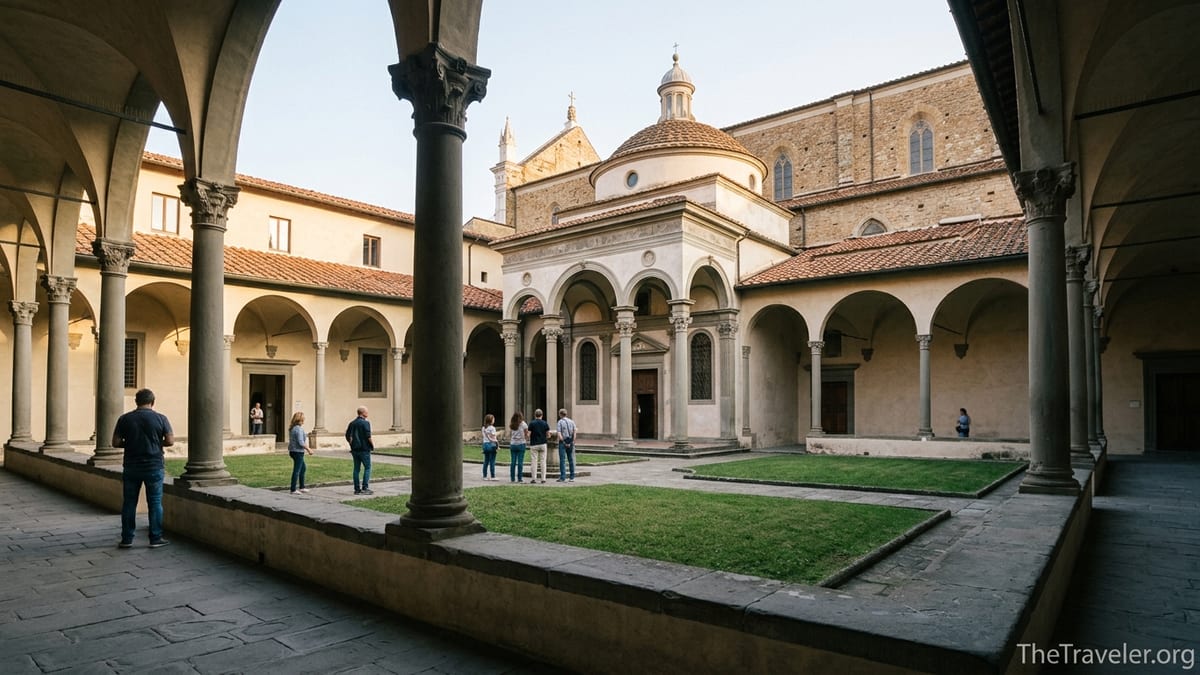
What Exactly Is the Pazzi Chapel?
The Pazzi Chapel is a small, harmoniously proportioned chapel within the monumental complex of Santa Croce, just off Piazza Santa Croce in central Florence. Designed in the mid 15th century and traditionally attributed to Filippo Brunelleschi, the engineer of Florence’s cathedral dome, it is considered a textbook work of early Renaissance architecture, with clear geometry, calm light and restrained decoration rather than baroque drama or gothic height.
The chapel served as the chapter house for the Franciscan friars of Santa Croce and as a funerary space for the powerful Pazzi family, who were closely tied to Florence’s banking and political elite. Its story unfolds against the backdrop of intense rivalry between the Pazzi and the Medici families, culminating in the infamous Pazzi Conspiracy of 1478. While the chapel predates that plot, standing inside it connects you with one of the city’s most turbulent political eras through a surprisingly tranquil environment.
Architecturally, the Pazzi Chapel is defined by a cube-shaped central space topped by a low umbrella dome, flanked by barrel-vaulted side bays. Inside, the pale walls are articulated with gray pietra serena stone, glazed terracotta roundels by Luca and Andrea della Robbia, and a delicate frieze of sculpted medallions above. Rather than overwhelming you with visual noise, everything is carefully measured and balanced, which is why many architecture students describe it as the place where Florentine Renaissance ideals suddenly “click.”
In everyday travel terms, this means you are not coming here for gilded altarpieces or massive fresco cycles. You are coming to step into a space that feels almost mathematically calm, a quiet counterpoint to Florence’s often crowded streets and headline attractions.
Location, Tickets and Practicalities
The Pazzi Chapel is part of the Basilica di Santa Croce complex, about a 10 to 15 minute walk from the Duomo and less than 10 minutes from the Bargello Museum. You do not buy a ticket solely for the chapel; instead, you purchase admission to Santa Croce’s monumental complex, which includes the basilica, cloisters, small museum areas and the chapel itself. As of mid 2026, standard adult tickets advertised by major ticketing platforms typically cost in the range of 8 to 10 euros, with reductions for students, children and some other categories, though prices can change over time.
In practice, most visitors buy Santa Croce tickets either at the on-site ticket office facing Piazza Santa Croce or online for a specific entry window, particularly during busy seasons like late spring and early autumn. Timed entry helps keep flows manageable, but Santa Croce is generally less congested than the Duomo complex or the Uffizi. Many recent travelers report being able to walk up mid-morning on weekdays and enter within minutes, while weekend afternoons in high season can see short queues outside the basilica facade.
Access to the Pazzi Chapel itself is straightforward once you are inside the complex. Visitors typically tour the interior of the basilica first, viewing the tombs of Michelangelo, Galileo and Machiavelli, then continue into the cloisters. Signage directs you toward the first cloister, or Primo Chiostro, where the chapel is located. If you have mobility issues, Santa Croce provides ramped access into the basilica and cloister areas, and staff at the entrance can point you toward the most accessible route through to the chapel.
Opening hours for Santa Croce can vary slightly by season and liturgical calendar, but it usually opens in the morning and closes by late afternoon or early evening, with final entry around an hour before closing. Midday is often the busiest; if you want a quieter experience in the Pazzi Chapel, plan for early morning entry soon after opening, or the last slots of the day.
What It Feels Like Inside: Atmosphere and Experience
Stepping into the Pazzi Chapel after the bustle of Santa Croce’s nave feels like moving from a crowded piazza into a private study. The space is small enough that you can take in the whole layout with a slow turn of the head, but detailed enough to keep you looking for 15 to 20 minutes. Natural light filters through round windows and the small dome, soft and slightly diffuse, especially on bright days when the white plaster walls glow against the cool gray stone ribs.
Many visitors describe an immediate sense of order. The geometry is clear: arches and pilasters align cleanly, the height of the central cube matches its width, and decorative elements repeat at measured intervals. For architecture-minded travelers, this is the moment when textbook diagrams of Renaissance proportion become real. You can stand in the center of the floor, look upward into the dome painted with a starry sky, then slowly rotate and see how the lines of the building guide your gaze.
Unlike some chapels in Florence that are filled with large crowds, the Pazzi Chapel is often relatively quiet. Even in high season, you may share it with only a handful of other visitors, especially outside the peak midday hours. This allows you to linger, listen to the muffled sounds of the cloister outside, and notice details such as the glazed terracotta tondi depicting apostles, each framed in blue and white, or the delicate terracotta rosettes bearing the Pazzi family emblem in the small dome of the vestibule.
Photography is generally allowed, though flash is discouraged or prohibited, so expect to shoot handheld in moderate indoor light. A wide-angle lens on a phone or camera will help you capture the entire central space, but the beauty of the chapel is as much in subtle shadows, stone textures and the rhythm of the architecture as in any single “money shot.”
How Long to Spend and How It Fits Into a Florence Itinerary
Most travelers will spend 60 to 90 minutes exploring the whole Santa Croce complex, with roughly 10 to 25 minutes devoted specifically to the Pazzi Chapel depending on interest. If you enjoy architecture, art history or quiet spaces, you could easily double that time in the chapel alone, especially if you bring a short guide or audio commentary.
On a first visit to Florence, Santa Croce and the Pazzi Chapel typically slot into a half-day plan on the eastern side of the historic center. A realistic route might start with a morning climb of the Duomo’s dome or Giotto’s bell tower, followed by lunch near Piazza della Signoria, an afternoon walk to Santa Croce for the basilica and chapel, then an evening stroll across the river toward Piazzale Michelangelo. This pattern works well because Santa Croce tends to be a bit less frenzied than the cathedral area, offering a more reflective few hours in the middle or later part of the day.
For travelers on the tightest schedules, such as cruise passengers in port for only one day, it becomes a question of priorities. If you are splitting limited time among the Uffizi, Accademia, Duomo complex and possibly a walk across Ponte Vecchio, Santa Croce and the Pazzi Chapel may fall into the “second-tier but highly rewarding” category. On a second or third trip, or on a longer stay of three or more full days in Florence, they move firmly into “must-see” territory, especially if you value quieter experiences beyond the classic icons.
Families with children often appreciate that Santa Croce offers open cloister space where kids can move more freely, and the Pazzi Chapel itself is compact enough to explore without testing short attention spans. On the other hand, travelers primarily interested in dramatic frescoes, relics or ornate baroque interiors may find more visually striking chapels elsewhere, such as the Brancacci Chapel in Santa Maria del Carmine or the Medici Chapels near San Lorenzo.
Who Will Find the Pazzi Chapel Most Rewarding?
The Pazzi Chapel is, above all, a space for travelers who notice structure and detail. Architecture enthusiasts, design professionals, engineers and anyone who has ever wondered how geometry shapes the way a room feels will likely rank this visit very highly. Standing in the center, you can literally trace the logic of early Renaissance architecture from the floor pattern to the curves of the dome, seeing how Brunelleschi and his circle moved away from Gothic verticality toward balanced, human-scaled spaces.
Art history lovers will appreciate how the chapel fits into a wider Florentine story. Its measured interior anticipates later Renaissance and even neoclassical ideals. The Della Robbia terracottas show the workshop’s signature glazed surfaces, which you may have seen elsewhere in Tuscany, but here they are woven carefully into the architectural rhythm rather than dominating it. Combined with a visit to San Lorenzo’s Old Sacristy or to the Ospedale degli Innocenti, you can build a small personal “Brunelleschi trail” through the city.
Travelers seeking calm will also find value here. After the queues and noise that often surround Florence’s biggest sites, the first cloister of Santa Croce and the Pazzi Chapel can feel like a reset button. It is a realistic place to pause on a hot afternoon, sit for a few minutes in the cloister loggia and then step into the chapel for a short, contemplative visit. Several recent visitors have described having the chapel almost to themselves late in the day, a rare luxury in central Florence.
On the other hand, if your interest in religious buildings is minimal and you are focused chiefly on food, shopping and panoramic views, the Pazzi Chapel might feel too subtle. In that case, you might still visit Santa Croce for its famous tombs and treat the chapel as an additional, pleasant but brief stop rather than a focal point.
Comparing the Pazzi Chapel to Other Florentine Highlights
When deciding whether the Pazzi Chapel is worth your time, it helps to compare it with other key Florence sites that might be competing for your attention. For example, the Duomo’s interior is vast but relatively sparsely decorated, while its dome climb offers spectacular city views at the cost of a long staircase. The Medici Chapels excel in opulent marble and Michelangelo sculptures, with a more theatrical feel. The Brancacci Chapel is renowned for its dramatic fresco cycle by Masaccio and others, telling complex biblical scenes in vivid color.
The Pazzi Chapel, by contrast, is about distilled architectural clarity. Instead of dozens of narrative frescoes or ornate tombs, you see a handful of major elements: the stone framework, the starry dome, the terracotta medallions. It is an ideal counterpoint to more exuberant spaces. Many seasoned travelers place it in the same mental category as the quiet cloister of Santa Maria Novella or the simple Romanesque interior of San Miniato al Monte: places where the experience is emotional and spatial rather than based on a single famous artwork.
In terms of value for money, Santa Croce and the Pazzi Chapel together often compare favorably with other ticketed churches in Florence. For roughly the price of a mid-range glass of wine or a simple lunch, you gain access to the basilica’s major tombs, important Giotto frescoes, the cloisters and the chapel. If you pair it with a nearby museum, such as the Galileo Museum, you can construct a full cultural day in the eastern part of the city without needing multiple long cross-town walks.
If you are planning a themed itinerary, the chapel integrates particularly well into an “early Renaissance” or “Brunelleschi and the birth of perspective” day. Start at the Duomo complex to see the exterior of the dome, continue to the Ospedale degli Innocenti on Piazza Santissima Annunziata to see Brunelleschi’s portico, then end at Santa Croce for the Pazzi Chapel, tying together different strands of the same architectural revolution.
The Takeaway: Is It Worth It for You?
For most travelers with at least two full days in Florence, the Pazzi Chapel is worth visiting as part of a broader stop at Santa Croce. It rarely requires a separate booking, adds only 20 to 30 focused minutes to your church visit, and offers a calm, coherent space that balances out more crowded, high-drama sites elsewhere in the city. If you care about how buildings feel and how Renaissance ideals translated from theory into stone, it will likely be a highlight rather than a footnote.
It becomes an essential stop if you are specifically interested in architecture or early Renaissance art, or if you are returning to Florence and looking for experiences that feel deeper and less tour bus driven. Many repeat visitors describe Santa Croce and the Pazzi Chapel as among the places that made Florence feel truly intelligible, rather than simply impressive.
Conversely, if your Florence itinerary is compressed into a single intense day and you are mainly focused on headline items like the Uffizi galleries and the Duomo climb, you may decide to keep Santa Croce and the Pazzi Chapel for a future trip. They are not about checklist tourism but about dwelling in a space. When you can spare that time, the chapel rewards it richly.
Ultimately, the question is less “Is the Pazzi Chapel famous enough?” and more “Do I want at least one moment in Florence that is about quiet perfection rather than crowds and spectacle?” If the answer is yes, then carving out an hour in Santa Croce, with 15 or 20 unhurried minutes inside the Pazzi Chapel, will likely become one of your most enduring memories of the city.
FAQ
Q1. Where is the Pazzi Chapel located in Florence?
The Pazzi Chapel sits inside the cloisters of the Basilica di Santa Croce, a short walk east of Florence’s historic center and Piazza della Signoria.
Q2. Do I need a separate ticket to visit the Pazzi Chapel?
No. Entry to the Pazzi Chapel is included with the general ticket for the Santa Croce monumental complex, which covers the basilica, cloisters and museum spaces.
Q3. How much time should I plan for the Pazzi Chapel?
Most visitors spend 10 to 25 minutes specifically in the Pazzi Chapel, usually as part of a broader 60 to 90 minute visit to Santa Croce.
Q4. Is the Pazzi Chapel very crowded?
Compared with the Duomo or the Uffizi, the Pazzi Chapel is usually much quieter. It can be busier at midday in high season, but often feels calm and uncrowded.
Q5. What is the best time of day to visit the Pazzi Chapel?
Early morning shortly after opening and the final hour before closing tend to be the most peaceful times, with softer light and fewer groups.
Q6. Is the Pazzi Chapel accessible for visitors with limited mobility?
Santa Croce provides ramped access into the basilica and cloisters, and staff can direct visitors with limited mobility along the easiest route to the chapel.
Q7. Can I take photos inside the Pazzi Chapel?
Photography is generally allowed for personal use, but flash and tripods are typically not permitted. Always follow on-site signage and staff instructions.
Q8. Is the Pazzi Chapel suitable for children?
Yes. The chapel is small and easy to explore quickly, and the adjoining cloisters give children a bit more room to move than many museums.
Q9. Do I need to book in advance to see the Pazzi Chapel?
You usually do not need a separate reservation for the chapel, but in busy months it is wise to secure a timed entry ticket for Santa Croce itself.
Q10. Is the Pazzi Chapel worth it on a short Florence trip?
If you have at least two full days in Florence, it is a worthwhile and rewarding stop. On a one-day visit focused on headline sites, it may be better saved for a future trip.