


Pescara has quietly become one of Italy’s most talked about beach cities. In Booking.com’s latest Travel Predictions report for 2027, the Adriatic port is highlighted among just ten “trending destinations” worldwide, singled out as an emerging alternative to Italy’s crowded marquee coasts. That recognition is drawing new attention to a place Italians have long used as their own summer playground, combining city energy, broad sandy beaches and access to some of the country’s most characterful regional food.
Get the latest updates straight to your inbox!
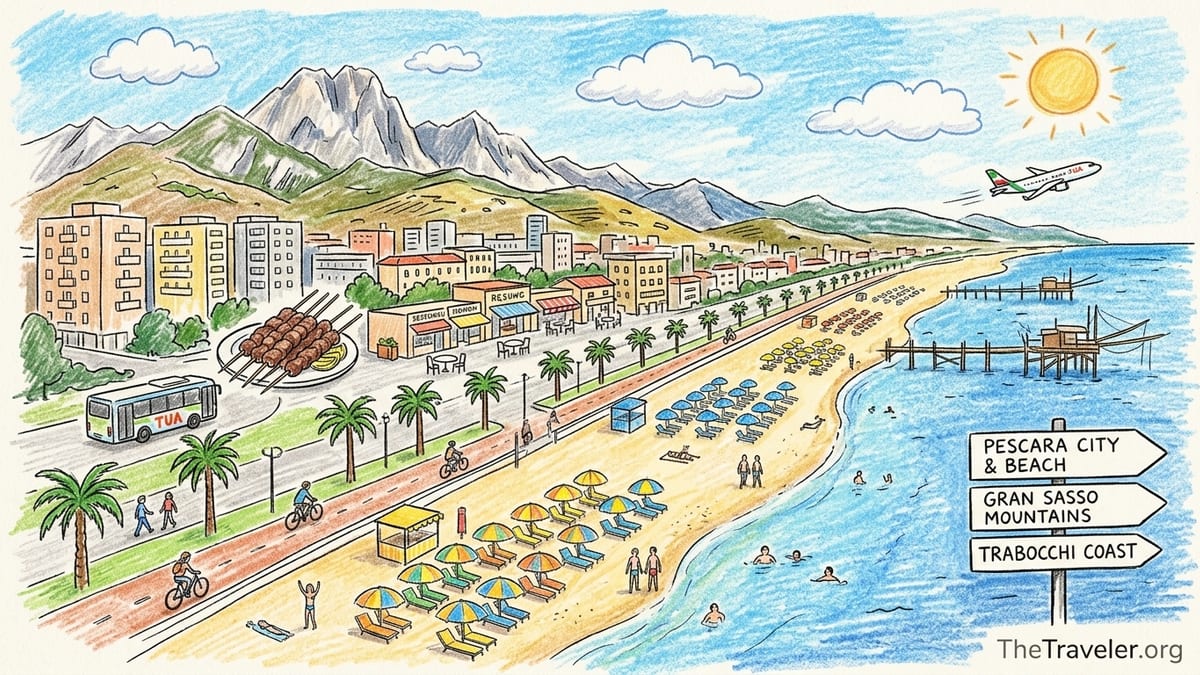
Why Pescara is on Booking.com’s 2027 watchlist
Booking.com’s Travel Predictions 2027, released in October 2026, puts Pescara in a small group of destinations expected to see a notable rise in international interest in the next year. The company’s analysis looked at the thousand most booked places on its platform between 1 January and 30 June 2026, then identified those that are seeing a marked upswing but are still relatively under the radar. Pescara appears beside cities such as Reims and Bratislava, flagged as an Italian beach escape that feels far removed from the crush of more famous resorts.
Part of Pescara’s appeal is that it offers many of the elements travelers look for in better known coastal regions, but in a more manageable key. The city fronts a long, continuous ribbon of sand on the Adriatic, backed by a level, palm lined promenade. Behind the coast, the hills rise quickly towards the Apennines and the Gran Sasso range, so visitors can realistically spend one day lying on a sunbed and the next hiking or visiting medieval hill towns. Travel media outlets echo this dual appeal, often describing Pescara as a base that combines sea time with access to what many call one of Italy’s most authentic regions.
Affordability also plays a role in the city’s new profile. While individual prices differ by location and season, recent hotel searches show modern three star properties near the seafront in high summer for figures that often undercut better known Italian coasts. Travelers who price a July weekend in Pescara against one in the Cinque Terre or the Amalfi Coast commonly find nightly rates in Pescara noticeably lower for comparable proximity to the sea. Combined with competitive airfares into Abruzzo Airport and a growing spread of mid range dining, that cost equation is part of what positions the city as a smart choice for 2027.
Pescara is also benefiting from a broader push by local and regional tourism bodies to promote Abruzzo as a place where nature reserves, mountains and marine parks are within relatively short travel times. Official tourism material emphasizes that the city is a gateway, not just a beach resort, which aligns well with Booking.com’s suggestion that 2027 travelers are looking for trips with a twist rather than straightforward resort stays. For visitors, that translates into a coastal holiday with plenty of day trip options and a sense of discovery.
Beaches in and around Pescara
Pescara’s urban beach stretches for several kilometers along the Adriatic, divided into sections run by stabilimenti balneari, or beach clubs, that rent umbrellas and sun loungers, interspersed with public stretches where access to the sand is free. In the busiest central areas, a pair of sunbeds and one umbrella at a mid range establishment in July or August often costs in the region of 20 to 30 euro per day, with lower prices in June and September. Many of these beach clubs include showers, changing cabins and café service in the rental, and some offer simple lunches such as grilled fish or salads.
The seafront promenade, called the lungomare, has separate spaces for pedestrians and cyclists and is lit and busy well into the evening in summer. Families walk with strollers, teenagers gather around beach volleyball courts and older residents take a passeggiata before dinner. On very hot days many beachgoers move into the rows of umbrellas before 10 in the morning, dip in the relatively shallow Adriatic and then retreat to covered bars at midday. The combination of level access and organized clubs makes this stretch particularly convenient for visitors who prefer services close at hand.
Travelers seeking a quieter feel can follow the coast north or south by local train or bus. Within a short ride to the north, the beaches around Montesilvano offer similar sand and shallow water but, away from the main strips, a generally more residential atmosphere. Moving further along the Abruzzo coast, towns like Silvi develop a more traditional resort character, with small hotels, family run bars and stretches of free beach between concessions. To the south, towards Francavilla al Mare and beyond, the coastline takes on a slightly wilder air in places, with some low cliffs and fewer high rise buildings.
The broader Abruzzo coast also includes the so called Trabocchi Coast further south, where historic wooden fishing platforms stand on stilts over the sea. Reaching these requires more time, usually by regional train to stations such as San Vito Lanciano, followed by short walks along coastal paths. There, the experience is more about rocky coves, clear water and views from cliffs than about rows of sunbeds, so many travelers choose to combine a few days on Pescara’s city beach with a day trip to this more rugged stretch.
Regional food: from arrosticini to brodetto
Abruzzo’s food culture is one of the strongest reasons to spend time in and around Pescara. Regional tourism information and culinary guides consistently highlight lamb skewers known as arrosticini, fish stews such as brodetto alla pescarese and robust local wines including Montepulciano d’Abruzzo and Trebbiano d’Abruzzo. Many of these specialties appear on the menus of traditional restaurants in Pescara’s center and seafront, at prices that, while varying by venue, are often lower than those in Italy’s largest cities for comparable quality.
Arrosticini, widely associated with the foothills of the Gran Sasso and the province of Pescara, are small cubes of lamb threaded onto long skewers and grilled over a narrow charcoal brazier. They are served in bunches, often in metal or terracotta containers, and eaten by pulling the meat off with one’s teeth. In informal bracerie and countryside trattorie around Pescara, it is common to order them by the dozen, with prices that, based on current menus, frequently fall into a range of a few euro per serving of several skewers. In the city itself, Reddit users and local diners often recommend simple places specializing in meat and arrosticini for a straightforward introduction to this dish.
On the coast, fish is equally central. Brodetto di pesce alla pescarese is a tomato based fish stew that uses a mix of Adriatic species, cooked in stages according to their firmness, and flavored with garlic, parsley and a measure of chili. Food and wine brochures produced for the Abruzzo region describe brodetto as a classic of several coastal towns, including Pescara, with each community insisting on its own variation. At seafront restaurants, a pot of brodetto for two can cost somewhere in the middle range for local dining, typically more than a simple plate of pasta but less than the most elaborate mixed grills, and is usually served with toasted bread to soak up the broth.
Sweets and baked goods have their own traditions. In Pescara, pastries such as parrozzo, a dome shaped cake traditionally made with ground almonds and coated in chocolate, appear in historic pasticcerie, especially around holidays. Across Abruzzo, thin waffle like ferratelle, small cheese filled pies known as fiadoni and honey coated clusters of fried dough called cicerchiata also appear in bakeries and dessert menus. Many visitors structure an evening stroll through the center around a stop at a gelateria or pasticceria, choosing a slice of parrozzo or a local biscotto alongside a coffee or glass of dessert wine.
Exploring the Abruzzo coast beyond Pescara
One of Pescara’s strengths as a base is its rail and road access up and down the Abruzzo shoreline. The main station, Pescara Centrale, sits a short walk inland from the beach and handles both long distance services and frequent regional trains along the Adriatic. Timetables change seasonally, but as of late 2026 it is possible to reach nearby coastal towns such as Montesilvano or Silvi in roughly 10 to 20 minutes on regional trains, often for single digit euro fares. This allows visitors to sample different seaside atmospheres without changing accommodation.
Further south, regional trains link Pescara with Ortona, San Vito Lanciano and Vasto San Salvo, opening up the more varied coastal landscapes of southern Abruzzo. Around San Vito and Rocca San Giovanni, the shoreline becomes the Trabocchi Coast, where converted fishing platforms now host simple restaurants serving grilled fish and local wine. Reaching these platforms usually involves a short walk from small stations or car parks along signed paths, so sturdy sandals are advisable. Travelers often plan a day that combines a train ride from Pescara, a few hours of swimming in small coves, a lingering lunch on a trabocco and a sunset return along the rail line.
Inland, buses and some train routes climb towards Chieti, an older hilltop city overlooking the Pescara valley, and on to areas closer to the Gran Sasso and Majella national parks. While these destinations move beyond the strictly coastal frame, they are realistic day trips from Pescara for travelers interested in combining the sea with hill towns and mountain landscapes. Bus companies publish updated timetables each season, and journey times to Chieti Scalo and the historic upper town are generally under an hour, with fares set at levels that make such excursions accessible for most visitors.
Car rentals, available at Abruzzo Airport and in the city, provide additional flexibility for exploring small fishing villages or inland wine country. Road connections from Pescara to both the north and south coasts and to key inland routes, including the A14 and A25 motorways, are straightforward, but summer congestion near popular beach access points can slow travel at peak weekend hours. Drivers should factor in time to find parking in smaller coastal towns, where free spaces nearest the water may fill by mid morning on sunny days in July and August.
Getting to Pescara and moving along the coast
Abruzzo Airport, located just outside Pescara, serves as the main international gateway to the region. Official regional tourism information states that the airport lies a little more than 4 kilometers from the city and about 10 minutes by car from the center. Major European low cost and flag carriers use the airport to connect Pescara with hubs such as London, Brussels and several domestic Italian cities, though routes and frequencies vary with the season and airlines adjust schedules annually.
For travelers arriving by air, reaching the city center is straightforward. Regional transport company TUA operates bus lines, including Linea 8 and Linea 38, that run between the airport and Pescara Centrale, stopping near the main railway station and the adjacent bus terminal. Service updates published in mid 2026 indicate that these lines offer multiple departures across the day, with journey times commonly in the range of 15 to 20 minutes under normal traffic conditions. Tickets are typically purchased from machines, airport kiosks or authorized newsstands and validated on board.
Rail travelers coming from elsewhere in Italy arrive at Pescara Centrale on the Adriatic line, which links the city northwards to Ancona and southwards towards Foggia and Bari. From Rome, trains usually travel via Sulmona to Pescara, with journey times that, depending on the category of service and any required changes, often fall between three and four hours. Regional rail and national operators update timetables several times a year, so it is important to verify precise schedules and fares shortly before travel, but Pescara’s role as the main coastal hub for Abruzzo ensures regular services.
Once in the city, moving along the seafront and between neighborhoods can be done largely on foot or by bicycle. The flat promenade and designated cycle path allow visitors to ride from the more residential northern beachfronts down to the southern areas near the harbor without major road crossings. Several bike hire outfits and hotels provide bicycles, sometimes included in room rates during low season. Urban buses supplement this with routes running parallel to the coast and inland towards residential districts, shopping streets and the university area, with ticketing systems that mirror those used on the airport connection.
Where and what to eat in Pescara
Dining in Pescara reflects both its role as a working city and its summer identity as a seaside resort. In the streets between the station and the seafront, visitors find a mix of traditional trattorie, modern wine bars, family run pizzerias and casual seafood places attached to beach clubs. Online discussions among residents and recent travelers regularly highlight a handful of recurrent themes: grilled lamb skewers at dedicated bracerie, seafood lunches directly on the sand and historic cafés serving regional cakes in the center.
For a beachside meal, a common pattern is to reserve a table at one of the lido restaurants that line the lungomare, order a starter of mixed fried fish or crudo di calamaretti, then share a pot of brodetto or a platter of grilled catch of the day, accompanied by a chilled bottle of Cerasuolo d’Abruzzo. Recent traveler reports mention venues where a full seafood lunch with house wine, dessert and coffee for two lands at a final bill that, while dependent on the exact order, is competitive with or below equivalents in more famous Italian resorts. As always, checking the menu displayed outside for per kilo fish prices and the coperto cover charge helps avoid surprises.
In the center, away from the seafront, restaurants often focus more on inland Abruzzo cooking. Menus might feature maccheroni alla chitarra with tomato and lamb ragu, hearty anellini alla pecorara with vegetables and cheese, slow cooked pork and house made desserts. Dinner in these places tends to start later in the evening, with locals arriving from around 8.30 pm onward, and reservations are advisable on Friday and Saturday nights in high season. Travelers on tighter budgets can look for osterie that offer fixed price menus at lunch, providing a couple of courses and water for amounts that undercut typical dinner bills.
For snacks, breakfast and dessert, Pescara’s cafés and bakeries are important stops. Classic Italian breakfasts of espresso and a filled cornetto are widely available, but regional options such as slices of parrozzo or seasonal pastries appear in glass cases alongside them. Some long established pasticcerie in the city center are known for particular specialties, such as maritozzi or fiadoni, and locals often point visitors to these when asked where to sample traditional sweets. Gelato shops, including a few with reputations that extend beyond the region, stay open late into the evening in summer, forming another anchor for the nightly passeggiata.
When to go and what to expect on arrival
The main beach season in Pescara runs from roughly June to early September, with July and August bringing the highest temperatures, the most crowded beaches and the liveliest nightlife. During those peak weeks, sunbeds at the more fashionable stabilimenti may be reserved in advance by local families for the whole month, and evening tables at popular lido restaurants fill fast. Travelers who want maximum atmosphere and do not mind crowds or higher accommodation prices often aim for this period, accepting the need to book hotels and trains early.
For visitors who prioritize more space on the sand and easier restaurant reservations, late May, June and September can be attractive alternatives. In those shoulder months, the sea is generally warm enough for swimming, beach clubs are operating, yet the promenade feels less congested and room rates at many hotels soften compared to August highs. Some services, such as certain seasonal bus routes or late night beach bars, may scale back their schedules outside peak season, so those who are set on specific venues should check current opening periods close to departure.
On arrival, most travelers find Pescara straightforward to navigate. The grid of streets between the station and the sea makes orientation easy, and the city center is compact enough that many visitors manage for several days without using any transport beyond their feet and an occasional bus. While any urban area requires normal precautions, residents often describe Pescara as generally safe, with the seafront promenade busy into the evening and a visible local presence. As in other Italian cities, safeguarding belongings on the beach and in crowded nightlife streets is sensible.
Language and payment pose few barriers. Italian is the dominant language and English levels vary, but staff in hotels, larger restaurants and rental agencies in this increasingly international destination usually handle basic interactions comfortably. Card payments are widely accepted, especially in formal establishments, though carrying some cash for small cafés, kiosks and certain bus tickets remains useful. With Booking.com and other platforms now directing more global attention to Pescara ahead of 2027, local businesses are likely to become even more accustomed to serving a mix of domestic and foreign guests.
Conclusion: an Adriatic city coming into focus
Pescara’s inclusion in Booking.com’s list of trending destinations for 2027 simply formalizes what many Italian travelers have known for years. This is a functional, lived in city that doubles as a long sandy beach resort, framed by a coastline that offers both organized comfort and, within easy reach, stretches of more dramatic scenery. It sits at the meeting point of sea and mountains, combining urban convenience with access to nature in a way that few better known resorts can match.
For international visitors considering Italy in the coming years, that combination makes Pescara and the Abruzzo coast a compelling alternative or complement to classic itineraries. A traveler might spend a few days here at the start or end of a trip, recovering from or preparing for more intense sightseeing in Rome, Florence or Venice. Others may choose to base themselves in Pescara for a week, alternating lazy days on the sand with train rides to trabocchi and inland hill towns, and evening meals built around lamb skewers or fish stews.
As always, the details matter. Checking current bus and train timetables, confirming up to date opening hours for restaurants and beach clubs, and monitoring air routes into Abruzzo Airport will help ensure that the practicalities of a Pescara stay match the promise. Yet the fundamentals that put the city on Booking.com’s 2027 radar are in place: extensive beaches, distinct and satisfying regional food and an accessible transport network along a stretch of coast that still feels, to many international travelers, like something to discover rather than something already fully known.