


More news on this day
Passengers at Pittsburgh International Airport faced hours of disruption as a wave of delays and cancellations involving American Airlines, Delta Air Lines and Southwest Airlines rippled through key routes to New York and London, with operational data indicating at least 72 delayed departures and arrivals and six outright cancellations tied to Friday’s schedule.
Get the latest news straight to your inbox!
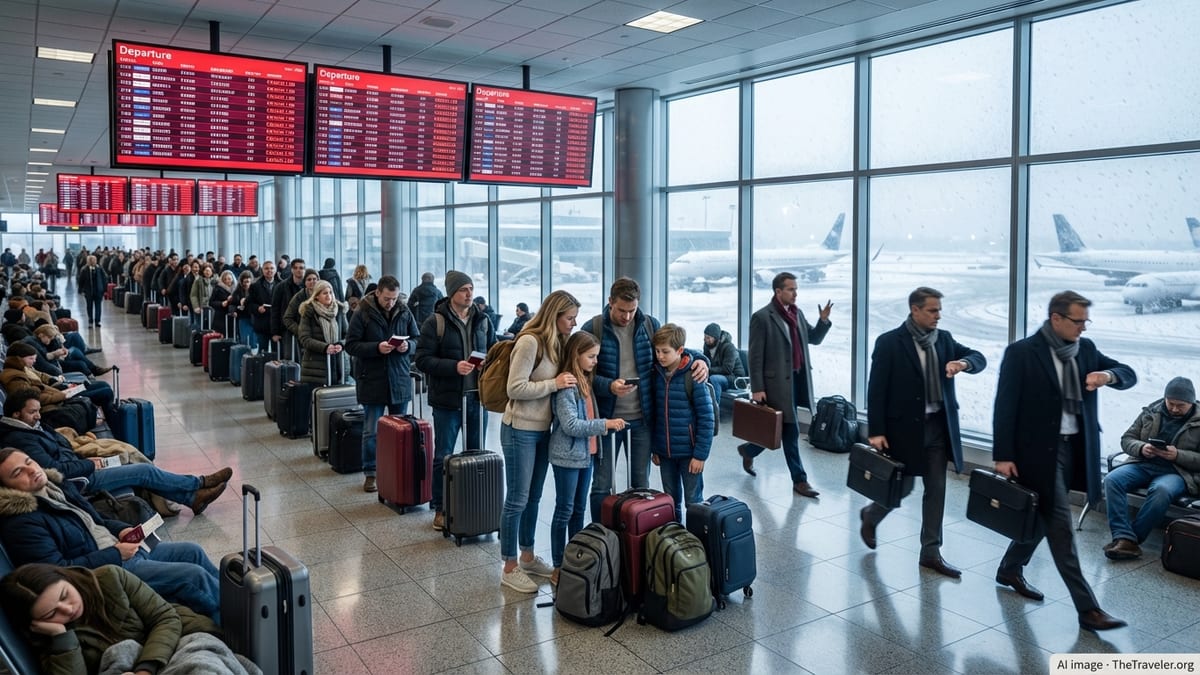
Ripple Effects Hit New York and London Connections
Publicly available flight-tracking data and airport schedules show that the heaviest disruption is concentrated on regional and long-haul services linking Pittsburgh with New York area airports and onward transatlantic connections to London. Multiple departures to New York John F. Kennedy, LaGuardia and Newark suffered extended ground holds, pushing back takeoff times by more than an hour in many cases and forcing passengers with onward itineraries to abandon or rebook their London-bound connections.
Airline schedule documents for early 2026 list New York and London among Pittsburgh’s most strategically important markets, with American, Delta and Southwest each operating high-frequency services to New York and American and Delta marketing connections onward to London through partner hubs. The current disruption has therefore had a disproportionate impact on travelers relying on Pittsburgh as a connecting point rather than an origin or final destination.
The delays and cancellations have been spread across the day, creating a rolling backlog in terminal operations, boarding queues and baggage handling. Travelers arriving from elsewhere in the Midwest and Southeast have encountered missed connections and unplanned overnight stays as evening bank departures to New York reached capacity, leaving limited options for same-day reaccommodation.
For London-bound passengers, the impact has been particularly acute. Many itineraries from Pittsburgh depend on tight connections through New York or other East Coast hubs; when early feeder services departed late, the transatlantic legs often became unworkable. Booking platforms and timetable data indicate that alternative routings via larger hubs such as Chicago, Philadelphia or Atlanta quickly filled, pushing some passengers onto flights 24 hours or more after their original plans.
Operational Strain Across American, Delta and Southwest
Data drawn from live status boards suggests that the three carriers most affected at Pittsburgh have experienced a combination of rolling delays and targeted cancellations rather than a single, short-lived outage. American Airlines, which operates several daily services between Pittsburgh and New York along with connections that feed London-bound flights, has recorded a cluster of late departures, in some cases more than two hours behind schedule, as crews and aircraft rotated through an already stretched network.
Delta Air Lines, a leading operator on the Pittsburgh to New York LaGuardia corridor, has also seen significant schedule pressure. Individual flight status pages show departures repeatedly pushed back in small increments, a pattern that tends to reflect wider congestion in the air traffic system and difficulties repositioning aircraft and crews after earlier disruptions elsewhere on the network.
Southwest Airlines, which uses Pittsburgh as a strong point in its point-to-point system, has not been spared. Several of its departures touching Pittsburgh have shown extended ground times, and at least one cancellation has been recorded among its daily rotations. Because Southwest typically does not interline bags or ticketing with other carriers, its customers often have fewer options to switch to alternative airlines when irregular operations occur.
Across all three airlines, the end result at Pittsburgh has been a patchwork of late departures, missed slots and last-minute cancellations that translated into the reported total of 72 delays and six scrapped flights. For passengers, the distinction between a delay and a cancellation has often been academic, as rolling pushbacks stretched travel times into the early hours or the following day.
Weather, Congestion and Network Vulnerabilities
While a single, definitive cause has not been identified in publicly available information, a combination of weather-related flow restrictions in the Northeast corridor and broader network congestion appears to be driving much of the disruption. Recent coverage of storm systems and traffic management initiatives across major hubs such as New York and Chicago highlights how quickly localized weather events can trigger ground delay programs and slot constraints that cascade into secondary airports like Pittsburgh.
Scheduling data and previous months’ disruption reports also underline how tightly airline networks are currently run. High summer demand, increased utilization of aircraft and crews, and ongoing infrastructure work at several large airports have left carriers with limited buffer to absorb irregular operations. When a morning or early afternoon arrival into Pittsburgh is significantly delayed, the outbound sector to New York or another connecting hub often departs late as well, setting off a chain reaction throughout the day.
Industry analysis of recent seasons has repeatedly pointed to New York’s crowded airspace and terminal capacity as a chronic vulnerability. Even modest weather systems or technical constraints can force controllers to meter arrivals and departures, leading to holding patterns in the sky and gate shortages on the ground. When Pittsburgh flights are caught in those restrictions, passengers connecting onward to London or other long-haul destinations can find their itineraries unraveling.
The situation is exacerbated by the way modern airline schedules concentrate connections into short “banks” of arrivals and departures. If a bank is heavily disrupted, options within that same window quickly disappear, and downstream banks grow congested as rebooked travelers compete for scarce seats. Friday’s pattern at Pittsburgh fits that profile, with the early disruption on New York legs spilling over into later banks and ultimately forcing some cancellations when crews timed out or aircraft could not be repositioned.
Impact on Travelers and What Passengers Can Do
For travelers on the ground at Pittsburgh, the operational story translated into long lines at customer service desks, crowded departure lounges and a scramble for hotel rooms and rental cars. Social media posts and forum discussions from affected passengers describe missed weddings, business meetings and vacations, along with out-of-pocket costs for meals and last-minute lodging that many standard airline policies do not automatically reimburse when weather or air traffic control issues are involved.
Consumer advocates frequently advise that in such situations, passengers should focus first on securing a workable itinerary, then pursue any compensation or reimbursement options later. That typically means using airline mobile apps or websites to rebook as soon as a delay passes the point of making a connection impossible, rather than waiting at a gate for a rolling series of new departure times. For complex international trips routed through New York or London, same-day alternatives may require accepting a different routing or even a different airport on either side of the Atlantic.
Travel insurance products vary widely, but some policies offer fixed payouts for delays beyond a set number of hours or for missed connections. Payment card benefits can also provide limited coverage for meals, transport and accommodation when flights are significantly disrupted. Passengers affected by the Pittsburgh chaos are likely to turn to these options where airline-issued vouchers or goodwill gestures fall short.
Looking ahead to the rest of the summer travel season, the episode at Pittsburgh serves as a reminder that smaller and mid-sized hubs are not immune from the systemic strains affecting major gateway airports. Travelers planning trips that depend on tight connections through New York to London may wish to build in longer layovers, schedule critical journeys earlier in the day when more fallback options are available, or choose itineraries with additional redundancy, even if that means a slightly longer routing.
Pittsburgh’s Growing Role Amid Systemic Strain
The turmoil comes at a time when Pittsburgh International is seeking to solidify its role as a growing regional gateway. Passenger traffic has been climbing back toward pre-2008 levels, and schedule documents for 2026 highlight expanded domestic and transatlantic offerings, including links that position the airport as a convenient alternative to larger and more congested hubs for travelers across western Pennsylvania, Ohio and West Virginia.
Yet the current disruption underlines how closely Pittsburgh’s fortunes are tied to the performance of larger hubs and the broader U.S. air traffic system. When New York’s airports struggle, Pittsburgh’s flights struggle as well, particularly on routes that feed long-haul services to Europe. The reliance on tight connecting banks through partner hubs makes the airport vulnerable to exactly the type of cascading delays and selective cancellations unfolding this week.
Analysts have noted that as airlines consolidate operations and concentrate long-haul flying in a handful of megahubs, secondary airports must balance growth ambitions with realistic expectations about reliability. Strengthening point-to-point options, diversifying partner networks and investing in ground infrastructure can help mitigate some of the risk, but they do not eliminate exposure to region-wide weather systems or policy-driven capacity caps in critical airspace.
For now, travelers at Pittsburgh face the immediate task of navigating disrupted journeys, while airlines work to reset their operations and clear the backlog. How quickly American, Delta and Southwest are able to restore normal patterns on New York and London-linked routes will be an early test of network resilience heading into the height of the summer season.