


On this short stretch of the French Riviera, two beaches just a few minutes apart offer very different moods. Plage de la Gravette sits tucked under Antibes’ medieval ramparts, a sheltered cove steps from the old town. Juan-les-Pins stretches out around the bay, a livelier resort with long sandy strands and beach clubs. If you only have a few days on the Côte d’Azur, choosing between them can shape your entire stay. Here is how each beach really feels on the ground, and which one is likely to suit your style, budget and pace.
Get the latest updates straight to your inbox!
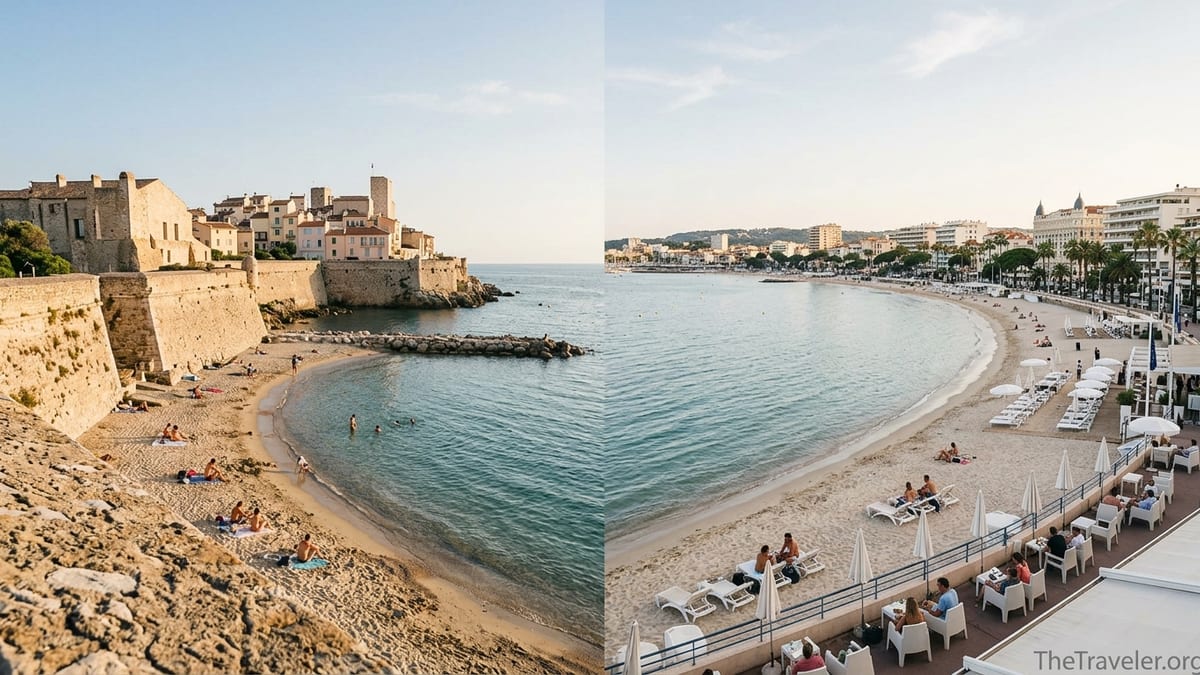
First impressions: cove vs resort strip
Arriving at Plage de la Gravette, the first thing you notice is how enclosed and intimate it feels. The beach sits in a small, nearly circular cove at the edge of Antibes’ old town, framed by honey-colored stone ramparts and the walls of the Picasso Museum. The sand is pale and fairly fine, the water usually calm thanks to a protective breakwater, and the port’s masts rise just beyond the curve of the bay. On a June morning, you might see local families spreading towels near the back wall, while office workers from Antibes drop in for a quick swim before work or at lunch.
Juan-les-Pins, in contrast, feels like a full-blown seaside resort. The main beachfront runs in a long arc facing west across the bay, with palms, Belle Époque buildings and mid-rise hotels lining the boulevard. Here the sand is also soft and golden, but the atmosphere is more open and expansive; you are looking out to sea and sunset rather than back toward city walls. Instead of a single cove, you have a series of public stretches interspersed with private beach clubs, each with its own loungers, restaurant deck and soundtrack.
For travelers who love a compact, postcard setting where everything is within a few minutes’ walk, Gravette instantly charms. Those who imagine their Riviera stay as days of strolling a promenade lined with bars, gelaterias and late-night energy usually click better with Juan-les-Pins.
Location, access and getting around without a car
Plage de la Gravette is hard to beat for pure convenience, particularly if you are staying in or near Antibes’ old town. From the covered Provençal market, it is about five minutes on foot through narrow lanes before the view opens onto the port and the sea. The beach entrance is cut through the ramparts on Quai Henri Rambaud, and the sand is just a few steps down from street level. Antibes train station is roughly a 10 to 15 minute walk, so you can arrive by regional train from Nice or Cannes and be swimming shortly after stepping off the platform.
Parking near Gravette can be challenging in peak summer, but there are practical options. Drivers often rely on Port Vauban’s paid parking, including a large underground garage beneath the open square by the ramparts, and a handful of free spaces along the quayside when available. Expect to pay typical Riviera rates for a central car park; a half-day in June or July will usually come out noticeably cheaper than a full day of parking in central Nice, but it adds up if you come every day.
Juan-les-Pins is also train-friendly, with its own station roughly one block back from the seafront. Many hotels and apartment rentals sit within a five to ten minute walk of both the station and the sand, which makes it easy to combine beach days with day trips to Antibes, Cannes or even Monaco. The main seafront road, Boulevard Charles Guillaumont and Boulevard Edouard Baudoin, carries regular bus services too, though in high summer traffic can slow things down.
Parking in Juan-les-Pins is mixed. There are several paid underground car parks and metered street spaces, but drivers arriving after late morning on a sunny August day will often circle for a while before finding a spot. If you plan to rent a lounger in a private club, it can be worth choosing one attached to a hotel or a venue with its own small parking area, accepting the higher price in exchange for less hassle.
Sand, water and swimming conditions
Plage de la Gravette is known for its sheltered swimming. The cove is enclosed by a breakwater that keeps out most waves, so the water usually stays calm, with a gentle gradient that suits less confident swimmers and young children. Parents often appreciate that from the back of the beach to the buoy line, the depth increases gradually rather than plunging. The flip side is that on very hot days in high season, the relatively enclosed bay can feel warmer and a little more crowded than open stretches further along the coast.
The sand at Gravette is generally soft but mixed with occasional small pebbles, especially near the waterline. Beach showers sit at the back of the cove, and in the core summer months lifeguards watch the designated swimming zone. Because of the breakwater, there are few waves to play in; it is more of a float-and-bob beach than a body-surfing spot.
Juan-les-Pins offers more variety along its length. Some sections of the public beach have broad, gently shelving sand that feels similar to Gravette but with more room to spread out. Others narrow at high tide, especially in front of long-established private concessions. The west-facing orientation means more exposure to passing boat wakes and afternoon breezes, so you will feel a little more movement in the water than in Gravette’s cove, but generally nothing rough. Swimmers who like to stretch out for longer laps may prefer Juan-les-Pins because there is more lateral space to swim parallel to shore.
Water quality across both areas is closely monitored, and in recent years local authorities have invested in improving waste-water management. Conditions can still vary after heavy rain, but on typical summer days visitors find both Gravette and Juan-les-Pins clear and inviting. As with anywhere on the Riviera, it is sensible to swim inside marked zones and keep an eye on local flag systems that indicate conditions.
Atmosphere: who each beach really suits
Plage de la Gravette tends to attract a mix of Antibes locals, nearby residents and travelers staying in the old town. Mornings are calm, with retirees reading under sun hats, parents helping toddlers build sandcastles, and solo swimmers slipping in for a brisk dip. In July and August afternoons, the tone shifts as day-trippers arrive from Nice or Cannes, but even then Gravette feels more like a neighborhood beach than a resort stage. There are no rows of for-hire loungers or loud DJ sets; towels on the sand, coolers, paperback novels and a kiosk at the back selling simple snacks and cold drinks are the norm.
Juan-les-Pins, by comparison, wears its resort identity openly. Along the public beaches, you will see families and couples setting up with umbrellas much as they would at Gravette, but the backdrop is livelier. Private clubs line much of the promenade, from laid-back venues like Cap Canailles with its boho decor and all-day restaurant service, to long-established institutions with white-linen setups and more formal dining. In the height of summer, some clubs host evening events or DJ sets, and the neighborhood’s bars and rooftop lounges, such as venues perched above the conference center overlooking the bay, keep the buzz going late.
If you want a beach that feels embedded in everyday town life, where you can walk straight from the market with fresh fruit and pastries to your towel on the sand, Gravette feels right. If you are picturing a classic seaside holiday with aperitifs on a terrace, strolling a lively promenade, and perhaps dancing after dark, Juan-les-Pins’ social energy is closer to that image.
Food, drinks and nearby things to do
One of Gravette’s biggest strengths is its immediate connection to Antibes old town. Within a five to ten minute radius on foot you can pick up socca from a local stand, pastries from artisan bakeries, or picnic supplies from the covered market and small supermarkets. Many travelers grab a still-warm baguette, a wedge of cheese and seasonal fruit before heading down to the beach. If you prefer to sit down, small bistros in the old town’s lanes serve fixed-price lunches that are often better value than seafront restaurants further along the coast.
Just above Gravette, you can walk the ramparts that circle the old town walls and take in views across the cove to the Alps in the distance. The Picasso Museum occupies a fortified seafront building a short stroll uphill, and streets around the cathedral are filled with galleries and artisan shops. This makes Gravette ideal if you like to mix swimming with culture; you can spend an hour in the museum, cool off with a swim, then head back into town for an ice cream without ever needing transport.
In Juan-les-Pins, the focus tilts more toward beachside dining and nightlife. Many private beach clubs double as restaurants, serving grilled fish, salads, pasta and Provençal dishes directly to loungers or tables on raised decks. Some, like long-established beach restaurants that form part of local hotels, add touches such as pastry counters or sunset cocktail menus. Prices are typical for the Riviera: expect to pay noticeably more for a main course with sea views than for a sandwich from a back-street bakery, but the setting is part of what you are paying for.
Beyond the beach, Juan-les-Pins' side streets and main avenues host a concentration of bars, gelato shops, casual pizzerias and a casino, as well as the pine-shaded park that hosts the famous jazz festival each July. Evening here can mean an aperitif on a beachfront terrace, a stroll to listen to live music, or a late-night drink at a stylish rooftop bar looking over the lights of the bay.
Costs, services and practical details
Plage de la Gravette is entirely public, which keeps costs simple if you are on a tighter budget. There is no entrance fee, and you bring your own towels or chairs. Children’s beach toys, umbrellas and inexpensive folding chairs can be picked up from supermarkets and beachfront kiosks in Antibes if you are staying for a week or longer. A typical day might involve spending just on food, with a couple selecting a bakery picnic and coffees in town, then perhaps a late-afternoon ice cream on the walk back from the beach.
Facilities at Gravette are basic but adequate for a city beach. Showers stand at the rear, and public toilets are located just outside the walls near the entrance. Lifeguard coverage is usually provided during the busiest summer months and posted locally. Because the beach is small, shade can be limited in the middle of the day, so families often set up early along the back wall or bring their own umbrellas. There are no permanent rental huts for loungers, inflatables or lockers, so you keep valuables simple and within reach.
In Juan-les-Pins, how much you spend depends heavily on whether you use the private clubs. Public areas of the beach are free, and many travelers stick to these, picking up picnic ingredients from supermarkets or grabbing takeaway salads and sandwiches from back-street delis. However, a full day with a pair of loungers and an umbrella in a private club can run to a noticeable sum in peak season, especially at the most in-demand venues directly on the main bay. Booking ahead is wise in July and August if you want front-row sunbeds close to the water.
On the positive side, Juan-les-Pins’ beach infrastructure is more developed. Private clubs often provide waiter service, changing cabins and sometimes showers and towels. Some advertise yoga sessions on the sand, water-sport rentals such as paddleboards or kayaks, and even on-site massage. For travelers who value comfort and convenience, these extras can make a day at the beach feel more like a resort experience than a simple seaside dip.
Seasonality and when each beach shines
From April to early June, Plage de la Gravette often feels like a local secret, especially on weekdays. Temperatures are warm enough for many swimmers, but the crowds of July and August have yet to arrive. This is an ideal time if you want to wander Antibes’ alleys without jostling and enjoy the beach with room to spare. Evenings are cooler, and you may want a light jacket to linger on the ramparts after sunset.
By mid-July and through August, Gravette grows busy, particularly on weekends and during French school holidays. Towels cover much of the sand by late morning, and parking at Port Vauban is more competitive. That said, the absence of private clubs keeps the experience grounded; even at its busiest, you are sharing space with local families and residents as much as with tourists. If you are sensitive to crowds, arriving before 10 a.m., taking a break at midday, and returning in the late afternoon can help.
Juan-les-Pins begins to buzz earlier in the season. Private beach clubs typically reopen in spring, expanding hours and services by late May as long weekends and early visitors arrive. By June, the promenade feels fully alive, with terraces filling for evening drinks and live music and events kicking off at select venues. The famous jazz festival in July brings an extra layer of energy, as concertgoers spill out toward the beach bars after performances in the pine grove.
Late summer and early autumn can be especially appealing in Juan-les-Pins. In September, sea temperatures remain inviting, but family holiday numbers drop, making it easier to secure loungers without advance bookings and to stroll the waterfront without shoulder-to-shoulder crowds. Many beach clubs stay open until late September or into October, especially in good weather, offering a more relaxed, grown-up version of the summer scene.
The Takeaway
Choosing between Plage de la Gravette and Juan-les-Pins is less about which beach is objectively better and more about what kind of Riviera day you want. Gravette feels like a pocket of calm built into the living fabric of Antibes: you wander past a morning market, step through centuries-old walls, and find yourself in a sheltered cove that works as well for a quick pre-dinner swim as for a full day of sunbathing. It suits travelers who prioritize walkable charm, low-key routines and easy access to culture and history.
Juan-les-Pins feels like the archetypal seaside resort, with its long sandy bay, sequence of beach clubs and lively promenade. It is ideal if your image of the Riviera includes drinks on a deck with your feet in the sand, a choice of restaurants a short stroll away, and the option to extend the day into late-night bars and live music. Families who want a wide choice of accommodation steps from the beach and couples looking for a sociable atmosphere often gravitate here.
Because the two are only minutes apart by train, bus or taxi, many visitors choose not to decide entirely and sample both. You might base yourself in Antibes old town for its character and use one morning to explore Gravette, then hop over to Juan-les-Pins one afternoon for a beach club lunch and sunset swim. Experiencing both is the surest way to understand which one truly “feels better” to you, and on this compact stretch of coast, you do not have to choose only one.
FAQ
Q1. Which beach is better for families with young children, Plage de la Gravette or Juan-les-Pins?
Plage de la Gravette is often more reassuring for parents of small children because the cove is sheltered and the water stays shallow for quite a distance, with minimal waves. Juan-les-Pins also works well for families, especially on the broader public sections, but there is generally a bit more movement in the water and a livelier backdrop from the promenade and beach clubs.
Q2. Is Plage de la Gravette completely free to use?
Yes, Plage de la Gravette is a fully public beach. There is no entry fee and no private concession renting rows of loungers on the sand. You bring your own towels and umbrellas, and you can picnic freely as long as you respect local cleanliness rules.
Q3. Do I need to book in advance for a beach club in Juan-les-Pins?
In July and August, and on sunny weekends in June and September, it is wise to reserve loungers at popular beach clubs in Juan-les-Pins, especially if you want front-row beds near the water or plan to arrive late in the morning. Outside peak periods, you can usually walk in, but calling ahead the day before still helps avoid disappointment.
Q4. Which area has better nightlife, Antibes near Gravette or Juan-les-Pins?
Juan-les-Pins generally offers more concentrated nightlife directly around the beach, with cocktail bars, late-opening beach restaurants, a casino and some venues featuring DJs or live music in summer. Antibes old town, a short walk from Gravette, has its own bar scene and can feel lively in the evenings, but Juan-les-Pins leans more toward the classic resort-night-out atmosphere.
Q5. How easy is it to visit both Plage de la Gravette and Juan-les-Pins in one day?
It is very easy to combine the two. By train, the ride between Antibes and Juan-les-Pins takes only a few minutes, and local buses and taxis cover the same short distance. Some visitors spend the morning exploring Antibes and swimming at Gravette, then head over to Juan-les-Pins for a late lunch and sunset on the west-facing bay.
Q6. Are there showers and toilets at Plage de la Gravette?
Yes, Plage de la Gravette has basic facilities. Public showers stand at the back of the beach, and toilets are located just outside the ramparts near the entrance. They are functional rather than luxurious, so it is wise to bring your own tissues and hand sanitizer.
Q7. Can I do water sports at either beach?
Plage de la Gravette is more about swimming and relaxing; organized water sports such as jet-skiing or parasailing are not the focus there. In Juan-les-Pins, several operators and beach clubs in the bay offer activities like paddleboarding, kayaking and boat trips in season, so it is better suited if you want to mix beach time with water sports.
Q8. Which beach is less crowded in peak summer?
Neither beach is truly quiet in late July and August, but Gravette’s smaller size means it can feel full more quickly, especially in the afternoon. Juan-les-Pins has more overall space along its bay, yet sections in front of private clubs and near the center still become packed. Arriving earlier in the day helps in both places, and in Juan-les-Pins you have a bit more flexibility to walk along the shore in search of a less crowded patch.
Q9. Where should I stay if I want to be close to both beaches?
Staying in or near Antibes old town places you within walking distance of Plage de la Gravette and only a short train or taxi ride from Juan-les-Pins. Alternatively, basing yourself in central Juan-les-Pins offers immediate beach access and a quick hop back to Antibes for sightseeing. Because the areas are so close, many visitors choose based on the neighborhood vibe they prefer rather than beach access alone.
Q10. Is it possible to visit either beach as a day trip from Nice or Cannes?
Yes, both Plage de la Gravette and Juan-les-Pins make straightforward day trips from Nice or Cannes by regional train. From Antibes station it is an easy walk to Gravette, and from Juan-les-Pins station you reach the waterfront in just a few minutes. This makes it simple to sample both settings even if you are staying elsewhere on the Riviera.