


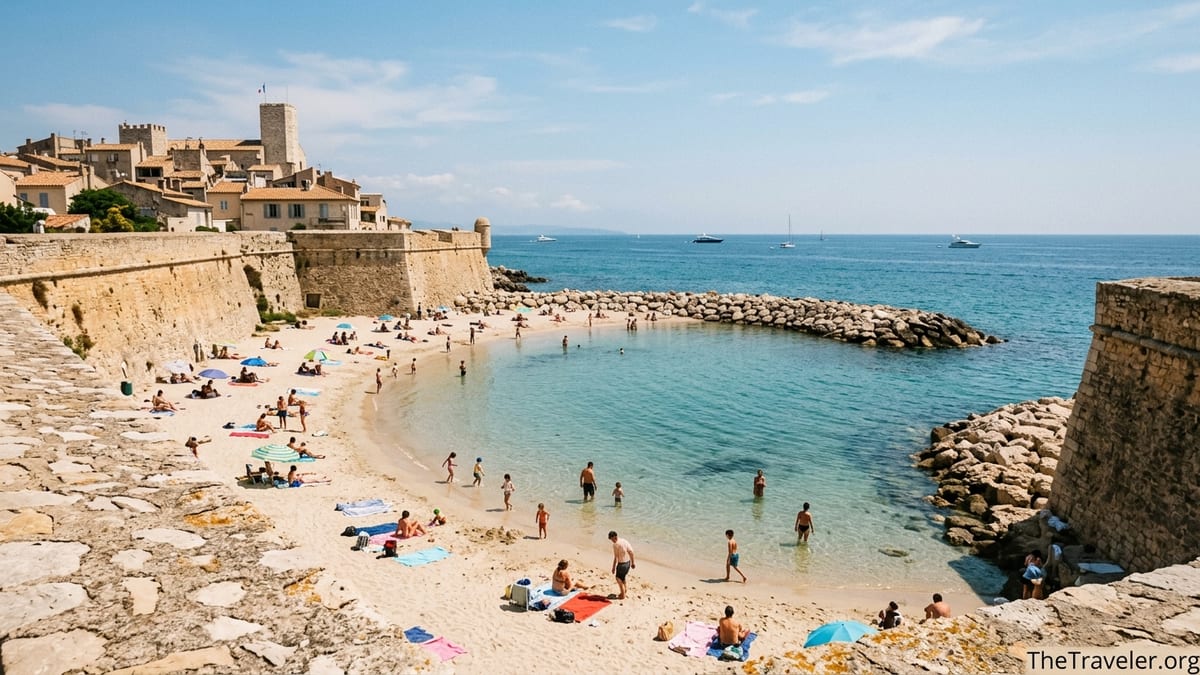
Standing on the sand at Plage de la Gravette for the first time, I was prepared for classic Riviera drama: wind-whipped waves, open horizons, superyachts cruising past. Instead, what struck me most was how sheltered it all felt. Hemmed in by stone ramparts and a curving breakwater, this little crescent of sand at the edge of Antibes felt less like a city beach and more like a hidden swimming hole locals had been keeping to themselves.
Get the latest updates straight to your inbox!
A Hidden Cove Beneath the Ramparts
If you simply follow the crowds out of Antibes’ old town, it is easy to underestimate just how tucked-away Plage de la Gravette really is. One moment you are threading through narrow lanes and market stalls, the next you slip through a gap in the medieval walls and the entire beach appears at your feet. From street level you barely see it. The ramparts act like a stone curtain, blocking road noise and funneling you down to a stretch of pale sand that feels almost enclosed.
Look up from your towel and the feeling of protection makes sense. Behind you rise the honey-colored fortifications of Vieil Antibes and the tower of the Picasso Museum. In front, a man-made crescent of rocks arcs out into the water, creating a semi-circle that almost completely seals the cove. Only a narrow opening faces the sea, just wide enough for the swell to breathe but not enough for serious surf to build. The result is a beach framed on three sides, with only the sky left wide open.
This geography is what surprised me most: you are technically on one of the most developed stretches of the Côte d’Azur, right between Port Vauban and the old town, yet the place feels shielded from the busier Riviera energy. Even on a busy July afternoon, you are more likely to hear children squealing in the shallows than the backing beeps of delivery trucks or the thrum of traffic.
Calm Water in a Region Known for Swell
The French Riviera is not short on beautiful beaches, but many of them are exposed. In neighboring Nice, for example, the long arc of the Baie des Anges faces open water, and even on calm days there is often a rolling swell that can knock less confident swimmers off their feet. At La Gravette the experience is radically different. The rocky breakwater that protects the cove flattens the waves, so the sea here is often closer to a lagoon than an oceanfront beach.
On a late June afternoon I watched a group of local kids play a game of catch in the water. They waded chest-deep almost all the way to the buoys, and the surface barely rippled around them. A couple visiting from Lyon told me they had chosen Antibes specifically because their five-year-old was nervous around waves; after she managed a full half hour paddling near the shore at La Gravette, they said they wished they had found the beach years earlier.
This does not mean it is a perfect swimming pool. There are scattered rocks in the shallows, and regulars will tell you it is worth packing cheap rubber-soled shoes from a local supermarket, especially for children. Lifeguards are usually on duty in peak season, from around mid June to mid September, and they keep a close eye on people drifting toward the breakwater. Still, compared with many Mediterranean beaches where even a small mistral can turn the sea feisty, La Gravette’s water often feels almost unnervingly calm.
A Sun Trap Protected From Wind
The sense of shelter at Plage de la Gravette is not only about the sea. The high ramparts behind the sand act as a windbreak, which transforms the beach on days when the rest of the Riviera feels blustery. In winter and early spring, locals talk about the beach as a kind of urban sun lounge. When a tramontane or mistral funnels down the coast, the breeze will whip along the seafront promenades, yet down on the sand at La Gravette you can often sit in a pocket of stillness.
I visited in March on a day when the forecast promised 59 degrees Fahrenheit with a stiff northerly wind. On the exposed path above the beach, people had zipped up jackets and wrapped scarves tight. But down on the sand, the story was different. A line of Antibois had claimed the stone ledge under the wall, shoes off, socks tucked into bags, faces tilted up to the sun. One woman in her seventies, reading a newspaper with her feet buried in the sand, told me she comes here to eat a baguette for lunch whenever the sun is out, even in January, because “the ramparts keep the cold away.”
In summer that same protection can make the cove feel a few degrees warmer than the open seafront. In the middle of the day, you will want decent sunscreen and perhaps a light shirt to throw on. The plus side is that evenings remain pleasantly mild for longer; even when the breeze picks up along the port, families linger on the sand at La Gravette until the municipal staff close the gates, typically around 8 pm in high season.
Urban Convenience Without the Usual Chaos
Another surprise is how orderly the beach feels, given its central location. La Gravette is a fully public beach. There are no rows of branded loungers, no roped-off sections run by beach clubs, and no waiters threading through the umbrellas. On much of the Riviera, especially around Cannes and Juan les Pins, it is normal to pay 20 to 40 euros per person for a sunbed at a private concession. At La Gravette you simply bring a towel, wedge yourself into a free patch of sand, and enjoy the same view as everyone else.
Facilities are basic but practical. A line of freshwater showers stands near the back of the beach, and public toilets are built into the rampart wall just outside the gate. In summer a snack van usually parks up near the entrance, selling ice creams, soft drinks, and the kind of fries and sandwiches that children instinctively gravitate toward. For something more local, it is an easy five minute stroll back to the covered Provençal market to pick up olives, goat cheese, and a paper cone of socca, the chickpea pancake that is a regional staple.
The sheltered feeling extends to logistics. For families, the distance from the road is a major plus. There are no cars cutting directly behind the sand, only the stone wall and the path above. Parents I spoke with appreciated that a runaway toddler would most likely end up with a face full of sand rather than dashing into traffic. Meanwhile, travelers without a car can walk to the beach from Antibes train station in about 15 to 20 minutes, or hop off a local bus at the port and reach the gate in under 10. It is that rare city beach that feels both central and cocooned.
A Gentle Introduction to the Riviera for Families
If you are visiting the Côte d’Azur with small children, the sheltered nature of Plage de la Gravette makes it one of the easiest landing spots. Many beaches along the coast either shelve quite steeply or combine waves with rolling pebbles that are hard on tiny feet. Here, the artificial sand is soft and the gradient into the water is gradual. Several parents I met had chosen accommodation in or near Antibes’ old town specifically to be within stroller distance of La Gravette.
One British couple staying near Place Nationale told me their daily routine revolved around the beach. Mornings were for the market: they would pick up fruit, a baguette, and some cheese for about 15 to 20 euros, let their toddler watch buskers in the square, then roll the stroller down through the gate and claim a spot near the waterline before the midday rush. Their daughter would alternate between paddling in the shallows and building sandcastles, and by early afternoon the whole family would head back for a nap.
Even older children benefit from the cove-like setting. The deeper water near the breakwater is still relatively calm, so confident swimmers can practice snorkeling around the rocks, watching small Mediterranean fish flicker between patches of seagrass. Because the space is compact and hemmed in, parents can usually keep an eye on kids without having to scan an endless horizon of umbrellas. The combination of enclosed geography, gentle water, and limited distractions makes it feel like a natural family corral by the sea.
Seasonal Quirks: When Shelter Has a Downside
That same protective layout, however, comes with trade-offs that are worth understanding. First is water quality. Because the cove is so enclosed and the opening between the breakwater arms is narrow, circulation can be limited during busy midsummer weeks. On still, hot days in late July or August, the water can sometimes feel a little less pristine than on more open beaches like Plage du Ponteil or Plage de la Salis farther along the coast. Locals often check municipal updates posted near the entrance or consult the day’s beach quality reports before planning a full swimming day.
Another quirk is crowding. La Gravette’s popularity, combined with its relatively compact size, means the sheltered vibe can shift to lively chaos by late morning in peak season. On a clear Saturday in early August, I watched every square meter of sand fill steadily from about 9:30 am onward. By 11 am it was towel-to-towel. Yet even at its busiest, the physical shelter of the walls and breakwater still shapes your experience: you feel like you are sharing a natural amphitheater rather than stretching along a long, impersonal strip of coast.
In winter, the city sometimes leaves driftwood and seaweed on the sand after strong storms, and the gates may stay closed on particularly rough days. For off-season travelers, that sheltered geography can therefore mean the beach swings between being the warmest, calmest spot in town and being temporarily off limits if conditions are severe enough. Planning a shoulder-season visit works best if you stay flexible and treat La Gravette as one of several nearby beach options rather than your only target.
Practical Tips to Make the Most of a Sheltered Beach Day
Experiencing the protected side of Plage de la Gravette is mostly about timing and small practical choices. In midsummer, arriving before 9 am gives you a good chance of claiming a spot close to the water, where children can dig and you can keep an easy eye on swimmers. Early morning also tends to offer the clearest water and softest light, before the sun climbs high above the ramparts and temperatures rise.
Footwear is one of the simplest upgrades. Even though the beach itself is sandy, the first few steps into the sea can be dotted with rounded stones. Lightweight reef shoes, which sell for the price of a couple of coffees in local sports stores, make it easier to wade confidently. A simple beach umbrella is useful too. While some patches near the wall get shade in late afternoon, the central section of the beach is exposed for much of the day, and rentals are not as common as on club-run beaches elsewhere.
Food-wise, take advantage of the old town’s proximity. Instead of relying entirely on the snack van, many travelers pause at the covered market on their way down. Picking up a paper bag of cherry tomatoes, a slice of pissaladière, or a tub of tapenade from local vendors costs significantly less than a restaurant lunch and feels more in tune with the laid-back, shared-sand atmosphere. Throw in a refillable water bottle and you are well equipped to linger through the warmest hours.
The Takeaway
What surprised me most about Plage de la Gravette was not its central location or its postcard setting beneath the old stone walls of Antibes, but how protected it feels in almost every way. The steep ramparts hush the city behind you. The rock breakwater calms the sea in front. The gate and distance from the road create a natural buffer that makes families relax. Even in the bustle of high season, the cove holds onto a sense of enclosure that sets it apart from more exposed Riviera beaches.
For travelers, that sheltered character has practical implications. It makes La Gravette ideal for nervous swimmers, young children, off-season sunseekers, and anyone who wants a simple, low-cost day by the water without the performance of a private beach club. At the same time, understanding the trade-offs of its enclosed geography, from occasional water-quality issues in peak heat to high-summer crowding, helps you plan your visit realistically.
If you are plotting a Riviera itinerary that balances romance with real life, it is worth penciling in at least a couple of unhurried hours here. Arrive on foot through the old town, let the ramparts close gently around you, and wade out into the quiet water. In a region famed for glitz and spectacle, the small, sheltered world of Plage de la Gravette feels like an unexpected kind of luxury.
FAQ
Q1. Where exactly is Plage de la Gravette in Antibes?
Plage de la Gravette sits directly beneath the old town ramparts of Antibes, between the Picasso Museum and Port Vauban, a short walk from the historic center.
Q2. Why does Plage de la Gravette feel more sheltered than other Riviera beaches?
The beach is enclosed on three sides by high stone ramparts and a curving rock breakwater, which block much of the wind, swell, and city noise, creating a protected cove.
Q3. Is the water at Plage de la Gravette calm enough for children?
Most days the water is very gentle thanks to the breakwater, and the seabed slopes gradually, which makes it popular with families and less confident swimmers.
Q4. Are there lifeguards on duty at Plage de la Gravette?
Lifeguards are typically present during the main summer season, generally from around mid June to mid September, though exact dates may vary slightly each year.
Q5. What facilities are available on the beach itself?
The beach has freshwater showers, basic public toilets just outside the gate, and in summer usually a small snack kiosk or van selling drinks and simple food.
Q6. Does Plage de la Gravette get very crowded in peak season?
Yes, in July and August it can fill up quickly, especially late morning and early afternoon, so arriving before 9 or 9:30 am helps secure a good spot on the sand.
Q7. How is the water quality at such a sheltered urban beach?
Water quality is generally good, but the enclosed shape means circulation can be limited in very hot, still weather, so locals often check daily municipal updates in midsummer.
Q8. Can I bring my own food and drinks to Plage de la Gravette?
Yes, it is a public beach, so picnics are common; many visitors stock up at the nearby covered Provençal market with fruit, bread, cheese, and local specialties.
Q9. Is the beach accessible without a car?
It is easy to reach on foot from Antibes train station in about 15 to 20 minutes, or via short walks from local bus stops near the port and the old town.
Q10. What should I bring to be comfortable on such a sheltered beach?
Lightweight reef shoes, sunscreen, plenty of water, and a small umbrella or shade tent are especially useful, since the protected cove can feel hotter and sunnier than expected.