


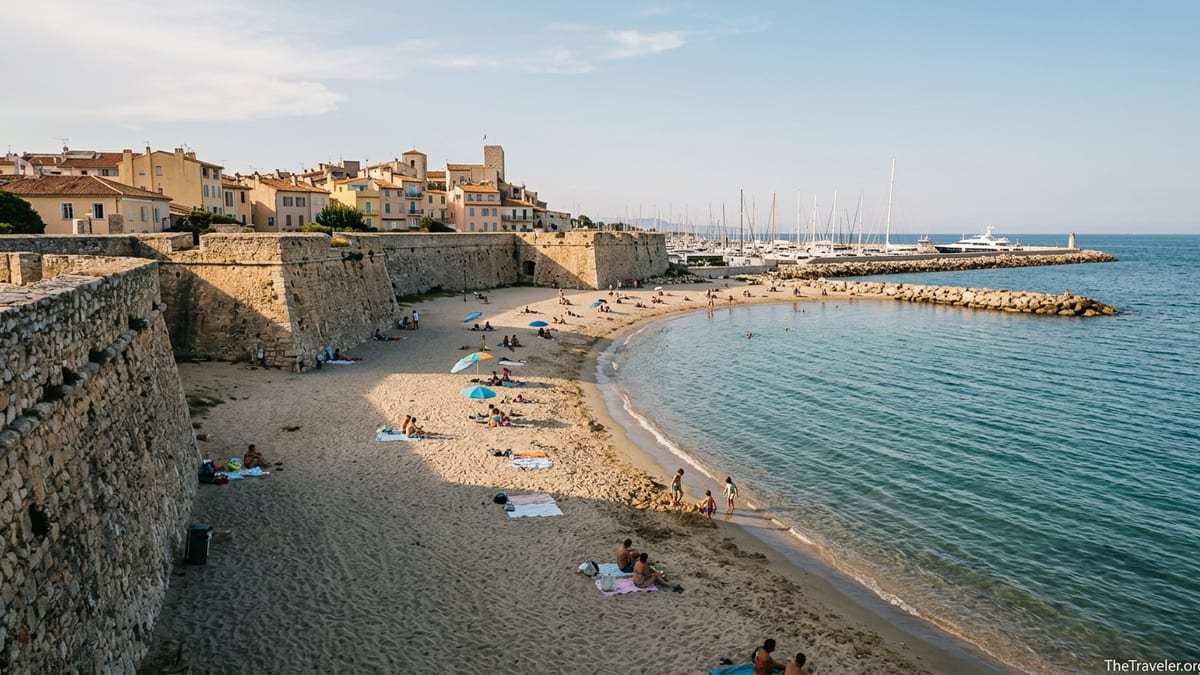
From the ramparts above, Plage de la Gravette looks like a simple city beach wedged between Old Antibes and the yachts of Port Vauban. Walk through the stone archway, though, and you discover how many small details most people miss. This compact cove is full of quiet vantage points, historical layers, and local rituals that only reveal themselves if you slow down and look more closely.
Get the latest updates straight to your inbox!
The Secret Geography of a “Hidden” City Beach
Plage de la Gravette is technically in plain sight, but its location makes it feel tucked away. To reach it, you leave the quay of Port Vauban at Quai Henri Rambaud and slip through a break in the medieval walls. Many travelers who stroll the harbor promenade never realize that just beyond the stone arch, a sandy horseshoe cove opens under the ramparts, shielded from the open sea and most of the wind.
Once on the beach, you notice how enclosed it feels. The high ramparts rise behind you, the curved breakwater closes the mouth of the cove, and the sea is usually calmer than on exposed stretches of the Riviera. That micro‑geography is not just scenic. It means the water tends to warm earlier in the season and stay swimmable later into autumn, so locals often sneak in a quick dip here in late May or early October while visitors are still assuming “beach season” has not begun.
There is also a subtle rhythm to the light that many first‑timers overlook. In early afternoon the sand can be bright and intense, but by late day the sun slides behind the tiled roofs of Old Antibes and the ramparts throw a long, cool shadow over the back of the beach. Regulars use this as a natural sundial. Families with small children often settle at the rear of the cove, knowing that from around 4.30 pm in June and July they will get shade without moving their towels.
Because Gravette is fully public and free to access year‑round, it draws a genuine cross‑section of Antibes life: office workers crossing from the old town for a 20‑minute swim on their lunch break, lycée students bringing take‑away paninis after class, and early‑morning swimmers finishing their laps just as the first cruise‑ship tenders arrive. That mix is part of its character, yet many visitors only experience the midday crush and never see how different the beach feels in the quiet shoulder hours.
How the Ramparts Shape Wind, Waves, and Viewpoints
Most people photograph the ramparts from the sand, with the old city stacked above the stones. The overlooked detail is how much those fortifications actually shape the experience of the beach. Built and reinforced between the 16th and 18th centuries to protect Antibes from naval attack, the walls now shield Gravette from the prevailing easterly and southeasterly winds. On days when waves are slamming the outer coast at Salis or Garoupe, the water here is often only gently ruffled, making it one of the most reliable options for a safe swim.
Walk up onto the rampart path and you discover a string of unmarked viewpoints that most beachgoers never climb up to see. From just above the stone arch that leads down to Gravette, you can look one way over the bright semicircle of sand and the other over the forest of masts in Port Vauban. On exceptionally clear days after a mistral, the jagged outline of the Alps sits behind the curve of the Baie des Anges. Locals often pause here in the evening, takeaway gelato in hand, while the beach below slowly empties.
The walls also create small acoustic pockets. If you walk to the right‑hand end of the sand and sit close to the stone, you will notice how the sounds of traffic and the marina fall away, replaced by a softer mix of waves and voices bouncing off the masonry. Couples sometimes bring a bottle of rosé and sit here at dusk, a few steps from the bustle of the old town yet wrapped in an oddly private echo chamber.
Another detail lies at the far left corner of the beach, where the ramparts meet the rocks of the breakwater. At low water, you can see the line where the sand gives way to stone and gravel, evidence of how the cove has been engineered and nourished over the years. It is not a wild beach. The city periodically redistributes sand after winter storms, which is why one season the slope to the water may feel shallow and toddler‑friendly, and the next year slightly steeper near the shoreline.
Water, Sand, and Safety: Quiet Clues Most People Miss
On the surface, Gravette looks like a simple sandy cove, but a closer look at the water and facilities reveals details that matter for safety and comfort. The cove is shallow with a gentle slope, and the rocky breakwater at its mouth limits currents. This is why lifeguard posts are installed here from roughly mid‑June to mid‑September in most recent years, while some more open stretches of coast remain unsupervised. During those months you will see yellow and red flags on the tower and a marked swimming zone inside the buoys.
Below the surface, though, the terrain changes faster than many visitors expect. About 15 to 20 meters out from the high‑season shoreline, patches of submerged rocks appear, especially toward the right‑hand side of the cove. Local swimmers know to either stay within the very shallow zone with children or to put on simple water shoes if they plan to wade around and look for fish. Every year, a few distracted tourists scrape a knee or stub a toe where the bottom suddenly hardens.
Another invisible detail concerns water quality. Gravette sits close to the old port and the mouth of a busy marina, and a decade ago you could sometimes see “bathing not advised” notices posted after heavy rain. In recent seasons, local authorities have invested in better monitoring and drainage, and water quality has improved. On summer days you may spot small signs near the entrance displaying that day’s rating and temperature. Many visitors walk straight past these panels; residents often glance at them before choosing where to swim.
The sand itself also hides a story. Underfoot it is a mix of fine imported sand and naturally occurring pale gravel. In early summer, you might notice lines of dried sea grass at the high‑tide mark. This is largely Posidonia, a protected seagrass that coastal managers are increasingly reluctant to remove entirely. Instead, they tend to clear narrow corridors for access and leave some of the washed‑up vegetation in place until just before the main July–August rush. The result is a beach that looks manicured but still bears subtle traces of the living ecosystem offshore.
Timing Gravette: When Locals Actually Use the Beach
First‑time visitors often arrive at Plage de la Gravette at the worst possible moment: between late morning and mid‑afternoon in July or August, when day‑trippers from Nice and Cannes spill off trains and cruise tenders. Towels overlap, the shallows are crowded with inflatables, and the charm can feel lost. Local patterns tell a different story, and paying attention to them is one of the most useful hidden details for planning a visit.
In high summer, residents favor two time slots. The first is sunrise to around 9.30 am, when the sand is almost empty apart from a few dedicated swimmers and people doing soft exercise near the waterline. The second is early evening, from about 6 pm onward, when the day’s heat eases, the rampart casts shade over parts of the beach, and families arrive with baguettes, tomatoes, and supermarket salads for a relaxed picnic. Prices in Antibes’ small supermarkets give a sense of how budget‑friendly this can be: a chilled bottle of local rosé often starts around 6 to 7 euros, and a bag of ripe peaches might be 3 to 4 euros in season, far cheaper than a restaurant terrace.
Outside the peak school‑holiday weeks, Gravette’s character changes again. In late September and early October, when the Mediterranean can still hover around the low twenties Celsius, you may share the beach mainly with retirees and office workers on flexible schedules. Umbrellas are fewer, conversations are mostly in French, and the beach feels more like a neighborhood park than a summer attraction. These shoulder‑season weeks are when you are most likely to witness small, unadvertised events, such as an early‑morning yoga class or a group of local swimmers organizing informal timed laps between the buoys.
Weather also plays a role. On days when the mistral clears the sky but whips up waves along exposed capes, Gravette becomes a refuge. It can be worth checking the wind forecast before choosing a beach in Antibes. If you see strong north‑westerlies or choppy conditions on more open bays, Gravette’s sheltered position under the walls often delivers calmer water and a more comfortable day, especially if you are traveling with children or anyone nervous in waves.
Subtle Historical Traces Around the Sand
Few people lying on the sand realize how much of Antibes’ history is compressed into the few hundred meters that surround Plage de la Gravette. The ramparts directly behind the beach once formed part of a defensive system that guarded the border of the Kingdom of France. If you walk up the stone steps from the beach entrance and follow the wall toward the old town, you pass a sequence of bastions that once held cannons pointing out to sea. Today they frame views of leisure yachts and distant cruise ships instead of galleys and merchant vessels.
Look carefully at the masonry above the beach entrance and you may notice stones of slightly different colors and textures. These mark successive restoration campaigns, from older pale blocks to newer, more uniform repairs in recent decades. For travelers interested in architecture, this patchwork is a visual record of how Antibes has balanced preserving its fortified silhouette with protecting the structures from salt, storms, and modern foot traffic.
Beyond the walls, the wider setting also adds context. A short walk from the beach entrance brings you into the tight lanes of Vieil Antibes, where you can still see house fronts that lean slightly toward each other above cobbled alleys. Many visitors head straight for the market and cafés, but a detour along the quieter streets leading back to the ramparts offers sudden framed views down to Gravette, with the sand glowing through narrow stone arches.
If you turn in the opposite direction and walk along Port Vauban, you come to viewpoints where you can see both Gravette and the more modern breakwaters that shield the marina. From here, the contrast between the medieval walls and the floating palaces in the harbor is striking. It is one of the few places on the Riviera where you can photograph superyachts and centuries‑old ramparts in the same wide shot, with the family‑friendly city beach sitting almost unnoticed at their junction.
Practical Micro‑Tips: Small Decisions that Transform Your Visit
Because Plage de la Gravette is compact and popular, tiny practical choices can make a big difference. One of the most overlooked details is where you spread your towel. The back half of the beach, closer to the wall, tends to offer firmer sand mixed with fine gravel, which is more comfortable for propping up a book or a beach bag. The front rows by the shoreline, while tempting for easy water access, are where incoming waves occasionally undercut the sand, leaving some towels damp when boat wakes roll in from the harbor mouth.
Facilities also hide in plain sight. Showers are usually set along the rear of the beach near the entrance, and public toilets sit just outside the walls to the left as you exit. Many visitors assume there are no proper amenities and cut their visit short, whereas in reality you can easily spend a full day here without needing to leave the area. Because there are no private beach clubs on Gravette, you will not find rows of rentable loungers, but that also means you are free from minimum‑spend pressures. A basic folding beach umbrella from a local supermarket may cost around 15 to 20 euros and will quickly pay for itself if you use it across several days.
Food is another area where local habits help. There is often a simple kiosk at the back of the sand selling cold drinks, ice creams, and snacks at fairly standard Riviera prices. However, most residents prefer to assemble their own picnics from nearby bakeries and the covered market, bringing down costs and improving quality. A still‑warm baguette, a small tub of tapenade, a wedge of local goat cheese, and a punnet of cherry tomatoes can comfortably feed two people for under 15 euros, less than the price of two basic salads on a busy seafront terrace.
Finally, think about what you bring for the specific conditions at Gravette. A lightweight mask and snorkel can be rewarding near the breakwater, where small fish hover above the rocks and the water clarity is often good. Simple jellyfish‑sting gel or vinegar wipes can be useful in midsummer when occasional blooms drift through the area, though the enclosed cove and regular monitoring usually mean stings are less frequent than on more open beaches. A thin beach mat under your towel will also make a noticeable difference where the sand grades into tiny pebbles.
The Takeaway
Plage de la Gravette is easy to treat as just another Riviera city beach: a quick swim, a few photos of the ramparts, and then back to the streets of Old Antibes. Yet the more time you spend here, the more its hidden details add up. The way the walls shape wind and shade, the micro‑topography of sand and submerged rock, the subtle water‑quality notices by the entrance, and the local rituals of early‑morning dips and twilight picnics all reveal a place that functions as Antibes’ informal seaside living room.
For travelers willing to tune into those small cues, Gravette becomes much more than a patch of sand. It is a lens on the city’s history, a practical refuge when the weather turns, and a rare free space in one of Europe’s most coveted stretches of coastline. Next time you pass under the stone arch from Port Vauban, pause for a moment. Look up at the ramparts, down at the sand, and out toward the Alps on the horizon. The beach in front of you is the same one everyone else sees, but how you read its details will change the experience entirely.
FAQ
Q1. Is Plage de la Gravette suitable for young children?
Yes, the cove is shallow with a gentle slope, usually calm water, and lifeguards on duty in the main summer months, which makes it popular with local families.
Q2. How crowded does the beach get in peak season?
In July and August, late mornings and afternoons can be very busy, with towels almost touching. Early mornings and evenings are much quieter and more relaxed.
Q3. Are there showers and toilets at Plage de la Gravette?
Yes, there are beach showers at the rear of the sand and public toilets just outside the walls near the entrance, so you can comfortably spend several hours there.
Q4. Can I rent sunbeds or umbrellas on the beach?
No, Gravette is a fully public beach with no private clubs, so there are no sunbed rentals. Visitors usually bring their own umbrellas or simple beach shelters.
Q5. Is there food available nearby or should I bring a picnic?
There is often a small kiosk selling snacks and drinks, and the cafés and market of Old Antibes are only a few minutes’ walk away. Many people still prefer to bring a picnic.
Q6. How close is Plage de la Gravette to the old town and Port Vauban?
The beach sits directly under the old town ramparts next to Port Vauban. It takes only a few minutes to walk from the harbor or the market to the sand.
Q7. What time of day is best for photography?
Early morning and late afternoon offer softer light and fewer crowds. After a clear day, sunset from the ramparts above the beach can be especially atmospheric.
Q8. Is the beach accessible outside the main summer season?
Yes, access is free and open all year. Outside July and August it is usually much quieter, and on calm, sunny days the water can remain pleasant well into autumn.
Q9. Are there any safety issues I should be aware of?
Within the cove, conditions are usually gentle, but there are some submerged rocks farther out, and occasional jellyfish in high summer. Check flags and notices by the entrance.
Q10. Can I combine a visit to Plage de la Gravette with other sights nearby?
Definitely. Many visitors pair a swim at Gravette with a walk along the ramparts, a visit to the old town lanes and market, or an evening stroll around Port Vauban.