


Ponte alla Carraia is not Florence’s most famous bridge, but it is one of its most rewarding. From here, the Arno curls toward the Ponte Vecchio, church towers rise above terracotta roofs, and the light at sunset can be spectacular. With a bit of advance planning around timing, access, safety and what to pair it with nearby, your visit to this quiet workhorse of a bridge can become one of the most memorable moments of your Florence trip.
Get the latest updates straight to your inbox!
Understand Where Ponte alla Carraia Fits in the City
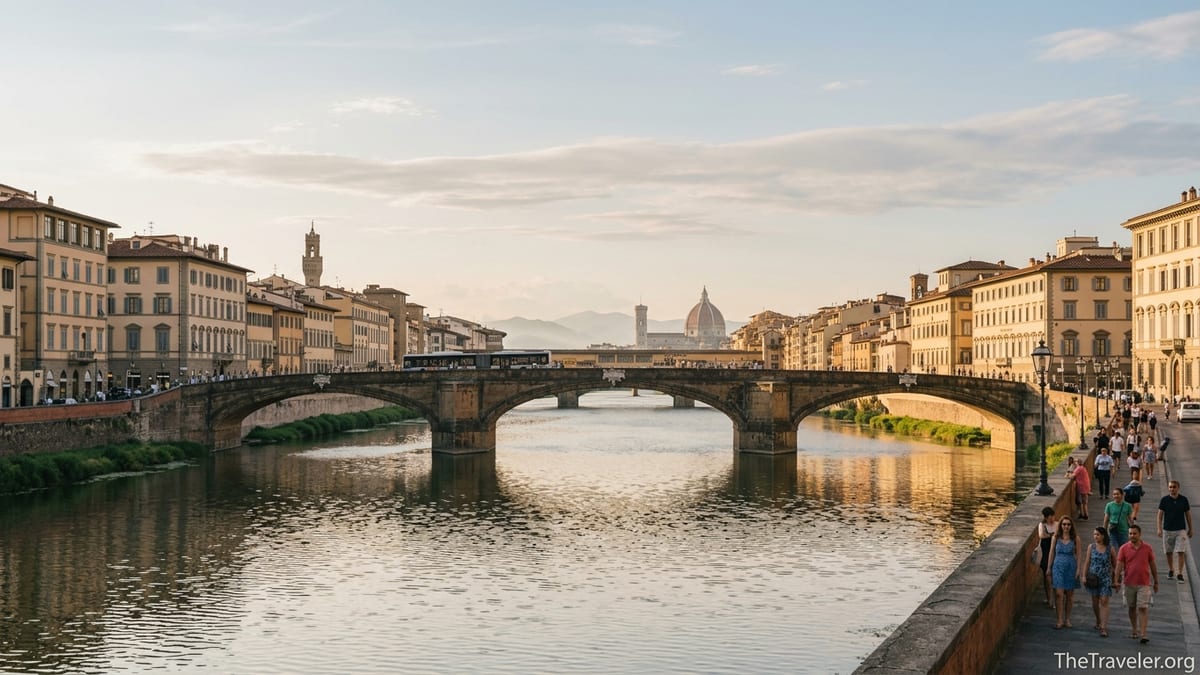
Ponte alla Carraia spans the Arno just west of Florence’s historic center, linking piazza Goldoni on the north bank with the Oltrarno side near Borgo San Frediano. It sits between Ponte Santa Trinita to the east and Ponte Amerigo Vespucci to the west, so you are only a few minutes’ walk from some of the city’s best riverfront views in either direction. The bridge itself is a simple five-arch structure, not ornate like Ponte Vecchio, but its position gives you a sweeping perspective back toward Florence’s skyline.
Before you arrive, it helps to look at a map and trace a walking route that uses the bridge as a scenic connector rather than an isolated destination. Many travelers walk south from Santa Maria Novella station to piazza Goldoni, cross Ponte alla Carraia, then continue into the Oltrarno toward Santa Maria del Carmine or the San Frediano neighborhood. Others do the reverse in the evening, starting from a dinner reservation in the Oltrarno and returning to the centro storicovia the bridge at dusk.
Knowing the context will also keep expectations realistic. This is still a working city bridge with cars and buses, not a pedestrian-only promenade. You come for the view along the river, not for architectural flourishes. Planning your visit as part of a longer riverside walk, perhaps linking it with Ponte Santa Trinita and Ponte Vecchio, makes the experience feel more coherent and less like a box to tick.
Choose the Best Time of Day for the View
The single most important decision you can make is when to visit. Light on the Arno is heavily directional, and Ponte alla Carraia faces east toward the curve of the river and the historic skyline. That makes sunrise and late afternoon into sunset the most rewarding times. Early in the morning, you can often find the bridge almost empty, with soft light catching the pale stone facades and calm water below. Travelers who stay in nearby Oltrarno guesthouses often report walking across around 6:30 in the morning and meeting only joggers and locals heading to work.
In the late afternoon, particularly from spring through early autumn, the sun drops behind you as you face the Ponte Vecchio, creating warm, side-lit facades and long reflections on the water. If your schedule allows, aim to be on the bridge about 30 to 45 minutes before official sunset. That gives you time to watch the changing color of the sky and still move on to a dinner reservation for around 8 pm, which is a typical start time at many local trattorie.
Midday is less flattering. The light is harsh, shadows are short, and the traffic is at its busiest. If your only free time falls at midday, you can still enjoy the walk, but you might plan to linger more on the shaded Lungarno promenades or in nearby piazzas rather than standing on the bridge itself for a long photo session. In winter, daylight hours are shorter, so consider visiting in mid-afternoon to avoid being caught on the bridge in the dark if you are still unfamiliar with the area.
Plan Your Transport and Approach Routes
Ponte alla Carraia is easy to reach on foot from most central Florence hotels, but it is worth planning your approach so you do not accidentally drive into the city’s restricted traffic zones. Florence’s ZTL system covers much of the historic center, with cameras on the main entry points and fines for unauthorized vehicles. If you are arriving by rental car, arrange secure parking outside the core, then walk or take a taxi to the river. Taxis are allowed in the ZTL and can drop you at nearby piazza Goldoni without issue.
If you are coming straight from Florence airport, the tram line T2 connects the terminal with Santa Maria Novella station in roughly 20 minutes, with tickets costing only a couple of euros for a 90 minute validity window. From the station, it is a level 10 to 15 minute walk along Via della Scala and then down to the river at piazza Goldoni. This is usually faster and cheaper than a taxi in rush hour, and it gives you a first look at the city at street level. Remember to validate any paper tram ticket at the machine on board or on the platform, and keep it with you in case of inspection.
Public buses also run along Lungarno Vespucci and through piazza Goldoni, but services and routes can be altered when there are roadworks on the waterfront. Closer to your trip dates, check current city notices or ask your hotel reception whether any work is affecting Lungarno Vespucci or nearby streets, and build in a little extra time. Many visitors find that simply walking is the least stressful option, especially in good weather. The streets from the Duomo, San Lorenzo and Santa Maria Novella areas are compact and well signposted.
Think About Safety, Traffic and Comfortable Viewing
Ponte alla Carraia is generally considered safe during the day and early evening, but it does carry regular traffic. The sidewalks are narrow in places, and buses and cars pass quite close. When planning your visit, assume you will need to be attentive to your footing and surroundings, especially if you are taking photos. Keep bags zipped and held in front of you, and avoid stepping off the pavement for a better angle when vehicles are approaching.
Families with young children should plan to hold hands while on the bridge and perhaps time their visit for quieter hours in the morning. For those with mobility concerns, the approaches on both sides are gently sloped, but the pavements can be uneven. If you use a cane or have limited mobility, it may be more comfortable to view the bridge and the river from the wider promenades on Lungarno Vespucci or Lungarno Soderini, then cross at a quieter moment.
At night, the bridge is lit but the surrounding streets can feel relatively quiet compared with Ponte Vecchio or piazza della Signoria. If you enjoy evening photography, plan to visit just after sunset rather than late at night, and walk back via well-lit main streets such as Borgo Ognissanti or Via dei Serragli. As in any popular European city, petty theft can occur. Before your trip, consider a crossbody bag that closes securely, and avoid setting cameras or phones on the parapet unattended while you adjust settings.
Pair the Bridge With Nearby Neighborhoods and Sights
You will get far more out of Ponte alla Carraia if you think of it as a gateway between two distinct areas rather than a standalone attraction. On the north bank, you are only a short walk from Santa Maria Novella church, with its inlaid marble facade and cloisters, and from the small streets around Via del Moro and Via della Vigna Nuova, which mix boutiques and cafes. Planning a coffee stop here before heading toward the bridge gives you a structured route and a natural pause.
On the south bank, a few minutes’ walk along Borgo San Frediano or Via de Serragli takes you into the Oltrarno, a district known for artisan workshops, small wine bars and more lived-in local streets. Many visitors like to cross Ponte alla Carraia in the late afternoon, wander toward piazza Santo Spirito for an aperitivo, then loop back over a different bridge after dinner. Booking a table at a neighborhood trattoria in San Frediano or Santo Spirito for around 8 pm is a practical way to fix your timing so that you reach the bridge just as the light is at its best.
If you are interested in art and architecture, you can fold the bridge into a longer day that includes Santa Maria Novella, the Brancacci Chapel at Santa Maria del Carmine, and perhaps the more famous Ponte Vecchio. This can be as simple as plotting a clockwise loop on a map: start at Santa Maria Novella, walk to piazza Goldoni, cross Ponte alla Carraia, continue to Santa Maria del Carmine, drift across to Santo Spirito, then return via Ponte Santa Trinita. Thinking in loops rather than backtracking reduces walking time and keeps the experience more relaxed.
Photography and Weather: Setting Expectations
Most people who seek out Ponte alla Carraia do so for its photographic potential. The classic view looks east along the Arno, with the Ponte Vecchio in the distance and rows of houses lining the riverbanks. To get the best results, plan ahead based on the season. In summer, a simple smartphone will capture rich colors in the warm evening light. In winter, skies can be overcast, and the palette shifts toward cooler tones. This can still make for atmospheric images, but you might adjust your expectations away from bright postcard shots toward more muted, almost monochrome scenes.
If you use a camera with interchangeable lenses, a moderate wide-angle in the range of 24 to 35 mm on a full-frame body is ideal for capturing both the river curve and the skyline without excessive distortion. Consider bringing a small microfiber cloth in case of light rain or mist on the lens. Handheld shooting is usually sufficient; setting up a tripod on the narrow sidewalk can be awkward and could obstruct walkers during busier times. If you want long-exposure shots of smooth water and light trails, visit early in the morning when the bridge is quieter and be ready to move quickly when others approach.
Weather on the Arno can change more quickly than many visitors expect. Florence does not experience frequent catastrophic flooding, but heavy rain upstream can raise the river level noticeably. Before your trip, keep an eye on the forecast for central Tuscany, and pack a compact umbrella or light waterproof jacket if rain is expected. Even in summer, evenings near the water can feel cooler than inland streets, so a light layer is useful if you plan to linger on the bridge or along the Lungarno after dark.
Practicalities: Food, Facilities and Comfort
The immediate area around Ponte alla Carraia is mostly residential and commercial, so you will not find cafes or public toilets directly on the bridge. Plan bathroom and snack breaks before or after your visit. North of the bridge, you can stop in a cafe along Borgo Ognissanti or around piazza Goldoni for an espresso or a pastry. South of the bridge, Borgo San Frediano and Via de Serragli have numerous small bars and bakeries where you can sit for an aperitivo or grab a slice of schiacciata to eat as you walk.
If you are traveling with children or anyone who tires easily, make sure your walking route to the bridge passes a park or square where you can rest. The small green spaces along Lungarno Vespucci and the benches in piazza Santo Spirito provide easy pauses. In the warmer months, consider carrying a reusable water bottle; many Italian cities, including Florence, have public drinking fountains where you can refill, although they are not always immediately obvious near the river itself.
Footwear is worth planning too. The pavements leading to the bridge and the bridge surface itself are a mix of stone and asphalt, sometimes with cracks and slight changes in level. Flat, closed shoes or supportive sandals are more comfortable than thin-soled fashion shoes for a full afternoon that includes the bridge, nearby churches and an evening stroll. If you plan to stay out for sunset, a light scarf or jacket is a practical addition even in summer, as temperatures drop quickly after the sun dips below the horizon.
The Takeaway
Visiting Ponte alla Carraia is less about checking off a famous monument and more about orchestrating a set of small choices that add up to a memorable moment along the Arno. When you plan your timing around the light, think through your route from the airport or train station, factor in Florence’s traffic restrictions if you are driving, and link the bridge with the characterful streets on both banks, the experience feels effortless rather than improvised.
For many travelers, the mental picture they carry home is not of the bridge itself, but of the view from its parapet: the river turning toward Ponte Vecchio, facades catching the last light, and the quiet sense of being just far enough from the crowds. With realistic expectations, a little logistical preparation, and sensitivity to the rhythms of the city, Ponte alla Carraia can become one of those rare places where Florence feels both iconic and personal at the same time.
FAQ
Q1. Is Ponte alla Carraia pedestrian friendly?
Yes, there are sidewalks on both sides of the bridge, but they are relatively narrow and shared with locals, so you need to stay aware of passing traffic and other pedestrians.
Q2. How long does it take to walk to Ponte alla Carraia from Santa Maria Novella station?
It usually takes about 10 to 15 minutes at a relaxed pace, following streets such as Via della Scala toward piazza Goldoni and then continuing straight to the bridge.
Q3. Is it worth visiting Ponte alla Carraia if I already plan to see Ponte Vecchio?
Yes. Ponte alla Carraia offers a wider, more open view of the river and the city skyline, with Ponte Vecchio framed in the distance, which you cannot see when you are standing on Ponte Vecchio itself.
Q4. What is the best time of day to photograph the view from Ponte alla Carraia?
Early morning around sunrise or late afternoon into sunset are usually best, when the light is softer and you are more likely to catch reflections and warmer tones along the Arno.
Q5. Can I reach Ponte alla Carraia directly from Florence airport?
Not directly, but the T2 tram from the airport takes you to Santa Maria Novella station in about 20 minutes, and from there you can walk to the bridge in another 10 to 15 minutes.
Q6. Are there good places to eat near Ponte alla Carraia?
Yes. On the Oltrarno side, streets like Borgo San Frediano and Via de Serragli have many trattorie and wine bars, while the north bank around Borgo Ognissanti offers cafes and pastry shops.
Q7. Is the area around Ponte alla Carraia safe at night?
It is generally considered safe, especially just after sunset, but it is quieter than the very center, so most visitors prefer to walk back along main, well-lit streets and keep valuables secure.
Q8. Does Ponte alla Carraia ever close to pedestrians because of high water or bad weather?
Temporary restrictions are rare and typically associated with severe weather or maintenance. In normal conditions, the bridge remains open to both vehicles and pedestrians year-round.
Q9. Can I use a tripod on Ponte alla Carraia for night photography?
You can, but the sidewalks are narrow and can become crowded, so if you bring a tripod it is best to use it briefly, at quieter times, and be ready to move to avoid blocking the way.
Q10. Is Ponte alla Carraia accessible for travelers with limited mobility?
The approaches are gently sloped and there are no stairs, but the pavements can be uneven. Most travelers with moderate mobility limitations manage the crossing, especially with support or a walking aid.