


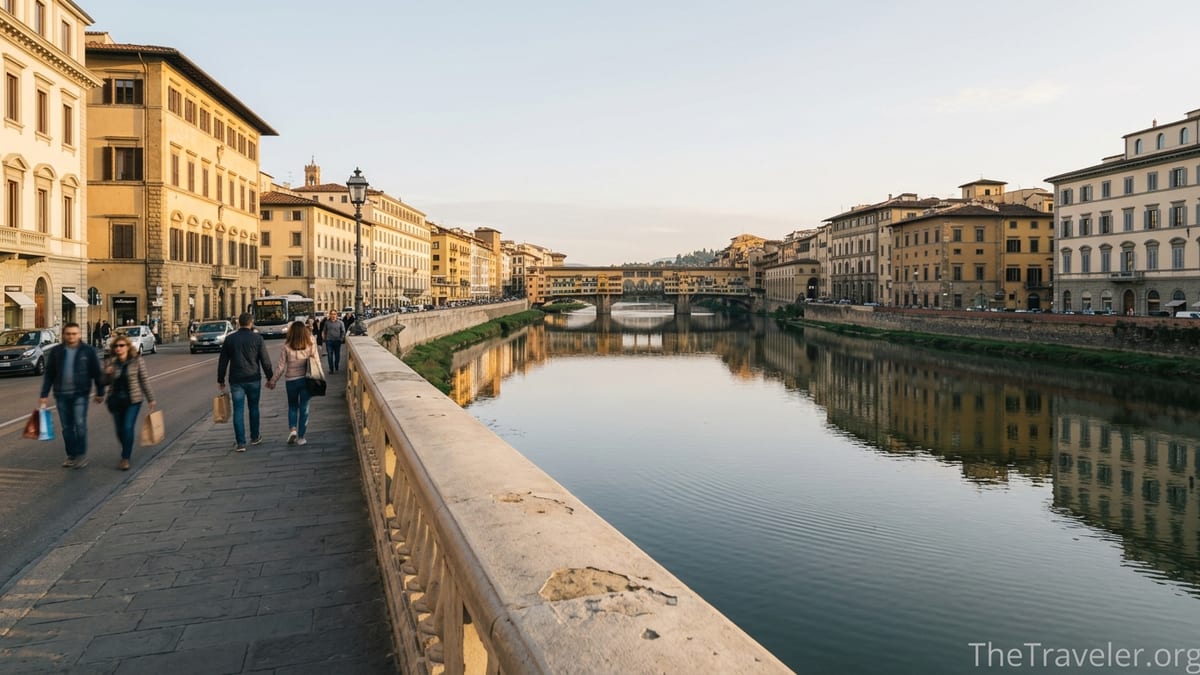
Like many visitors to Florence, I arrived convinced that the Arno River was essentially a stage set for one star: Ponte Vecchio. It took a slow, almost accidental walk across a quieter bridge, Ponte alla Carraia, to realize that the river is not just a backdrop but the thread that has stitched Florence together for centuries. From that span of stone, late in the afternoon with traffic humming at my back and light pouring down the water, the Arno finally came into focus as a living presence rather than a line on the map.
Get the latest updates straight to your inbox!
Meeting the Arno Somewhere Other Than Ponte Vecchio
Most first-time itineraries in Florence orbit the same cluster of icons: the Duomo, Piazza della Signoria, the Uffizi, and of course Ponte Vecchio. Stand in front of the jewellery shop windows on Ponte Vecchio at 5 p.m. in July and you are more likely to notice selfie sticks than water. The river lies hidden behind the shops, glimpsed through tight stone arches or from tiny viewing terraces jammed with people angling for a sunset shot. It is beautiful and atmospheric, but it is difficult to feel the river as anything more than a scenic prop.
Ponte alla Carraia quietly offers a different experience. A five-arched stone bridge downstream from Ponte Vecchio, it links Piazza Carlo Goldoni on the north bank to Piazza Nazario Sauro in the Oltrarno, about a 7 to 10 minute walk from Piazza Santa Maria Novella. Here the Arno suddenly opens up. You can see the curve of the river toward Ponte Vecchio in one direction and toward Ponte Amerigo Vespucci in the other, with long reflections of palazzi and church domes unfolding on the water.
The bridge is still part of daily Florentine life. City buses rumble over it, locals cut across with grocery bags or briefcases, and cyclists ride past toward San Frediano. When you pause in the middle, leaning on the stone parapet, you feel more like a participant in the city’s routine than a spectator fighting for space. That ordinariness is exactly what allows the Arno to step forward.
On my first walk across, I realized how little I had actually looked at the river before. From here, the wind had a faint scent of damp stone and algae. The water carried a subtle surface current, flecked by the wake of a passing rowing shell. The contrasted calm of Ponte alla Carraia made the Arno feel less like an Instagram frame and more like the core of Florence’s geography.
A Bridge Built for Work, Not Romance
Ponte alla Carraia’s character is rooted in its practical origins. The first bridge here, a wooden structure built in the early 13th century, was erected as the second crossing over the Arno after Ponte Vecchio. It was initially known as the “new bridge” and was meant to siphon off heavy traffic away from the older crossing. Its name, which refers to carts and wagons, reflects its role as an artery for commerce, particularly for wool, which helped fuel Florence’s medieval wealth.
That workhorse history helps explain why the bridge feels different from Florence’s more celebrated spans. There are no built-in chapels as on Ponte alle Grazie, no sculpted elegance like Ponte Santa Trinita. The current version of Ponte alla Carraia is a restrained, functional reconstruction in stone dating from the post-war period, after the retreating German army destroyed many Arno bridges in 1944. Its design respects the historical five-arch form but strips away decorative excess, keeping the focus on space and perspective rather than ornament.
For a traveler, that sobriety is liberating. When you step onto Ponte alla Carraia, you are not invited to worship the bridge itself; you are invited to look outward. The slightly lower profile and broad pedestrian sidewalks give you room to pause without feeling that you are blocking a photo line. You can stand there with a coffee from a nearby bar, let ten minutes stretch to thirty, and watch the river traffic: a lone kayaker training for a race, a renaiolo sand-digger’s flat-bottomed boat used for heritage tours, or a small maintenance craft heading toward one of the weirs.
Understanding that this was once the route of carts creaking under the weight of wool bales also reframed the Arno for me. The river had always been presented as a picturesque backdrop; here, it revealed itself as the original highway. Wool came in, finished cloth went out, and Florence’s golden age rose on that watery road. Standing on the Carraia, it suddenly made sense that the city feels like it faces inward: the real frontage was always toward the river.
How the Light Changes the Arno at Carraia
What ultimately changed how I saw the Arno was not a fact or a story but the way the light moved across the water during a single evening on Ponte alla Carraia. Around an hour before sunset in late spring, the western sky begins to soften. The facades along Lungarno Corsini and Lungarno degli Acciaiuoli upstream shift from stark cream to a gentle honey color. If you time your walk to about 7:30 p.m. in May or 8 p.m. in June, you reach the center of the bridge just as the first gold streaks slide down the river’s surface.
From here, Ponte Vecchio appears almost in silhouette, a compact mass of arcades and shops hugged by the banks. The water between the two bridges forms a long, shining corridor. On calm evenings, you can see detailed mirror images of houses, windows, and rooftop terraces. A breeze introduces just enough texture to warp those reflections into an abstract pattern of squares and streaks. It is less the famous postcard of Florence and more a living, breathing river city.
Different weather gives the Arno very different moods at Carraia. After rain, when the river runs high and muddy, the surface turns a bruised brown, surging over the low weirs downstream. In winter, pale afternoon light skims across it, flattening the colors into steely blues and grays. On hot August days, when the water level is lower, you can see exposed sandbars and the outlines of the Pescaia di Santa Rosa, a sort of mid-river island between Ponte Amerigo Vespucci and Ponte alla Carraia where locals gather on warm evenings.
Watching those shifts from the middle of Ponte alla Carraia, you start to read the Arno the way locals do: as a barometer of the season, of recent rains in the Apennines, of the rhythm of the city itself. The river that might look static in photographs turns out to be expressive, even moody, and the bridge becomes a front-row balcony for that daily performance.
Everyday Life Along the Banks
One of the clearest ways Ponte alla Carraia changed my perception of the Arno was by putting the river back into the context of everyday life. Just below the bridge on the Oltrarno side, a sloping embankment drops toward the water. On a warm June evening around 9 p.m., you might see groups of students sitting here with supermarket beers, couples sharing takeaway pizza from a nearby pizzeria along Via dei Serragli, or a family with children tossing pebbles near the river’s edge before bedtime.
Up on street level, the north bank near Piazza Carlo Goldoni is anchored by sober 19th century palazzi. A short walk toward the station brings you to typical neighborhood bars where an espresso at the counter costs roughly one to one and a half euros, and a glass of house wine at aperitivo time might be three to five euros. These prices are not dramatically different from elsewhere in the center, but the clientele shifts: more office workers with loosened ties, fewer day-trippers juggling guidebooks.
On the Oltrarno side, turning left after crossing from the north, you soon find yourself on Lungarno Soderini, a stretch of riverbank that feels definitively local after dark. Here in recent years, pop-up summer bars and small cultural events have appeared along the water, from outdoor film screenings to live jazz on temporary platforms. The river is not just something to photograph from a distance; it becomes a place to sit, listen, and linger. Walking back over Ponte alla Carraia later, you hear the echo of music off the water.
Seeing these scenes unfold made it harder to treat the Arno purely as an aesthetic object. The river is a venue, a meeting place, and occasionally a stage. In past seasons, floating platforms between Ponte alla Carraia and Ponte Vecchio have hosted contemporary art performances and fashion events, with spotlights flickering on the current. Even if you never attend such an occasion, knowing that the Arno serves this role deepens your sense of the city as something alive rather than preserved.
A Safer, More Complex River Than It First Appears
From Ponte alla Carraia, you are also reminded that the Arno is not only beautiful but powerful and occasionally dangerous. The parapet height, the visible weirs, and the flood warning markers discreetly positioned along the banks all speak to a long history of managing a temperamental river. Locals still reference the disastrous flood of 1966, when muddy water surged through the historic center, damaging churches, libraries, and shops. That event shaped Florence’s approach to the Arno for decades, prompting reinforcement of embankments, careful monitoring of water levels, and a deep cultural memory of the river’s force.
Looking east toward Ponte Vecchio from Carraia, you notice how narrow the floodplain really is. Renaissance and 19th century buildings rise almost directly from the embankments, their foundations close to the water. During heavy rain in the Apennines, the Arno can rise dramatically in Florence, turning the wide brown-green surface you see on a sunny day into a racing sheet of water. Even on tranquil evenings, metal ladders and secured gates along the banks hint at evacuation routes and maintenance access points for high-water events.
At the same time, modern Florence has been reclaiming the riverfront in subtle ways. Sections of embankment once dominated by traffic now have widened sidewalks, improved lighting, and occasional benches, particularly along the Oltrarno side between Ponte Vecchio and Ponte alla Carraia. In practice, this means that after your contemplative pause on the bridge, you can walk downriver along a safer, more welcoming promenade instead of hugging narrow curbs. The Arno feels less like something to be fenced off and more like a public space to be approached respectfully.
That duality is what makes the view from Ponte alla Carraia so compelling. The river is clearly tamed and engineered, with stone walls and carefully shaped banks, yet its volume and history defy complete control. Recognizing that tension helps explain why Florentines speak of the Arno with both affection and caution, and why the city’s relationship to the river has oscillated between reliance, fear, and renewed embrace.
Using Ponte alla Carraia to Rethink Your Florence Itinerary
Letting Ponte alla Carraia reshape your view of the Arno is not just a poetic idea; it can change how you structure time in Florence. Rather than treating the river as a backdrop you cross en route to museums, you can consciously build it into your day. For instance, one realistic plan is to start at Mercato Centrale for a late morning snack, wander the San Lorenzo streets, then drift down to Santa Maria Novella and follow Via dei Fossi to Piazza Carlo Goldoni. From there, stepping onto Ponte alla Carraia becomes a natural extension, not a detour.
After lingering on the bridge, you might continue into the Oltrarno, taking Via de’ Serragli to explore artisan workshops or heading toward Piazza Santo Spirito for an early aperitivo. Later, instead of climbing to the always-crowded Piazzale Michelangelo for sunset, you could return to Ponte alla Carraia or to the stretch of riverbank between it and Ponte Santa Trinita. The perspective from Carraia gives you a long, layered view of the river’s curve and the skyline without requiring a steep uphill walk or jostling for space on a terrace wall.
This approach also balances your day. Museum-heavy mornings in Florence can be intense, with dense crowds and visual overload in places like the Uffizi and the Accademia. Building in an unhurried half hour on the Arno, either at midday or during golden hour, gives your brain a pause and offers a different kind of encounter with the city. Water tends to reset perception. The quiet repetition of waves against stone and the slow procession of boats downstream help you process what you have seen and make space for noticing details you might otherwise miss.
From a practical standpoint, Ponte alla Carraia is easy to integrate because it sits near both key hotels around Santa Maria Novella and the nightlife of San Frediano. If you are staying anywhere within a 10 to 15 minute walk of the station, the bridge is within reach before breakfast or after dinner. This makes it an ideal anchor point for a more river-focused understanding of Florence, especially if you are in the city for several days and want to avoid repeating the same crowded viewpoints.
The Takeaway
Walking across Ponte alla Carraia turned the Arno from a postcard border into a central character. On that bridge, with the hum of traffic behind me and the long, reflective surface of the river ahead, Florence reorganized itself in my mind around the water. The Duomo, Palazzo Vecchio, the Oltrarno churches, and the modern apartment blocks further west all became supporting actors in a story driven by the river’s course.
For travelers, this shift of perspective matters. It encourages you to experience Florence not just through its landmark interiors but through the open air along the Arno, where the city’s past and present flow side by side. Ponte alla Carraia offers one of the most accessible ways to begin that reorientation: a short walk, a generous view, and enough space to stand still and pay attention.
If you give the Arno more than a passing glance, you come to understand why this relatively modest river has shaped politics, trade, and daily life in Florence for centuries. The realization might arrive during a quiet sunrise, a stormy afternoon, or a crowded summer evening as the sky turns orange. Whenever it happens, it is likely to happen somewhere like Ponte alla Carraia, where the river finally has room to speak.
FAQ
Q1. Where exactly is Ponte alla Carraia in Florence?
Ponte alla Carraia is a bridge over the Arno River that connects Piazza Carlo Goldoni on the north bank with Piazza Nazario Sauro in the Oltrarno district, a short walk southwest of Santa Maria Novella station.
Q2. Is Ponte alla Carraia a good place to watch the sunset?
Yes. About an hour before sunset, the bridge offers long views toward Ponte Vecchio and west toward Ponte Amerigo Vespucci, with warm light reflecting along the river and the facades on both banks.
Q3. How crowded does Ponte alla Carraia get compared with Ponte Vecchio?
Ponte alla Carraia usually has light to moderate foot traffic, mostly locals and commuters, making it far less crowded than Ponte Vecchio, which can be packed with visitors most of the day.
Q4. How do I reach Ponte alla Carraia from the historic center?
From Piazza del Duomo, you can walk roughly 15 to 20 minutes via Via dei Calzaiuoli, Piazza della Signoria, the Uffizi area, and then follow the lungarni west along the river, or come through Santa Maria Novella and Via dei Fossi to Piazza Carlo Goldoni.
Q5. Is the area around Ponte alla Carraia safe in the evening?
The streets and riverbanks around the bridge are generally busy with locals, traffic, and nearby restaurants, and most visitors find them comfortable after dark, though normal big-city precautions remain sensible.
Q6. Can I access the riverbank near Ponte alla Carraia?
Yes. On the Oltrarno side there are sloping embankments and walkways where people sit and stroll, especially in warmer months, and on both banks you can walk along the lungarni with frequent access points down to the water level.
Q7. Are there good places to eat or drink near Ponte alla Carraia?
Within a five to ten minute walk you will find neighborhood bars, gelaterie, and trattorias on both sides of the bridge, including casual spots in San Frediano and around Piazza Santo Spirito in the Oltrarno.
Q8. What time of day is best to photograph the Arno from Ponte alla Carraia?
Golden hour before sunset is ideal for warm colors and long reflections, while early morning offers softer light and quieter streets; both give clear views of Ponte Vecchio and the river’s curve.
Q9. Does public transport cross Ponte alla Carraia?
Yes. Several city bus routes use the bridge, and you will see regular traffic, but there are sidewalks on both sides wide enough for pedestrians to stop and enjoy the view safely.
Q10. How does Ponte alla Carraia compare with other Florence bridges for views?
Ponte alla Carraia provides one of the broadest perspectives on the central Arno, with downstream and upstream views, making it more about river panoramas, while bridges like Ponte Santa Trinita are better for close-up views of Ponte Vecchio itself.