


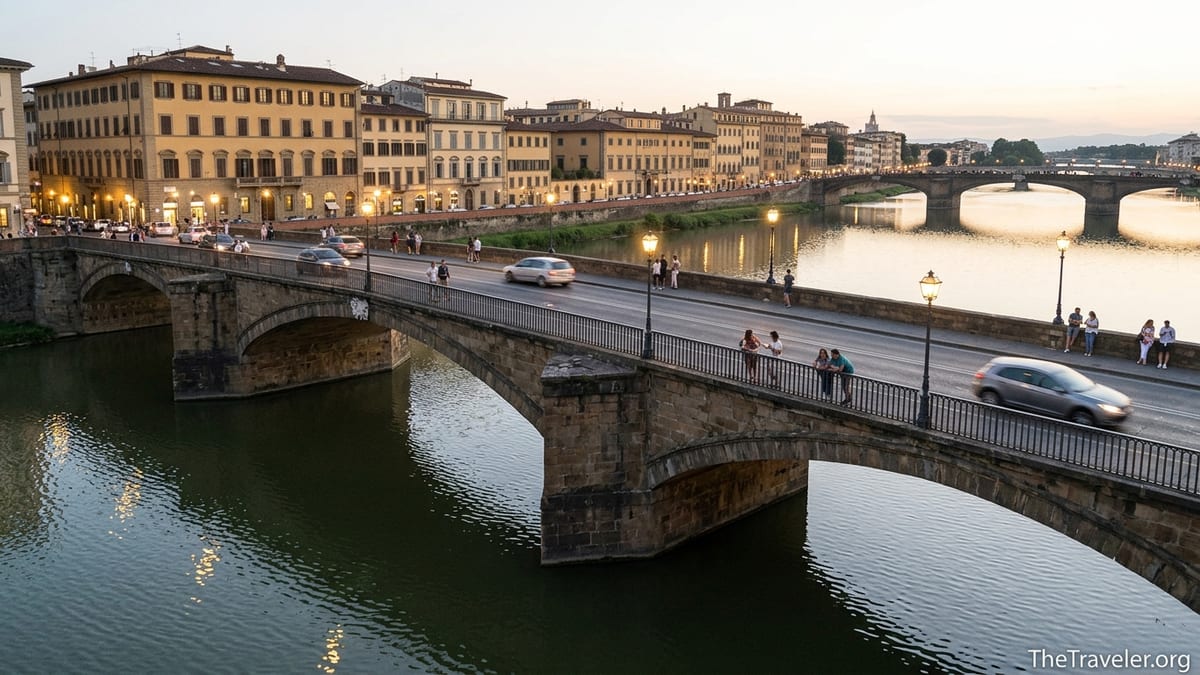
Ponte alla Carraia is one of Florence’s most atmospheric spots at sunset, a workaday bridge that has quietly become a favorite hangout for visitors carrying cones from nearby gelato institutions. Yet the very things that make this corner of the Oltrarno so charming can also catch travelers off guard, from traffic and river safety to crowds and late-night noise. Understanding the most common mistakes people make around Ponte alla Carraia will help you enjoy the views and flavors with fewer mishaps and more of the relaxed Florentine atmosphere you came for.
Get the latest updates straight to your inbox!
Forgetting That Ponte alla Carraia Is a Real Traffic Bridge
Many visitors arrive at Ponte alla Carraia expecting a pedestrian promenade similar to Ponte Vecchio. In reality, it is a five-arched road bridge that links the Oltrarno district with the historic center, carrying a steady stream of cars, buses, scooters and delivery vans throughout the day. The sidewalks are not especially wide, and there is no protective barrier beyond the low stone parapet. Treating it like a car-free viewpoint is one of the most frequent and potentially dangerous mistakes travelers make here.
In practice, this means that stopping suddenly in the middle of the narrow sidewalk to take photos, or fanning out as a group to admire the Arno, quickly forces other pedestrians into the gutter or up against traffic. Locals commuting home from work are often moving quickly, and cyclists ring their bells or swerve around distracted visitors. If you want to photograph the golden light on the river, step to one side, form a single line, and always be aware of people trying to pass behind you.
A safer approach is to use the low stone niches and slightly wider areas near the middle arches for brief photo stops, and then move on. Parents with strollers and anyone with reduced mobility should be especially cautious at rush hour, roughly from 8 to 9:30 in the morning and 5 to 7 in the evening, when traffic noise and fumes are at their worst. For a calmer atmosphere, come earlier in the morning or after the evening peak, when the bridge still feels lively but not hectic.
If you are walking with a gelato in hand, keep to the building side of the pavement when possible and avoid drifting toward the curb. It takes only one sudden step sideways to avoid a drip for you or someone else to collide with a cyclist or scooter. Remember that this is an everyday route for residents, not just a scenic overlook, and adjust your pace accordingly.
Underestimating River and Parapet Risks
The Arno looks serene at dusk, especially when the water reflects the warm lights of the riverside buildings and nearby bridges. That calm appearance can tempt visitors to perch on the outer edge of the parapet for a dramatic photo or to lean far over the wall while trying to capture the reflections. This is a serious mistake. The stone ledge is narrow, polished smooth by years of use, and often dusty. A small slip, unexpected shove from a passerby, or moment of dizziness can end in a dangerous fall.
Local authorities have repeatedly warned visitors not to sit on the outside edge of Florence’s bridges, and residents often react with alarm when they see people swinging their legs over the Arno. Even on the inner side of the parapet, it is wise to stay seated only long enough to finish a cone or brief conversation, and keep bags or backpacks off the ledge itself so they cannot roll or be knocked into the river. It is not uncommon to see sunglasses, cameras and phones vanish over the side after being left carelessly close to the drop.
The riverside embankments just below Ponte alla Carraia are another area where visitors sometimes misjudge risks. In good weather, especially between late spring and early autumn, people climb down to the lower quay that runs near the water. While it can be a pleasant place to sit, there are no railings, the stone can be slippery from algae or rain, and there is little lighting after dark. A better plan is to enjoy the view from the main street level or from one of the benches slightly back from the river, where you can observe the current and the weir to the west without putting yourself at risk.
If you are visiting during or after heavy rain, avoid going near the water level altogether. The Arno can rise quickly, and currents become stronger than they look from above. Shoes with good grip, particularly in winter months when mornings are damp, make a real difference on the smooth stone surfaces around the bridge. Treat the river with the same respect you would give a mountain trail or a busy road.
Turning Gelato Time into a Sticky, Crowded Hassle
One of the main reasons Ponte alla Carraia has become so popular is the presence of some of Florence’s most loved gelato shops just a few steps away. Gelateria La Carraia, on Piazza Nazario Sauro at the south end of the bridge, is frequently cited in local and international guides for its creamy, reasonably priced flavors and long opening hours. On a warm evening in high season, the line for a cone or cup can snake across the square, and many people immediately head onto the bridge to enjoy their gelato with a view.
The mistake visitors often make is assuming this ritual is effortless. Without a plan, you can easily end up trapped in a slow queue, then spill your gelato as you try to juggle a camera and cone in the middle of a moving crowd. Prices at reputable gelaterie near the bridge are typically posted clearly at the counter, with small cups or cones starting around a couple of euros and larger portions rising in sensible increments. If you see a place without visible prices, or where the tubs of gelato are piled high in artificial-looking, brightly colored mounds, it is usually better to keep walking and wait for a more authentic shop.
Before ordering, decide roughly what you want so you can move quickly when your turn comes. At La Carraia and similar spots, you will usually pay first at the cashier, then take your receipt to the counter to choose flavors. Have your cash or card ready, and remember that staff work faster if you simply say the size and number of flavors in straightforward terms. Afterwards, instead of stopping just outside the door, walk a little way toward the river and find a space along the wall or on the inner side of the parapet where you are not blocking the entrance or the pavement.
If crowds on the bridge feel overwhelming, consider crossing to the opposite bank and walking slightly east toward Ponte Santa Trinita or west toward Ponte Amerigo Vespucci. Both directions offer quieter spots to enjoy your gelato while still looking back at the bridge and the Oltrarno skyline. Visiting earlier in the afternoon or later in the evening, when tour groups are fewer, can transform the experience from a jostling queue into a relaxed neighborhood ritual.
Ignoring Local Etiquette and Noise in the Oltrarno
The streets around Ponte alla Carraia on the Oltrarno side are lined with residential buildings, small bars and restaurants, and long-established family businesses. In recent years, the area has drawn more visitors who are looking for a less touristy atmosphere than the streets directly around the Duomo or Ponte Vecchio. The downside is that gatherings on the bridge and nearby squares sometimes continue late into the night, creating tension with residents who need to sleep and work the next day.
One common mistake is treating the bridge as an open-air party venue after midnight, with portable speakers, shouting and drinking on the parapets. Florence has introduced various measures over the years to curb late-night noise and street drinking in sensitive areas, and although enforcement levels may vary, visitors should assume that loud behavior and open bottles on the bridge are unwelcome. If you want to continue the evening, move into an indoor bar or a venue specifically licensed for late hours, rather than lingering directly outside apartment windows.
Another point of etiquette concerns litter. Gelato cups, plastic spoons, napkins and water bottles can quickly accumulate on the parapet or along the riverbank when people leave them behind. Waste bins are scattered on both sides of the bridge and on Piazza Nazario Sauro, but in busy periods they may fill up. If you cannot find an empty bin, carry your rubbish with you until you do, rather than balancing it on top of an overflowing container where wind can easily blow it into the Arno.
Finally, remember that stairways, doorways and shopfront steps near the bridge are often the entrances to private homes or small businesses. Sitting across these to eat, smoke or scroll through your phone might seem harmless, but it can block residents from entering or leaving. Choosing a spot that is clearly part of the public space, such as a bench or the open parapet, is a simple way to show respect for the people who live and work here year-round.
Misreading the Area’s Layout and Missing Nearby Highlights
Because Ponte alla Carraia is overshadowed by the more instantly recognizable Ponte Vecchio, many visitors cross it almost by accident on their way between the station area and the Oltrarno. A frequent mistake is to treat the bridge as nothing more than a shortcut, without realizing how much there is to see within a five to ten minute walk in each direction. This not only means missing worthwhile sights, but also contributes to crowding at a handful of famous spots while quieter streets remain almost empty.
From the north side of the bridge, a short walk inland takes you toward Piazza Goldoni and the elegant streets leading up to the Santa Maria Novella area. From the south side, you can head into the heart of the Oltrarno, where artisan workshops, small churches and local cafes offer a very different feel from the areas most packed with tour groups. Planning a simple loop that includes Ponte alla Carraia, another bridge such as Ponte Santa Trinita, and a few side streets will give you a richer sense of the city.
Visitors often underestimate how easy it is to get turned around in Florence’s narrow streets, especially when looking for a specific riverside viewpoint. Offline maps or a printed city map help, but so does noticing landmarks: the dome of the Duomo to the northeast, the tall bell tower of Santa Maria Novella to the northwest, and the more modern lines of Ponte Amerigo Vespucci to the west. Using the river as your anchor, you can always reorient yourself by walking back to the Arno and checking which bridges you see.
When planning your time, resist the urge to tick off every famous bridge in a single rushed walk. Instead, allow at least an hour to wander slowly between Ponte Vecchio, Ponte Santa Trinita and Ponte alla Carraia, stopping for coffee, a pastry or a gelato along the way. This slower rhythm reduces the temptation to zigzag through traffic, run across the bridge when the light changes, or take unsafe shortcuts along the riverbanks simply to keep up with a tightly packed schedule.
Getting Caught by Weather, Light and Seasonal Crowds
Another common oversight around Ponte alla Carraia is failing to take into account how much the experience changes with light, weather and season. Many people arrive at the bridge in the early evening in late spring or summer, when the sun sets behind the city and casts a warm glow over the water. This is beautiful, but also one of the busiest times, especially between roughly 7 and 9 in the evening when both residents and visitors are out for a stroll or on their way to dinner.
In summer, the stone of the bridge and embankments can radiate heat even after sunset, making the area feel warmer than the forecast suggests. Light clothing, a small bottle of water and sunscreen for earlier in the afternoon make a difference, particularly if you plan to queue for gelato. In winter and early spring, by contrast, wind along the river can be surprisingly sharp, and temperatures drop quickly once the sun goes down. A scarf, gloves and a warm layer allow you to stay long enough to enjoy the dusk light without rushing away shivering.
Rain changes the equation again. The stone surfaces of the bridge become slick, puddles form along the curbs, and passing vehicles can splash water onto the sidewalk. Umbrellas block sightlines and can poke other pedestrians on the narrow walkways. When rain is forecast, consider a shorter visit to the bridge itself and more time in nearby indoor cafes or gelaterie. The reflections of wet cobblestones and the Arno in the drizzle can be atmospheric, but only if you have footwear with decent grip and are not distracted trying to keep expensive cameras dry without proper covers.
Crowds are also highly seasonal. Florence in July and August sees a far greater number of visitors than in January or February, and Ponte alla Carraia reflects this. If you are traveling in peak season and want a quieter experience, think about visiting the bridge around mid-morning, when day-trippers have not yet fully arrived, or later at night after the dinner rush. Outside of the high months, even a sunset visit can feel relatively peaceful, lending a more local, everyday character to the scene.
The Takeaway
Ponte alla Carraia rewards those who treat it as both a working part of Florence and a place of beauty. Approaching it with the awareness that it carries real traffic, borders a powerful river, and sits at the heart of a lived-in neighborhood will help you avoid the most common missteps. Take a moment to look up from your cone, respect the flow of people around you, and notice how the light changes on the water and the stone facades.
With a little planning and consideration, you can enjoy some of the city’s best gelato, take memorable photos of the Arno and neighboring bridges, and still leave space for residents to go about their evening. The bridge then becomes not just a backdrop for quick snapshots, but a place where you can feel Florence’s rhythms: commuters heading home, friends meeting on the corner, and visitors pausing to watch the sky turn from gold to deep blue over the river.
FAQ
Q1. Is Ponte alla Carraia pedestrian only?
Ponte alla Carraia is a mixed-use road bridge with sidewalks on both sides and regular vehicle traffic, so visitors should stay on the pavements and be alert.
Q2. Is it safe to sit on the parapet of Ponte alla Carraia?
Sitting briefly on the inner side of the parapet is common, but perching on the outer edge or leaning far over the wall is risky and strongly discouraged.
Q3. Are there good gelato shops near Ponte alla Carraia?
Yes, there are several well regarded gelaterie within a minute or two of the bridge on the Oltrarno side, known for quality, fairly priced artisan gelato.
Q4. How crowded does Ponte alla Carraia get at sunset?
In late spring and summer, sunset can be very busy with people buying gelato and taking photos, especially between early evening and around 9 pm.
Q5. Can I drink alcohol on the bridge in the evening?
Open street drinking and noisy gatherings late at night are often restricted or discouraged, and visitors are expected to keep noise and litter under control.
Q6. What is the best time of day to visit for photos?
Early morning offers softer light and fewer people, while early evening gives warm colors on the river but usually involves more crowds.
Q7. Are there benches or places to sit near the bridge?
There are some benches and low walls near the approaches to the bridge and along the riverside, but seating is limited during busy times.
Q8. Is the area around Ponte alla Carraia suitable for families with children?
Yes, but parents should keep children close, as the sidewalks are narrow, traffic passes nearby and the river is directly below the parapet.
Q9. How can I avoid tourist traps when buying gelato nearby?
Look for shops with clearly posted prices and modestly displayed gelato, and be wary of places with towering, brightly colored piles and no visible menu.
Q10. Is Ponte alla Carraia worth visiting if I have already seen Ponte Vecchio?
Yes, it offers a more everyday local feel and wide views of the Arno and other bridges, especially attractive at sunset and in the evening.