


Ponte alla Carraia rarely gets the headlines that Ponte Vecchio does, yet for many Florence lovers it is the bridge where the city finally slows down. With open river views, everyday Florentine life unfolding on both banks and far fewer tour groups, it is one of the best places to understand how the Arno shapes the city. This guide explains how to visit Ponte alla Carraia, where to walk, and the exact spots that reward photographers at sunrise, sunset and after dark.
Get the latest updates straight to your inbox!
Getting Your Bearings: Where Ponte alla Carraia Sits in Florence
Ponte alla Carraia spans the Arno just west of Florence’s historic core, connecting Piazza Goldoni on the north bank with the Oltrarno district on the south. It is the next bridge upstream from Ponte Amerigo Vespucci and one bridge downstream from the elegant Renaissance Ponte Santa Trinita. From the bridge itself you can look east towards the arches of Ponte Santa Trinita and Ponte Vecchio, and west towards the weir known as the Pescaia di Santa Rosa, where the Arno drops slightly and creates a stretch of calmer water and reflections.
The bridge carries both vehicles and pedestrians, but the sidewalks on each side are separated from the road by a low barrier, so walkers still feel relatively protected from traffic. Most visitors reach it on foot in about 8 to 10 minutes from Santa Maria Novella station by following Via della Scala to the river and cutting through Piazza Santa Maria Novella and Piazza Goldoni. If you are staying near the Duomo or Piazza della Signoria, it is roughly a 15-minute walk through the shopping streets around Via Tornabuoni and then down to the river.
Because Ponte alla Carraia sits at the edge of the densest tourist area, you notice an immediate shift in atmosphere. Tour groups thin out, buses are mostly local rather than sightseeing lines, and you are more likely to share the pavement with office workers, students from the nearby design schools and residents walking home with shopping bags. This mix makes it an ideal base for a slow river walk that still keeps all the major sights within easy reach.
Geographically, this section of the Arno is slightly wider and more open than the tight bend around Ponte Vecchio. That extra width is what gives Ponte alla Carraia such satisfying long perspectives: the domes and campaniles of Florence rise in the distance, framed by repeated arches of the bridges between you and the historic centre.
A Short History of the “Cart Bridge”
The name Ponte alla Carraia roughly translates as “bridge of the carts.” A wooden bridge was first built here in the early 13th century to divert heavy wagon traffic away from the older Ponte Vecchio, which at the time was already busy with shops and market stalls. Merchants hauling wool bales and other bulky goods used this new crossing, and the connection with carts stuck in the local memory. Over the centuries the bridge collapsed and was rebuilt several times after floods, particularly after the devastating Arno flood of 1333.
After that flood it was rebuilt in stone and became one of the city’s key western crossings. Renaissance chroniclers mention festive events staged on the bridge and the river below, including theatrical performances and floating shows during Medici celebrations. Later reconstructions tried to balance structural strength with the need to keep the arches low enough not to obstruct the river view from nearby palaces along the Lungarno.
Like almost every bridge in Florence except Ponte Vecchio, Ponte alla Carraia was destroyed by retreating German forces in 1944. The current five-arch structure dates from the late 1940s reconstruction, when engineers reused parts of the previous stonework but adapted the design to modern loads and traffic. The result is not as ornate as Ponte Santa Trinita, but its clean lines, pale stone and low arches fit quietly into the river landscape and, crucially for photographers, do not dominate the view.
Today, Ponte alla Carraia is part of everyday circulation more than a monument in itself. Public buses use it to cross between the station area and Oltrarno, cyclists commute over it at all hours, and locals tend to think of it in terms of nearby reference points such as Piazza Goldoni, Borgo Ognissanti and the southern streets Via dei Serragli and Via Sant’Agostino.
Best Viewpoints On and Around Ponte alla Carraia
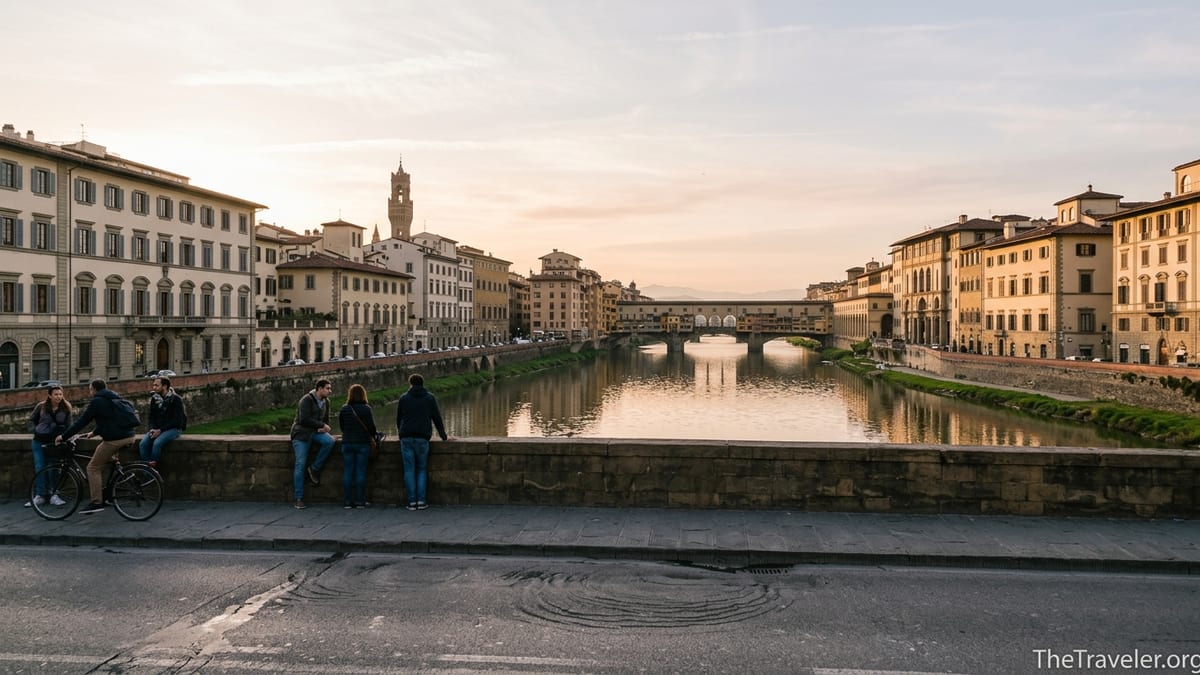
The first classic viewpoint is simply the east-facing side of Ponte alla Carraia itself. Stand on the upstream sidewalk near the centre of the bridge and you get a layered perspective: Ponte Santa Trinita in the foreground, Ponte Vecchio beyond that, and, if the light is right, the Duomo’s dome and Giotto’s bell tower rising behind the city roofs. In late afternoon, the sun moves behind you, lighting the river frontage and creating those warm golden tones on the stone facades along Lungarno Corsini and Lungarno Guicciardini.
Switch to the west-facing side of the bridge and the scene changes completely. Here the Arno widens toward the Pescaia di Santa Rosa, where a low weir interrupts the water and forms gentle cascades depending on the season. At sunset, the sky often opens up over this less-built-up part of the river, so you get soft color gradations reflected in the calmer water and in the windows of riverside buildings. Locals often pause here on their way home, leaning on the stone parapet for a few minutes to watch the light fade behind the Cascine park in the distance.
Another strong viewpoint is not on the bridge but beside it. From the north bank, stand on Lungarno Vespucci just upstream from Piazza Goldoni and frame Ponte alla Carraia from the side. This angle is especially good in the blue hour, when car lights streak across and the sodium lamps along the bridge cast warm reflections on the water. Conversely, from the south bank along Lungarno Soderini you can shoot back towards the bridge with the towers of the historic centre peeking above the line of buildings.
For visitors who want to compare viewpoints, it is easy to build a mini “bridge circuit.” Start on Ponte alla Carraia, walk east along Lungarno towards Ponte Santa Trinita, then continue to Ponte Vecchio. Each crossing gives a slightly different composition of river, skyline and hills. Many photographers find that the images they like best later are taken from Ponte alla Carraia and Ponte Santa Trinita rather than from Ponte Vecchio itself, because you actually see the famous bridge in the frame instead of standing on it.
Walking Routes That Start or Finish at Ponte alla Carraia
Ponte alla Carraia makes a natural starting point for exploring Oltrarno on foot. From the south end of the bridge, walk straight down Via dei Serragli, a long, mostly residential street lined with small workshops, interior design studios and neighborhood cafes. Within 10 minutes you can branch off towards Piazza Santo Spirito, one of Florence’s liveliest squares, surrounded by simple trattorias and wine bars that are much more local in feel than the venues right around Ponte Vecchio.
A popular self-guided loop begins on the north bank at Piazza Goldoni, crosses Ponte alla Carraia into Oltrarno, continues along Borgo San Frediano and Via Romana to reach Piazza Pitti, then returns to the centre via Ponte Vecchio and the Uffizi riverfront. Walked at a relaxed pace with short coffee stops, this loop takes around two to three hours. It offers a satisfying contrast between the workshop-filled backstreets of San Frediano and the high Renaissance formality of Palazzo Pitti and the Vasari Corridor.
Runners and walkers looking for a slightly longer route often extend west along the river from Ponte alla Carraia. From the north bank, you can follow Lungarno Vespucci towards the Cascine park, Florence’s largest green space, which begins near Piazza Vittorio Veneto. This flat riverside path is popular with locals out for an evening jog, especially in late spring and early autumn when the temperatures are milder. It is easy to turn back whenever you wish, which makes it a flexible choice if you are coping with jet lag and just want fresh air rather than a fixed sightseeing plan.
If you prefer to prioritize views of the historic centre, a different route heads east from Ponte alla Carraia along Lungarno Corsini to Ponte Santa Trinita, then crosses into the luxury-shopping street Via de’ Tornabuoni and eventually loops back down to the river. This combination of Lungarno views and high-end storefronts means you can mix architecture photography with window-shopping at Italian brands and historic Florentine artisans.
Photography Tips: Light, Angles and Realistic Expectations
For photographers, Ponte alla Carraia is less about a single postcard shot and more about a sequence of changing moods across the day. Sunrise can be excellent if you are looking east towards Ponte Vecchio. In the early morning, the river is often calmer, and you may capture mirror-like reflections of Santa Trinita and the buildings along the Lungarno. On summer mornings local runners and dog-walkers provide scale without overwhelming the frame.
Late afternoon and sunset are the most popular times. Standing on the west-facing side of the bridge, you watch as the sky above Cascine park picks up pastel pink and orange tones that then bounce onto the stone facades along the river. With a basic smartphone you can usually capture this scene well; if you are using a camera with interchangeable lenses, something in the 24 to 35 mm range on a full-frame body works nicely for wide views, while a 50 to 85 mm lens lets you compress the sequence of bridges together for more graphic compositions.
Blue hour, roughly 20 to 40 minutes after sunset, is particularly rewarding from Lungarno Vespucci facing Ponte alla Carraia. Here the streetlights and apartment windows glow while the sky still holds a deep cobalt tone. Long exposures of two to five seconds at a low ISO can produce clean, sharp images of light trails from cars crossing the bridge. A compact travel tripod or even a small tabletop tripod placed on the stone parapet makes a big difference to the final result.
Finally, remember that Ponte alla Carraia has more traffic than Ponte Vecchio, so you will not get empty-bridge shots in the middle of the day. Instead of fighting this, embrace the everyday movement in your images. People cycling to work, a bus crossing in the background, or friends leaning on the parapet with takeaway gelato all help convey the lived-in side of Florence that many visitors miss when they stick only to the postcard spots.
Everyday Food and Drink Stops Near the Bridge
One of the advantages of using Ponte alla Carraia as a base is the access to more local-oriented food options on both sides of the river. Just south of the bridge in the Oltrarno, the streets of San Frediano and Santo Spirito are dotted with small bakeries, wine bars and neighborhood trattorias. You are more likely to find daily specials written on chalkboards in Italian and short menus focused on seasonal dishes rather than laminated tourist menus in multiple languages.
On the north bank around Piazza Goldoni and Borgo Ognissanti, cafes cater to office workers from nearby law firms and agencies. Many offer affordable set lunches on weekdays, often including a pasta dish, main course and water for a price that is competitive compared with the narrower streets immediately around the Duomo. The vibe around here is functional and urban rather than scenic, but because you are only a minute or two from the bridge you can easily grab a quick espresso or sandwich and then return to the riverfront.
For an evening drink with a view, several rooftop terraces and hotel bars along the Arno east of Ponte alla Carraia offer direct river sightlines. These tend to be more expensive than ground-level wine bars in Oltrarno, but they can be worthwhile if you want a single, memorable aperitivo overlooking the water. If your budget is tight, a simple alternative is to buy a takeaway drink or gelato and stand on the bridge itself, observing the changing colors over the Arno without any service charge.
Numerous small alimentari and mini-markets within five minutes’ walk sell bottled water, fruit and snacks at prices generally lower than in the most touristy pockets around Piazza della Signoria. This makes it easy to assemble a simple picnic and carry it to a quieter spot along Lungarno Soderini or the small steps leading down to the riverbank near the Pescaia di Santa Rosa, always being mindful of any local signage about where sitting is or is not permitted.
Safety, Practicalities and When to Visit
Ponte alla Carraia is busy throughout the day with regular city life, so most travelers feel comfortable crossing it early in the morning and well into the evening. Standard city awareness still applies: keep your bag closed, avoid leaving cameras unattended on the parapet and watch for cyclists when stepping on and off the sidewalk. Traffic on the bridge itself is controlled but steady, including buses and taxis, so stay within the pedestrian areas rather than walking in the roadway for photos.
Weather strongly influences the experience. In high summer, midday on the bridge can be very hot because there is almost no shade. Plan your photography and longer walks for early morning or late afternoon, and use the hours around noon to explore indoor sights such as Santa Maria Novella or the artisan workshops of Oltrarno. In winter, fog sometimes hangs low over the river, especially early in the morning, giving Ponte alla Carraia a quiet, almost ghostly atmosphere. Light drizzle can add interesting reflections on the stone surface, but heavy rain will make the sidewalks slick, so use footwear with at least moderate grip.
If you are in Florence for only one full day, consider timing your first Arno walk so that you reach Ponte alla Carraia about an hour before sunset. This gives you enough time to explore both sides of the river, experiment with different vantage points and then watch the city lights emerge as the evening deepens. Visitors staying several days often find themselves returning again and again to this bridge, using it as a reference point or a calm pause between museums, churches and hilltop viewpoints like Piazzale Michelangelo.
There are no ticketed attractions or entry fees specifically attached to Ponte alla Carraia. The bridge is simply part of the city fabric, open 24 hours a day. Public toilets are not located on the bridge itself, but you will find facilities in nearby cafes and bars, and in train stations and some underground passages in the centre. As always in Italy, it is courteous to order something if you are using a private establishment’s restroom.
The Takeaway
Ponte alla Carraia is unlikely to appear on the front of a Florence postcard, yet it quietly delivers many of the experiences people come to the city seeking. From its low, understated arches you can see the sequence of bridges that define the Arno, with the famous profile of Ponte Vecchio framed at just the right distance. Everyday Florentine life plays out on both banks, and within a few blocks you can move from riverside views to neighborhood cafes, artisan workshops and tranquil side streets.
Using Ponte alla Carraia as an anchor point helps you slow down and read Florence at a more local pace. It breaks the pattern of moving only between headline monuments and encourages you to watch the light, feel the changes in rhythm from one neighborhood to the next and notice small details such as laundry lines on Oltrarno balconies or the reflections of church facades in the Arno. Whether you cross it once on a quick evening walk or build several walks and photo sessions around it, the bridge offers a grounded, authentic counterpoint to the city’s more theatrical viewpoints.
FAQ
Q1. Where exactly is Ponte alla Carraia in Florence?
The bridge links Piazza Goldoni on the north bank of the Arno with the Oltrarno district on the south, one bridge west of Ponte Santa Trinita.
Q2. Is Ponte alla Carraia a good place to watch sunset?
Yes, especially from the west-facing side of the bridge, where you look towards the Pescaia di Santa Rosa and the sky opening over the Cascine park area.
Q3. How crowded does Ponte alla Carraia get compared with Ponte Vecchio?
It is noticeably quieter. You share it mainly with locals, commuters and a few photographers, rather than dense tour groups and souvenir shoppers.
Q4. Can I walk from Ponte alla Carraia to Ponte Vecchio?
Yes. Walking along the north or south bank of the river, it takes roughly 10 to 15 minutes, passing Ponte Santa Trinita along the way.
Q5. Is the area around Ponte alla Carraia safe at night?
It is generally considered safe, with regular local foot traffic and vehicles, though you should use normal city awareness and stick to well-lit streets.
Q6. Are there good restaurants or bars near the bridge?
Yes. On the Oltrarno side, San Frediano and Santo Spirito offer many small trattorias and wine bars, while the north bank has practical cafes used by office workers.
Q7. What is the best time of day to photograph Ponte alla Carraia?
Sunrise and the hour before sunset are ideal for soft light and reflections, while blue hour after sunset works well for long exposures and city lights.
Q8. Does traffic on the bridge make it difficult to take photos?
Cars and buses do cross, but there are sidewalks on both sides. If you stay on the pedestrian section and watch for cyclists, photography is straightforward.
Q9. Can I use Ponte alla Carraia as a starting point for exploring Oltrarno?
Yes. From the south end, streets like Via dei Serragli and Borgo San Frediano lead you into some of Florence’s most characterful neighborhoods within minutes.
Q10. Is there any cost or ticket needed to visit Ponte alla Carraia?
No. Like all Florence bridges, it is a public thoroughfare that you can cross at any time of day without any fee or reservation.