


The 2027 Taiwan Lantern Festival will light up Miaoli County from February 20 to March 7, 2027, bringing sixteen nights of illuminated art, performances and night-time revelry to Taiwan’s northwestern coast. With exhibition areas centered around the Taiwan High Speed Rail (HSR) Miaoli Station district in Houlong and additional zones proposed in Zhunan and Toufen, it is a festival that rewards careful planning, especially because it coincides with the busy Lunar New Year period. This guide brings together current official announcements and the latest transport and accommodation information to help you build a realistic, on-the-ground plan for visiting.
Get the latest updates straight to your inbox!
Official dates, theme and exhibition areas
The Ministry of Transportation and Communications and the Taiwan Tourism Administration have confirmed that the 2027 Taiwan Lantern Festival is scheduled for February 20 to March 7, 2027, a sixteen day run that opens on Lantern Festival night itself. These dates appear in Miaoli County Government communications and in the national tourism calendar as the working exhibition period. Authorities still describe them as tentative for operational reasons, but all current planning, including the national lantern competition documentation, uses this window. Travellers can plan around these dates with reasonable confidence while allowing for minor adjustments to closing weekend programming.
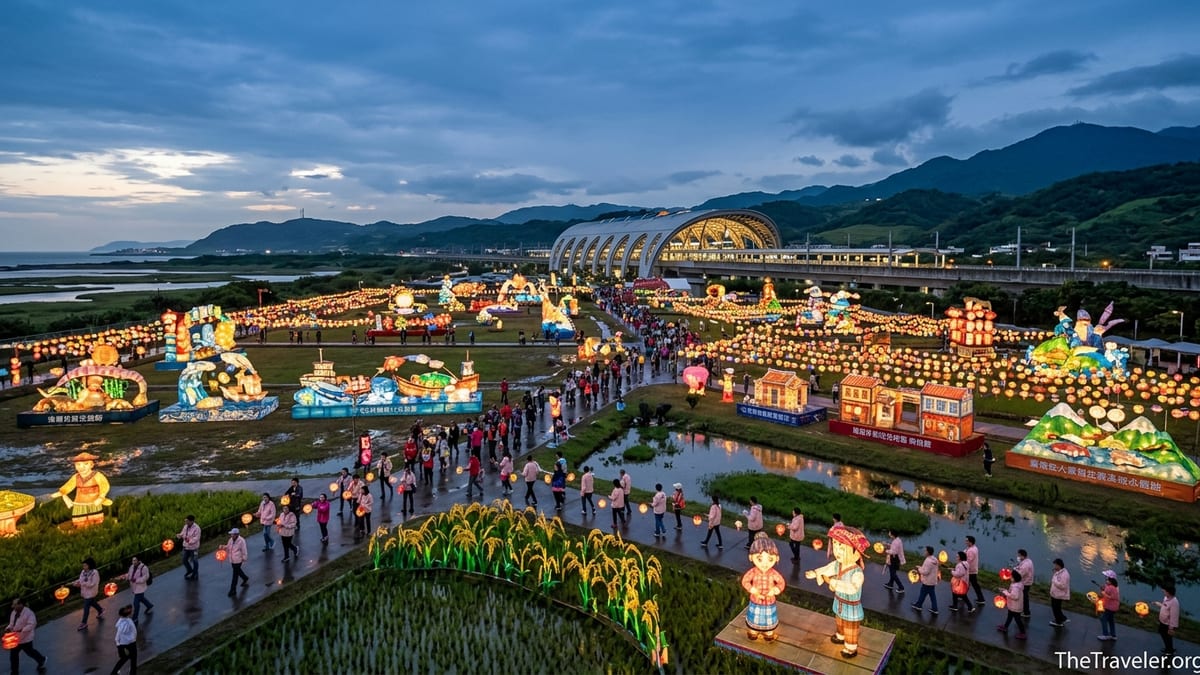
Miaoli County has announced the festival theme as “Between Mountains and Sea: Radiant Miaoli, a City of Slow Living,” a concept that highlights the county’s coastal wetlands, rice fields and fishing harbors alongside its Hakka towns and mountain villages. County announcements in 2026 refer to a structure of fourteen county-run lantern districts plus a dedicated national lantern competition zone and at least one main pavilion. This is a larger geographic footprint than early Taiwan Lantern Festivals but is consistent with recent multi-zone editions in Taichung, Tainan and Chiayi.
In more recent planning statements and tourism briefings, Miaoli has identified the principal national festival area as the district around Taiwan High Speed Rail Miaoli Station in Houlong. Maps used in working documents and in English-language tourism materials show the HSR station area as the anchor for major lantern fields, performance stages and main transport interchanges. Earlier ministry-level documents mentioning Zhunan and Toufen Sports Parks as candidate host venues have since been superseded as the county refined its layout, but Zhunan and Toufen remain under consideration for satellite or thematic zones connected by shuttles.
Because final detailed maps are usually published only a few months before opening, visitors should treat any reference to specific parks, streets or fields as provisional. What is confirmed is the overall structure: a core festival zone clustered around Miaoli HSR station in Houlong, county-level lantern areas distributed across Miaoli, and a national competition area integrated into the Miaoli plan. Satellite zones in Zhunan or Toufen look likely but await final sign-off and naming.
What is confirmed, what is still provisional
Based on official Miaoli County Government releases and the national lantern competition implementation plan circulated in late 2026, several elements are now clearly defined. The festival will run from February 20 to March 7, 2027, with an opening lighting ceremony and headline performances on the first weekend. There will be a nationwide lantern competition with categories for schools, communities and professionals, judged and exhibited inside the Miaoli festival area. The county will operate multiple themed exhibition zones, and the principal lantern displays and public areas are described as free to enter, in keeping with the long-standing practice of the Taiwan Lantern Festival.
Separately ticketed experiences are anticipated but not yet itemised. In recent host cities, these have included immersive multimedia domes, limited-capacity skywalks through lantern structures, or special-viewing stands for opening and closing shows, typically priced from about NT$150 to NT$500 per person. Miaoli has not confirmed specific paid experiences or exact prices for 2027, but officials have indicated that any ticketed elements will be clearly marked and will not affect access to the main outdoor lantern displays.
Some earlier central-government planning papers described main venues in Zhunan and Toufen Sports Parks. As Miaoli’s team has progressed, they have shifted emphasis toward the HSR Miaoli Station district in Houlong for the principal national area. Current Miaoli County and tourism bureau messaging treats Zhunan and Toufen more as supporting or local lantern zones, possibly themed around coastal ecology or Hakka culture. Until the final masterplan is released, travellers should understand that references to these towns indicate a wider regional festival footprint rather than multiple equally large “main sites.”
Programming details such as nightly performance schedules, international guest performers, and exact opening hours for each zone will be finalized closer to the festival. Looking at recent editions, main lantern zones have generally illuminated from around 5:30 p.m. to 10:30 or 11 p.m., with extended hours on Fridays and Saturdays. Miaoli officials have already stressed traffic and shuttle planning in county meetings, a sign that visitors can expect structured crowd control, road closures near the venues and official shuttle routes from rail stations and park-and-ride lots, even if exact street lists are not yet public.
Free admission, ceremonies and on-site experience
Consistent with previous Taiwan Lantern Festivals, entry to the outdoor lantern areas in Miaoli is expected to be free of charge. Miaoli County and the Tourism Administration describe the event as a national public festival, and budget documents show major funding from central grants, county resources and corporate sponsorship, rather than gate receipts. Visitors walking through the main lantern fields, competition displays and public squares around Miaoli HSR should not need to buy tickets, although they may encounter optional paid elements such as VR experiences, guided tours or curated seating areas.
The 2027 opening ceremony is expected on the night of Saturday February 20, 2027, with the traditional first lighting of the main lantern, speeches from national and county leaders, and a performance program. On opening night and during any specially advertised concert evenings, security screening, holding pens and timed entry may be used around the main stage. In past festivals this has meant controlled queues starting from mid-afternoon, wristbands or hand stamps for access, and occasional temporary closures when zones reach capacity. Miaoli officials have already highlighted crowd-management as a key planning task, so visitors should be prepared for similar arrangements.
Throughout the sixteen days, the festival will host scheduled stage shows, folk performances, and sometimes drone or laser shows. While the full 2027 roster is not yet published, travellers can reasonably expect a mix of Taiwanese pop acts, indigenous and Hakka performers, lion dances and children’s programs, especially on weekend evenings. If you hope to see specific acts, plan to check updated schedules in early 2027 and consider attending on Friday or Sunday nights rather than only the opening Saturday, when crowds will likely be densest.
On the ground, visitors can expect food streets selling snacks like Hakka mochi, oyster omelettes, grilled squid and bubble tea at prices broadly in line with major night markets. In recent large festivals, common items such as fried chicken cutlets or bowls of noodles have averaged around NT$70 to NT$120, with drinks around NT$40 to NT$70. These figures provide a realistic starting point to estimate your nightly food budget, though exact prices will depend on chosen vendors.
Getting to Miaoli: HSR, conventional rail and shuttles
The single most important logistical detail for 2027 is the distinction between Miaoli’s Taiwan High Speed Rail station and its conventional railway stations. Taiwan High Speed Rail Miaoli Station sits in Houlong Township on the western edge of the county and will anchor the principal lantern area. Conventional Taiwan Railways (TRA) services stop at Miaoli City, Zhunan, Toufen-adjacent stations and Houlong station itself, but the HSR and TRA stations are in different locations. In 2027, most visitors arriving for the national lantern site will aim for Miaoli HSR, not the downtown Miaoli TRA station.
From Taipei, HSR services to Miaoli typically take around 40 to 50 minutes depending on stopping pattern. As of late 2026 fares for reserved economy seats on comparable sectors are approximately NT$540 to NT$600 one way; actual 2027 fares may change slightly with annual adjustments. From Taichung, the HSR ride to Miaoli is around 15 to 20 minutes, at an indicative fare around NT$200 to NT$250. From Kaohsiung Zuoying, fast services to Miaoli usually take about 1 hour 40 minutes to just under 2 hours; current fares on that distance are roughly NT$1,200 one way in standard class.
TRA offers slower but often cheaper options. From Taipei to Miaoli City by conventional train, travel times vary from about 1 hour 20 minutes on limited express services to over 2 hours on all-stops trains, with typical one-way fares in the NT$170 to NT$280 range. However, because the main lantern areas are planned around Miaoli HSR in Houlong, travellers using TRA will likely need to transfer to festival shuttles or regular buses to reach the HSR district. Miaoli has flagged specific traffic and shuttle planning as a priority, and it is reasonable to expect clearly branded festival shuttle buses connecting key TRA stations such as Miaoli City, Zhunan or Houlong to the lantern zones.
Festival-specific traffic measures usually include partial road closures near major entrances, designated pick-up and drop-off zones for buses and taxis, and time-limited parking. Miaoli’s internal meetings about the lantern festival already mention securing large parking areas and prioritizing shuttle access. While the exact 2027 shuttle routes and frequencies are not yet published, recent festivals have run buses every 5 to 15 minutes from park-and-ride lots and major transport nodes during peak evening hours. Visitors planning to stay late for illuminations should check last-train times once the 2027 timetables are released and aim to leave the main site at least 45 to 60 minutes before their final HSR or TRA departure to account for shuttle waiting times.
Crowds, timing and where to stay
Because the 2027 Taiwan Lantern Festival overlaps with the post-Lunar New Year holiday period, crowding is a critical factor. Lantern Festival day itself on February 20, 2027 will draw substantial domestic tourism, and opening weekend is likely to be the busiest time overall. Additional spikes can be expected on the final weekend, on nights featuring headline concerts or drone shows, and on Saturdays when local families and bus tours converge. Experience from earlier editions suggests that crowd density is highest between about 7 p.m. and 9 p.m., easing somewhat after 9:30 p.m. on non-holiday weekdays.
For accommodation, travellers are balancing proximity against price and onward connections. In Miaoli County, mid-range business hotels in Miaoli City, Zhunan or Toufen commonly quote rates around NT$2,000 to NT$3,000 per night for a double room in late winter, with smaller guesthouses sometimes under NT$2,000 if booked early. During a national event like the Taiwan Lantern Festival, it is reasonable to anticipate rate increases and minimum-stay requirements, especially on Saturdays and around the opening weekend.
Taichung, about 20 minutes away by HSR, offers a much larger hotel stock. Recent winter rates for standard double rooms in international or good domestic chains near Taichung HSR or the city’s main shopping districts often range from about NT$1,800 to NT$3,500 per night, depending on brand and date. Taichung can be a strategic base for visitors who want daytime sightseeing options and relatively quick festival access, though returning on the last trains after evening shows will demand close attention to timetables.
Taipei provides the broadest accommodation range, from budget hostels under NT$1,000 per night for dorm beds to mid-range downtown hotels around NT$2,500 to NT$4,000 and higher-end properties beyond that. Using Taipei as a base makes sense for travellers combining the Miaoli festival with urban sightseeing, but travel time is longer and late-night returns more constrained. For example, if the final northbound HSR from Miaoli to Taipei on a given night departs around 10:30 or 11 p.m., visitors lingering near closing time risk needing taxis or regional trains to intermediate cities instead of direct fast services.
Sample budgets, rail fares and food costs
To frame a realistic budget, it is helpful to run through representative numbers using late-2026 transport and lodging prices as a guide. A visitor based in Taipei who does a single-evening round-trip to the Miaoli lantern festival by HSR might spend roughly NT$1,100 to NT$1,200 on transport for standard-class return tickets, NT$300 to NT$500 on food and drinks at the festival, and perhaps NT$200 to NT$400 on extras such as snacks, small souvenirs or a paid attraction. That places a single-evening outlay in the region of NT$1,600 to NT$2,100 before any hotel costs.
A two-day visit with one overnight stay in Miaoli County could involve NT$540 to NT$600 each way on the HSR from Taipei, NT$2,000 to NT$3,000 for a mid-range hotel in Miaoli City or Zhunan, and NT$600 to NT$1,000 for two evenings of festival food and a simple breakfast and lunch the next day. Factoring in some daytime sightseeing transport and entry fees, a realistic working budget might fall between NT$4,000 and NT$5,500 per person, depending on room sharing.
For visitors coming from Taichung, the cost profile is different. HSR from Taichung to Miaoli and back could cost in the order of NT$400 to NT$500 total, with local urban transport added on top. Staying in Taichung and doing a festival round-trip in one evening might therefore be around NT$1,000 to NT$1,500 including food, making Taichung an economical base for those who do not need to stay overnight in Miaoli itself.
Travellers from Kaohsiung Zuoying using HSR should anticipate transport as a major expense. With indicative one-way fares toward NT$1,200 in standard class, a return trip may approach or exceed NT$2,400. Spreading that cost over a two or three night stay, perhaps with one night in Miaoli and others exploring central Taiwan, will often provide better value than a single late-night dash in and out. Food and incidental spending at the festival are unlikely to dominate the budget compared with long-distance rail tickets and accommodation.
Suggested itineraries: one evening to three days
For a one-evening visit arriving by HSR, a practical itinerary from Taipei might look like this. Take a mid-afternoon HSR departure arriving at Miaoli around 4 p.m. Follow festival signage or staff directions from the HSR concourse to the lantern zone; if shuttle buses are running, they are likely to depart from clearly marked bays just outside the station. Spend the early twilight hour exploring quieter sections and the national lantern competition displays, then rotate toward the main lantern and central avenue by 7 p.m. to see coordinated light and music shows. Allow time for dinner at nearby food streets or designated food courts, then finish the evening photographing lantern reflections and smaller themed areas before returning to Miaoli HSR in time for a late-evening train back to Taipei.
A two-day plan can combine the lantern festival with regional attractions. On day one, travel to Miaoli in the late morning, check into a hotel in Miaoli City or Zhunan, and spend the afternoon visiting a nearby Hakka cultural site or old street, such as a historic commercial lane or temple area highlighted in Miaoli tourism brochures. In the late afternoon, head to the festival site for sunset and evening illuminations. On day two, use local buses, tours or rental cars to explore the county’s mountain or coastal destinations. Examples include a visit to a fishing harbor and wetland area along the coast, or a trip into the foothills to see tea plantations or river valleys. Return to your base city by HSR or TRA in the late afternoon or early evening.
An optional three-day itinerary allows deeper exploration. Day one follows the first evening festival plan. Day two might focus on Miaoli’s mountain villages, hiking trails or forest recreation areas in districts such as Nanzhuang or a nearby highland, returning early enough to enjoy a second, more relaxed festival evening concentrated on areas you missed the first night. Day three could be devoted to a slow-food or cultural circuit, visiting local markets, Hakka cuisine restaurants and rural attractions before returning to Taipei or Taichung. Such an itinerary spreads costs over multiple experiences and provides flexibility if one festival night is affected by rain.
In all cases, itinerary success depends heavily on last-train times and expected shuttle queues. Keeping a printed or screenshot copy of the day’s return HSR and TRA schedules is strongly recommended, as is arriving at the station at least 20 to 30 minutes before departure once you have cleared the festival zone.
Etiquette, accessibility and weather considerations
Visitors are generally free to photograph lanterns across the Taiwan Lantern Festival, and 2027 Miaoli should be no exception. Tripods are usually allowed in open spaces, but festival staff may restrict them in crowded aisles or near stages for safety. Drone photography is normally prohibited around main lantern areas for security reasons. Signs and announcements will indicate any zones where flash photography is discouraged, such as close to performances or interactive installations involving children.
Lantern etiquette emphasizes respect for the artworks and for other visitors’ experience. Touching or leaning on lantern structures is discouraged, and climbing onto bases or barriers is likely to draw swift staff intervention. When photographing, try not to block passageways for extended periods, and step back promptly after getting a shot at popular viewpoints. Waste bins are usually placed at frequent intervals; using them helps keep narrow aisles and viewing platforms clear.
Accessibility has been an increasing focus of recent lantern festivals, and Miaoli’s planning documents refer to barrier-free design in staging public events. In practice this should translate into step-free routes into major zones, ramps alongside staircases, and designated viewing areas for wheelchair users or visitors with mobility challenges. Temporary accessible toilets are typically installed, and many food areas use flat or gently sloped surfaces suitable for strollers. Families can expect baby-care rooms at nearby stations and in larger pavilions, though facilities may be limited in satellite zones.
Weather in late February and early March in Miaoli is usually cool and can be damp. Typical evening temperatures sit in the low to mid-teens Celsius, with occasional colder nights and a moderate chance of rain. Coastal wind can increase the chill factor near open fields. Visitors should bring light layers, a windproof outer jacket and, ideally, compact rain protection. Waterproof footwear or at least sturdy sneakers will make walking easier on wet grass or temporary walkways. Because much of the experience is outdoors, a folding umbrella or rain poncho is a worthwhile addition to your packing list.
Backup plans for rain, crowds and shuttle delays
Even the best-organized lantern festivals experience occasional bottlenecks, and 2027 in Miaoli will be no exception. If heavy rain coincides with your planned visit, consider postponing by a day or shifting focus to indoor or covered areas in the festival footprint, such as exhibition halls or transit concourses decorated with lantern art. Another option is to explore daytime attractions in Miaoli or Taichung and visit the festival only for a shorter window during breaks in the weather, rather than trying to endure many hours outdoors.
In the face of severe crowding, flexibility in timing can make a real difference. Arriving at the festival site shortly after opening, for example around 5:30 p.m., allows you to see lanterns at dusk before peak arrival times. Alternatively, if last-train times permit, entering after 8:30 p.m. on non-holiday weekdays often provides a more relaxed experience. Avoiding the opening and closing Saturdays in favor of mid-week evenings will generally yield thinner crowds, shorter food queues and easier photography.
Shuttle delays can arise when thousands of people leave simultaneously after nightly finales or fireworks. To reduce the risk of missing a return train, consider exiting the main stage area 15 to 20 minutes before the end of major shows, or walking to a slightly more distant shuttle stop if multiple routes exist. Where safe and practical, walking portions of the distance back toward the HSR station or a TRA stop may also be an option. In past festivals, taxi and ride-hail availability near the main exits has been limited at peak times, with surge pricing in larger cities; in Miaoli’s case, taxi numbers are lower than in Taipei or Taichung, so public shuttles and trains will be the backbone of most visitors’ departure plans.
If your return train is cancelled or you miscalculate and miss the last service, having a contingency list of nearby hotels in Miaoli City, Zhunan or Taichung can be invaluable. Rates for last-minute walk-in bookings during busy festival nights may be higher than advance prices, but in many cases small business hotels keep a few rooms for on-the-day guests. Keeping enough funds loaded on an EasyCard or equivalent and carrying a credit card accepted by major hotel chains can help you secure a room without stress.
Who should stay overnight and who can day-trip
First-time visitors to Taiwan who are already staying in Taipei often ask whether to treat the Miaoli Lantern Festival as a long evening trip or an overnight excursion. For those comfortable with late-night public transport and willing to anchor their schedule to HSR timetables, a carefully planned day-trip from Taipei is feasible, especially on weekdays without special performances. However, the margin for error narrows on opening weekend and on nights when crowd-control measures are strict, so more cautious travellers may appreciate an overnight stay in Miaoli County or Taichung.
Families with young children usually benefit from staying closer to the festival site, either in Miaoli City, Zhunan or Taichung. Shorter return journeys after a full evening minimize overtired children on packed trains and allow the flexibility to leave early if needed. A two-night stay can also hedge against bad weather on one of the evenings. Photographers, especially those wanting tripod shots late at night when crowds thin out, stand to gain from a local base that frees them from last-train cutoffs.
Budget-conscious travellers might choose Taichung as a compromise: hotels tend to be competitively priced, and the quick HSR hop to Miaoli keeps transport times manageable. Those prioritizing nightlife and urban sightseeing before or after their lantern visit may prefer to remain based in Taipei and accept the longer commute. Visitors coming from southern Taiwan will often find that spreading the cost of long-distance HSR over at least two days of activity provides better value than a single intense round-trip.
Ultimately, your decision should weigh travel time, your tolerance for crowds and schedule pressure, and your interest in exploring wider Miaoli County. With clear dates, a confirmed core venue around Miaoli HSR Station in Houlong, free access to the main lantern displays and improving rail links from across Taiwan, the 2027 Taiwan Lantern Festival in Miaoli is well positioned to reward those who plan ahead with memorable evenings between mountains and sea.