


Island Beach State Park in New Jersey looks blissfully simple at first glance: ten miles of wild Atlantic shoreline, rolling sand dunes, and a single main road. In reality, the park runs on a detailed set of access rules that govern when you can enter, where you can park, whether your dog is welcome, and even how you drive onto the sand to fish. Once you understand those rules, planning a visit becomes far easier and you can focus on what you actually came for: a quiet stretch of beach and the sound of waves.
Get the latest updates straight to your inbox!
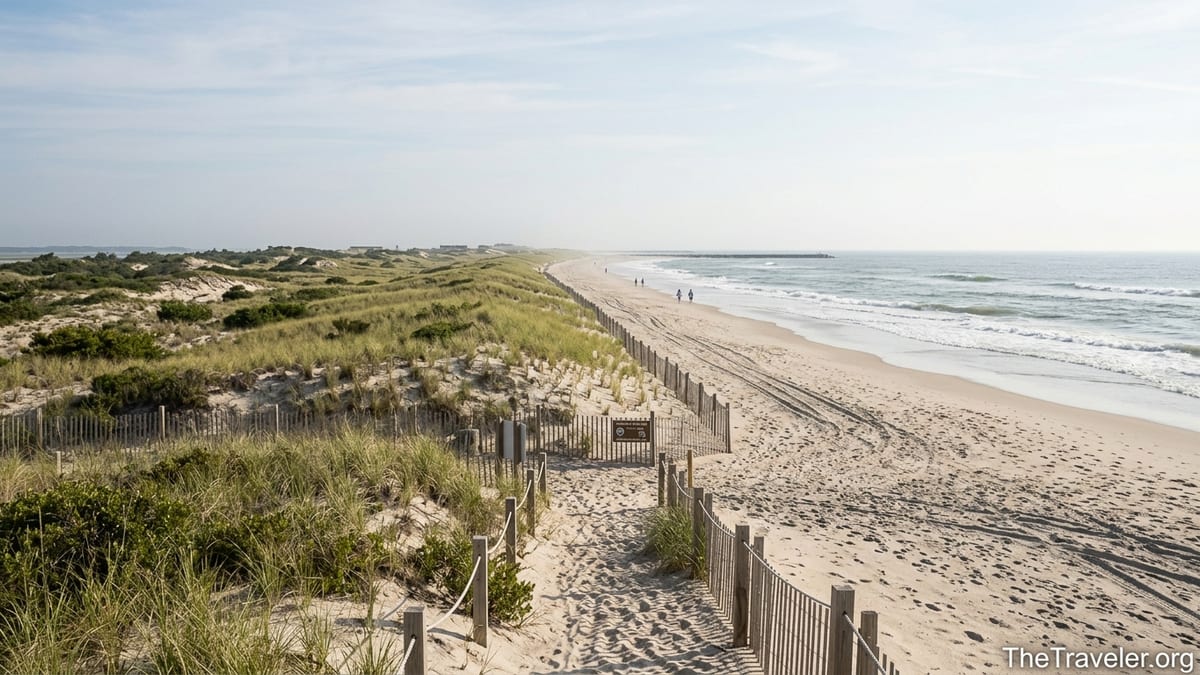
Why Access Rules Matter At Island Beach State Park
Island Beach State Park protects one of the last undeveloped stretches of barrier island left on the New Jersey shore. The same dunes and marshes that make the park feel remote are also fragile, so New Jersey’s Department of Environmental Protection uses access rules to keep cars, crowds, and wildlife in balance. Those rules are not just for anglers with four wheel drives. They affect every visitor, whether you are coming for a quick ocean swim, a full family beach day, or a shoulder season birding trip.
A common first time experience goes something like this: a family from North Jersey leaves home late on a sunny Saturday in July, hits traffic on the Garden State Parkway, reaches the park gate at 10:30 a.m., and finds it already closed at capacity. Meanwhile, a local angler with a mobile sport fishing vehicle permit has been on the sand since dawn, driving through a signed access road and parking above the high tide line with a cooler and surf rods. The rules have not given anyone special treatment; they have simply created different categories of access, and planning around those categories is the key to a smooth visit.
Understanding how entrance hours, vehicle permits, and activity restrictions fit together helps you choose the right arrival time, decide whether to bring bikes or dogs, and know which part of the park best matches your plans. With a bit of homework, you can avoid surprises at the gate or on the beach and enjoy the park the way regulars do.
Gate Hours, Daily Fees, And Capacity Closures
The park’s main gate typically opens at 8 a.m. and closes at 8 p.m., with hours occasionally adjusted during shoulder seasons or for weather and special conditions. You enter from Seaside Park at the north end, pay at the entrance booths, and then follow a single two lane road south with signed parking areas along the way. In peak summer, it is common for the park to stop admitting vehicles for several hours on busy weekend mornings once the parking lots fill.
Entrance fees are charged per vehicle during the main summer season from Memorial Day weekend through Labor Day. The New Jersey State Park Service lists separate rates for residents and nonresidents, with weekday fees noticeably lower than weekend and holiday rates. For example, a New Jersey resident driving in on a midweek July morning typically pays a modest single digit fee, while a nonresident arriving on a Sunday of a holiday weekend can expect to pay roughly double that amount. Outside the summer window, off season daily fees drop slightly but still follow the same resident and nonresident split.
Visitors who walk or bike into the park from Seaside Park bypass the vehicle queue and often enter more quickly on busy days. A couple staying in a Seaside Park rental, for instance, might lock their bikes in town and pedal in just after 8 a.m., avoiding the lines of cars stacked on Route 35. Ride share users should plan on paying the standard vehicle entrance fee at the gate in addition to the Uber or Lyft fare; the driver pays at the booth, drops passengers at a chosen parking area, and then turns around to exit.
Because capacity closures are a fact of life on peak days, it is worth using the New Jersey State Park communication tools, such as official text alerts and social media updates, which announce when Island Beach has closed or reopened to additional vehicles. If you are driving from an hour or more away in mid July, checking for an alert before leaving home can mean the difference between a laid back day at Area 7 and a frustrating turnaround in Seaside Heights.
Understanding Mobile Sport Fishing Vehicle Permits
One of the most distinctive access features at Island Beach State Park is the Mobile Sport Fishing Vehicle permit, often called the beach buggy permit. This permit allows a four wheel drive or all wheel drive passenger vehicle to drive onto designated sections of the beach for the sole purpose of surf fishing. The privilege is tightly regulated under state code and park rules, and it is not a general off road driving pass.
For 2026, the state offers several types of permits. Annual permits provide year round access, as conditions allow, and are priced at roughly the cost of a modest weekend getaway: just under two hundred dollars for New Jersey residents and somewhat more for nonresidents. Weekday only permits are less expensive and focus on access between Monday and Friday, with certain holidays excluded. For anglers planning a fall striped bass trip, three day permits are available in spring and late fall windows, giving visiting fishers from Pennsylvania or New York a practical option for a long weekend without committing to a full season pass.
The rules attached to these permits are non negotiable. Vehicles must be true four wheel drive or all wheel drive, with the ability to air down tires for sand driving. Every vehicle must carry equipment including a shovel, tow strap or chain, jack and support board, tire gauge, spare tire, flashlight, fire extinguisher, first aid kit, trash bags, and fishing gear for each person over age twelve. Rangers on the sand regularly check for permits and gear; an angler who forgets a jack support board or shows up with a two wheel drive crossover risks being turned around at the access road.
It is equally important to understand where you can drive. Access is limited to marked sport fishing access roads and defined stretches of open beach. Vehicles are prohibited on dunes and vegetation, and certain areas close temporarily for wildlife protection, such as when piping plovers nest. In practice, this means that on a spring morning you might drive on at a northern access, cruise slowly south with other anglers spaced along the tide line, and then encounter a sign and barrier closing a sensitive section, requiring you to turn and route around to a different access point.
Parking, Pedestrian Areas, And Getting Around The Park
Most day visitors experience Island Beach State Park entirely from the paved road and walk in access paths. After the gate, you will encounter a series of numbered parking lots on the ocean side and occasional pullouts on the bay side. The northern lots tend to fill first, as they are closer to the entrance and offer guarded swimming areas, snack bars, and restrooms during the main summer season. Farther south, smaller lots and unguarded beaches attract visitors seeking more solitude or focused activities such as fishing or birding.
A family planning to set up for a full day with umbrellas, coolers, and beach toys will generally be happiest in one of the mid range parking areas with lifeguards and restrooms, often Areas 6 or 7. From these lots, short boardwalks and sand paths lead to the ocean, while on the opposite side a bay access point might offer calm water for wading or launching a paddleboard. Serious surf anglers, meanwhile, often prefer the southern natural areas, where parking is more limited but the surf is less crowded and the dunes feel wilder.
Walking and biking are straightforward within the park but still subject to some practical constraints. The main road has a narrow shoulder, so families with younger riders may feel more comfortable biking only short stretches between adjacent parking areas rather than attempting the full ten mile length. During peak midday hours in July and August, the road corridor can be busy with cars searching for open spots, so pedestrians should stick to marked paths rather than walking along the asphalt itself.
Accessibility is an evolving priority. Island Beach offers a boardwalk style Fisherman’s Walkway at one of the main parking areas that provides wheelchair friendly access across the dunes to both the ocean and bay sides. Beach wheelchairs are available in season from the pavilion for visitors who want help traversing soft sand to the waterline. These options are particularly useful for multi generational groups, such as a grandparent with limited mobility joining a family beach day, or for anglers who need adaptive equipment to reach the surf line safely.
Swimming, Surfing, Fishing, And Other Activity Zones
Island Beach State Park divides its shoreline into zones for different uses, and the rules change with the seasons. During the main summer period, guarded swimming areas operate daily, typically from mid June through Labor Day, with lifeguards on duty from around 10 a.m. to 6 p.m. These sections of beach are clearly marked with flags and signs. Body surfing, casual boogie boarding, and wading are welcome within the flags, but certain equipment such as hard surfboards or casted fishing lines are usually prohibited when lifeguards are present to keep swimmers safe.
Surfing and sailboarding are directed to specific stretches, often toward the southern edge of the main bathing zones. On a July afternoon, for example, you might see families clustered near the lifeguard stands while a line of surfers waits farther down the beach where signs indicate boards are allowed. During the off season, when guards are not present, surfers can often roam more freely as long as they obey general park rules and respect any wildlife related closures.
Fishing is interwoven throughout the park’s identity. Anglers can walk in from any open access point with a rod and cooler, or drive on with a mobile sport fishing vehicle permit where allowed. State rules require anyone driving onto the sand to be actively engaged in fishing, not simply parked for a picnic or sunbathing session. It is common to see trucks lined along the water during fall striped bass migrations, each with rod holders, sand spikes, and bait coolers, while beachgoers with umbrellas cluster farther north in the more developed bathing areas.
Other niche activities, such as horseback riding, are tightly restricted to specific seasons and hours, often during winter when crowds are minimal and shorebird nesting is not an issue. Before planning something uncommon like a winter horseback ride or organizing a group event on the sand, visitors should review current state park guidance or apply for a special use permit through the park office to avoid last minute cancellations.
Pets, Prohibited Areas, And Common Missteps
Dogs are welcome in parts of Island Beach State Park, but not everywhere and not at all times. Pets must remain leashed and are generally prohibited from the designated swimming beaches during the guarded season. A local dog owner might happily walk her Labrador on a blustery March afternoon along a quiet stretch near the northern natural area, but that same dog would not be allowed to sit beside a family at the main lifeguarded beach on a Saturday in late July. The rules are designed to protect wildlife, reduce conflicts with other visitors, and keep crowded swim zones safe.
One of the most common missteps for new visitors is assuming that a permit for one activity covers another. A mobile sport fishing vehicle permit does not authorize camping, overnight beach parties, or recreational driving with no rods in sight. Likewise, a daily entrance receipt for your car does not allow you to drive onto the sand, even if your vehicle is four wheel drive. The state code and park signage make those distinctions clear, and rangers actively enforce them.
Camping is another frequent source of confusion. Despite the park’s wilderness feel, traditional campgrounds do not exist inside Island Beach State Park, and overnight stays in tents or parked cars on the beach are not permitted for general visitors. The only activity allowed overnight on the sand is active sport fishing under the conditions described by the mobile sport fishing vehicle program, and even then, certain areas may close overnight for wildlife management or safety reasons.
To avoid problems, visitors should pay close attention to signs at parking areas and trailheads, which spell out local restrictions on glass containers, fires, vehicles, and pets. On a practical level, that means leaving the charcoal grill at home in favor of cold picnic food, using cans or plastic bottles instead of glass, and planning bathroom breaks around available restrooms or portable facilities in designated areas.
Planning Around Seasons, Weather, And Special Restrictions
Island Beach State Park is open year round, and the rules you encounter can differ greatly between a peak summer weekend and a cold November weekday. In July and August, the primary constraints are crowd driven: early morning capacity closures, full parking lots near bathing beaches, and tighter enforcement of rules around swimming zones and pets. A family with school age children might choose to arrive at the gate before 8:30 a.m. and head straight for a mid park lot to secure a spot near restrooms and lifeguards before the midday rush.
In spring and fall, wildlife management becomes more prominent. Sections of dunes and beach may close temporarily to protect nesting shorebirds like piping plovers and least terns. These closures are not arbitrary; they are driven by federal and state conservation requirements and adjust as conditions change. A surf angler who has been using a particular cut in the sand all spring, for example, might find that access road closed in late May when nesting begins, and must shift to a different access point farther south.
Winter brings its own rhythm. With cold water and short days, crowds thin out, lifeguards leave, and entrance operations sometimes scale back, though the gate and road generally remain open during daylight hours except in severe storms. This is when hardy locals walk dogs along empty beaches, photographers capture dramatic storm light, and a handful of anglers chase migrating striped bass. Access rules still apply, but enforcement focuses more on safety, such as closing the park during nor’easters or high wind events when driving conditions become hazardous.
No matter the season, weather can quickly change conditions on the sand. Heavy surf and strong winds reshape the dune line and can narrow drivable stretches for mobile sport fishing vehicles. The park occasionally warns permit holders about soft sand or eroded beaches in certain sections, advising extra caution or temporary closures. Visitors without permits may see these advisories posted at the entrance station or on information boards, which is useful context even if you are only walking to the waterline.
The Takeaway
Planning a visit to Island Beach State Park becomes far easier once you understand how its access rules work in practice. The gate hours and daily vehicle fees determine when and how you enter. Parking patterns and capacity closures shape which part of the beach you are likely to use. Activity zones separate guarded swimming from surfing and fishing, while special programs like mobile sport fishing vehicle permits add another layer of access for specific users.
Instead of treating the rules as obstacles, think of them as a practical checklist. Decide your priorities first: a guarded swim with kids, a quiet dog walk, or a dawn surf casting session. Then match those goals to the appropriate season, time of day, and part of the park, and check the latest state guidance for any temporary closures or adjustments. With expectations set and a flexible backup plan in mind, Island Beach’s regulations fade into the background and the park becomes what it is meant to be: a rare stretch of wild New Jersey coastline you can return to in every season.
FAQ
Q1. What are the typical gate hours at Island Beach State Park?
The main entrance generally opens at 8 a.m. and closes at 8 p.m., though hours can shift slightly in shoulder seasons or for weather and special events.
Q2. How much does it cost to enter Island Beach State Park by car?
From Memorial Day weekend through Labor Day, daily entrance is charged per vehicle, with lower weekday rates and higher weekend and holiday rates, and separate pricing for residents and nonresidents.
Q3. Do I need a special permit to drive my vehicle onto the beach?
Yes. Only four wheel drive or all wheel drive vehicles with a valid Mobile Sport Fishing Vehicle permit and required safety equipment may drive onto designated beach sections for surf fishing.
Q4. Can I camp or sleep overnight on the beach inside the park?
No. Traditional camping is not available inside Island Beach State Park, and overnight stays in tents or parked vehicles on the sand are not permitted for general visitors.
Q5. Are dogs allowed on the beach at Island Beach State Park?
Dogs are generally allowed on certain non bathing beaches when leashed, but they are not permitted in designated swimming areas during the guarded summer season.
Q6. How early should I arrive in summer to avoid capacity closures?
On busy July and August weekends, aim to arrive shortly after the gate opens, often before 9 a.m., and check official state park alerts for real time closure updates before driving.
Q7. Where are the lifeguarded swimming areas located?
Lifeguarded beaches operate near the main central parking areas during summer, clearly marked by flags, signs, and lifeguard stands, typically staffed from late morning to late afternoon.
Q8. Is the park accessible for visitors with limited mobility?
Yes. The park offers features such as the Fisherman’s Walkway boardwalk to the ocean and bay and seasonal beach wheelchairs, helping visitors with limited mobility reach the sand and waterline.
Q9. Can I bike through Island Beach State Park?
Yes, you can bike along the main road and between parking areas, but shoulders are narrow and traffic can be heavy on peak days, so cyclists should ride defensively and consider off peak hours.
Q10. Do I need a separate permit for surfing or walking in to fish?
No special permit is required to surf or to walk in and fish from the beach, but you must follow general park rules and any state fishing license requirements that apply outside the park system.