


Drive south through Seaside Heights and Seaside Park, past the motels, mini-golf, rooftop bars and condos, and the landscape suddenly changes. The billboards fall away. The neon gives over to sea oats and bayberry. Within a few minutes you arrive at a low, weathered gatehouse and a two-lane blacktop disappearing into dunes. This is Island Beach State Park, a nearly ten-mile ribbon of protected barrier island that locals often describe as “the Jersey Shore before it got built up.” For travelers used to crowded boardwalks and high-rise hotels, it can feel like stepping back in time.
Get the latest updates straight to your inbox!
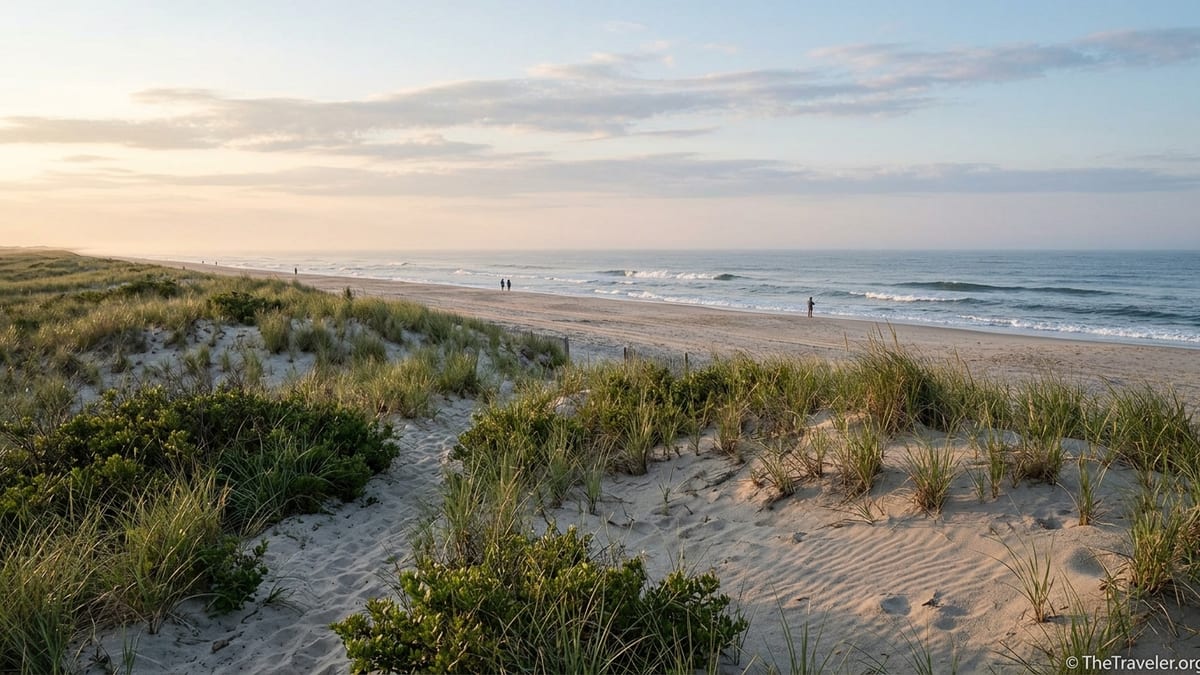
A Rare Stretch of Undeveloped Jersey Shore
Island Beach State Park protects roughly 3,000 acres on the Barnegat Peninsula, making it the largest remaining stretch of undeveloped barrier island in New Jersey and one of the largest on the U.S. Atlantic coast. On a map, the contrast is obvious. To the north lie the tightly packed blocks of Seaside Heights and Seaside Park, where the oceanfront is lined with boardwalk amusements, new luxury condos, and multi-story beach houses. Inside the park boundary, those buildings simply stop. In their place are uninterrupted dunes, low maritime forest and tidal marsh running for nearly ten miles between the Atlantic Ocean and Barnegat Bay.
That lack of development is not an accident. Through the late 19th and early 20th centuries, this strip of sand was eyed repeatedly for resorts that would have rivaled Atlantic City. In the 1920s, investors even began carving out streets and promotion plans for a private shore community, but the Great Depression halted the project. In 1953, the State of New Jersey bought the land and formally created Island Beach State Park, locking in a different future from neighboring barrier islands where hotels, casinos and boardwalks multiplied for decades.
For visitors today, the result is an experience that feels distinctly out of step with much of the modern Jersey Shore. You still pass a gatehouse and pay a modest car fee for day use during the season, but once you drive inside, there are no amusement piers, no high-rises and no rows of oceanfront bars. The only structures you notice are small parking lots tucked behind dunes, simple bathhouses, a few historic buildings and ranger facilities. The skyline is dominated by grasses and sky, not concrete.
This absence of continuous commercial frontage shapes everything else. Light pollution is limited, so stars are more visible on clear nights than in most shore towns. Sound carries differently; instead of bass from a club or clatter from a boardwalk, you hear only surf, wind, shorebirds and the occasional 4x4 easing along the sand with a fishing permit on its windshield. For travelers used to summer crowds in places like Wildwood or Point Pleasant, that quiet can be startling in the best possible way.
Dunes, Forest and Bay: The Barrier Island as It Once Was
Island Beach State Park preserves an unusually complete cross-section of barrier island habitats, which is a big part of why it feels like a throwback. On many developed shore towns, the original dune system was flattened to build oceanfront homes or reinforced with artificial dune ridges. Here, you can still walk from active ocean beach over natural primary dunes, through dense thickets and into a shady maritime forest before emerging at calm Barnegat Bay, all through a landscape that looks much as it did generations ago.
Several short signed trails, including the popular Fisherman’s Walk and the Spizzle Creek Bird Blind trail, make this progression especially clear. You park behind the dunes, cross a boardwalk through beach grass and pitch pine, and then find yourself overlooking expansive salt marsh dotted with egrets and fiddler crabs. It is easy to imagine that if early 20th-century developers had succeeded, these same marshes might now be bulkheaded and lined with vacation rentals and marinas like those in Toms River or Brick Township across the bay.
The park also shelters a surprisingly diverse set of plants and animals. Naturalists point out that Island Beach includes rare maritime forest, freshwater wetlands tucked behind dunes and extensive tidal flats. Birders come for migrating shorebirds and raptors, and in some years beachgoers share the sand with protected piping plovers and least terns, which nest on the open beach. During nesting season, portions of the shoreline may be roped off or access slightly rerouted, a reminder that conservation, not pure recreation, is the park’s first priority.
That priority affects maintenance decisions too. Instead of the wide, groomed beaches you might see in Cape May after a major replenishment project, Island Beach tends to maintain a more natural beach profile, with wrack lines of shells and seaweed that support invertebrates and shorebirds. You will still find designated guarded swimming beaches with lifeguards, restrooms and showers in summer, but just a short walk away, the shore looks more like a wild Atlantic coastline than a managed resort strip.
Driving In Feels Like Entering a Different Era
The transition from developed resort town to protected landscape is one of Island Beach State Park’s most striking features. If you approach from the north on Route 35, you may start your day among arcades, pizza stands and T-shirt shops in Seaside Heights, passing new high-end condos now rising along the Boulevard and oceanfront motels that stay booked through peak summer weekends. After a few traffic lights and beach-badge kiosks in Seaside Park, you reach a final string of houses and motels, then the road narrows, the buildings stop and a sign announces the entrance to Island Beach State Park.
Beyond the gatehouse, there is just a single two-lane road running down the spine of the peninsula with the ocean always just over the dunes to your left and the bay to your right. Instead of boardwalk access every block, you find numbered beach access points spaced out along the road. Each leads to a small parking area, a short sandy path or boardwalk over the dunes, and a stretch of beach that, even on busy days, tends to feel less congested than town beaches where day-trippers and hotel guests compete for towel space.
For travelers, that spacing and simplicity shifts expectations. You plan your day around one or two access points, not constant back-and-forth between the beach and a boardwalk. If you forgot something, there is no 24-hour convenience store on the corner. You bring your own cooler and beach gear, or you stop at small outfitters in Seaside Park before entering. It recalls an earlier style of beach day, when families packed station wagons and spent the whole afternoon at a single stretch of sand.
Even the limited commercial presence inside the park underscores the difference. There is no amusement pier or chain coffee shop, though in summer you may find simple concessions near the main swimming beaches selling basics like cold drinks, ice cream and beach snacks. The absence of large-scale commercial signage and strip-style development keeps sightlines clean, so the dunes and horizon dominate your photographs rather than branded awnings and billboards.
What a Beach Day Costs: Old-School Value in a Pricey Shore World
Compared with some New Jersey shore towns, Island Beach State Park can still feel relatively affordable, particularly for families or small groups. Instead of buying individual daily beach badges, most visitors pay a flat vehicle entry fee at the gate during the main season. That fee is lower for New Jersey residents and tends to be higher on busy summer weekends than on weekdays or in the shoulder season. Exact dollar amounts change periodically, but the structure means that a car with four people can often enjoy a full day on the beach for less than the combined per-person badge cost in places like Belmar or Spring Lake.
There are no resort fees, no hotel taxes within the park, and no premium boardwalk pricing on food and attractions. That does not mean a trip is free. Parking lots can fill early on prime weekends in July and August, and if you arrive late you may spend time queuing at the entrance or be turned away until spaces open. Many travelers choose to stay overnight in nearby towns such as Seaside Park, Toms River or on Long Beach Island, then drive into Island Beach State Park for day trips, combining relatively affordable motels or vacation rentals with low-cost beach days.
Anglers pay separate surf fishing permit fees if they want to drive four-wheel-drive vehicles directly onto the sand in designated areas, usually on an annual basis. Those permits cost significantly more than a standard day-use fee but are still considered good value by serious surf casters who return for striped bass runs in spring and fall. For them, the ability to park right on the beach with rod holders in the bumper and the truck acting as a base camp is part of Island Beach’s old-school charm.
Because there are no big box stores or supermarkets within the park, you will want to budget for groceries and gear outside. It is common to see coolers loaded at chain supermarkets in Toms River, reusable water jugs filled at a rental house, and beach umbrellas bought once and reused for years, rather than rented daily from commercial beach operators. The overall effect is that an Island Beach outing often feels more self-reliant and less transactional than a day spent moving between paid attractions on a classic boardwalk.
Simple Recreation: Surf, Sand and Quiet Traditions
The activity menu at Island Beach State Park is shorter than in most resort towns, and that is exactly why many visitors return year after year. Your options are mostly the basics: swimming at guarded beaches in summer, walking the shoreline, surfing, surf fishing, birdwatching, kayaking on Barnegat Bay and exploring a modest network of nature trails. There are no thrill rides, no arcades, no waterfront concerts amplified into the night, and after dark the park largely clears out except for permitted night anglers.
For families, the appeal is straightforward. Parents can set up chairs and umbrellas near the lifeguard stands while kids body-surf in small breakers or search tide lines for shells. Without the constant pull of boardwalk games or the smell of funnel cake drifting over the sand, there is less pressure to spend money every hour. Many visitors pack simple lunches and stay on the beach all afternoon, creating a rhythm that feels more like a 1970s beach outing than a modern resort day.
Island Beach is also a favorite among New Jersey surfers and paddlers seeking quieter breaks than the more crowded jetties in Manasquan or Belmar. On a midweek morning outside the peak season, you might see only a handful of surfers sharing a sandbar. On the bay side, kayakers and stand-up paddleboarders explore calm coves and creeks, especially near areas like Spizzle Creek, where osprey platforms and marsh views make for classic coastal scenes.
Traditional shore pastimes persist here in a way that is increasingly rare. Surf casters line the beach at dawn and dusk during striped bass migrations in spring and fall, swapping reports about water temperature and bait conditions. Birders arrive with spotting scopes in May and September for migration peaks. In winter, bundled-up walkers and photographers come for empty, windswept sand and ice-skimmed bay shallows, experiencing a seasonal face of the Jersey Shore that can be hard to find in boardwalk towns that essentially shut down between October and May.
How Island Beach Compares to the Rest of the Jersey Shore
To understand why Island Beach State Park feels so different, it helps to compare it directly with other well-known Jersey Shore destinations. In Seaside Heights, a few miles north, a dense grid of streets backs a busy boardwalk where you can find roller coasters, water parks, seafood shacks, cocktail bars, souvenir stores and ice cream stands, many open late into the night during summer. Music spills onto the boardwalk, colored lights reflect off the surf, and traffic crawls on weekend evenings as visitors circle for parking.
Drive south from Island Beach’s southern tip, cross Barnegat Inlet by boat or continue down the coast to Long Beach Island, and you quickly return to a familiar pattern of tightly spaced houses, seasonal shops and paved bayfront. In Atlantic City and the other towns on Absecon Island, large casino hotels dominate the skyline. Even more low-key communities such as Ocean City or Avalon feature extensive residential development layered close to the dunes, with commercial districts that hum on summer nights.
Island Beach State Park largely avoids this pattern. Aside from essential service buildings and modest visitor facilities, there are no streets platted onto the dunes and marshes, no residential subdivisions and no boardwalk amusement zones. That means you do not walk off the sand and immediately find a block of bars and restaurants, but it also means that from many vantage points you can look north or south and see little more than sand, water and low vegetation.
For travelers, this contrast can shape trip planning. Island Beach is ideal as a daytime escape paired with evenings in nearby developed towns. You might spend the morning hiking a bay trail and swimming at a guarded beach, then drive back to Seaside Park for a casual seafood dinner or head to a classic boardwalk in Point Pleasant for rides and games. In that sense, Island Beach lets you sample what the Jersey Shore felt like before heavy development while still keeping modern comforts within a short drive.
Conservation, Climate and the Future of a Wild Shoreline
The sense that Island Beach State Park is a preserved slice of “old shore” is not just nostalgic marketing; it is tied to ongoing conservation work and changing coastal realities. Barrier islands are dynamic by nature. Winter storms reshape beaches and dunes, inlet channels shift and sea levels slowly rise. In heavily built-up towns, roads, seawalls and buildings can limit that natural movement, sometimes increasing risk from flooding and erosion. At Island Beach, the landscape still has more room to adjust.
Park managers juggle several priorities: providing public access, protecting wildlife habitat and allowing natural coastal processes to continue where practical. That is why you may see seasonal fences around dune grasses, informational signs about staying off fragile vegetation, or certain unguarded beaches closed temporarily for nesting birds. For visitors, these measures sometimes feel restrictive compared with the open, groomed beaches elsewhere, but they are part of what keeps Island Beach looking and functioning like a pre-development shore.
Climate considerations also factor into the park’s future. As sea levels rise and storms intensify, undeveloped stretches like Island Beach may prove increasingly valuable both as habitat and as buffers that absorb wave energy before it reaches the mainland. The marshes on the bay side filter water, store carbon in sediments and provide nursery grounds for fish and shellfish that support recreational and commercial fisheries in Barnegat Bay. By keeping hard infrastructure to a minimum, the park allows these systems to migrate and adjust over time.
For travelers, this big-picture context may not be the main reason to visit, but it quietly shapes the experience. When you walk a narrow trail through bayberry and holly to an overlook on the bay, or when you watch a storm swell rearrange the beach over the course of a weekend, you are seeing a barrier island behave much as it did a century ago. That living coastline, still governed more by tides and wind than by concrete and rebar, is at the heart of why Island Beach State Park feels like the Jersey Shore before heavy development.
The Takeaway
Island Beach State Park is not the place to go for nightlife, luxury hotels or a boardwalk stacked with rides. It is, instead, a long, mostly wild peninsula where the sounds of the surf and the cries of shorebirds drown out the noise of modern resort life. From the moment you pass the gatehouse and the strip development drops away, you are reminded that much of the Jersey Shore once looked more like this: dunes rolling toward the ocean, maritime forest sheltering wildlife, bay marshes shimmering in the sun.
For travelers, that makes Island Beach a rare find on a heavily built-up coast. You can pair it with the bright lights and energy of nearby resort towns, or you can let it stand on its own as a quiet, low-cost day trip focused on sand, water and sky. Either way, walking its trails and beaches offers a tangible glimpse of what the shore was like before highways, high-rises and high season crowds transformed so much of New Jersey’s coastline.
If you want to experience the Jersey Shore as it once was, before heavy development reshaped most of its barrier islands, set your sights on Island Beach State Park. Pack a cooler, leave extra time to arrive early on busy days, and be ready to trade arcade lights for starlight and boardwalk noise for the rush of Atlantic surf. That trade is precisely what keeps this stretch of sand feeling timeless.
FAQ
Q1. Where exactly is Island Beach State Park, and how do I get there?
Island Beach State Park sits on the Barnegat Peninsula in Ocean County, just south of Seaside Park. Most visitors arrive by car via Route 35 through Seaside Heights and Seaside Park; from there, it is a short drive to the park entrance gatehouse.
Q2. How is Island Beach State Park different from other Jersey Shore towns?
Unlike places such as Seaside Heights, Long Beach Island or Atlantic City, Island Beach has no boardwalk, no hotels and almost no commercial development. The focus is on preserved dunes, beaches, forest and bay marsh rather than rides, bars and oceanfront condos.
Q3. Do I need a beach badge to visit, and how much does it cost?
Instead of per-person beach badges, the park charges a vehicle entry fee at the gate during the main season, with different rates for New Jersey residents and nonresidents and lower fees outside peak summer. Exact prices change periodically, so it is wise to check current rates before you go.
Q4. Are there lifeguards and family-friendly swimming areas?
Yes. During the summer season, designated oceanfront swimming beaches have lifeguards on duty during posted hours, along with restrooms, showers and changing facilities. Families typically set up near these guarded zones, while more experienced visitors sometimes walk farther for quieter stretches of sand.
Q5. Can I surf or fish at Island Beach State Park?
Surfing and surf fishing are both popular. You can surf at many unguarded stretches when conditions allow, and anglers can fish from the beach or, with a separate permit, drive four-wheel-drive vehicles onto designated sections of sand for surf casting, especially during spring and fall striped bass runs.
Q6. Are there food options inside the park?
Food service inside the park is limited. In summer, small concessions near main swimming areas may sell drinks and snacks, but there are no full-service restaurants or grocery stores, so most visitors pack coolers or buy supplies in nearby Seaside Park or Toms River before entering.
Q7. What kind of wildlife and nature can I expect to see?
Island Beach is known for its natural dunes, maritime forest and salt marshes. Depending on the season, you might spot ospreys, shorebirds, foxes, migrating songbirds and, occasionally, protected species like piping plovers. Short nature trails and bay overlooks make wildlife viewing easy even for casual visitors.
Q8. Is Island Beach State Park open year-round?
The park is generally open year-round, but services such as lifeguards, concessions and some facilities operate mainly during the late spring and summer season. In the off-season, visitors still come for walking, birdwatching and quiet beach views, but should be prepared for limited amenities and changing weather.
Q9. Can I stay overnight or camp in the park?
Island Beach State Park does not have traditional oceanfront hotels or large campgrounds like some state parks. Most visitors stay in nearby shore towns and make day trips into the park. There may be limited, specialized overnight options or group facilities, so it is best to confirm current offerings with park management before planning an overnight stay.
Q10. Is Island Beach State Park suitable for first-time Jersey Shore visitors?
Yes. It is an excellent choice if you want to experience the natural side of the Jersey Shore without the intensity of a full boardwalk scene. Many visitors combine a day at Island Beach with evenings in nearby resort towns, getting both a wild, undeveloped beach experience and a taste of classic Jersey Shore nightlife and dining.