


More news on this day
Poland is edging into a new era of fast rail travel, with trains capable of 250 km/h, upgraded main lines and an emerging high speed network set to cut journey times between the country’s largest cities and its planned Central Communication Port hub.
Get the latest news straight to your inbox!
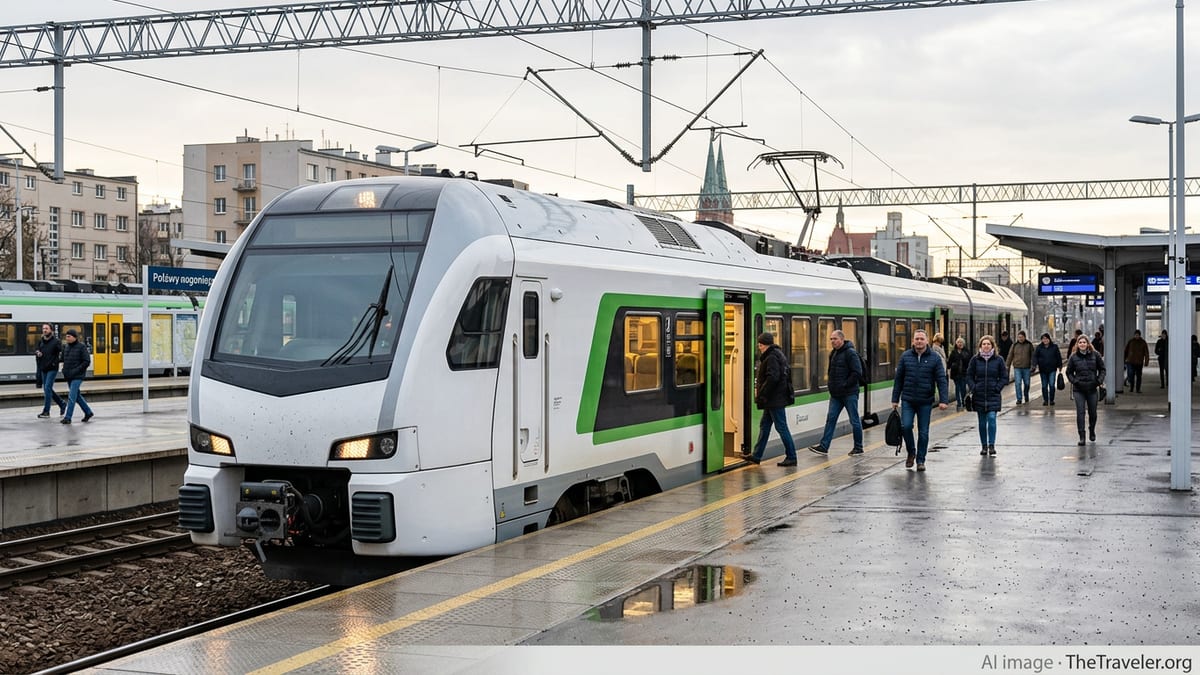
From Pendolino Pioneer to 250 km/h Capability
High speed-style services in Poland began in 2014, when PKP Intercity introduced a fleet of ED250 New Pendolino electric multiple units under the Express InterCity Premium (EIP) brand. Publicly available information shows these seven-car trains were ordered with a maximum operational speed of 250 km/h and tailored for key corridors radiating from Warsaw, including routes to Gdynia, Kraków, Katowice and Wrocław.
Technical documentation and specialist rail coverage indicate that the Pendolino units were homologated for 250 km/h operation under European Train Control System (ETCS) Level 2 signaling. On test runs, the trains have set Polish speed records close to 291 km/h on the Central Rail Line, demonstrating a performance envelope well above conventional intercity stock.
In regular service, however, EIP trains typically run at up to 200 km/h on upgraded segments of the E65 corridor, reflecting historical infrastructure limits rather than train technology. This gap between train capability and real-world speed has become a central driver behind current investment strategies that aim to lift line speeds toward the 250 km/h mark on core national routes.
Central Rail Line Upgrades Target 250 km/h Running
At the heart of Poland’s fast rail vision is the Central Rail Line, known domestically as Centralna Magistrala Kolejowa (CMK). Built in the 1970s as a high standard passenger corridor, the line connects the Warsaw area with the industrial south and is the country’s most advanced conventional route in terms of geometry and alignment.
Project briefs from the Centre for EU Transport Projects and infrastructure manager PKP Polskie Linie Kolejowe outline a multi-stage program to adapt CMK for 250 km/h operation. Key works include modernizing track, power supply and signaling systems, and replacing legacy protection with ETCS Level 2 and the GSM-R communications standard to enable higher speeds under European interoperability rules.
Recent updates on the European Train Control System’s rollout confirm that CMK is undergoing an upgrade from ETCS Level 1 to Level 2 specifically to raise the maximum permitted speed from 200 km/h to 250 km/h once commissioning is complete. Until the new digital signaling is fully tested and certified, sections of the route are temporarily limited to lower speeds, underscoring the complexity of transitioning an active main line to next-generation standards.
Government transport material also points to complementary improvements on the northern part of the E65 corridor between Warsaw and Gdańsk, where infrastructure has been adapted for 200 km/h and, in some aspects of the traction system, for higher technical limits. Together, these corridors form the spine of Poland’s fast passenger network and provide the natural testing ground for widespread 250 km/h operation.
Passenger Journeys Shortened on Key Intercity Routes
As upgrades advance, journey times on flagship services are already falling. Official travel time data highlighted in recent government communications show that Pendolino journeys between Warsaw and the Baltic port city of Szczecin now take around 4 hours 12 minutes, a record for that route and a sign of faster timings becoming standard across the network.
The Central Rail Line is central to further reductions. Planning documents and press materials from PKP PLK note that once 250 km/h running is fully enabled on CMK, travel times between Warsaw and southern hubs such as Kraków and Katowice are projected to fall by up to 25 minutes compared with pre-upgrade schedules. That change would place these city pairs firmly in the range where rail competes strongly with air on total door-to-door time.
Passenger-facing enhancements are developing alongside raw speed. PKP Intercity information shows that Pendolino sets feature reserved seating, accessible interiors, onboard Wi-Fi and at-seat power, aligning the product with Western European high speed standards. As lines are modernized and timetables tightened, published analyses suggest that end-to-end reliability and comfort are becoming as important as headline speeds in attracting travelers away from cars and domestic flights.
CPK Mega-Project Aims to Lock In a High Speed Future
The fast services now appearing on existing corridors are only one part of Poland’s wider rail transformation. Strategic planning documents on high speed rail in Poland describe the Central Communication Port (Centralny Port Komunikacyjny, CPK) as a dual aviation and rail mega-project that would anchor a new nationwide high speed network, largely independent of legacy alignments.
According to published coverage, the CPK concept foresees purpose-built high speed lines radiating from a new hub airport located between Warsaw and Łódź, with target operating speeds at or above 250 km/h and selected trunk sections designed for 320 km/h. These routes are intended to connect Warsaw and the planned airport with major cities including Gdańsk, Poznań, Wrocław and Kraków, as well as to form part of an international corridor toward Budapest.
Government procurement notices in late 2024 reported a tender by PKP Intercity for 20 new electric trainsets capable of 320 km/h for use on future high speed lines, with experience in supplying stock of at least 250 km/h set as a qualifying condition. This requirement underlines how 250 km/h capability is evolving from a cutting-edge feature on a limited fleet to a baseline standard for the next generation of Polish long-distance trains.
Complementary rolling stock contracts, including new intercity units based on Alstom’s Coradia platform with design speeds up to 250 km/h, are expected to allow flexible deployment. These trains are planned to operate both on emerging high speed routes and on upgraded conventional lines, broadening the range of cities that can benefit from shorter journey times.
Economic and Environmental Impact of Faster Rail
Transport studies focusing on the Polish case suggest that high speed and high-performance rail offers notable environmental benefits compared with private car use and short-haul aviation. Academic analysis of the ED250 fleet indicates that the shift to faster, electric trains on key corridors has the potential to reduce overall energy consumption and associated CO2 emissions per passenger-kilometer, provided that services maintain high load factors.
The economic rationale is equally significant. Policy papers on Poland’s transport strategy argue that cutting intercity travel times to around two hours between Warsaw and major regional centers can stimulate business travel, tourism and labor mobility, effectively enlarging functional urban regions. Faster rail also supports the decentralization of economic activity by making it feasible to live in one city and work regularly in another.
National investment over recent years, combining domestic funds and European Union support, has targeted not only higher speeds but also improved safety, station accessibility and noise protection along upgraded lines. Publicly available budget figures for CMK modernization cite multi-billion-zloty allocations, reflecting the scale of works needed to bring a historically important corridor up to contemporary high speed standards.
As more segments reach 200 km/h and above, passengers are beginning to experience a tangible shift in how they move around the country. With trains and infrastructure being engineered for 250 km/h and a new generation of even faster sets on order for CPK-linked routes, Poland’s rail system is positioned to transition from incremental improvements to a comprehensive fast travel network over the coming decade.
PKP Polskie Linie Kolejowe: CMK 250 km/h project information
High-speed rail in Poland overview
Ministry of Infrastructure: PKP Intercity tender for new high speed trains