


More news on this day
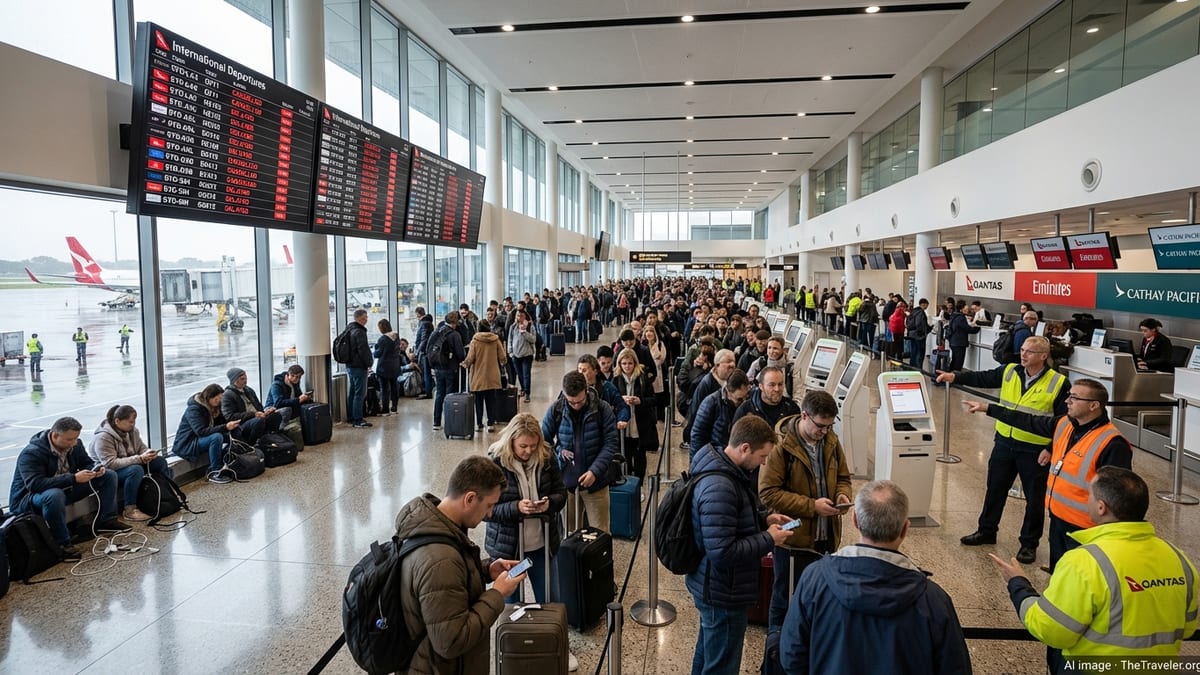
Air travel across Oceania faced renewed strain on August 26 as Sydney and Auckland, the region’s busiest international gateways, recorded a combined 303 delayed flights and six cancellations, disrupting itineraries for thousands of passengers on trans-Tasman and long-haul routes.
Get the latest news straight to your inbox!
Busy regional gateways under pressure
The disruption comes at a time when both Sydney Kingsford Smith Airport and Auckland Airport are operating near or above pre-pandemic traffic levels, with robust demand on domestic and trans-Tasman routes. Publicly available operational data shows that Sydney now sees more than 400 scheduled flights a day, serving close to 100 destinations with a mix of full-service and low-cost carriers.
Real-time performance trackers and airport flight boards indicated an unusually high number of schedule changes on August 26, with delays concentrated in the morning and early afternoon peaks. While the majority of services eventually departed, rolling knock-on effects left aircraft and crew out of position, contributing to late departures across both hubs.
In Auckland, live flight-status feeds showed a stream of short-haul services departing behind schedule, including regional departures to domestic centers such as Blenheim and Tauranga, as well as some international services. Sydney experienced a similar pattern, with select departures to New Zealand, Asia and the Pacific operating later than planned according to airport listings.
Together, the two hubs form the backbone of Oceania’s international connectivity, and simultaneous disruption at both locations amplified the impact for travelers connecting between Australia, New Zealand, the Pacific Islands and North America.
Operational strains and recent safety concerns
The elevated disruption level is unfolding against a backdrop of wider operational strain in Australian airspace. Recent coverage of air traffic control incidents at Sydney has highlighted a series of close calls involving major carriers, prompting renewed scrutiny of staffing levels and workload management in one of the region’s busiest control sectors.
Reports indicate at least six safety-related incidents in the Sydney area over the past month, including ground-movement and runway-incursion events that have drawn national attention. While the August 26 delay figures are not directly linked to any single episode, ongoing air traffic management pressures can contribute to tighter margins in daily operations, particularly during peak traffic waves.
Separate regulatory and parliamentary documents in Australia have also catalogued the impact of air traffic control staffing shortages on airline schedules in recent years, with carriers attributing a share of cancellations to ground delay programs initiated to manage constrained capacity. These systemic factors create a more fragile operating environment in which weather or technical issues can more quickly cascade into widespread disruption.
For airlines, the combination of high demand, limited spare capacity and infrastructure upgrades under way at both hubs leaves less flexibility to recover when irregular operations take hold. That increases the likelihood that a cluster of delays at one airport will ripple through to the other via shared fleets and crew rotations.
Weather, technical issues and infrastructure work
Short-term weather variation remains a familiar trigger for day-of-travel disruptions across the Tasman region, and forecaster data for the Sydney basin on August 26 pointed to changeable conditions around the airport precinct. Even modest bouts of low cloud, wind shifts or showers can require spacing adjustments between arrivals and departures, gradually slowing throughput in congested airspace.
In New Zealand, infrastructure and fleet-related factors are contributing to a more complex operating picture. Industry bulletins on Tasman and South Pacific shipping and aviation links have recently flagged technical issues and maintenance-related withdrawals for equipment operating through Auckland, underlining how mechanical problems can force schedule reshuffles and equipment swaps on short notice.
Strategic planning documents from Auckland Airport set out an ambitious construction and upgrade agenda designed to expand terminal capacity and modernize airfield infrastructure. While these projects aim to improve resilience over the medium term, they can also introduce short-term constraints as work progresses in and around active operating areas, particularly when combined with adverse weather windows.
Together, operational, technical and infrastructure variables create a layered risk environment in which even routine disruptions can accumulate. The 303 delays and six cancellations recorded on August 26 illustrate how quickly those pressures can materialize into a difficult day for airlines and passengers alike.
Impact on passengers and regional connectivity
The practical impact for travelers was felt in longer queues at check-in and security, rebookings at transfer desks and extended waits in departure lounges at both airports. With Sydney and Auckland serving as primary connection points for journeys linking secondary Australian and New Zealand cities with long-haul destinations, relatively small schedule changes can cause missed connections and overnight stays for onward passengers.
Real-time tracking platforms showed a mix of short delays of 15 to 30 minutes and more substantial disruptions exceeding an hour, particularly on morning departures. For some long-haul services, late-arriving inbound aircraft compounded the problem, compressing turnaround times and leaving little margin for ground handling or boarding delays.
Industry performance statistics for Sydney over recent weeks show that while the average arrival and departure times remain close to schedule, cancellation counts can spike sharply on individual days, reflecting sensitivity to weather and staffing constraints. At Auckland, historic disclosure documents note that airport-driven delays represent only a small share of overall schedule variance, suggesting that airline and broader network factors also play a role when disruption levels rise.
For regional tourism operators and business travelers, recurring bouts of irregular operations pose a challenge to planning and reliability. Travel advisers increasingly recommend building longer connection buffers through Sydney and Auckland, particularly during peak holiday periods or when forecasts indicate unsettled weather around either hub.
What travelers can do on high-disruption days
Travel platforms emphasize that on days with elevated disruption levels, proactive monitoring is essential. Most major airlines operating through Sydney and Auckland offer real-time notifications via apps, text messages or email, while both airports provide searchable online flight boards with status updates. Independent aggregators also track delays and arrivals, providing an additional cross-check for passengers.
On disruption-heavy days, rebooking options can be constrained as subsequent flights fill quickly, especially on popular routes such as Sydney to Auckland or onward connections to Asia and North America. Travelers holding flexible tickets or those who have allowed additional time between connections may have a wider range of alternatives if their original service is heavily delayed or cancelled.
Consumer advocates often advise travelers to keep records of delay durations and any out-of-pocket expenses, in case airline policies or local regulations provide for compensation or reimbursement in specific circumstances. While Oceania’s consumer protection frameworks differ from those in regions such as the European Union, many carriers publish customer-charter commitments covering meal vouchers, accommodation and rebooking support when disruptions reach certain thresholds.
With both Sydney and Auckland pursuing long-term investment programs to ease bottlenecks and improve punctuality, the hope for travelers is that days like August 26 will become less frequent. Until then, the experience of 303 delays and six cancellations across the two hubs underscores the value of flexible planning and real-time information when flying through Oceania’s busiest gateways.
Sydney Airport performance data
Sydney Airport live flight information