


I thought I knew ancient Rome. I had studied the emperors, memorised dates, and walked through marble-filled museums from London to Rome. But it was only when I spent a full day walking the dusty streets of Pompeii, tracing ruts left by carriage wheels and stepping over the same stones that townspeople once used to cross flooded roads, that the Roman world stopped being an abstraction. In Pompeii, life is not a list of facts. It is a city you can still navigate, a place where you can almost hear the clatter of plates in a tavern and smell bread in the oven. That walk changed the way I understood ancient Roman life more than any book ever had.
Get the latest updates straight to your inbox!
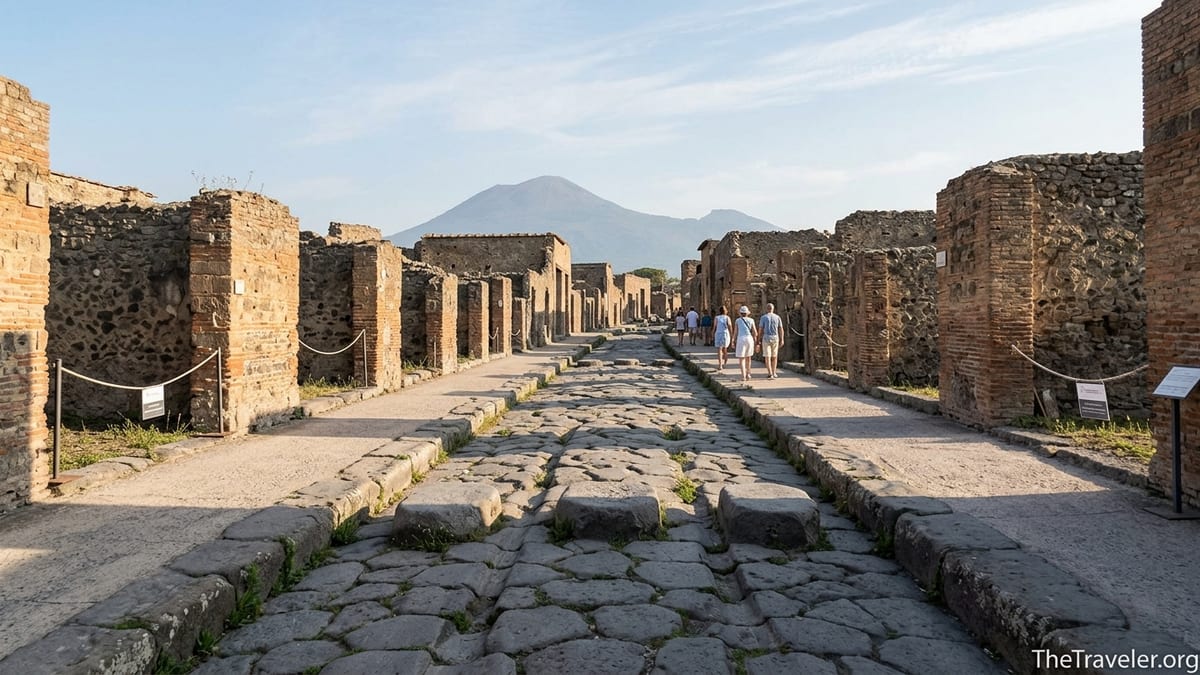
Arriving in a City Paused Mid‑Day
The first surprise is how large Pompeii feels. Officially, the archaeological park covers around 66 hectares, and once you pass the modern turnstiles at Porta Marina or Piazza Anfiteatro, the site opens into a genuine cityscape rather than a cluster of isolated ruins. You move along a proper grid of streets, flanked by shopfronts, apartment-style upper floors and busy crossroads. It takes only a few minutes of walking before you realise you are not in a temple complex or a forum museum. You are in a town where bakers, bar owners and laundry workers once worried about customers and closing times.
On my visit, I joined the morning stream of travellers who had arrived from Naples and Sorrento on the Circumvesuviana train, spilling out at Pompei Scavi station. By 9.30 am, as the park’s standard opening hours stretch from roughly 9 am into the early evening depending on season, the first tour groups were already clustered in the main forum, guides holding aloft coloured umbrellas. Yet it is remarkably easy to step away from the crowds. A side street, an unassuming doorway, and you are suddenly alone with the echo of your own footsteps on two-thousand-year-old paving.
What strikes you almost immediately is the ordinariness of it all. The public buildings are impressive, of course, but the feeling of a paused workday is stronger. In one corner, a tavern counter waits for customers. In another, a laundry stands with its basins ready for the next load. Archaeologists have long described Pompeii as a snapshot of 79 AD. Walking its streets, that phrase stops being a cliché and becomes visceral, like stepping into a photograph in which the people have just, and only just, walked out of frame.
Streets Built for Feet, Carts and Floodwater
Moving deeper into Pompeii, the streets themselves become your first lesson in Roman urban design. They are uneven, yes, but they are also profoundly functional. The basalt blocks are deeply scored by grooves from wagon wheels, a physical reminder that this was a city of deliveries, errands and daily commerce, not just ritual processions. Standing in Via dell’Abbondanza, one of the main east–west arteries, you can align your own feet with those ruts and imagine a cart passing by, loaded with amphorae of wine or baskets of olives.
Then you notice the stepping stones that cross the road at intervals, raised blocks that allow pedestrians to walk across even when the street was channeled with water and waste. Their height reveals a city designed to flood its own roads, flushing away the refuse of thousands of people. The gaps between the stones are precisely spaced so that a typical wagon could pass without scraping its wheels. Until you step gingerly across those stones yourself, balancing like any Roman in a hurry, it is easy to think of Roman engineering only in terms of aqueducts and amphitheatres. Pompeii reminds you that engineering also meant designing a safe school run and a clean grocery run.
The sidewalks, too, tell their own story. Some stretches are raised and paved, others crumble away into rough stones. Shop thresholds are worn smooth by feet. In front of certain doorways you can still see shallow holes where wooden doors once pivoted, mute proof that this was a living rental market, with shops that opened and closed each day just like the boutiques in modern Naples. For all the marble and mythology of the Roman world, the street plan of Pompeii reveals a civilisation obsessed with the logistics of ordinary life.
Bakeries, Bars and the Smell of Everyday Work
If the streets reveal how Romans moved, Pompeii’s commercial buildings show how they made a living. One of the most affecting stops is a bakery, such as the well-known Bakery of Popidius Priscus. Here, four great stone mills stand frozen in mid-rotation, shaped like hourglasses, their upper sections once turned by donkeys or slaves walking in endless circles. In the same room, a brick oven yawns open, its arched mouth big enough to bake dozens of loaves at a time. Archaeologists have even found carbonised loaves, divided into wedges by deep scoring, giving us a literal snapshot of what bread looked like the morning Vesuvius erupted.
Standing in that flour-dusted space, it is difficult not to think of an early start on a modern Neapolitan side street, bakers hauling trays of cornetti into glass cases. The bakery’s location, right on a busy road, made sense for foot traffic, just as it would today. You realise that for the people who lived here, Rome was not an idea. It was their shift pattern, their wage, their rent.
Just a short walk away, taverns and street food counters line the roads. Many are identified by their characteristic L-shaped counters dotted with large circular holes, called dolia, which once held hot stews, wine or lentils. Today, those counters are bare stone, but it takes little imagination to picture a worker stopping here for a quick lunch, leaning on the same surface where your guide now rests a fold-out map. In some, traces of wall paintings advertise food and drink, like ancient menu boards. In one bar, faded frescoes show jars and seafood, a direct visual marketing pitch to passing customers.
Modern visitors often gravitate toward grand villas, but it is these small spaces that changed my understanding of Roman life. Rome became not a civilisation of marble busts, but a society where people queued for cheap wine, measured grain by the scoop, and complained about prices. When you pair this with today’s ticket costs, roughly starting around 18 to 22 euros for standard adult entry depending on the season and provider, the contrast between our role as spectators and their role as workers becomes very clear.
Homes, Gardens and the Private Face of Status
Pompeii’s houses provide the most intimate revelations of all. Take the House of the Faun, one of the largest and grandest residences in the city. Step inside and you are immediately greeted by an elegant atrium, engineered so that rainwater falls through a central opening in the roof into an indoor pool, the impluvium. That indoor water feature was both practical and a status symbol, a constant ripple of sound and reflection for guests entering the home. Beyond, peristyle gardens unfold with columns framing manicured courtyards. In a world without Instagram, this was how you displayed success.
Farther along another street, you might enter the more modest House of the Vettii, reopened after major conservation work. Here, rooms cluster around an internal garden, their walls alive with colour: mythological scenes, delicate borders, still-life depictions of fruit and silverware. The frescoes show that even private spaces were crafted as visual experiences. They suggest owners who wanted to be seen as cultivated, worldly and connected to the stories that defined Roman identity.
Yet not all homes are grand. Many are compact and dark, with simple cubicula that would once have held little more than a bed and a chest, and staircases suggesting cramped upper floors. In some, a tiny shopfront opens directly onto the street, with the family’s living quarters tucked behind or above. When you move from palatial atriums to these narrow backrooms in a matter of minutes, the social hierarchy of Roman life becomes tangible. You can measure the gap between elite and ordinary families in floor space, natural light and the number of painted walls.
What moved me most were the small details: a charcoal graffiti scrawled near a doorway, a faint tally scratched into plaster, the sudden glimpse of a painted lararium, a household shrine tucked into a corner. These traces show a Pompeii made up not only of senators and merchants, but of children, tenants and servants, each with their own quiet rituals at the start or end of the day.
Baths, Amphitheatres and the Social Rhythm of Leisure
Roman life in Pompeii was not all work and worry. The public baths make that abundantly clear. At the Stabian Baths, you follow a route from the changing room into warm and hot rooms, passing beneath carefully engineered ceilings with tiny windows and stucco decorations. Marble benches once lined the walls. In the steam rooms, double floors and hollow walls carried hot air from furnaces below, an underfloor heating system that feels startlingly modern. You stand in the tepidarium and imagine the conversations that filled the air here: business deals, gossip, political rumours carried by steam and laughter.
Visiting a bath complex helps you understand Romans as people who valued both cleanliness and community. Entry fees were affordable enough that even modest citizens could attend regularly. The baths were an equaliser, a place where class distinctions blurred in the shared ritual of undressing, sweating, scraping off oil and plunging into cold pools. Today, many travellers pay significantly more for a modern spa day in Naples or along the Amalfi Coast, yet the principle of wellness as a social activity has changed little.
At the far edge of the city, the amphitheatre adds another dimension to this rhythm of leisure. Built decades before the Colosseum in Rome, it could accommodate thousands of spectators. Stand at ground level and look up at the steep stands; you can almost hear the roar of a crowd hungry for spectacle, whether gladiatorial contests or animal hunts. The attached palaestra, a large training field framed by colonnades, reminds you that sport, exercise and competition were central to Roman identity long before modern gyms.
Seeing these places in person dissolves the illusion that Romans spent their lives either conquering territories or reciting poetry. They bathed after work, argued over favourite fighters, and watched the equivalent of Saturday entertainment. The physical spaces of Pompeii’s baths and amphitheatre give that rhythm a scale and an acoustic, not just a line in a textbook.
Words on the Walls: Graffiti, Politics and Private Jokes
Perhaps the most humanising discovery in Pompeii is the graffiti that survives on so many walls. As you pass along certain streets, a guide may point out scratched or painted inscriptions that range from election slogans to love notes. In one area, you can still read messages supporting political candidates, written in formulaic language urging neighbours to vote for a particular man for a local office. It quickly becomes clear that Roman politics relied on name recognition and persuasive advertising, not unlike our own.
Elsewhere, less official voices appear. There are insults that would not be out of place in a schoolyard, boasts about romantic conquests, and even complaints about the bread. One graffito famously apologises for writing badly, the ancient equivalent of a self-conscious text message. Some inscriptions record everyday transactions or simply mark that someone was here, a quiet assertion of presence in a crowded city.
Reading these words, often translated on small signs or in guidebooks, feels like scrolling an ancient social feed etched directly into plaster. You recognise the same desire to joke, to vent, to support a favourite candidate or simply to be seen. It challenges the tendency to put Romans on a moral or cultural pedestal. They were witty, crude, sentimental and political, all at once, just like any modern community.
For travellers, the graffiti also offers a fresh lens on heavily visited spots. Instead of focusing only on frescoes or columns, you find yourself scanning doorways for faint scratches that reveal the voices of people who rarely appear in official inscriptions: women, slaves, foreigners and the young. It is one of the few times ancient history feels genuinely democratic.
Walking in With Modern Expectations
Walking through Pompeii does not just reshape your sense of the past. It also reframes how you think about travel in the present. The site operates as a modern archaeological park with timed tickets, security checks and clear regulations. Since recent regulatory updates, many tickets are personalised with visitor names, and staff can ask for identification at the gate. Standard adult tickets usually start around the high-teens to low-twenties in euros, with options for combined passes that include nearby sites such as Boscoreale or Oplontis. Guided tours with licensed archaeologists cost more but often add essential context that can transform a hot, confusing walk into a coherent story.
On a practical level, a full visit demands time and energy. Most travellers find that three to five hours is a realistic window to cover the major highlights without rushing, though you could easily spend a full day and still leave areas unexplored. In summer, the midday heat on the exposed stone can be intense, making an early arrival worth the effort. Winter offers cooler temperatures and fewer crowds, though shorter daylight hours can limit how much you see. Comfortable walking shoes, sun protection and plenty of water are not optional extras; the ancient paving is unforgiving and shade is limited.
The park’s management continues to adapt. Visitor numbers are monitored, smaller sites rotate open and closed to protect frescoes, and new excavations in areas such as Regio V periodically open to the public via special guided routes. Downloadable apps and audio guides now overlay digital commentary onto the ancient stones, a layer of twenty-first-century interpretation that can either enhance or distract depending on how you use it. The result is a curious blend: an ancient city navigated with modern crowd control, mobile tickets and in-ear commentary in multiple languages.
For me, these logistics underscored a final point. Just as the Romans once balanced preservation and practicality in maintaining streets, sewers and public baths, we now face our own responsibility toward Pompeii. Every entry fee, every plastic bottle recycled or not, and every hand that touches a fragile fresco has a cumulative effect. Understanding Roman life through Pompeii also means acknowledging our role in whether this city can continue speaking to future travellers.
The Takeaway
By the end of my walk, as I stood looking back toward the forum with Vesuvius looming in the distance, ancient Rome no longer felt like a distant, marble-clad civilisation. Thanks to Pompeii, it felt like a dense, imperfect, noisy town full of shopkeepers, teenagers, artisans and overworked bakers, all living under the same unpredictable sky. The city’s preserved streets, houses, baths and even jokes on the walls had quietly dismantled my tendency to see Romans as statues instead of neighbours separated by time.
If you approach Pompeii not as a checklist of famous sites but as a place where people once commuted, cooked, argued and relaxed, your understanding of ancient Roman life will change too. You will leave not only with photos of frescoes and amphitheatres, but with a mental map of a community that feels startlingly contemporary in its worries and pleasures. That, more than any textbook chapter or museum gallery, is Pompeii’s greatest gift: it lets you walk the city as its citizens once did and discover that the past is made of people who, in all the ways that matter, were very much like us.
FAQ
Q1. How much time do I need to visit Pompeii properly?
Most visitors should allow at least three to five hours to see the main streets, forum, a few houses, a bath complex and part of the amphitheatre area without rushing.
Q2. What is the typical ticket price for Pompeii?
Standard adult tickets are usually priced in the high‑teens to low‑twenties in euros, with occasional variations for seasonal offers, combined passes and concessions.
Q3. Is a guided tour worth it, or can I explore Pompeii on my own?
You can walk independently with maps and apps, but many travellers find a licensed guide or archaeologist‑led tour helpful for understanding the layout, context and small details.
Q4. What should I wear and bring for a day at Pompeii?
Wear sturdy walking shoes, light breathable clothing, a hat and sunscreen, and bring a refillable water bottle and some snacks, as shade and on‑site options can be limited.
Q5. When is the best time of year to visit to avoid extreme heat and big crowds?
Spring and autumn generally offer milder temperatures and more manageable crowds, while peak summer can be very hot and busy, especially in the middle of the day.
Q6. Can people with limited mobility visit Pompeii comfortably?
Parts of Pompeii are challenging due to uneven stone streets, but there are designated accessible routes with ramps and smoother paths that make key areas more reachable.
Q7. Are children likely to enjoy a visit to Pompeii?
Yes, many children enjoy the sense of exploring a "real" ruined city, especially the amphitheatre and houses, though frequent breaks and shade are important for younger kids.
Q8. Is it possible to visit Pompeii as a day trip from Rome?
Yes, it is possible using high‑speed trains and local connections, but it makes for a long day; staying overnight near Naples or Sorrento allows a more relaxed visit.
Q9. Can I combine Pompeii with Herculaneum or Vesuvius in one day?
It is feasible but demanding. Many travellers choose either a focused half‑day at Pompeii plus Herculaneum, or Pompeii plus a shorter organised excursion to Vesuvius.
Q10. Are there rules I should know about before entering the archaeological park?
Yes, expect airport‑style bag checks, restrictions on large luggage, drones and professional photography equipment, and clear rules about not touching frescoes or climbing on walls.