


Port Everglades in Fort Lauderdale is one of the busiest cruise ports in the world, and on peak Saturdays it can feel like a small city of ships, buses and rolling suitcases. Knowing exactly where your ship is docked, where to park and how to drop your bags can turn a stressful arrival into a smooth, 10 minute stroll from car to check-in. This guide walks you through the major cruise terminals currently in use at Port Everglades, with a practical focus on Terminals 2, 4, 18, 19, 21, 25, 26 and 29, how cruise lines typically use them, where you actually leave your luggage, and how to find your ship on the day you sail.
Get the latest updates straight to your inbox!
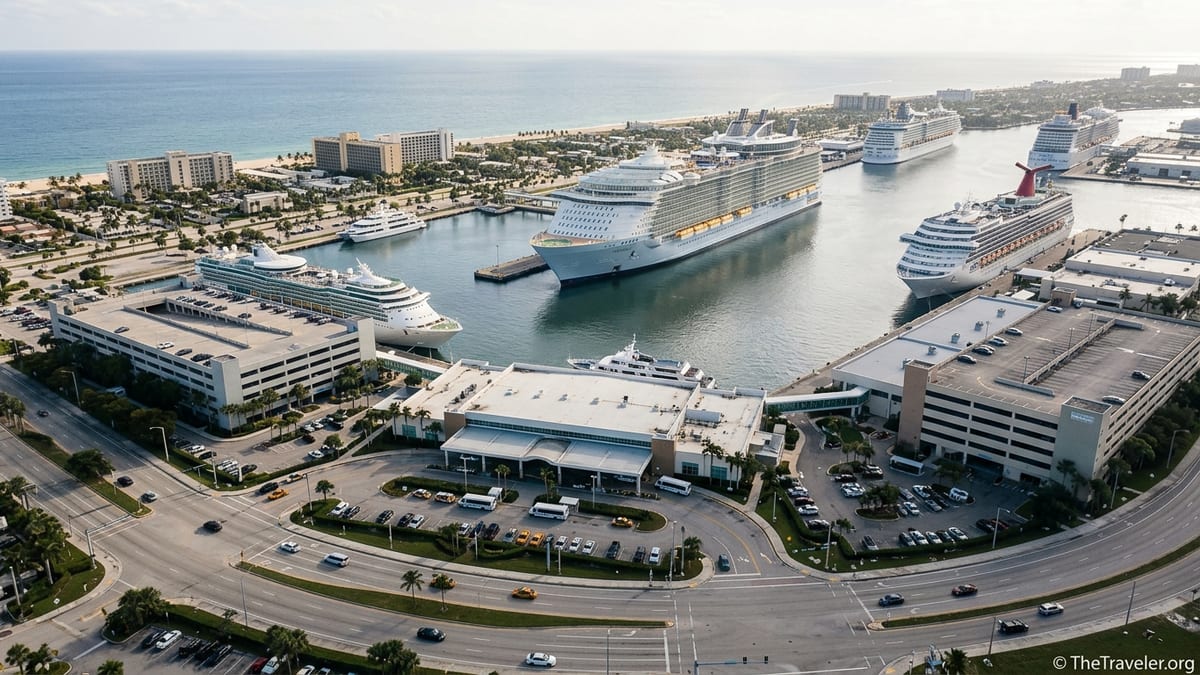
How Port Everglades Is Laid Out
Port Everglades is spread along a long, sheltered channel just south of Fort Lauderdale Beach and immediately east of Fort Lauderdale–Hollywood International Airport. For cruise passengers, the port is usually described in two main zones: Northport, near the Broward County Convention Center, and Midport, a little farther south along Eller Drive. Terminals 2 and 4 sit in Northport, while Terminals 18, 19, 21, 25, 26 and 29 are in the Midport area, clustered along the main channel where the largest cruise ships dock.
Driving in, most cruisers use either the I‑595 / Eller Drive entrance or the US‑1 / State Road 84 entrance. From both, digital roadside signs typically list each ship in port that day with an arrow toward the correct terminal. These signs are helpful, but assignments can occasionally change at the last minute, so you should still confirm your terminal with your cruise line and double check the morning of sailing using the port’s official information or your cruise app.
Think of the port as a series of driveways branching off a central spine road. Each driveway ends at a single terminal building with a curb for drop‑off and a nearby garage or parking lot. If you arrive, for example, for a Royal Caribbean cruise on a Saturday in February, you might see Oasis‑class ships at Terminal 18, a Celebrity ship at Terminal 25, and a Carnival or Holland America ship at Terminal 26, all within a few minutes’ drive of each other but each with its own entrance and traffic pattern.
The key to a low‑stress arrival is to know your terminal number before you reach the security checkpoint at the port entrance. Have your cruise documents handy and be ready to tell the officer which terminal you need; this determines whether you are directed toward Northport for Terminals 2 and 4 or straight down Eller Drive into Midport for Terminals 18, 19, 21, 25, 26 and 29.
Finding Your Ship and Confirming Your Terminal
Cruise terminal assignments at Port Everglades are scheduled ship by ship and can change even a few days before sailing, especially during busy winter seasons when multiple large vessels share the port. As a general pattern, Princess often uses Terminal 2, Disney is primarily at Terminal 4, Royal Caribbean relies heavily on Terminal 18 and sometimes Terminal 29, Celebrity frequently uses Terminal 25, and Carnival and Holland America often operate from Terminals 21, 26 or 19. These patterns are helpful, but they are not guarantees.
In practice, you should treat your cruise documents, the cruise line app and the morning‑of information as your final authority. For example, a family boarding a Disney Dream sailing in December may find “Cruise Terminal 4, Port Everglades” clearly printed in their official instructions, matched by the Disney Cruise Line app once they log in. A Celebrity guest in March might see “Terminal 25, Port Everglades” on their e‑ticket, while a Royal Caribbean guest booked on an Icon‑class ship will typically see “Terminal 18.” If anything in your email, app or luggage tags conflicts, use the most recent notification from the cruise line.
On arrival day, Port Everglades usually posts a list of ships and terminal assignments that you can review before you head to the port, and many experienced cruisers quickly check this the morning they leave their hotel. When you reach the port access road, large electronic signs repeat that information. If you accidentally follow signs to the wrong terminal, staff and port police are used to redirecting cruisers and will wave you back out to Eller Drive so you can follow signage to the correct driveway.
For those arriving by taxi, rideshare or hotel shuttle, drivers in the Fort Lauderdale area are generally very familiar with the port. Simply saying “Royal Caribbean, Terminal 18” or “Celebrity, Terminal 25” is usually enough. If your driver seems uncertain, show the terminal number in your app or documents and ask them to follow the digital signs that appear after the security checkpoint.
Terminal 2 and Terminal 4: Northport and the Heron Garage
Terminal 2 is located in the Northport section of Port Everglades and is closely associated with Princess Cruises. It has been upgraded in recent years to support Princess’s Ocean Medallion technology and is designed for high‑volume turnaround days. Directly across from Terminal 2 sits the Heron Parking Garage, an enclosed, multi‑level structure connected to the terminal area by crosswalks and an elevated, air‑conditioned pedestrian bridge. For a typical Princess cruise, many guests will first pull up at the curbside in front of Terminal 2, hand their checked luggage to porters, then loop around and park in the Heron Garage before walking back across the bridge to enter the building.
Terminal 4, immediately adjacent to Terminal 2 on the water side, is currently the primary home at Port Everglades for Disney Cruise Line. The same Heron Garage serves both Terminals 2 and 4, which means that on popular holiday sailings you may see both Disney and Princess passengers using the same garage structure but different ground‑level entrances. If you are sailing on Disney, your arrival instructions will usually say something like “Park in the Heron Garage, then follow signs to Disney Cruise Line check‑in at Terminal 4.” Families with strollers or mobility concerns often appreciate the covered, walkable route from the garage straight to the terminal doors.
Luggage drop‑off at both Terminals 2 and 4 works similarly. As you pull along the terminal curb, uniformed porters stand at rope‑lined zones matching the signage for your cruise line. You leave your large suitcases there with porters, keep your carry‑ons and travel documents, and then your driver or a member of your party takes the car to park in the Heron Garage. For example, a couple driving themselves to a Princess cruise might pull up around 11:00 a.m., unload two large roller bags and a garment bag at the curb in front of Terminal 2, then one person parks the car in the garage while the other waits with the smaller bags near the entrance.
If you are staying in a nearby hotel, especially around the 17th Street Causeway and Convention Center area, some properties operate shuttle vans that drop guests directly at Terminal 2 or Terminal 4. In those cases, the driver will usually pull as close as possible to the terminal door, unload your bags near the porters, and depart immediately, leaving you to proceed into the terminal without any need to visit the garage.
Terminal 18: Royal Caribbean’s Giant‑Ship Hub
Terminal 18, in Midport, is one of Port Everglades’ best known buildings because it regularly serves some of the largest cruise ships in the world for Royal Caribbean. Icon, Wonder and other Oasis‑class vessels frequently use this terminal, which was purpose‑built to handle very high passenger volumes as quickly as possible. When you approach along Eller Drive, bright roadway signs for “Cruise Terminal 18” make it clear which driveway to take, and the wide curb area can host long lines of taxis, rideshares and private vehicles during peak embarkation hours.
Unlike most other terminals at Port Everglades, Terminal 18 has its own dedicated surface parking lot directly in front of the building. This is convenient for those driving themselves because you can often see your ship while you park. A typical embarkation day pattern might be: a family driving from Orlando arrives around 10:30 a.m., follows the signs to Terminal 18, pulls to the curb to unload large suitcases with porters, then circles into the on‑site lot to park. From there it is usually just a short, open‑air walk back to the terminal entrance, often no more than a few minutes even from the far side of the lot.
Inside, Terminal 18 is set up to move passengers quickly through security and check‑in. Royal Caribbean often staggers arrivals using 30‑minute windows visible in the cruise line app. If your app shows an 11:00 a.m. arrival time, plan to drive through the port gates around 10:45 to allow for traffic on Eller Drive and a few minutes at the curb for luggage. Because of the dedicated lot, you do not need to worry about shuttles or bridges; you simply walk across clearly marked crosswalks from the lot to the terminal doors with your carry‑ons.
On disembarkation day, many drivers appreciate that they can clear customs, wheel their suitcases outside, walk directly across the drop‑off lane to the lot, load the car and be on I‑595 within 15 to 20 minutes. This is especially helpful if you have a late‑morning or midday flight from Fort Lauderdale–Hollywood International Airport, which is typically only an approximate 10 to 15 minute drive in light traffic from Terminal 18.
Terminals 19, 21, 25 and 26: The Midport Cluster
South of Terminal 18, the Midport area continues with Terminals 19, 21, 25 and 26 serving a mix of cruise lines throughout the year. These terminals share the Palm Parking Garage and several nearby surface lots, which together provide much of the port’s parking capacity for Midport ships. The Palm Garage is situated near Terminal 19, roughly central to this cluster, so walking distances vary from just a few minutes to a cruise ship length or two depending on which terminal your ship uses.
Terminal 25 is a modern, brand‑designed facility that frequently serves Celebrity Cruises. Passengers often comment that the walk from the Palm Garage to Terminal 25 is straightforward: you park, take the elevator down, cross the street at a marked crosswalk and follow clear signage along the sidewalk to the terminal doors. For a Celebrity Edge‑class ship, arrival instructions typically suggest dropping your checked luggage first at the curb in front of Terminal 25, then circling around to park in the garage before walking back. This pattern keeps heavy bags out of the garage elevators and makes the arrival much easier, especially for longer sailings.
Terminal 26 is another Midport building frequently used by lines such as Holland America and Carnival for certain ships. It is also served by the Palm Garage, which means that on a Saturday with a Holland America ship at Terminal 26 and a Celebrity ship at Terminal 25, the garage might hold a mix of different cruise passengers all heading to slightly different sidewalks once they park. An example: a couple sailing on a 10‑day Panama Canal cruise with Holland America might park on level three of the Palm Garage, take the elevator down with only their carry‑ons, cross the street and follow signs pointing toward Terminal 26, a walk of just a few minutes on level pavement.
Terminals 19 and 21 also use the same general parking facilities and are accessed from separate driveways along Eller Drive. Your exact walking route from the Palm Garage will depend on any temporary construction or traffic patterns, but port staff are usually positioned along the sidewalks on busy days to point passengers toward the correct entrance. If you have mobility concerns, you can request that your driver drop you directly at the curb in front of your specific terminal before heading to the garage, which minimizes walking distances.
On disembarkation mornings, expect the Palm Garage to be busy as multiple ships unload passengers who are heading to cars at the same time. Elevators can be crowded between 8:00 and 9:30 a.m., so if you prefer a quieter experience, wait an extra half hour in the cruise terminal or enjoy a later breakfast on board before walking off with your luggage.
Terminal 29: Remote But Well Connected
Terminal 29 sits slightly apart from the main Midport strip, farther along the channel and served by a dedicated roadway spur. It is occasionally used for larger Royal Caribbean or other line deployments when the main terminals are full. Because of its location, Terminal 29 does not have its own multi‑story garage directly attached. Instead, cruise passengers driving themselves generally park in the Palm Parking Garage and then take the official port shuttle service between the garage and Terminal 29.
In practice, this works as follows. You drive through the port entrance, follow signs to the Palm Garage and park as normal, dropping your checked luggage at your assigned terminal if instructed by your cruise line. If your embarkation documents list Terminal 29, signs and port staff will direct you to a shuttle pick‑up zone near the garage. Air‑conditioned shuttle buses run back and forth between the Palm Garage and Terminal 29 during peak arrival hours, typically every few minutes on heavy embarkation days.
If you are arriving by taxi, rideshare or hotel shuttle and sailing from Terminal 29, your driver will usually be able to take you directly to the terminal door without needing to involve the Palm Garage at all. This can be simpler than driving and parking yourself, especially if you are traveling with several children or many bags. Some travelers choose to stay at a hotel that offers a port shuttle and then take a taxi or rideshare back to their car at the hotel after the cruise instead of using the port’s parking and shuttle combination.
On disembarkation, the shuttle buses line up just outside the customs exit at Terminal 29. Passengers who parked at the Palm Garage board the shuttles with their bags, ride back to the garage, then walk or roll luggage through the garage to their parked vehicles. Allow a bit of extra time if you are catching a late‑morning flight; between exiting the ship, clearing formalities, boarding the shuttle and reaching your car, the process can easily take 45 minutes to an hour on a busy day.
On‑Site Parking, Off‑Site Lots and Realistic Costs
Port Everglades offers on‑site parking in two large multi‑story garages, Heron and Palm, plus dedicated surface lots such as the one in front of Terminal 18 and several open‑air lots around Midport. Official port parking is typically priced at a daily rate comparable to other major Florida cruise ports. For a seven‑night cruise, many travelers budget for low‑to‑mid three figures to park at the port itself. Exact rates can change, so always verify current pricing on the port’s official information before you arrive.
The primary advantage of parking on‑site is convenience. Drivers can drop luggage and passengers directly at Terminals 2, 4, 18, 19, 21, 25, 26 or 29, then park in a garage or lot that is either adjacent or connected by a short shuttle ride. For example, a couple sailing on Celebrity from Terminal 25 might arrive at 11:30 a.m., stop at the curb to hand over two large suitcases, then spend another five minutes looping into the Palm Garage, finding a space and walking back to the terminal. They are under cover for most of the walk, they do not need to wait for a commercial shuttle, and on return they are back at their car within 20 to 30 minutes of leaving the ship.
Off‑site parking operators around Fort Lauderdale often advertise lower daily rates than the port’s on‑site facilities, with secured lots and complimentary shuttles to Port Everglades. These can make sense for longer cruises or for travelers who are comfortable with an added transfer. A realistic example: for a 14‑night sailing, a family might choose an off‑site lot located near Eller Drive with a daily rate notably under the official port price, leaving their car there and using the operator’s shuttle to reach Terminal 26. For a shorter three‑ or four‑night itinerary, many passengers find the time savings of on‑site parking worth the extra cost.
Whether you choose on‑site or off‑site parking, it is wise to arrive a bit earlier than your assigned boarding time during peak winter season. The combination of road construction, drawbridge openings on the 17th Street Causeway and heavy port traffic can easily add 15 to 20 minutes to your trip, especially on Saturdays when several large ships are turning around at once.
Luggage Drop‑Off, Check‑In Flow and Accessibility
Luggage handling at Port Everglades is broadly similar across all cruise terminals. As your vehicle approaches the curb, porters in reflective vests and cruise line badges guide you into a loading area where you can quickly unload large suitcases. You should have your printed luggage tags already attached to each checked bag. The porter will usually confirm your ship name, sailing date and cabin number to ensure the tags are correct, then load your bags into rolling carts for transport into the terminal and on to the ship.
For a typical arrival at Terminal 18 or Terminal 25, this process takes only a few minutes. A ride‑share car might pull up, the driver pops the trunk, the passengers hand three large bags to the porter and tip in cash, then step away with their carry‑ons toward the security entrance. The car pulls back out into traffic and leaves. If you are driving yourself, one person may stay near the terminal entrance with the carry‑ons while the other takes the car to park in the Heron or Palm Garage, then walks back and rejoins the group before entering security together.
Once inside any of the Port Everglades terminals, you pass through airport‑style security screening before reaching the cruise line check‑in desks or self‑service kiosks. Many lines now encourage guests to complete online check‑in and use digital boarding passes on their phones, which can significantly speed things up. For instance, passengers sailing Celebrity from Terminal 25 who complete all pre‑cruise steps often move through security, present their digital pass to a crew member with a tablet and are cleared to board within a short period, depending on boarding group.
Accessibility is generally good across the major terminals. Curb areas usually have ramps, and the Heron and Palm Garages have elevators that connect parking levels to the ground‑floor pedestrian exits. Guests who use wheelchairs or mobility scooters can request assistance from the cruise line; porters or contracted staff often help move luggage and guide guests to priority lines at security. If you have specific accessibility needs, contact your cruise line before sailing so they can note your reservation and coordinate with the terminal staff at Port Everglades.
The Takeaway
Port Everglades is large and busy, but it runs on fairly simple rules once you understand the layout. Know your terminal number before you leave your hotel, verify it with the cruise line app or documents, and watch for the digital signs that guide you to Northport for Terminals 2 and 4 or to Midport for Terminals 18, 19, 21, 25, 26 and 29. Expect Princess largely at Terminal 2, Disney at Terminal 4, big Royal Caribbean ships at Terminal 18, Celebrity at Terminal 25 and a rotating cast of Carnival, Holland America and other lines at Terminals 19, 21, 26 and sometimes 29.
Parking is straightforward once you match each zone to its garage or lot. Heron Garage serves Terminals 2 and 4; Palm Garage and nearby lots serve Terminals 19, 21, 25, 26 and 29, while Terminal 18 enjoys its own dedicated surface lot. On‑site parking costs more than most off‑site options but rewards you with a short, simple walk and no dependence on commercial shuttles. Off‑site parking can save money on longer voyages if you are comfortable adding an extra transfer at the start and end of your trip.
If you follow the basic rhythm that locals use drop luggage first, then park, then walk back lightly loaded you will find that even on a day when multiple mega‑ships are sailing, Port Everglades is manageable. Build in a little time cushion for traffic, keep your terminal number handy, and do not hesitate to ask port staff for directions. With those steps in place, the journey from car door to gangway can be as relaxed as the cruise that follows.
FAQ
Q1. How do I find out which Port Everglades terminal my ship uses?
Check your cruise confirmation, e‑ticket or cruise line app a few days before sailing and again on the morning of embarkation. Terminal assignments can move, so rely on the most recent information from your cruise line and follow the electronic signs after you pass the port security gate.
Q2. Which cruise lines usually use Terminals 2, 4, 18, 19, 21, 25, 26 and 29?
Patterns can change, but Princess commonly uses Terminal 2, Disney is primarily at Terminal 4, Royal Caribbean often uses Terminal 18 and sometimes 29, Celebrity frequently uses Terminal 25, and Carnival and Holland America typically rotate among Terminals 19, 21 and 26 when sailing from Port Everglades.
Q3. Where should I park for Terminal 2 or Terminal 4?
Drivers for Terminals 2 and 4 generally use the Heron Parking Garage in the Northport area. Many travelers first drop luggage at the terminal curb with a porter, then loop into the Heron Garage and walk back across the bridge or crosswalks to the terminal entrance.
Q4. Where do I park if I am sailing from Terminals 18, 19, 21, 25 or 26?
Terminal 18 has its own dedicated surface lot directly in front of the building, so you usually park there. Passengers for Terminals 19, 21, 25 and 26 typically park in the Palm Parking Garage or adjacent surface lots, then walk a short distance on marked sidewalks to their specific terminal.
Q5. How does parking work if my ship uses Terminal 29?
Drivers usually park in the Palm Parking Garage and then take an official port shuttle to and from Terminal 29. On embarkation and disembarkation days, shuttles run frequent loops between the garage and the terminal, but you should allow extra time for this transfer, especially if your flight is soon after your cruise.
Q6. Can the port parking garages fill up on busy days?
On peak winter Saturdays the Heron and Palm Garages can become very busy, but they are designed to handle thousands of vehicles. If one facility nears capacity, port staff may direct arriving drivers to a different garage or surface lot within Port Everglades. Arriving earlier in your suggested boarding window gives you more flexibility.
Q7. How much should I budget for on‑site parking at Port Everglades?
Official port parking is charged per day and is usually in line with rates at other major Florida cruise ports. For a standard seven‑night cruise, many travelers plan for a total cost in the low‑to‑mid three figures to park in the Heron Garage, Palm Garage or Terminal 18 lot, while verifying exact current rates before departure.
Q8. Is it better to use off‑site parking or park at the port?
Off‑site lots near Port Everglades often cost less per day and include shuttle transfers, which can be attractive for long cruises. On‑site parking costs more but is simpler, with short walks and no need to wait for commercial shuttles. Many travelers choose off‑site parking for very long voyages and on‑site parking for shorter trips of a week or less.
Q9. How does luggage drop‑off work at Port Everglades?
At each cruise terminal, vehicles pull up to a marked loading zone where porters collect large suitcases that already have cruise line luggage tags attached. You keep your carry‑ons and documents, tip the porter, and then either enter the terminal for check‑in or proceed to park your car before returning to go through security and boarding.
Q10. Are the terminals and garages accessible for guests with limited mobility?
Yes. Major cruise terminals and the Heron and Palm Garages have ramps, elevators and curb cuts, and cruise lines can arrange wheelchair assistance on request. If walking distances are a concern, ask your driver to drop you as close as possible to the terminal entrance before they park, and contact your cruise line in advance so terminal staff can be prepared to help.