


More news on this day
Thai AirAsia is sharpening its focus on domestic travel ahead of Thailand’s 2026 high season, adding new routes, boosting capacity from key hubs and aligning its strategy with a tourism outlook that increasingly emphasizes value and regional connectivity.
Get the latest news straight to your inbox!
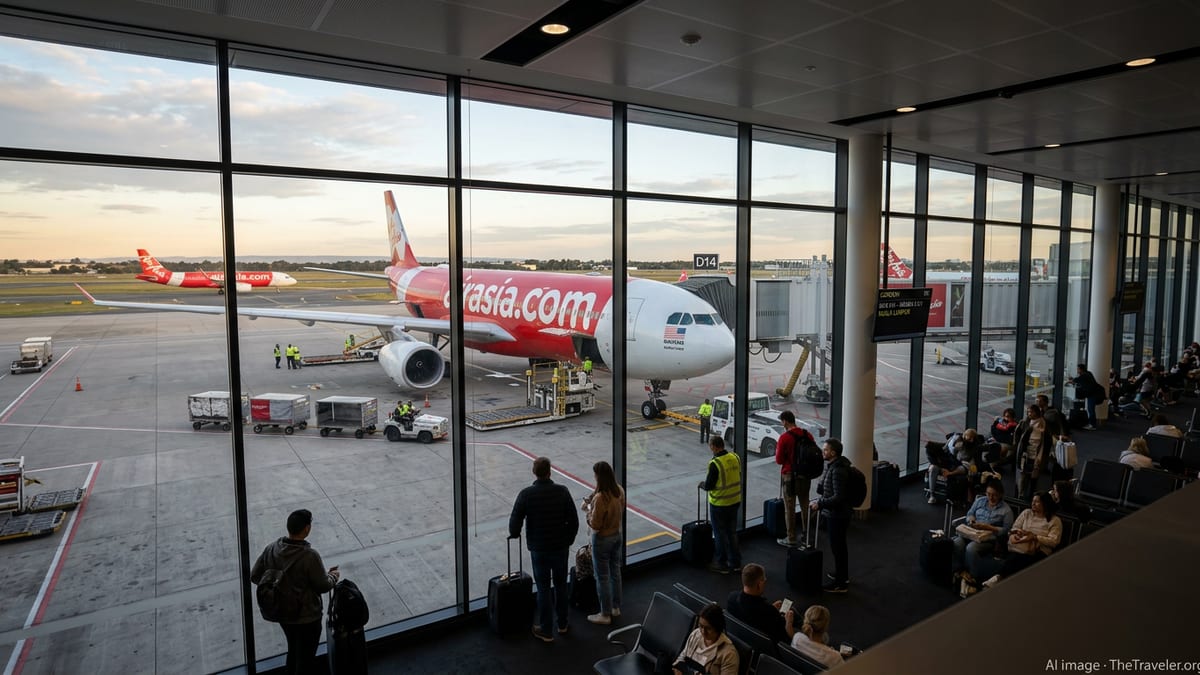
Domestic Network Growth From Bangkok to the Regions
Publicly available information shows that Thai AirAsia has continued to expand its domestic reach by layering new routes onto an already dense Thailand network. From Bangkok’s Suvarnabhumi Airport, the carrier is introducing new daily services to Chiang Rai and Nakhon Si Thammarat from 1 October 2025, strengthening links between the capital and both the far north and the lower south. These additions are designed to capture leisure and visiting-friends-and-relatives traffic that is expected to swell as the 2025–2026 travel season approaches.
Reports indicate that, with these new city pairs, Thai AirAsia will operate more than 40 domestic routes nationwide, giving it one of the broadest domestic offerings in Thailand. The airline’s dual presence at Don Mueang and Suvarnabhumi, complemented by regional operations from Chiang Mai and Phuket, allows it to distribute capacity according to demand patterns and airport preferences, which can be critical during the compressed high-season window.
Aviation-focused coverage notes that the strategy is part of a wider push to reinforce Thai AirAsia’s leadership in the domestic low-cost segment. Additional services from Bangkok are framed as an effort to meet strong internal demand while also supporting inbound international travelers who rely on domestic connections to reach secondary cities and island gateways.
Cross-Region Links Strengthen Northern and Northeastern Connectivity
The domestic build-out is not limited to capital-centric routes. In northern Thailand, Thai AirAsia has been adding cross-region flights that bypass Bangkok entirely, a move that reflects stronger point-to-point demand within the country. One of the headline additions is the Chiang Mai – Udon Thani route, scheduled to begin in December 2025 with multiple weekly frequencies. The link connects a key tourism and digital-nomad hub in the north with a major commercial center in the northeast.
According to specialist route-tracking publications, Thai AirAsia now operates numerous direct domestic services from Chiang Mai, including flights to Bangkok’s two main airports as well as to southern and central tourist destinations. By positioning Chiang Mai as more than just a spoke to Bangkok, the airline is helping to create a secondary domestic hub that can relieve pressure on the capital’s airports during peak months.
This cross-region model is also visible in the south, where Phuket has become a strategic base for both domestic and short-haul international services. While recent announcements have focused on routes such as Phuket – Medan, publicly available data also highlight intensive domestic schedules linking Phuket with both Bangkok airports and with Chiang Mai. These patterns collectively suggest a network built to keep more domestic traffic within Thai AirAsia’s system without forcing a transfer in Bangkok.
Fleet Expansion Positions Airline for 2026 Demand
Network growth is underpinned by aircraft availability. Asia Aviation, the majority shareholder of Thai AirAsia, reported that the airline ended 2025 with one of the largest narrowbody fleets in the Thai market, and signaled plans to add several more aircraft in the second half of 2026. Company disclosures project passenger traffic of around 23.5 million in 2026, supported by targeted capacity increases and optimized deployment across domestic and regional routes.
Investor presentations and financial updates show that Thai AirAsia has been gradually modernizing and enlarging its fleet, incorporating higher-capacity and more fuel-efficient Airbus A321neo aircraft alongside its A320 family jets. This mix is intended to provide flexibility: larger aircraft can be concentrated on high-density domestic routes during the peak travel season, while smaller units can serve thinner markets or shoulder-period frequencies.
At the broader group level, AirAsia’s recent order for 150 Airbus A220-300 aircraft, with deliveries set to begin in 2028, underscores a long-term commitment to short- and medium-haul efficiency across Southeast Asia. While these jets will enter service after the 2026 high season, the order signals a strategy of gradually replacing older narrowbodies and reinforcing the group’s ability to sustain low fares on domestic sectors in markets such as Thailand.
Tourism Outlook and Domestic Demand for 2026
The network and fleet moves are unfolding against a mixed tourism backdrop for Thailand. The Tourism Authority of Thailand projects domestic travel to reach roughly 206 million trips in 2026, with total tourism revenue of about 2.58 trillion baht. At the same time, official outlooks have been recalibrated to emphasize quality and spending per visitor, rather than headline arrival numbers alone, in line with a “value over volume” strategy.
Government and industry commentary indicates that the traditional high season, once stretching from roughly October through April, has become more compressed, with peak months now concentrated between November and February. Weather patterns, air quality concerns in the far north and shifting global travel preferences are all cited as contributing factors. This shorter window adds pressure on airlines to align capacity closely with seasonal peaks and adjust quickly if demand weakens.
External headwinds complicate the picture. International news coverage in 2026 has highlighted the impact of elevated jet fuel prices and geopolitical tensions on airlines operating in tourism-dependent economies, including Thailand. Higher operating costs and softer long-haul demand can translate into selective route reductions or frequency adjustments, even as carriers continue to invest in core domestic markets that feed the country’s tourism ecosystem.
Balancing Growth With Cost Pressures
Thai AirAsia’s latest financial disclosures for 2025 show revenue softness compared with the previous year, reflecting heightened competition, weaker foreign tourist confidence at times and broader economic uncertainty. However, the same reports emphasize that domestic services remain a cornerstone of the airline’s recovery strategy, with management prioritizing route optimization and cost discipline over pure capacity expansion.
Analyst commentary suggests that the dual-airport model in Bangkok and the extensive domestic network give Thai AirAsia room to reallocate capacity quickly as conditions change. Routes that perform strongly during the 2026 high season can be reinforced, while underperforming services may see adjusted frequencies or aircraft swaps. This flexibility may prove critical if global fuel prices remain volatile or if outbound and inbound travel sentiment shifts further.
For travelers, the expanding web of Thai AirAsia domestic flights means more choice of departure points, travel times and one-stop connections to smaller Thai destinations during the coming high season. For the airline, the challenge will be to sustain that network breadth profitably, using a growing and more efficient fleet to navigate a 2026 market defined by robust domestic demand, tighter high-season timeframes and persistent cost pressures.
AirAsia Newsroom: Bangkok Suvarnabhumi – Chiang Rai & Nakhon Si Thammarat launch
Asia Aviation PLC: 2025 financial results and 2026 outlook
Tourism Authority of Thailand: 2026 tourism projections
Associated Press: Cost pressures on Asian tourism and airlines