


Port Everglades in Fort Lauderdale is one of the busiest cruise ports in the world, serving Royal Caribbean, Celebrity, Princess, Holland America, Disney and more. Its location beside Fort Lauderdale–Hollywood International Airport makes it convenient, but the port’s size, multiple security checkpoints and many different terminals can confuse first-time cruisers. This step-by-step guide walks you through arrival, luggage, parking, security and check-in so embarkation day feels smooth instead of stressful.
Get the latest updates straight to your inbox!
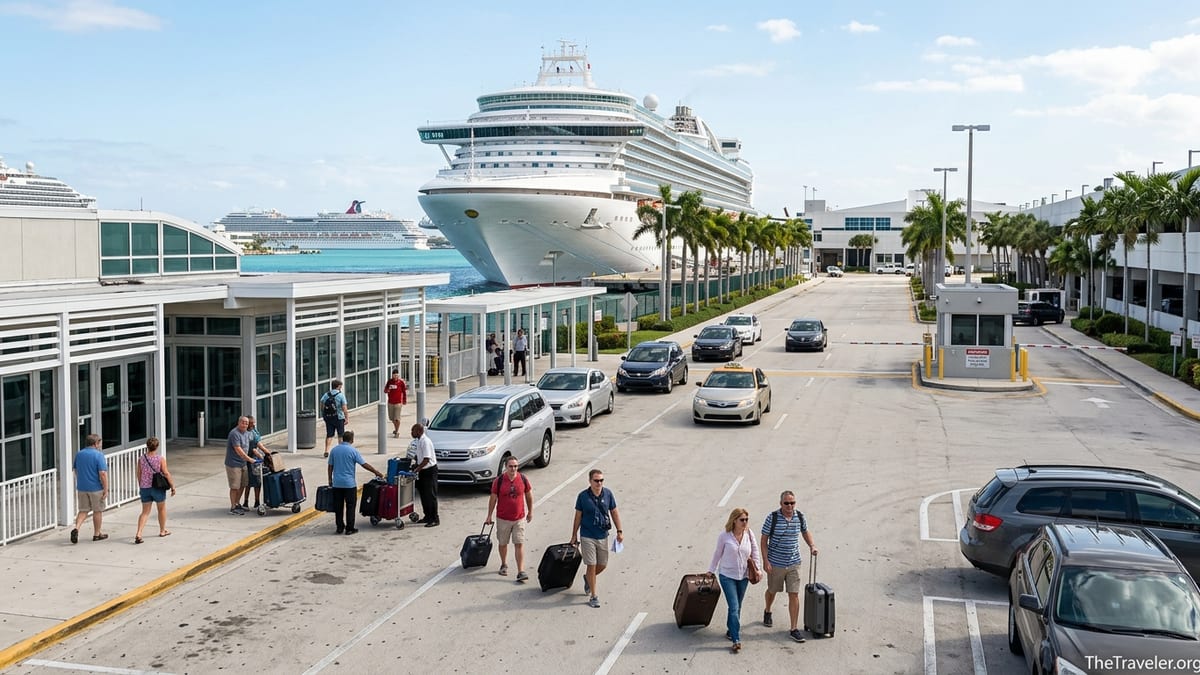
Understanding Port Everglades and Choosing Your Arrival Time
Port Everglades sits immediately east of Fort Lauderdale–Hollywood International Airport, with three main vehicle entrances and more than a dozen passenger terminals serving multiple cruise lines on any given day. On busy Saturdays in winter, it routinely handles several large ships boarding at the same time. That means traffic backups at the port security gates and congestion in front of popular terminals like 18 and 25. Giving yourself a realistic time buffer for these bottlenecks is essential, especially if you are checking bags and parking.
Most cruise lines sailing from Port Everglades now assign a port arrival window during online check-in, often in one-hour blocks. Royal Caribbean passengers commonly see times such as 11:00 a.m. to 11:30 a.m., while Disney Cruise Line and Princess often stagger guests from late morning through mid-afternoon. In practice, travelers report that arriving up to an hour earlier than the start of your window is usually accepted, particularly late morning when the terminal has cleared departing passengers. For example, one Royal Caribbean guest with a 1:00 p.m. arrival reported being dropped at Terminal 18 at 11:00 a.m. and walking onto the ship by 11:30 a.m. as boarding had already started.
If you are flying into Fort Lauderdale on embarkation morning, the airport is typically a 10 to 15 minute taxi or rideshare ride from the port in light traffic. Many frequent cruisers aim for flights landing before 11:00 a.m. for a ship departure around 4:00 p.m., which leaves time for baggage claim, a short wait for a ride and possible congestion at the port entrance. If you are driving from elsewhere in Florida, build in extra margin for Interstate 95 or Florida’s Turnpike traffic and potential weather delays, particularly during summer storm season.
Arriving too early can backfire. Before 10:00 a.m., terminals may still be full of disembarking guests, and security can hold new arrivals in outdoor queues until the building is cleared and screening stations are reset. As a rule of thumb, aim to arrive at the port roughly 30 to 60 minutes before your assigned arrival window if you want a head start, but avoid showing up more than three hours before your ship’s scheduled departure unless your cruise line explicitly invites you.
Parking First or Baggage First: What Works Best at Port Everglades
One of the biggest embarkation-day questions for drivers is whether to park first and then walk your luggage to the terminal or to drop your bags at the curb and then go park. Port Everglades can accommodate both approaches, but the “right” choice depends heavily on which terminal your ship uses and which parking facility serves it. The port operates multiple garages and surface lots, including the Heron Garage for the northern terminals and the Palm Garage plus several surface lots like Lots 18 and 19 for midport terminals.
At Terminal 18, a major home for Royal Caribbean’s large ships, there is a dedicated surface lot directly adjacent to the terminal plus nearby overflow. Many repeat cruisers report that parking first is easier here: you drive straight into the lot, park, roll your suitcases a short distance to the curb where porters are waiting and then head into the terminal together. Because the walk is relatively short and flat, even families with rolling bags or collapsible duffels usually find this manageable without an extra vehicle loop for curbside drop-off.
For terminals served primarily by larger garages such as the Palm Garage or Heron Garage, the decision can be more nuanced. If you are traveling with multiple large suitcases, children or older relatives, it is often more convenient to drive through the terminal’s curbside area first, tip a porter to take the checked luggage and then circle back to the garage. For example, a family sailing Princess from Terminal 2 might drop bags at the curb, then the driver alone continues up the ramp into the adjacent garage and uses the walkway over the street back to the terminal while everyone else waits near security. This avoids wrestling multiple suitcases into elevators or over bridges from the garage.
On very busy days, curbside lines for luggage drop can snake far down the street, and traffic control may direct vehicles to keep moving. In those situations, parking first and walking your bags can be less stressful than being stuck in a slow-moving lane with impatient drivers behind you. Before arrival, check your cruise documents and port information to confirm which terminal you are using and whether your garage directly abuts the building or is served by shuttle. If your ship uses a terminal supported by shuttle service from a shared garage, plan on dropping luggage at the terminal before parking so you do not have to bring large suitcases onto a crowded shuttle bus.
Luggage Drop-Off, Porters and What to Keep With You
At each Port Everglades cruise terminal, you will find a line of porters with large rolling carts positioned in front of the building or just inside the first security perimeter. Their job is to take checked luggage from passengers, group it by ship and cabin area and pass it to the stevedores who load it into the ship’s baggage handling system. You will attach your cruise line’s printed luggage tags to every checked bag before you hand it to a porter. Many guests print tags at home and secure them with clear plastic tag holders or strong tape; others pick up blank tags from port staff and fill them out curbside if they forgot.
Porters at Port Everglades work for the port or a contracted stevedore company, not the cruise line, and they are tipped workers. A widely used guideline is 1 to 2 dollars per bag, paid in cash. For instance, if a couple checks two large suitcases and one garment bag, a 5 dollar tip is typical. Some travelers tip more when bags are heavy or when a porter helps with additional tasks such as escorting a wheelchair-bound relative closer to the entrance. While tipping is technically optional, it is customary in this setting and helps ensure prompt handling.
Once you hand over a bag, you will not see it again until it appears outside your cabin later that afternoon or early evening. That makes it critical to keep a small carry-on or daypack with everything you might need for the first few hours on board. In practice, this means travel documents, medications, valuables such as electronics and jewelry, a swimsuit and sunscreen if you want to enjoy the pool early, and perhaps a change of clothes. Many cruisers at Port Everglades have reported that luggage often reaches hallways within one to three hours of boarding, but delays can occur if the ship is late docking, if there is a weather interruption or if port staffing is stretched thin.
Some cruise lines sell priority luggage services or bundled packages that promise faster delivery at Port Everglades, but traveler reports suggest that results can be inconsistent. In recent seasons, guests sailing premium lines from the port have commented that “priority” tags did not noticeably speed up delivery, since porters typically load bags as they receive them and the ship’s internal conveyors sort by deck and zone. It is safer to assume you will not have your checked suitcase until just before sail-away and plan your carry-on accordingly, rather than counting on an upgrade to close that gap.
Navigating Port Security and Terminal Check-In
Before you even reach the cruise terminal entrance, you will go through an initial port security checkpoint in your vehicle. At this outer gate, everyone aged 18 and older must be prepared to show a government-issued photo ID such as a driver’s license or passport along with cruise documents if requested. Security officers verify that your name matches the day’s passenger manifests and that you have legitimate business inside the restricted port area. During peak embarkation times, lines of cars and shuttles can stretch back toward the main road, so having documents in hand speeds this step considerably.
After clearing the vehicle gate and dropping luggage or parking, you will approach the terminal building itself for passenger screening. Just inside the entrance, port staff and cruise line representatives check your boarding pass and ID again, sometimes confirming your assigned check-in time or loyalty status. From there, you proceed to airport-style security machines where carry-ons pass through an X-ray belt and guests walk through metal detectors. Unlike at the airport, you generally do not remove shoes, but you should be ready to take laptops or large electronics out of bags if requested and place loose items like keys and phones into provided trays.
Once you have cleared security, you move into the main check-in hall. This area is usually divided into multiple zones: general check-in for standard cabins, priority lines for suites and elite loyalty members, and sometimes separate desks for special assistance or large groups. Cruise line staff will review your travel documents, verify citizenship information, confirm any required health questionnaires and take or verify your security photo. If your sailing uses physical keycards, they may be issued at the desk; many newer systems now deliver keycards in sealed envelopes at your stateroom door while using a digital boarding pass on the cruise line’s app to board.
When check-in is complete, you will either walk directly onto the ship via the gangway or be directed to a seated waiting area if boarding has not yet opened. At Port Everglades, boarding often begins in waves aligned with muster station zones or cabin decks. For example, guests in suites and upper loyalty tiers may board first, followed by those in earlier arrival groups. On many sailings, regular cabins begin boarding by late morning, and the ship is open to all embarked guests by early afternoon. If waiting, keep your carry-on with you, and resist the urge to open bottled beverages or snacks that might conflict with the cruise line’s stated policies while still in the terminal.
Documents, Identification and Special Considerations
Because Port Everglades handles both closed-loop Caribbean cruises and itineraries that touch foreign ports with stricter rules, having the correct identification and paperwork is critical. For most U.S. citizens on closed-loop sailings that begin and end in Fort Lauderdale and visit nearby Caribbean or Bahamas ports, a valid passport is strongly recommended but a government-issued photo ID plus an original or certified copy of a birth certificate may still be accepted. However, if your cruise includes certain destinations or if you are doing a repositioning itinerary that ends in a different port, a passport book is typically required. Non-U.S. citizens almost always need a valid passport and, in some cases, visas as determined by their itinerary and nationality.
In addition to identity documents, you will need your boarding pass, which can be printed or presented on a smartphone, and any health or travel forms the cruise line still uses. Many lines now rely on their mobile apps for expedited check-in, facial recognition at some terminals and digital boarding passes. For instance, Royal Caribbean and Celebrity guests with fully completed app check-in often move through dedicated lanes at Port Everglades, where staff simply scan the code on their phone and verify passports, shortening the time spent standing in line.
Travelers with mobility challenges or other special needs will find that Port Everglades terminals are generally modern and accessible, with ramps, elevators and designated drop-off zones. The on-site garages typically offer disabled parking near elevators, and the port waives parking fees for disabled persons driving their own vehicles and displaying appropriate state-issued permits. If you require wheelchair assistance, you can usually request it through your cruise line prior to sailing; on embarkation day, porters or contracted staff will meet you curbside or just inside the terminal and escort you through security and check-in.
Families traveling with children should make sure minors’ documents are organized together for swift presentation at each checkpoint. If a child is traveling with only one parent or with another adult such as a grandparent, carrying a notarized letter of consent from the non-traveling parent can prevent delays during check-in or immigration review, particularly on itineraries that include countries with stricter exit control practices. While such a letter may not always be requested, having it ready is an inexpensive safeguard against last-minute complications at the port.
Common Mistakes to Avoid on Embarkation Day
Many embarkation headaches at Port Everglades stem from avoidable planning mistakes rather than from the port itself. One frequent issue is flying into Fort Lauderdale or Miami on a tight schedule the same day the ship sails. A mid-afternoon arrival on a busy winter Saturday leaves little room for delays, and even a minor weather hold-up or baggage mishandling can threaten your ability to reach the port before final boarding. Regular cruisers often recommend arriving in South Florida at least one day before departure and staying at an airport or 17th Street-area hotel, which are a short taxi or rideshare ride from the port the next morning.
Another common misstep is forgetting to verify the correct terminal in the days before sailing. Port Everglades occasionally shifts ships between terminals based on construction, scheduling changes or simultaneous arrivals of multiple large vessels. If you rely solely on an old email or generic cruise documents, you might follow GPS directions to the wrong part of the port and then have to navigate internal roadways and road signs that can be confusing under pressure. Checking your cruise line’s app or most recent pre-cruise communication within 24 hours of departure helps ensure you drive directly to the right entrance.
At the curb, travelers sometimes hand over items to porters that should have stayed in carry-on bags, such as medications, travel documents, wedding attire for a same-day ceremony on board or electronics they plan to use immediately. Remember that checked luggage is not guaranteed to reach your stateroom before late afternoon. Also, do not pack prohibited items like irons, certain extension cords or large bottles of liquor in either checked or carry-on bags, as security screening at Port Everglades is rigorous and such items can be confiscated or hold up the line while your bag is pulled for manual inspection.
Finally, some guests underestimate sun and heat exposure while waiting outside terminals during peak times. Even on winter days, South Florida’s sun reflects off pavement and metal, and the front of some terminals provides limited shade. If you expect to arrive around the same time as several other ships’ passengers, carry a refillable water bottle, apply sunscreen and wear a hat or light clothing so a short delay in curbside or security lines does not leave you overheated before your vacation even starts.
Real-World Parking, Transport and Timing Examples
To put all of this into context, consider a family of four from Orlando driving to Port Everglades for a seven-night Caribbean cruise on a Royal Caribbean ship departing from Terminal 18. They leave Orlando at 7:00 a.m., arrive in Fort Lauderdale around 11:00 a.m. and follow signs to the midport entrance. After clearing the security gate with their driver’s licenses and boarding passes ready, they proceed directly to the parking lot adjacent to Terminal 18, find a spot within a few rows of the terminal and roll two large suitcases and a carry-on each to the curb. They tip a porter 6 dollars for handling the checked bags, keep swimsuits and medications in their backpacks and are through security and check-in by 11:45 a.m., in time for an early lunch on board.
In another scenario, a couple flying from the Midwest lands at Fort Lauderdale–Hollywood International Airport at 10:15 a.m. for a Holland America sailing from a midport terminal linked to the Palm Garage. After collecting bags, they follow airport signage to the taxi stand, where the flat-rate taxi fare to Port Everglades makes the 10 to 15 minute ride predictable. Because their assigned arrival time is 1:00 p.m., they ask the driver to drop them at the terminal around 11:45 a.m. Traffic into the port is moderate, they hand two tagged suitcases to a porter at the curb, then the driver continues directly out of the port without circling. By noon they are inside the terminal, have completed check-in and are seated in the waiting area until general boarding is announced.
A different example involves an extended family group on a Disney Cruise Line sailing using a northern terminal served by the Heron Garage and connected via a pedestrian bridge. The group includes grandparents who prefer to avoid long walks with luggage. They arrange for everyone and all checked bags to be dropped at the terminal entrance by a rideshare vehicle, tip the porter for seven large bags and then have the vehicle proceed up the ramp to the garage entrance. Only one adult rides along to handle payment and parking; once parked, that person takes the elevator up to the level with the pedestrian bridge and walks directly into the terminal to rejoin the family near security. This approach limits the distance the grandparents must walk while still taking advantage of the connected garage.
Finally, imagine a first-time cruiser staying at a 17th Street hotel the night before a Princess cruise. On embarkation morning, they request a late checkout at 12:00 p.m., then call a rideshare around 12:30 p.m. for the short ride to their assigned terminal. They arrive about 30 minutes before the start of their official arrival window, find that security lines are shorter than mid-morning rush, and are onboard with a drink in hand by mid-afternoon. Because they traveled with only carry-on-sized luggage, they bypass curbside porters entirely and wheel bags through security themselves, allowing them to access their belongings immediately without waiting for hallway delivery.
The Takeaway
Embarking on a cruise from Port Everglades can be straightforward and even relaxing if you understand how the port works and make a few smart decisions ahead of time. Knowing your exact terminal, deciding whether to park first or drop bags first based on that terminal’s layout, and giving yourself a realistic arrival window in relation to your flight or drive can eliminate much of the confusion that first-timers experience.
Focus on controlling the details you can: arrive in South Florida at least a day early when possible, print and attach luggage tags before you reach the port, keep essentials in a carry-on you will not check, and have identification ready both at the vehicle gate and at terminal security. Respect the rhythms of the port by avoiding the earliest crush of arrivals if your schedule allows, and remember that port staff and cruise line agents process thousands of guests every embarkation day, so clear communication and patience go a long way.
With thoughtful planning and an understanding of Port Everglades’ specific procedures, embarkation day becomes a smooth on-ramp to your vacation rather than a stressful obstacle. By following the practical, real-world tips in this guide, you can step aboard confident that you have navigated one of America’s busiest cruise ports like a seasoned traveler.
FAQ
Q1. How early should I arrive at Port Everglades before my cruise?
Most travelers aim to reach the port 30 to 60 minutes before their assigned arrival window and no more than about three hours before scheduled departure, which balances avoiding the earliest crowds while allowing time for traffic, security and check-in.
Q2. Is it better to park first or drop luggage first at Port Everglades?
If your terminal has parking directly adjacent, such as Terminal 18’s surface lot, parking first and then walking luggage to the curb usually works well; if you are using a shared garage or shuttle, many guests prefer to drop checked bags and companions at the terminal curb, then have the driver park and walk or shuttle back.
Q3. How much should I tip the porters for luggage handling?
A common guideline at Port Everglades is 1 to 2 dollars per checked bag, adjusted upward if bags are very heavy or if the porter provides extra assistance, and paid in cash at drop-off.
Q4. What ID and documents do I need to show at the port?
Adults must present a government-issued photo ID at the vehicle security gate and the terminal, and most guests will also need a valid passport or, for some closed-loop U.S. citizen sailings, a photo ID plus an original or certified birth certificate, along with their boarding pass and any required cruise forms.
Q5. How long does it take to get from Fort Lauderdale Airport to Port Everglades?
In typical conditions the ride from Fort Lauderdale–Hollywood International Airport to the port takes around 10 to 15 minutes by taxi or rideshare, but you should budget extra time during peak cruise weekends or heavy traffic.
Q6. When will my checked luggage arrive at my cabin?
While timing varies by ship and port congestion, many guests at Port Everglades see their checked bags outside their stateroom within one to three hours of boarding, though it can be later if there are delays or if you board early in the day.
Q7. Can I walk from my hotel to Port Everglades?
Some hotels on 17th Street and near the port are physically close, but walking is often impractical or unsafe because access roads pass through secure areas; most travelers use short taxi or rideshare rides instead of walking into the port.
Q8. What if I arrive at the port earlier than my assigned arrival time?
Port staff often allow guests who are slightly early to enter and check in once the terminal is ready, but if you are very early you may be asked to wait outside until disembarking passengers have cleared and security screening is reset.
Q9. Is parking at Port Everglades safe and is there accessible parking?
Port garages and lots are patrolled and well lit, and they offer designated accessible parking near elevators or terminal walkways; drivers with qualifying disability permits may have parking fees waived according to current port policy.
Q10. What happens if my flight is delayed on embarkation day?
If a delay threatens your ability to reach Port Everglades before final boarding, contact your cruise line as soon as you are aware of the issue so they can advise you; this risk is a major reason many experienced cruisers choose to fly in at least one day before departure.