


More news on this day
Port Tampa Bay is preparing roughly five acres of waterfront land for a future cruise terminal, marking a new phase in the port’s strategy to capture rising cruise demand on Florida’s Gulf Coast while reshaping valuable downtown-adjacent property.
Get the latest news straight to your inbox!
Site preparation signals long-planned cruise expansion
Recent planning documents and local development reports indicate that Port Tampa Bay has begun clearing and grading about five acres within its central waterfront footprint, positioning the site for a new cruise terminal. The work appears focused on readying the land with utility access, roadway connections and shoreline improvements so the port can move quickly once a final terminal design and funding package are in place.
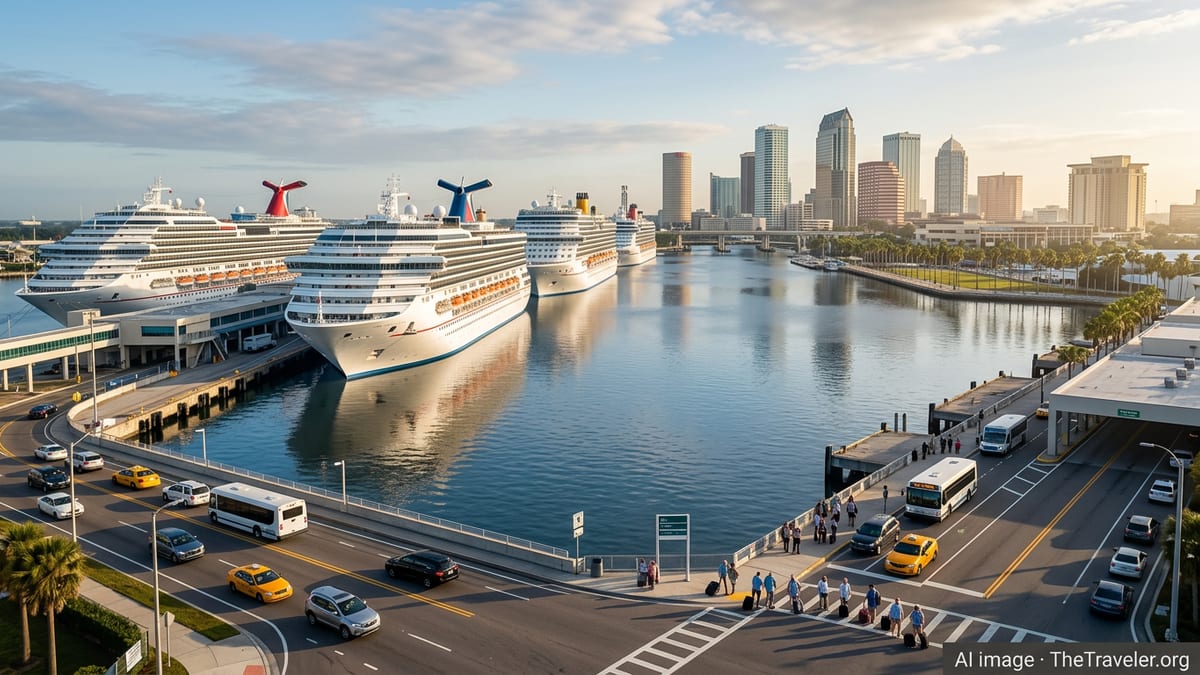
The prepared acreage is understood to sit within the port’s core cruise and mixed-use zone, close to existing terminals that serve major brands such as Carnival Cruise Line, Royal Caribbean International, Norwegian Cruise Line, Holland America Line and Margaritaville at Sea. Publicly available information shows the port has been studying options for a fourth primary cruise facility for several years, seeking additional berth and processing capacity beyond its current downtown terminals.
The new five-acre pad is expected to accommodate a modern embarkation building, security and screening areas, staging lanes for coaches and rideshare traffic, and related support space such as provisioning and baggage handling. The configuration would be designed to interface with nearby road networks and parking structures while maintaining separation between cruise operations and adjacent commercial or residential development.
Port planning documents in recent Florida seaport reports describe future cruise infrastructure as a priority to keep up with vessel deployments and itinerary growth along the Gulf of Mexico. The prepared land represents a tangible step from long-range plans toward a build-ready site that could attract new or expanded commitments from cruise brands.
Growing cruise demand on Florida’s Gulf Coast
Port Tampa Bay already ranks among Florida’s established homeports, serving multiple year-round and seasonal ships that sail to the Caribbean and Mexico. Statewide cruise assessments note that Tampa’s passenger volumes rebounded strongly after the pandemic and continue to trend upward as lines redeploy capacity and experiment with new itineraries from the Gulf Coast.
Analysts of Florida’s cruise sector point to several factors behind the interest in additional Tampa capacity. The port draws from a large drive-in market across central Florida and the Southeast, offering an alternative to the busier ports on the Atlantic coast. Its location on Tampa Bay provides relatively sheltered access to the Gulf, which can be attractive for deployment of older or mid-sized ships that fit under the region’s bridge constraints.
Industry commentary also suggests that cruise lines are looking for more flexibility in their Florida homeport mix, balancing operations among Miami, Port Canaveral, Port Everglades and Gulf-side facilities. A new or expanded terminal at Port Tampa Bay would give operators an additional embarkation point for Western Caribbean and Mexico routes, potentially easing pressure on terminals elsewhere in the state.
By preparing land in advance, the port positions itself to respond quickly if cruise lines seek dedicated berths or tailored facilities. Observers note that the current wave of terminal investments at competing Florida ports has often been tied to specific long-term agreements with individual brands, with building designs optimized around particular classes of ships.
Balancing cruise growth with waterfront redevelopment
The five-acre cruise site preparation is unfolding amid a broader transformation of Tampa’s urban waterfront, where industrial parcels are gradually giving way to mixed-use districts. In recent years, areas around Sparkman Wharf, Water Street Tampa and Ybor-adjacent tracts have seen a surge of residential, office and entertainment projects that sit close to working port facilities.
Urban development commentary in the region has highlighted lingering tensions between preserving deep-water berths for maritime trade and unlocking prime real estate for higher-value uses such as housing and tourism. Cruise terminals occupy some of the most visible waterfront parcels, which has prompted periodic discussion about whether cruise infrastructure should remain concentrated downtown or shift toward more peripheral sites over the long term.
Within this context, port strategists appear to be using the five-acre preparation to reconfigure how cruise operations fit into the evolving cityscape. A new terminal footprint could help consolidate passenger processing, free up smaller legacy structures for repurposing, or allow cruise-related traffic to be routed more efficiently around planned residential and commercial blocks.
Planning materials for future projects around the port reference coordinated roadway improvements, upgraded bulkheads and utility work that support both maritime operations and adjacent private development. The current site preparation is consistent with that dual-track approach, in which infrastructure is laid out to serve cruise activity while keeping options open for integrated urban design along the waterfront.
Competitive landscape and ship size constraints
Any new cruise terminal at Port Tampa Bay will need to contend with physical limitations that differentiate the port from its Atlantic coast rivals. The iconic Sunshine Skyway Bridge at the mouth of Tampa Bay has an air draft that prevents the largest new-generation cruise ships from reaching downtown berths, a constraint frequently cited in industry discussions and traveler forums.
This limitation has historically steered the biggest vessels toward ports such as Miami, Port Everglades and Port Canaveral, while Tampa has specialized in older and mid-sized ships that can safely pass under the bridge. Recent proposals by private companies for additional cruise facilities elsewhere in the bay region, closer to open water, underscore ongoing interest in accommodating larger ships outside the current downtown approach channel.
Port Tampa Bay’s five-acre preparation effort is generally viewed as an incremental enhancement to its existing cruise cluster rather than a fundamental solution to the ship-size constraint. However, by modernizing its infrastructure and streamlining passenger flows, the port may strengthen its position as a niche homeport for select vessels and itineraries that match its physical profile.
Regional maritime observers note that cruise demand does not depend solely on the newest or largest ship classes. Many passengers value convenient drive-to access, familiar brands and manageable terminal experiences, all of which Tampa can continue to offer with upgraded facilities on its existing waterfront.
Timeline and next steps for a future terminal
While the five-acre site is being prepared, a definitive construction timeline for a new cruise terminal has not been publicly finalized. Port planning documents and project lists identify cruise-related design work, civil engineering and bulkhead improvements as prospective initiatives over the next several planning cycles, suggesting that detailed terminal architecture and financing arrangements are still to come.
Observers of Florida port development note that major terminal projects frequently advance in stages, beginning with land preparation and utility work, followed by design procurement, environmental review and, ultimately, construction tied to a specific cruise line partnership. The current activity at Port Tampa Bay appears consistent with this phased approach, focusing first on creating a flexible, development-ready pad.
Local business and tourism stakeholders are expected to watch the next steps closely, as a new terminal could bring additional embarkation days, provisioning activity and visitor spending into the downtown core. At the same time, community discussions around traffic, air quality and waterfront access are likely to shape how any new cruise infrastructure is integrated with surrounding neighborhoods.
For now, the prepared five-acre site stands as a visible marker of Port Tampa Bay’s intent to stay in the cruise market’s competitive mix. As Florida’s cruise industry continues to expand, the port’s ability to translate that graded land into a functioning terminal will help determine how much of the sector’s growth flows through Tampa’s evolving waterfront.