


Portugal’s financial infrastructure combines a mature eurozone banking system with one of Europe’s most advanced domestic payment networks. For prospective expats, understanding how the banking sector, payment rails, digital tools and consumer protections work in practice is essential for assessing day-to-day financial usability after relocation.
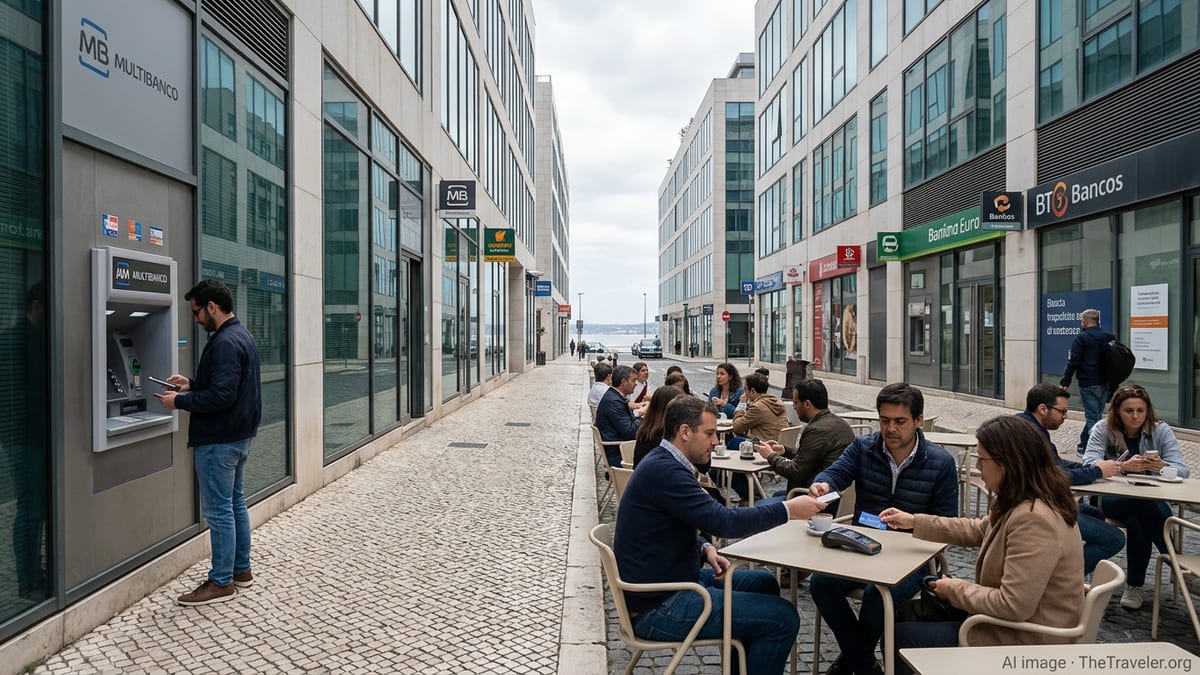
Overview of Portugal’s Financial Infrastructure for Expats
Portugal operates within the eurozone’s integrated financial framework, using the euro as its currency and relying on European Central Bank regulation and Single Euro Payments Area standards. This positions the country within a highly standardized cross-border payments environment, which simplifies transfers and card usage between Portugal and other European Economic Area countries.
The domestic layer of this system is distinctive. Portugal’s Multibanco and MB Way ecosystem is widely regarded as one of Europe’s most developed national payment networks, enabling card payments, ATM services, bill settlement and mobile instant transfers across practically all banks and merchants. Multibanco connects the ATMs and point-of-sale terminals of more than two dozen banks, supporting tens of thousands of machines and terminals nationwide, creating dense coverage for cash withdrawals and card payments in urban and regional areas alike.
Digitalisation levels are high and rising. Recent data from Banco de Portugal and industry studies indicate that roughly three-quarters of adults use some form of digital banking, with mobile payment adoption in major cities estimated in the mid‑60 percent range. This environment underpins a generally strong financial infrastructure score for expats, particularly those comfortable with online and mobile channels.
For relocation planning, this means that opening accounts, moving funds, managing recurring payments and transacting in daily life can usually be performed using robust electronic channels. However, expats must also understand the local specificity of tools such as Multibanco references and MB Way, as these differ from typical US or non‑euro systems and can be a learning curve in the first months.
Banking System Structure and Accessibility
Portugal’s banking sector is concentrated in a handful of large universal banks and a second tier of mid‑sized and regional institutions. A 2024 industry report from the Portuguese Banking Association highlights a system dominated by several major banking groups, with smaller cooperative and savings banks completing the landscape. The sector is regulated and supervised by Banco de Portugal within the eurozone prudential framework, which provides a standard of stability broadly similar to other Western European markets.
Retail banking penetration is high, with the vast majority of residents holding at least one current account. Branch networks have been rationalised over the last decade in response to digitalisation, but physical presence remains relatively dense in cities and mid‑sized towns. For expats, this means that in urban centres, in‑person access to banking services is readily available, although smaller rural communities may now rely more on ATMs and online banking than on local branches.
From an infrastructure standpoint, account offerings are broadly in line with other eurozone countries. Standard services include current accounts with debit cards, online and mobile banking, domestic and SEPA transfers, and access to overdrafts and consumer credit subject to credit assessment. The entire system is fully integrated with SEPA credit transfer and SEPA instant payment standards, supporting low‑cost euro transfers across Europe and instant transfers for participating institutions.
For expats, a critical dimension of the financial infrastructure score is interoperability with foreign banks. Portuguese banks accept standard international card schemes, and SEPA ensures straightforward euro transfers within the European area. Transfers from outside SEPA, such as from the United States, typically route via correspondent banks and can be slower and more expensive, but this reflects global banking practices rather than a Portugal‑specific weakness.
Payment Networks: Multibanco and Card Infrastructure
Multibanco is the backbone of Portugal’s retail payments infrastructure. Operated by SIBS, it connects ATMs and point‑of‑sale terminals of around 27 banks and supports not only cash withdrawals but also a wide range of functions including bill payments, tax payments, mobile phone top‑ups and government fees. By the mid‑2010s there were over 12,000 Multibanco ATMs in operation, and while absolute numbers fluctuate, coverage remains extensive across urban and non‑urban areas. This density gives Portugal one of the more accessible ATM networks in Europe for residents and expats alike.
At point of sale, both Multibanco debit cards and international Visa and Mastercard products are widely accepted, especially in supermarkets, fuel stations, chain retailers and most service providers. The network supports EMV chip and contactless transactions, and it is common for merchants to accept small contactless payments with low or zero minimums. Smaller independent businesses and certain trades may still prefer cash or Multibanco card payments, but broad card acceptance contributes positively to the overall financial usability for new arrivals.
Multibanco also underpins a unique reference payment system. Many invoices and online purchases in Portugal allow customers to choose “Multibanco” at checkout, generating a reference number that can be paid via ATM, online banking or mobile apps. For expats, mastering this mechanism is important because it is frequently used for utilities, insurance premiums, e‑commerce and government charges. The underlying infrastructure is robust and highly reliable, but new users must adapt to using references rather than direct card entry in many domestic transactions.
Overall, the card and ATM infrastructure in Portugal is mature, integrated and stable. The combination of an interbank domestic network and global scheme acceptance gives expats multiple options for payments and cash access, and significantly reduces the risk of being dependent on a single provider or channel.
Digital Payments, MB Way and Instant Transfers
Portugal’s mobile payment environment is anchored by MB Way, a digital wallet and mobile app launched by SIBS around 2015 and built on the Multibanco network. MB Way allows users to link a mobile phone number to one or more bank cards or accounts, enabling instant transfers between users, QR code and contactless payments in stores, virtual card creation for online purchases, and cardless ATM withdrawals. Industry materials indicate that MB Way now serves well over 5 million users in a country of roughly 10 million people, and is described as the leading mobile wallet with an estimated share approaching half of domestic e‑commerce transactions.
In practical terms, this makes MB Way the default peer‑to‑peer payment method in Portugal. It is widely used among residents for splitting bills, paying small merchants, sending money between friends and family, and topping up certain services. For expats who open Portuguese bank accounts, activation is often as simple as linking the bank card to the MB Way app or activating the service via a Multibanco ATM. Once enabled, instant transfers between MB Way users are typically executed in seconds, leveraging SEPA instant rails at the interbank level.
Recent developments further strengthen the system’s cross‑border dimensions. In late 2024 and into 2025, SIBS, Spain’s Bizum and Italy’s Bancomat launched interoperability under the European Payments Alliance initiative, enabling instant mobile payments between users in the three countries using their domestic apps. Press announcements and news coverage describe this as a step towards a broader pan‑European mobile payments market built on SEPA Instant standards. For expats with ties to Spain or Italy, this emerging interoperability can significantly reduce friction in small cross‑border transfers and reimbursements.
From a financial infrastructure scoring perspective, MB Way and its integration with Multibanco and SEPA Instant place Portugal near the top tier of European countries in terms of everyday digital payment usability. New arrivals accustomed to US‑style peer‑to‑peer apps or UK faster payments generally find an equivalent or superior experience once fully onboarded into the Portuguese system.
Fintech, Open Banking and Digital Banking Tools
Portugal is subject to the European Union’s PSD2 framework, which mandates open banking interfaces and strong customer authentication for electronic payments. Open banking trackers confirm that major Portuguese banks have live APIs supporting account information and payment initiation services for licensed third‑party providers. In practice, this underpins a growing ecosystem of budgeting apps, account aggregators and specialised payment services that can connect to Portuguese bank accounts with user consent.
Digital banking adoption is widespread. Bank and consultancy reports suggest that around 78 percent of adults now use digital banking in some form, with mobile banking apps and web platforms central to everyday account management. Expat‑relevant features, such as bilingual interfaces and English‑language support, vary by bank, but the core infrastructure for secure log‑in, two‑factor authentication, biometric access and real‑time transaction monitoring is firmly established across the sector.
The country has also seen strong uptake in pan‑European fintech solutions, including international digital banks and multi‑currency wallets that are authorised elsewhere in the EU but passport services into Portugal. These providers typically issue IBANs, payment cards and mobile apps that integrate smoothly into the Portuguese payments ecosystem, including support for SEPA transfers and, increasingly, local methods such as Multibanco and MB Way via partnerships. For expats, this creates flexibility to maintain a hybrid setup combining a local bank with a digital provider optimised for cross‑border transfers or multi‑currency holdings.
While Portugal is not yet a primary global fintech hub, regulatory openness combined with robust national payment rails gives it a favourable financial infrastructure profile. For expats, the key implication is choice: it is generally possible to tailor a stack of local and international financial tools to personal needs, with most major categories of service covered by multiple providers.
Consumer Protection, Security and Fraud Landscape
Consumer protection in Portugal’s financial system is largely aligned with European norms. Bank deposits in EU‑regulated banks are covered by the national deposit guarantee scheme up to 100,000 euros per depositor and institution, which is standard across the eurozone. Banking conduct is supervised by Banco de Portugal, while payment services must comply with PSD2 security requirements, including strong customer authentication and clear disclosure of fees and conditions.
Payment security on Multibanco cards and MB Way is based on EMV chip and PIN, secure app authentication and, for online transactions, strong two‑factor authentication. Industry materials stress that MB Way is designed to offer security levels comparable to or better than conventional card payments, including one‑time codes for virtual cards and granular control over transaction limits. However, as in other countries, the main vulnerabilities tend to be social‑engineering scams, particularly targeting new or inattentive users who can be persuaded to authorise transfers or share codes.
Expats should therefore factor in the learning curve around Portuguese payment flows as part of their risk assessment. Common scam vectors reported in expat communities include fraudulent buyers requesting MB Way “receiving” operations that are actually outgoing transfers, and phishing attempts imitating banks or government bodies requesting authentication codes. The underlying infrastructure is technically robust, but personal security hygiene remains essential.
Dispute resolution frameworks exist for unauthorised transactions, and banks are generally obliged under EU rules to refund clearly unauthorised electronic payments once reported promptly, subject to investigative procedures and user liability caps. However, where users have themselves authorised transfers under deception or shared sensitive credentials, recovery can be more complex. Overall, the system provides a high baseline of consumer protection, but expats should receive and understand security briefings from their banks and take advantage of features such as transaction alerts and low per‑transaction limits in mobile apps.
Practical Usability for Expats and Common Pain Points
On balance, Portugal’s financial infrastructure is highly usable for expats once fully integrated into the domestic system. Day‑to‑day transactions, including rent payments, utilities, mobile contracts, supermarket purchases and transport, can typically be handled using a mix of Multibanco card payments, mobile banking and MB Way. The strong penetration of contactless terminals and mobile wallets reduces the need for cash in most urban settings.
However, there are several practical friction points that prospective movers should anticipate. First, many domestic billers and e‑commerce merchants rely on Multibanco reference payments rather than card‑on‑file models common in North America. This means that even after setting up a bank account, expats must learn how to input references via ATM or app, and understand associated deadlines. Second, some government and municipal payments, including certain tax or fee obligations, may only be payable via Multibanco or MB Way, which can pose challenges before a local account and phone number are established.
Third, while SEPA significantly facilitates euro transfers within Europe, inbound transfers from outside the eurozone can still be slower and higher‑cost than expats may expect. International digital banks and specialised money transfer providers can mitigate this, but require additional setup and understanding of regulatory compliance such as source‑of‑funds documentation. Finally, English‑language documentation and app interfaces, although available at many institutions, are not universal and may be less complete for certain services, requiring additional care during onboarding and configuration.
Despite these issues, most expats report that the financial operating environment becomes straightforward after an initial adaptation period. Once accustomed to Portuguese‑style payment references, MB Way flows and SEPA transfers, users typically benefit from fast, inexpensive transactions and a high degree of digital convenience relative to many other relocation destinations.
The Takeaway
Portugal’s financial infrastructure score for expats can be characterised as strong to very strong across the main dimensions of banking stability, payment network coverage, digital capability and regulatory protection. Integration into the eurozone and SEPA provides a predictable macro framework, while the country’s distinctive Multibanco and MB Way ecosystem delivers high‑functionality everyday payments and instant transfers.
For relocation decision making, the main considerations are practical rather than structural. Expats should plan for an initial learning period around Multibanco references and MB Way usage, ensure early access to a Portuguese bank account to unlock the full capabilities of domestic payment rails, and implement robust personal security practices against social‑engineering fraud. Once these elements are in place, Portugal offers a highly efficient environment for managing personal finances, supporting both routine local transactions and cross‑border movements of funds.
FAQ
Q1. How advanced is Portugal’s banking and payment infrastructure compared with other EU countries?
Portugal’s banking system operates under eurozone standards, while its Multibanco and MB Way network is often considered among the most advanced domestic payment ecosystems in Europe, particularly for instant and mobile payments.
Q2. Do I need a Portuguese bank account to use MB Way and Multibanco?
To use MB Way fully and pay Multibanco references easily, a Portuguese bank account linked to the Multibanco network is typically required. Limited functionality may be available via certain foreign fintechs, but domestic accounts offer the smoothest experience.
Q3. Are international cards widely accepted in Portugal?
Yes. Visa and Mastercard are widely accepted in supermarkets, fuel stations, chain stores and many services. However, some smaller merchants may prefer Multibanco debit payments or cash, so having a Portuguese card can still be advantageous.
Q4. How common are instant bank transfers in Portugal?
Instant transfers are very common, primarily via MB Way and SEPA instant payments between participating banks. Peer‑to‑peer transfers between MB Way users are usually completed in seconds and widely used in everyday life.
Q5. Can I easily send money between Portugal and other EU countries?
Within the eurozone, SEPA transfers make sending euros relatively simple and cost‑effective. Instant SEPA payments are increasingly supported, and MB Way now has growing interoperability with Spain’s Bizum and Italy’s Bancomat mobile systems.
Q6. How strong are consumer protections in the Portuguese banking system?
Portugal follows EU rules on deposit guarantees and electronic payment protections. Deposits in EU‑regulated banks are protected up to 100,000 euros per depositor, and banks must apply strong customer authentication and clear disclosure of fees.
Q7. Is mobile and online banking widely used in Portugal?
Yes. The majority of adults use digital banking, and mobile apps are the main interface for many customers. Most banks offer full account management, transfers, bill payments and card controls online and via mobile.
Q8. Are there significant risks of fraud when using MB Way and online banking?
The technical infrastructure is secure and uses strong authentication, but social‑engineering scams do occur, particularly around MB Way transfers. Users should never share codes, approve unfamiliar requests or follow payment instructions from unverified contacts.
Q9. How easy is it to pay government bills and taxes using Portugal’s financial infrastructure?
Many government and municipal payments are designed to be made via Multibanco references or MB Way. Once a local bank account and access to ATMs or mobile banking are in place, these payments are generally straightforward and fast.
Q10. Can I rely primarily on digital payments or will I still need cash?
In cities and large towns, most everyday transactions can be handled with cards, contactless terminals and MB Way. Cash is still useful for small independent businesses or rural areas, but reliance on cash is lower than in many non‑euro countries.