


More news on this day
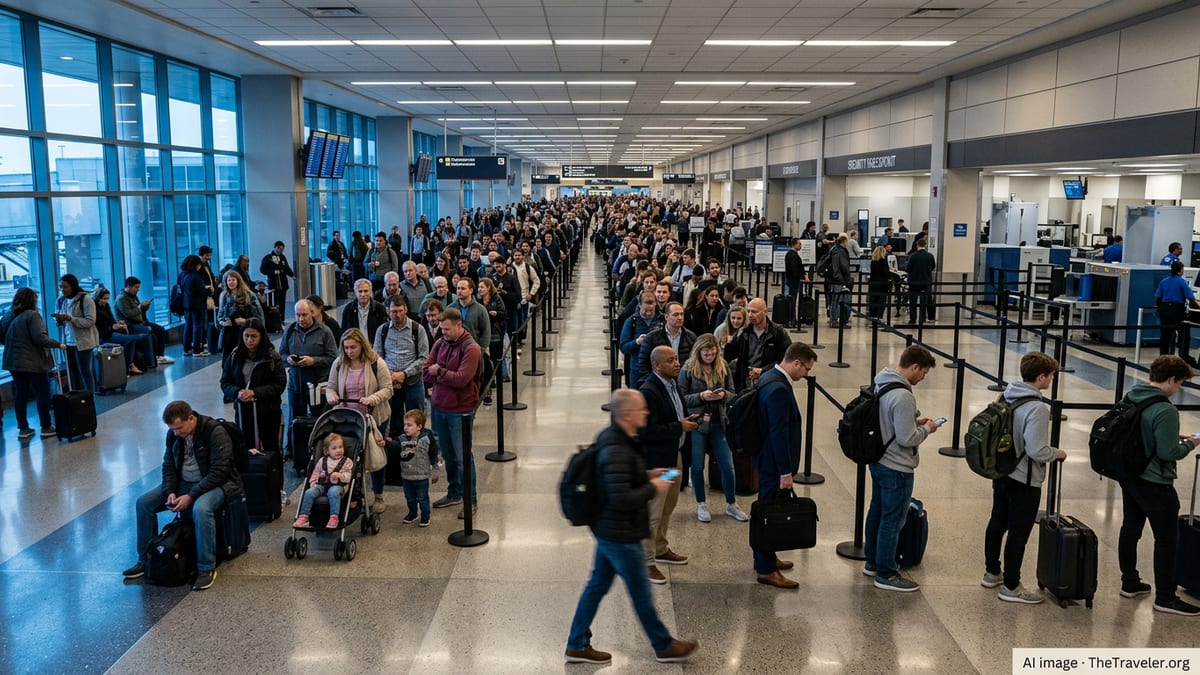
Hundreds of passengers were left queueing for hours at London Stansted Airport after a sudden power surge disrupted key terminal systems, with images on social media showing crowds packed into departure halls, security lanes and baggage reclaim areas during one of the busiest weekends of the UK half-term travel period.
Get the latest news straight to your inbox!
Power surge hits at peak half-term getaway
Published coverage indicates that the disruption began on Sunday 25 October 2026, when a brief but powerful electrical surge affected both Stansted Airport and parts of the surrounding Essex area. Reports suggest that the incident occurred during the late morning and early afternoon, coinciding with heavy half-term traffic at the airport, which handles around 85,000 passengers on a typical day.
According to multiple UK news outlets, the electrical disturbance led to a power cut or significant drop in voltage that temporarily knocked out or degraded a range of airport systems. Security screening equipment, baggage handling belts and immigration controls were among the areas reported to have been affected, forcing staff to fall back on contingency procedures.
Airport statements quoted in local and regional media described the event as a power surge that had a knock-on effect across parts of the terminal and airfield operation. While the underlying cause had not been fully detailed by 28 October, power to the wider site was reported to have been restored relatively quickly, even as staff worked to bring individual systems back online and move through a mounting passenger backlog.
The timing compounded wider travel problems that had already affected passengers heading to and from London Stansted over the same weekend, including earlier rail disruption and weather-related issues linked to a passing autumn storm system.
Images show queues stretching across terminal
Photos shared by passengers and reproduced in outlets such as AOL, BBC local radio reports and travel-focused sites show long, tightly packed queues stretching across Stansted’s single terminal. Images from near the security area capture snaking lines filling the queuing hall and spilling back into check-in zones, with passengers standing shoulder to shoulder in the main concourse.
Other widely shared pictures show arriving passengers jammed in corridors and at baggage reclaim, with people clustered around static carousels and waiting for updates. Some images depict travellers sitting on the floor beside their luggage, using suitcases as makeshift seats as they waited for movement in the queues.
Further coverage highlights that the airport’s shuttle system, which normally carries passengers between the main terminal and certain gates, was also affected around the same period by a separate technical fault. With the automated transit out of service, replacement bus transfers were put into operation. Reports suggest that this added another layer of delay for some arriving and departing flights as passengers had to be moved in smaller groups.
While the precise number of people caught up in the disruption has not been confirmed, visual evidence and passenger accounts collected by UK broadcasters and online news sites point to several hundred travellers, and likely many more, being directly impacted over a period of several hours.
Delays, missed flights and knock-on disruption
Publicly available information from local and national media indicates that security queues at Stansted reached around two hours for some passengers at the height of the disruption. With screening lanes operating at reduced capacity, airlines delayed a number of departures to allow additional time for travellers to clear security.
Reports on travel and general news sites describe a mixed picture regarding flight operations. Many services eventually departed with delays ranging from modest to several hours, while some passengers reported missing flights entirely after being caught in the queues. In several accounts, travellers said they reached their gate only after the aircraft door had closed, even where they had arrived at the airport well ahead of the usual check-in window.
Baggage handling issues were also highlighted, with some arriving customers describing long waits for luggage while ground systems were reset. A combination of strained terminal facilities, shuttle problems and earlier rail disruption meant that, for some, onward connections by train or coach were also lost, extending journeys late into the evening.
Consumer reports note that compensation for missed flights in situations involving airport infrastructure failures can be complex, because responsibility is often shared between different parties, including airlines, airport operators and external utility providers. Early commentary suggests that affected passengers are being advised to retain receipts and records of their travel in case of later claims, but detailed guidance is still evolving as the picture of the incident becomes clearer.
Stansted’s resilience under renewed scrutiny
The incident has renewed attention on electrical resilience at Stansted and other major UK airports. Previous government and industry documents have identified power cuts and voltage spikes as key operational risks for large aviation hubs, noting that a single failure can quickly cascade across security, check-in, airfield lighting and passenger welfare systems.
Background material on Stansted’s infrastructure, including climate adaptation and resilience planning papers, points to work in recent years to strengthen backup power, surge protection and uninterruptible power supplies. However, travel analysts quoted in UK media coverage note that even short-lived disturbances can still cause prolonged disruption because complex systems must be restarted, rechecked and resynchronised before normal operation can resume.
The latest disruption also comes after a broader period of strain on UK aviation infrastructure, including air traffic control problems, e-gate failures and separate rail outages affecting access to major airports. Observers suggest that the Stansted incident illustrates how overlapping vulnerabilities in grid power, IT systems and ground transport can quickly converge on passengers, particularly during peak holiday periods.
While early reports indicate that safety was not compromised during the power surge at Stansted, the scale of inconvenience experienced by passengers has prompted renewed discussion about investment in redundancy, real-time communication tools and contingency planning for sudden loss-of-power scenarios at busy single-terminal airports.
What travelers can expect in the coming days
By Tuesday 27 October and into Wednesday 28 October, reports from regional media and passenger updates on social platforms suggested that operations at London Stansted had largely returned to normal, with security queues closer to usual levels and flight schedules running broadly as planned.
Airport information feeds and travel advisories nonetheless continued to recommend that passengers allow additional time before departure during the immediate aftermath of the incident, particularly in the early mornings when security and check-in are busiest. For half-term and weekend departures, a target of arriving three hours before short-haul flights and even earlier for long-haul connections has been widely advised in light of recent events.
Travel commentators note that the episode is likely to prompt further review of how disruption information is shared in real time inside terminals, including the use of public address systems, display boards and digital channels. Passengers caught in the queues reported differing experiences on how quickly and clearly information was relayed, and this is expected to be a focus for both the airport operator and airlines.
In the meantime, those planning to travel through Stansted in the coming days are being encouraged, in published travel guidance, to check flight status regularly, build in extra time for security and baggage, and be prepared for occasional residual delays as systems and schedules fully stabilise after the power surge.