


More news on this day
The United Kingdom has significantly tightened its official travel advice across the Middle East in late October 2026, with the Foreign, Commonwealth and Development Office highlighting a high risk of sudden regional escalation, new no‑go areas and the growing possibility of flight and airspace disruption for British travellers.
Get the latest news straight to your inbox!
Expanded warnings across conflict-affected states
Updated UK government travel advisories for Israel, the Palestinian territories and Lebanon underline how quickly conditions have deteriorated across parts of the Middle East. On the Israel country page, guidance current as of 27 October 2026 states that the situation in the wider region is deeply unpredictable and that the risk of sudden escalation remains high. The advisory notes that there have been strikes and retaliatory attacks linked to the conflict that began in early 2026, and warns that locations associated with the United States and Israel may be targeted.
In practical terms, the UK advises against all travel to Gaza and areas immediately surrounding the Strip, against all travel to specified governorates in the northern West Bank, and against all or all but essential travel to parts of Israel close to active fronts. Travellers are told that journeys within or out of Israel and the occupied Palestinian territories are at their own risk and are urged to check whether roads, rail services and border crossings are open before moving.
Lebanon has seen some of the starkest changes in advice. Official UK guidance now warns against all travel to active conflict zones in the south and to areas near the Syrian border, as well as against all but essential travel to large parts of the rest of the country, citing exchanges of fire along the Israel–Lebanon frontier, internal instability and the spillover effects of regional tensions. Other states, including Iran, Iraq, Syria and Yemen, remain subject to long-standing “do not travel” warnings, which have been reinforced in the context of the 2026 Iran-related conflict.
Regional escalation risk and air travel disruption
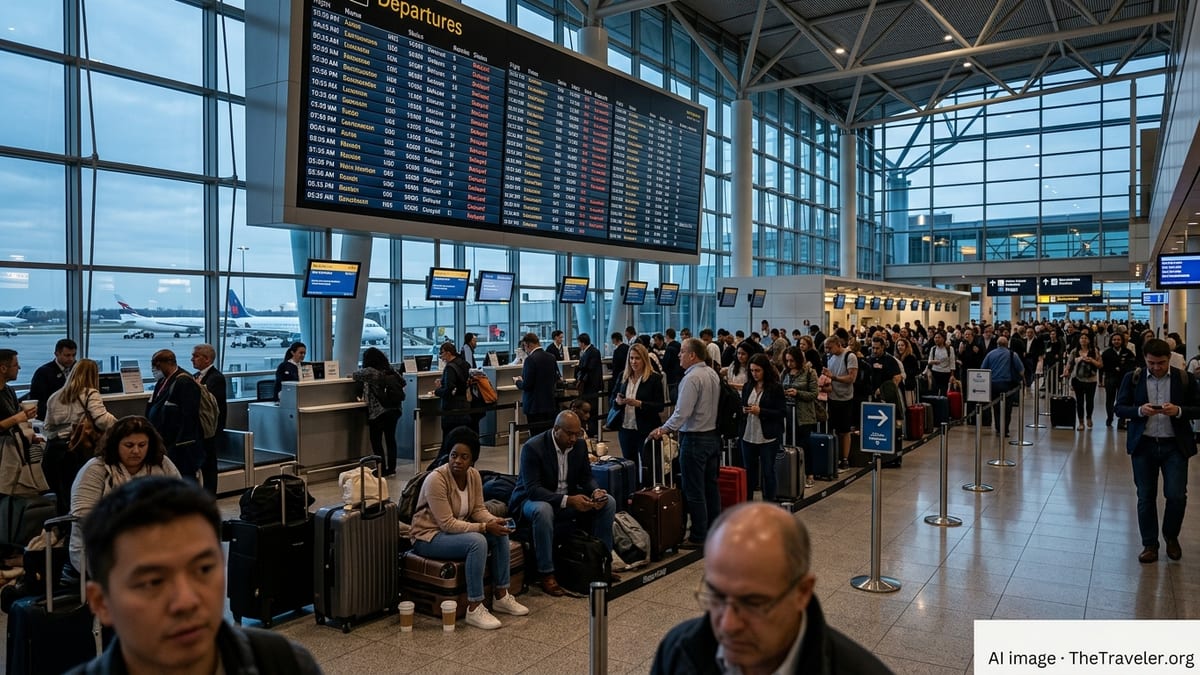
The latest wording on the Israel advice page stresses that British nationals in or planning to travel through the broader Middle East should be prepared for possible flight cancellations, airspace closures and wider travel disruption at short notice. The guidance reflects a pattern seen since early 2026, when large-scale military events prompted temporary closures or restrictions on airspace over Israel, Iran, Iraq, Syria and several Gulf states, triggering widespread diversions and suspensions by international carriers.
A series of aviation notices and risk briefings from European regulators and travel-security firms in October 2026 continue to flag the Strait of Hormuz and surrounding air routes as among the highest-risk corridors for civil aviation and maritime traffic. Some advisories recommend that airlines avoid parts of Gulf and adjacent airspace or operate with specific routing and altitude restrictions, contributing to longer flight times and, in some cases, reduced connectivity through major hubs.
Industry-facing circulars show that UK travel insurers and corporate security providers are closely aligning their policies with official Foreign Office ratings. Where the government advises against all but essential travel or all travel to a destination, many standard leisure and business insurance policies either exclude cover entirely or restrict it to narrowly defined circumstances. As a result, even travellers whose flights are technically still operating may find that they are unable to secure comprehensive cover for trips into higher-risk parts of the region.
Impact on Gulf hubs and connecting itineraries
While much of the heaviest fighting is concentrated in and around Israel, Lebanon and adjacent theatres, there are consequences for travellers transiting through Gulf states that traditionally serve as major long-haul hubs for UK passengers. Trade and travel bodies report that the Foreign Office has moved Saudi Arabia into an “all but essential travel” category as of mid-October 2026 and continues to update its advice for neighbouring states including Qatar, the United Arab Emirates, Bahrain, Kuwait and Oman in response to evolving security assessments.
Travel risk briefings published in October 2026 describe a mixed picture on the ground. In some Gulf capitals daily life and commercial activity have continued largely as normal, albeit with heightened security around airports, government compounds and critical infrastructure. At the same time, travellers are warned that a sudden escalation involving Iranian or US-linked targets could prompt rapid changes to airspace status, temporary suspension of certain routes, or short-notice re-routing of flights that normally overfly higher-risk areas.
This environment complicates itineraries that rely on Gulf stopovers. British nationals connecting through Doha, Dubai, Abu Dhabi or other hubs are advised in public guidance and industry circulars to monitor airline notifications closely, keep flexible tickets where possible, and allow for potential overnight delays if schedules are disrupted. Some corporate travel departments have introduced temporary restrictions on routing staff through specific hubs for non-essential trips, even where direct government advice stops short of a formal travel warning.
Consular capacity, registration and crisis planning
The tightening of travel advice has been accompanied by measures to manage expectations about what assistance the UK can provide if the situation deteriorates further. Published briefings to Parliament earlier in 2026 set out that consular support is often severely constrained or unavailable in active conflict areas such as Gaza, parts of southern Lebanon, Yemen and parts of Syria, where security conditions limit the ability of officials to operate.
Guidance released on 1 March 2026 encouraged British nationals in a number of higher-risk countries, including Bahrain, Israel, Kuwait, Lebanon, Palestine, Qatar and the United Arab Emirates, to register their presence with the government in order to receive direct updates in the event of a crisis. Subsequent travel-advice updates have continued to recommend that UK nationals sign up for email alerts for each relevant country and review online guidance on how to prepare for and respond to emergencies abroad.
The Foreign Office emphasises in its public-facing material that travel insurance may be invalidated if individuals choose to visit or remain in areas where the UK advises against all travel or all but essential travel. Travellers are urged to check the precise wording of their policies, including any exclusions relating to war, terrorism and civil unrest, before departure, and to ensure that they have contingency funds and plans in place if commercial options to leave a country become limited.
What the changes mean for UK travellers and the industry
For leisure travellers, the most immediate effect of the tightened warnings is a shrinking pool of destinations that are realistically viable for holidays or independent trips. Some tour operators have suspended departures to affected countries entirely, rerouting customers to alternative destinations, while others are offering date changes or credits where government advice has invalidated insurance or made operations untenable.
Business travellers and expatriate workers face more complex decisions. Corporate risk teams are weighing contractual obligations against duty-of-care concerns, often using Foreign Office ratings as a baseline. Employees are being asked to undergo more rigorous risk assessments before authorisation is granted for travel into or through higher-risk Middle Eastern locations, and some firms have temporarily frozen non-essential site visits in sensitive areas.
For the wider aviation and hospitality sectors, the tightened UK stance reinforces a broader pattern of volatility since early 2026. Airlines with substantial exposure to Middle Eastern routes are adjusting capacity and contingency plans to reflect the possibility of further escalation, while hotel groups in relatively stable parts of the region are working to reassure guests and corporate clients about on-site security measures. Industry analysis published in recent months suggests that even if the conflict does not widen significantly, sustained perception of risk could delay a full recovery of long-haul demand through key Middle Eastern gateways into 2027.