


More news on this day
The United Kingdom has widened its travel warning across much of the Middle East, updating advice for 16 countries as the government highlights a highly unpredictable security environment and the risk of sudden escalation affecting air travel, consular support and insurance cover for British nationals.
Get the latest news straight to your inbox!
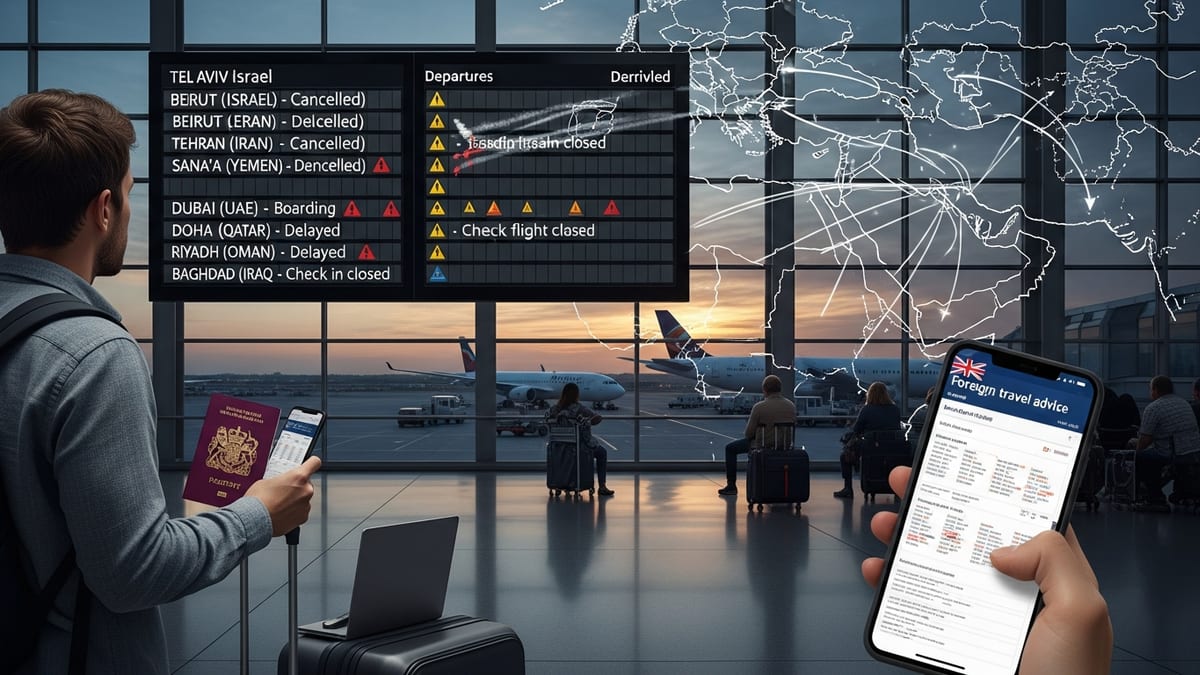
Expanded Warnings Across 16 Middle East Destinations
Updated Foreign, Commonwealth and Development Office travel advice issued in late October 2026 now flags heightened regional risk across a broad swathe of the Middle East, including Turkey, Egypt, the United Arab Emirates, Jordan, Oman, Qatar, Pakistan, Bahrain, Saudi Arabia, Iraq, Yemen, Kuwait, the Palestinian territories, Israel, Syria and Iran. According to published coverage of the latest changes, the overarching message is that the regional context remains deeply unpredictable and that the risk of sudden escalation is high.
On the official country pages for Iran, Iraq, Israel and several Gulf states, UK travel advisories now carry a common regional-tensions section. Publicly available information shows that the language has been strengthened since mid-2026 to refer explicitly to missile and drone strikes, retaliatory attacks and stated intentions by Iran to target locations associated with the United States and Israel, including organisations, businesses and infrastructure across the region.
For some destinations, such as Saudi Arabia, Yemen and parts of Iraq, the UK government already advised against all travel or against all but essential travel. Recent updates have broadened that approach to entire national territories in certain cases, rather than restricting the warning to specific provinces or border regions. Travellers reviewing the advice now see extensive red and amber areas on the UK’s interactive foreign travel map for the region.
Media reports on the latest round of changes indicate that the UK move aligns with a wider international pattern. The United States has renewed its worldwide caution notice, Australia and New Zealand have upgraded warnings for several Gulf states and the European Union Aviation Safety Agency has issued guidance to carriers regarding conflict-affected airspace.
Escalation Risk Tied to Iran–US–Israel Confrontation
The strengthened UK travel warnings are closely tied to the escalation of hostilities between Iran and a United States–Israel military alignment that intensified in early 2026. Analyses by security consultancies and travel-risk firms describe the crisis as a regional conflict that spilled across borders following high-profile strikes and the death of senior Iranian figures, triggering retaliatory missile and drone attacks on targets in Israel and on US military facilities throughout the Middle East.
Official UK travel pages for Iran, Iraq, Saudi Arabia and the United Arab Emirates now underline that there have been strikes and retaliatory attacks in multiple locations, affecting both civilian and military infrastructure. Advisories describe an ongoing risk of further military escalation across the region, including in strategic corridors such as the Red Sea, and emphasise that new incidents could occur with little or no warning.
The updated language repeatedly notes that British nationals in or transiting through the Middle East should be prepared for airspace closures, last-minute flight cancellations and broader travel disruption. The wording highlights not only direct security threats but also knock-on operational impacts, such as diversions away from major aviation hubs in the Gulf and temporary suspensions on certain routes.
Travel-security briefings published this year suggest that, although the intensity of strikes has varied over time, the underlying drivers of the confrontation remain unresolved. That assessment informs the UK government’s decision to maintain a cautious posture and to caution that the situation could deteriorate rapidly even after periods of relative calm.
Implications for Flights, Routing and Travel Insurance
The most immediate impact for travellers is on flight reliability and routing. Industry circulars and university travel advisories note that airspace over parts of Iran, Iraq, Israel, Syria, Qatar, Bahrain, Kuwait and segments of the Gulf has faced periodic closures or operational restrictions since the escalation began in early 2026. Airlines have responded by rerouting services around conflict zones, introducing longer flight times and, in some cases, suspending connections through key Middle Eastern hubs for defined periods.
UK government travel pages explicitly warn that British nationals should keep departure plans under close review and be ready for short-notice schedule changes. Examples cited in official and academic guidance include simultaneous airspace closures and the temporary shutdown of land crossings, such as the King Fahd Causeway between Bahrain and Saudi Arabia earlier this year, which left some travellers needing to rearrange exits via alternative routes.
Travel insurance is another critical area affected by the expanded warnings. UK guidance stresses that policies may be invalidated if a traveller visits a destination where the Foreign, Commonwealth and Development Office advises against all travel or against all but essential travel. Advisory notices from universities and corporate risk managers reiterate that conflict-related disruption is now widely regarded as a foreseeable risk, meaning that future cancellations or diversions linked to renewed escalation might not qualify for reimbursement under standard policies.
Travel-risk specialists recommend that individuals heading to the wider region, even to countries still rated at lower advisory levels, check for war, terrorism and political-violence exclusions in their insurance documents. Prospective visitors are also urged in public guidance to confirm that their airline and accommodation providers offer flexible change or cancellation terms in case the security environment worsens.
What the Warnings Mean for Leisure and Business Travellers
For leisure travellers, the widened UK warnings translate into a need for careful route planning and a lower risk tolerance. While some destinations such as parts of the Gulf continue to receive large volumes of visitors, recent advisories urge Britons to weigh the benefits of travel against the possibility of disruption and the constraints on consular assistance in higher-risk countries. Travel discussion forums show that some visitors have already postponed or rerouted holidays that would have involved transits through affected hubs.
Business travel faces additional challenges. Corporate security and human-resources teams are now benchmarking itineraries against the latest UK foreign travel map and associated risk assessments. Guidance shared by professional associations in the travel and hospitality sector encourages companies to avoid non-essential trips to locations subject to “against all but essential travel” advisories, to document risk-mitigation measures for journeys that must proceed and to ensure that employees can opt out of travel to high-risk areas without penalty.
In practical terms, publicly available guidance recommends that travellers who still plan to visit or transit the region register for Foreign, Commonwealth and Development Office email alerts, monitor local and international media before and during trips, keep passports and key documents readily accessible and maintain a basic contingency plan for rapid departure if conditions deteriorate.
Universities and large organisations are also revisiting their duty-of-care policies for staff and students abroad, with several institutional advisories emphasising pre-trip security briefings, stricter approval processes for itineraries involving conflict-adjacent states and close coordination with travel providers in case of sudden route changes.
How Prospective Visitors Can Respond to the New Landscape
The widened UK travel warning does not automatically prohibit trips to the Middle East, but it establishes a higher bar for what is considered an acceptable level of risk. For travellers contemplating journeys in late 2026 and early 2027, the first step is to consult the latest Foreign, Commonwealth and Development Office advice for both their destination and any transit points, as the updated language stresses that individuals merely passing through airports in the region may still be affected by security incidents or airspace decisions.
Experts contributing to publicly accessible travel-risk reports suggest that travellers should build more redundancy into their plans, allowing time for missed connections, holding confirmed bookings on alternative routings where possible and being prepared for longer, indirect journeys that avoid certain airspace. They also underline the importance of ensuring that family or employers at home have up-to-date itineraries and contact details in case communication networks are disrupted.
There is no clear indication in open-source government material of when the current level of caution might be relaxed. The recurring phrasing in UK and allied travel advisories is that the security context remains fluid and that escalation can happen with little warning. In that environment, the widened UK travel warning functions less as a snapshot and more as an evolving framework that travellers will need to monitor closely in the months ahead.