


Public transportation in Thailand is a critical factor for expatriates assessing daily mobility, commuting feasibility, and long term settlement patterns. While Bangkok offers one of Southeast Asia’s more extensive multimodal networks, coverage and reliability vary sharply between the capital, secondary cities, and provincial areas. Understanding what public transport can and cannot provide in practice is essential for evaluating whether a car free or transit dependent lifestyle is realistic after relocation.
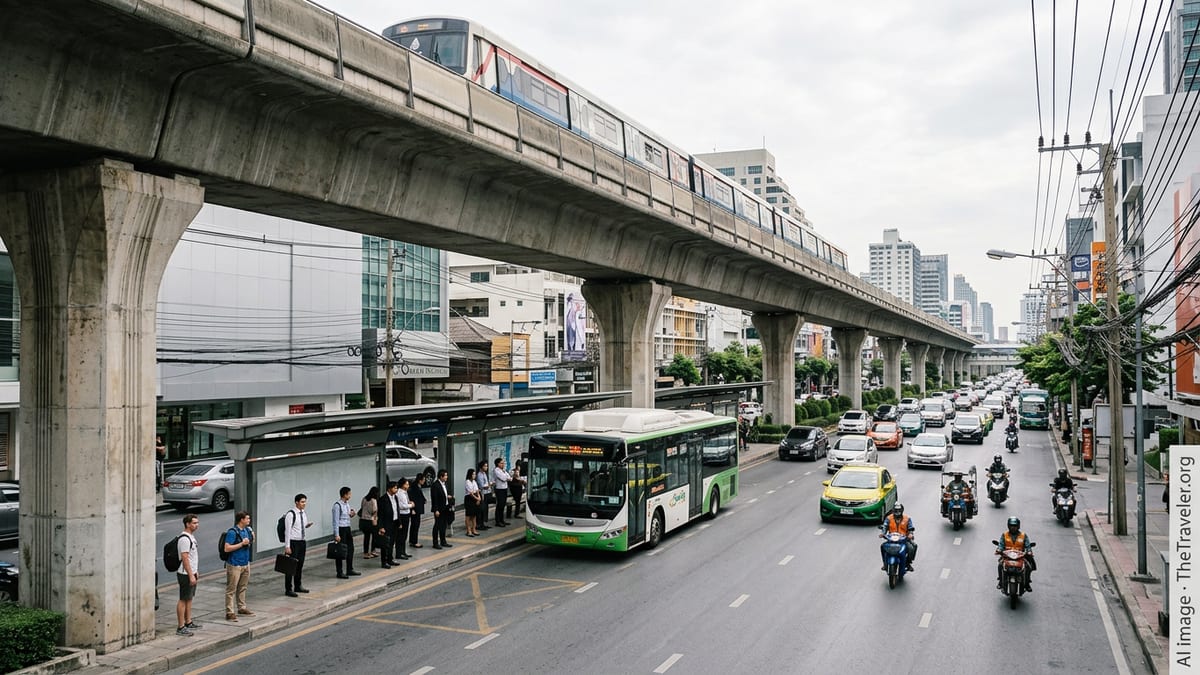
Overview of Thailand’s Public Transport Landscape
Thailand’s public transportation is highly uneven by geography. Bangkok and its surrounding provinces have a dense but fragmented mix of elevated rail, underground metro, commuter rail, buses, vans, motorcycle taxis, and river or canal boats. Outside the capital, long distance buses and interprovincial vans form the backbone of mobility between cities, while within cities many residents rely on songthaews, motorcycle taxis, and private cars rather than formal urban transit systems.
For expatriates, this means expectations must be calibrated to location. In central Bangkok, it is feasible to rely primarily on rail and app based ride hailing, with only occasional need for private vehicles. In most provincial cities, by contrast, public transport is geared toward low cost, low frequency services and assumes widespread motorcycle or car ownership. Daily commuting by formal mass transit is often not an option outside a few urban centers such as Bangkok, Chiang Mai, and to a lesser degree Phuket and Pattaya.
Regulatory oversight is split among several national and local agencies, and many services are operated by private concessionaires under government contracts. This creates complexity in ticketing, fare policy, and service planning. Expatriates can expect modern, air conditioned, punctual rail systems running alongside aging buses and informal services whose schedules and practices may change with relatively little notice.
Overall, Thailand’s public transport is extensive in coverage at the national level but inconsistent in quality and user friendliness. Its suitability for a long term resident depends on specific neighborhood choices, tolerance for modal transfers, and willingness to mix formal and informal transport options on a daily basis.
Bangkok Rail Systems: Coverage, Reliability, and Fares
Bangkok’s rail network includes several distinct systems: the BTS Skytrain (elevated), the MRT (underground and elevated Blue and Purple lines plus monorail style Pink and Yellow lines), the Airport Rail Link to Suvarnabhumi Airport, and the SRT Red Line commuter rail. Collectively these lines now cover most of the core business districts, major residential corridors, and key suburban hubs, and have been progressively extended through 2024 and 2025.
Service hours on the main lines typically run from approximately 5:30–6:00 in the morning to around midnight, with trains every 3–6 minutes at peak times and 5–10 minutes off peak. Reliability is generally high, though occasional service suspensions due to infrastructure incidents or regional events have occurred in recent years. Crowding is substantial during rush hours, especially on the BTS Sukhumvit Line and MRT Blue Line, and expatriates should anticipate standing for several stops if traveling between 7:00–9:30 in the morning or 17:00–19:30 in the evening.
Fares remain distance based on most lines. As of early 2026, regular adult fares on core BTS and MRT corridors typically fall in a band of roughly 17–45 baht per trip depending on distance, with maximum through fares across certain interconnected lines reaching the low 60 baht range for the longest trips. Periodic government policies have introduced temporary flat fare caps or discounts on selected lines or for registered Thai citizens; expatriates without Thai nationality may not always be eligible for these schemes and should plan using standard distance based fares as a baseline.
Monthly passes and stored value cards can reduce effective per trip costs. The Mangmoom style common ticket has expanded acceptance across multiple MRT operated lines, while BTS relies heavily on its Rabbit card and associated trip packages. However, full integration across all systems remains incomplete, and expatriates should expect to manage at least two separate cards if they use both BTS and MRT regularly.
Bangkok Buses, Vans, and Feeder Services
Bangkok’s surface public transport comprises an extensive but complex network of buses, bus rapid transit style corridors, and shared vans. The Bangkok Mass Transit Authority manages a large fleet of conventional buses, supplemented by privately operated routes and newer electric buses such as the Thai Smile Bus network, which by 2025 has deployed over one hundred routes across the metropolitan region. Services range from non air conditioned older buses charging low single digit baht fares to modern air conditioned models with higher, but still modest, fares.
Routes and numbers can be difficult to interpret for newcomers because of overlapping services, route variants, and changing stop locations due to road works or traffic management. Timetables are rarely adhered to in a strict sense; instead, headways are approximate, with more frequent service on main corridors and sparser coverage late at night or on less busy routes. Trip times are highly sensitive to road congestion, which is severe during peak periods. Expatriates relying on buses for commuting should budget significant buffer time and consider them more suitable as feeders to rail lines than as primary long haul modes during rush hours.
Large air conditioned vans, once a widespread intercity and suburban option, have been progressively brought under tighter regulation and shifted into formal terminals. They still operate important links between Bangkok and neighboring provinces and between city center and outer suburbs. While cost effective, they can be crowded, and luggage space is limited, which reduces their practicality for airport travel or moves involving bulky items.
Several rail lines, especially newer MRT monorail routes, are supported by official feeder buses or contracted shuttle services that connect stations with residential areas or business parks. Coverage is uneven and may change as ridership patterns evolve. In some newer suburbs, these feeders can make a car free lifestyle feasible, but in many neighborhoods, last mile access still depends on motorcycle taxis or walking on narrow or discontinuous sidewalks.
Informal and On Demand Modes: Taxis, Motorcycle Taxis, and Ride Hailing
Metered taxis are widely available in Bangkok and present a key complement to mass transit. Since 2023, the official starting fare in the capital has been around 40 baht for the first kilometer, with incremental charges for additional distance and time in traffic. A typical cross town trip in moderate traffic might fall in the 120–250 baht range, while an airport journey from central districts often runs in the 300–500 baht band before tolls and airport surcharges. For expatriates, these levels are moderate compared with many Western cities but can accumulate for daily commuting.
Operational issues are significant. Refusal to use the meter, selective acceptance of passengers, and route manipulation to increase fares are documented concerns, particularly in tourist heavy areas and during peak demand. Regulatory enforcement has improved over time, but expatriates should be prepared to insist on meter usage, decline inflated fixed price offers, and, when possible, board taxis from official stands rather than ad hoc street solicitations in front of malls and tourist venues.
Motorcycle taxis provide hyper local, point to point services ideal for short hops down sois and for connecting from a main road to residential compounds. Pricing is generally regulated by distance band but in practice is often negotiated; very short rides may cost 10–20 baht, with longer neighborhood trips rising into the 30–60 baht range. Safety standards vary, and helmets are not always strictly provided or worn, although legally required. For relocation planning, motorcycle taxis are important primarily as a last mile solution rather than a main commuting mode for those concerned about road safety.
App based ride hailing through platforms such as Grab and local competitors is now well established in major cities. These services offer greater fare transparency and electronic receipts, which can be valuable for expense reporting or employer sponsored commuting programs. However, surge pricing during peak hours or bad weather can significantly raise costs, and pick up times in suburban or provincial areas may be longer. Some app based services utilize licensed taxis running on meters plus a booking fee, while others use private vehicles with app calculated fares; expatriates should review the tariff structure in the app and monitor final charges to avoid disputes.
Public Transport Outside Bangkok: Regional and Provincial Realities
Beyond the Bangkok Metropolitan Region, Thailand’s public transportation is dominated by intercity buses and national rail for longer distances and by informal or semi formal modes inside cities. The State Railway of Thailand operates long distance trains linking Bangkok to Chiang Mai, the northeast, the eastern seaboard, and the south. Rail travel is cost effective but can be slow on older lines, and schedules may not be conducive to daily commuting. For most expatriates in provincial areas, these services are used sporadically for regional travel rather than daily mobility.
Long distance buses run from Bangkok’s main terminals and from provincial cities to almost every part of the country. There is a clear hierarchy, from basic government operated buses with low fares and frequent stops to higher end private operators offering more comfortable seating and fewer stops. Journey times depend heavily on road conditions, but for planning purposes, a 700–800 kilometer trip might reasonably take 10–12 hours by bus. For residents, these services are fundamental for occasional interprovincial trips, though not relevant to day to day commuting within a city.
Within provincial cities and towns, formal urban bus networks are underdeveloped. Many areas rely on songthaews, which are pickup trucks fitted with bench seating that follow semi fixed routes, along with local buses, tuk tuks, motorcycle taxis, and informal shared taxis. Fares for these modes are generally low, often in the 10–30 baht range for typical intra city trips, but schedules and routes are rarely documented in English or fixed on posted timetables. For expatriates, this environment can be navigable with local support or after a learning period, but it complicates rigid car free lifestyles outside Bangkok.
Popular expatriate destinations such as Chiang Mai, Phuket, and Pattaya have denser networks of songthaews and tuk tuks, along with moderate coverage from app based ride hailing services. However, limited late night service, weather exposure, and inconsistent route enforcement mean that many long term foreign residents in these locations eventually acquire motorcycles or cars for reliability and flexibility, especially if living or working outside central districts.
Ticketing, Payment, and Accessibility Considerations
Payment mechanisms differ across modes. Bangkok rail systems use contactless smart cards and QR code based single journey tickets purchased from vending machines or counters. Expatriates can expect English language interfaces at most ticket machines and bilingual signage in stations. Stored value cards such as Rabbit and Mangmoom offer convenience and discounted packages but require initial deposits and periodic top ups; automatic top up via local bank accounts or credit cards is gradually becoming more common but may require Thai banking relationships.
Buses, songthaews, and many informal modes still rely on cash payment to conductors or drivers. Exact change is helpful but not strictly required on most urban buses. Intercity buses and trains increasingly support online booking and mobile tickets, though physical ticket windows remain important for same day departures and for travelers paying in cash. Expatriates should anticipate carrying small denomination banknotes for daily local trips, especially in provincial settings where contactless payment adoption is slower.
From an accessibility perspective, Bangkok’s newer rail systems offer elevators, escalators, tactile paving, and priority seating, but last mile infrastructure can be a constraint. Sidewalks around some stations are narrow, uneven, or interrupted by street vendors, making wheelchair or stroller access challenging despite station level accessibility features. Older bus fleets are often not low floor and may be difficult to board for those with mobility impairments. Provincial and informal modes typically lack systematic accessibility adaptations.
Language is a further consideration. Station announcements on major rail lines are in Thai and English, and signage includes Romanized station names. On buses and informal modes, English usage is far more limited, and route information is commonly displayed only in Thai script. Expatriates intending to rely on these services will benefit from learning basic Thai numerals and place names or from using mapping applications that support real time navigation and route identification.
Planning a Transit Dependent Lifestyle in Thailand
For expatriates wishing to minimize car ownership, Thailand offers realistic options in specific contexts. A transit dependent lifestyle is most viable for those living and working within walking distance of central Bangkok rail stations or along corridors well served by both rail and official feeder buses. In these areas, daily commuting can be accomplished through a combination of rail, short motorcycle taxi or walking links, and occasional use of taxis or ride hailing during off hours.
However, several structural constraints must be recognized. First, coverage gaps remain in outer suburbs, low density residential neighborhoods, and many industrial estates or office parks. Commuters whose workplaces lie far from rail stations may face complex, time consuming transfers or heavy reliance on motorcycle taxis and informal shuttles. Second, peak hour congestion on both roads and rail requires realistic time budgeting. Even when rail travel times are predictable, reaching stations can be delayed by traffic, especially during the rainy season when road conditions worsen.
Third, late night service frequency declines across most modes, and 24 hour public transit is not common. Shift workers or those with frequent late evening engagements may find themselves dependent on taxis or ride hailing, with associated cost and safety considerations. Finally, families with children may weigh the practicality of navigating crowded trains and limited stroller friendly sidewalks against the flexibility of private vehicles, particularly for school runs and extracurricular activities dispersed across the city.
In regional and coastal cities, a fully transit dependent lifestyle is considerably more challenging. While it is possible to live near city centers with dense concentrations of services and rely heavily on walking and informal modes, many expatriates in these locations find that at least partial vehicle access, whether through motorcycle ownership, car leasing, or regular use of ride hailing, becomes a functional necessity.
The Takeaway
Public transportation in Thailand presents a mixed picture for expatriates evaluating relocation. Bangkok offers a relatively modern and expanding rail network supported by a wide array of surface modes, making car free living feasible in carefully chosen neighborhoods and for particular commuting patterns. However, fragmentation of operators, incomplete ticketing integration, and persistent last mile challenges mean that even in the capital, mobility often depends on a patchwork of rail, motorcycle taxis, and app based rides rather than a seamless single system.
Outside Bangkok, the national rail and bus networks provide comprehensive coverage for intercity travel but do not substitute for urban mass transit. Daily mobility within provincial cities relies heavily on informal, low cost services that may not meet international expectations for schedule reliability, comfort, or accessibility. For long term foreign residents, this typically nudges decisions toward at least limited private vehicle use, especially for families or those working in dispersed employment zones.
When incorporated into relocation planning, these realities influence housing location choices, employer transport policies, and lifestyle preferences. Prospective expatriates who prioritize public transit access should conduct location specific assessments focused on proximity to rail stations, quality of pedestrian infrastructure, and availability of reliable feeder services. With realistic expectations and careful neighborhood selection, Thailand’s public transportation can support a functional, though often multimodal and sometimes crowded, everyday mobility pattern for expatriates.
FAQ
Q1. Is it realistic to live in Bangkok without owning a car as an expatriate?
Yes, for many expatriates it is realistic if both home and workplace are located within reasonable walking or short motorcycle taxi distance of BTS, MRT, Airport Rail Link, or SRT Red Line stations. In such cases, daily commuting can rely primarily on rail with taxis or ride hailing for occasional trips. If either end of the commute lies far from rail corridors, car free living becomes significantly less convenient.
Q2. How much should an expat budget monthly for public transport in Bangkok?
Budgets vary by travel intensity, but a single commuter making two rail trips per weekday with occasional weekend journeys might expect to spend in the range of 2,000–4,000 baht per month on rail fares. Adding regular taxi or ride hailing use can raise this to 4,000–6,000 baht or more. Actual costs depend on distance traveled, use of discount passes, and reliance on premium services.
Q3. Are public transport systems in Thailand safe for daily use?
Major rail systems in Bangkok are generally considered safe, with surveillance, staff presence, and clear safety procedures. Crime on trains is relatively low, though normal precautions against pickpocketing are advisable during crowded periods. Safety concerns are more pronounced for road based modes, especially motorcycle taxis and some long distance buses, due to traffic conditions and driving standards. Choosing reputable operators and avoiding high risk driving situations improves safety.
Q4. How accessible is public transport for people with mobility challenges?
Bangkok’s newer rail stations provide elevators, escalators, and priority areas, but obstacles may arise in reaching stations due to uneven sidewalks, stairs, and street congestion. Many buses and informal modes are not fully accessible, particularly outside Bangkok. Individuals with significant mobility needs should carefully evaluate station surroundings and consider proximity to newer lines and developments designed with barrier free access in mind.
Q5. What are typical commuting times using public transport in Bangkok?
Commuting times depend on distance and the number of transfers. A cross city rail trip of 15–20 kilometers might take 30–50 minutes on trains alone, but door to door times can extend to 45–70 minutes once walking, waiting, and feeder modes are included. During peak congestion or heavy rain, surface feeder legs may take substantially longer, so conservative time allowances are advisable.
Q6. Is public transportation reliable during Thailand’s rainy season?
Rail systems generally continue to operate on schedule during rain, although very severe weather or localized flooding can cause occasional disruptions. Road based services are more affected; traffic slows considerably, journey times lengthen, and some streets may experience temporary flooding. Expatriates relying on buses, songthaews, or motorcycle taxis should anticipate delays and consider alternative plans during intense storms.
Q7. How common is English language support on public transport?
On Bangkok’s BTS, MRT, Airport Rail Link, and SRT Red Line, station names, signage, and announcements are provided in Thai and English. Ticket machines usually offer English interfaces. On buses, songthaews, and most informal modes, English support is limited, and route information is typically in Thai. In provincial cities, basic English may be spoken in tourist areas, but relying on English alone for detailed route navigation is not advisable.
Q8. Do public transport systems run late at night?
Most Bangkok rail lines operate until around midnight, with last trains departing central sections shortly before that time. Bus services may continue later on selected routes but with reduced frequency, and many provincial and informal services wind down earlier in the evening. Expatriates with late night work or social schedules often depend on taxis or ride hailing after mass transit has closed or become infrequent.
Q9. How does public transport in Thai provincial cities compare to Bangkok?
Provincial cities typically lack high capacity rail systems and formal urban bus networks with dense coverage. Instead, they rely on songthaews, local buses, tuk tuks, and motorcycle taxis that offer low fares but limited schedules and less predictable routing. Compared with Bangkok, service is less structured, less documented, and less suited to rigid, time sensitive commuting patterns, which has implications for residents contemplating a car free lifestyle outside the capital.
Q10. Are there integrated tickets that work across multiple transport modes?
Progress has been made toward integrated ticketing, particularly with smart cards used on several MRT operated lines and specific rail systems. However, a fully universal card covering all rail, bus, and informal modes is not yet consistently implemented in practice, and separate cards or payment methods are still often required. Expatriates should expect to manage more than one card and to use cash for many buses and informal services, especially outside Bangkok.