


More news on this day
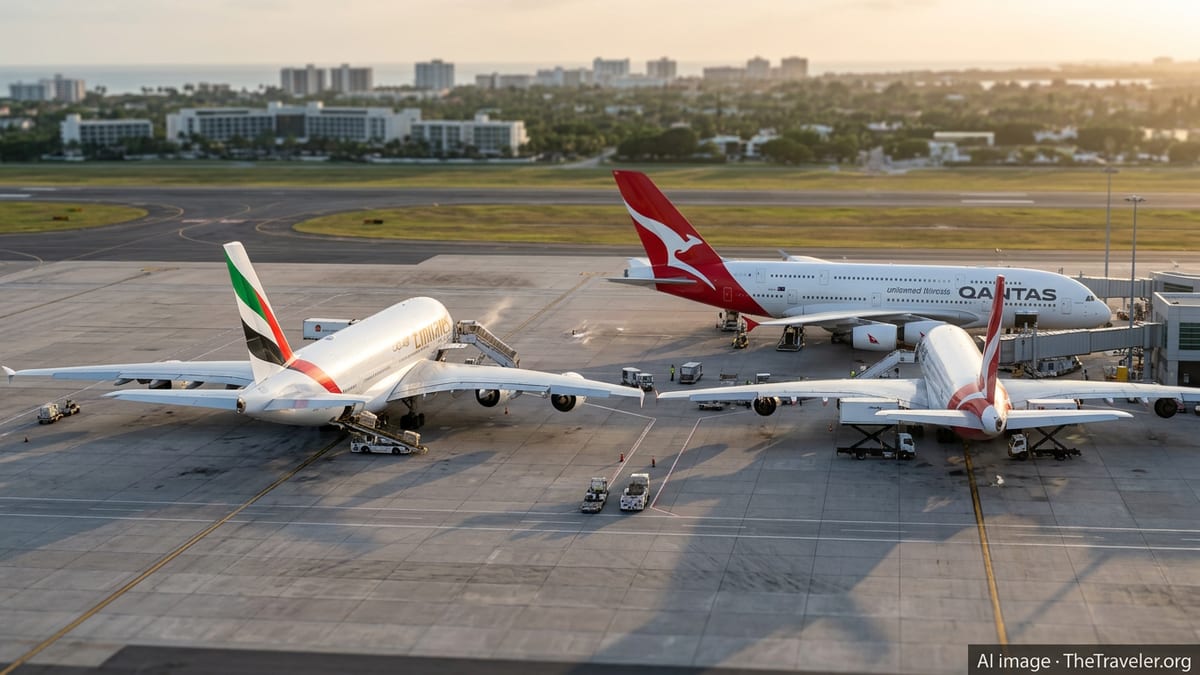
Qantas is reshaping its long haul strategy by recommitting to the Airbus A380, positioning the double decker flagship at the heart of a network push aimed at soaking up premium and leisure demand on trunk routes from Australia to Hong Kong, New York and other major global cities.
Get the latest news straight to your inbox!
A Superjumbo Revival at the Heart of Qantas Strategy
Publicly available fleet data shows that Qantas now has all of its remaining Airbus A380s back in service after the final aircraft returned from long term storage and refurbishment in late 2025. The carrier is keeping 12 superjumbos in its fleet into the 2030s, reversing early pandemic expectations that the four engine type would be phased out quickly in favor of smaller twins.
Qantas reporting and investor materials describe the A380s as critical capacity on long haul sectors where airport slots are scarce but demand is strong, particularly between Sydney and major hubs in North America, Asia and Europe. The aircraft’s 485 seat layout, including First, Business and Premium Economy cabins, allows the airline to concentrate high yielding traffic and manage growing leisure flows on a limited number of daily frequencies.
According to fleet renewal fact sheets, the A380s will remain in service alongside incoming Airbus A350 1000s for Project Sunrise and additional Boeing 787s, creating a mixed long haul fleet rather than a rapid switch to twin engines. The combination suggests a two track strategy in which the A380 continues to handle dense, slot constrained routes while the A350 and 787 families take on ultra long haul and thinner markets.
Hong Kong and North Asia Benefit from A380 Capacity
The most visible sign of this renewed commitment has been the deployment of the A380 on the busy Sydney Hong Kong corridor. Qantas newsroom material on recent schedule updates highlights the start of regular A380 services on the route, facilitated by the return of additional superjumbos from storage and heavy maintenance.
Hong Kong’s role as a key financial, logistics and tourism hub has helped restore traffic volumes quickly after border restrictions eased. Published schedules indicate that Qantas is using the A380 to capture both premium and connecting demand, particularly from travellers bound for Australia from mainland China and North Asia who value through ticketing and the airline’s alliance ties.
Industry coverage notes that the A380’s premium heavy upper deck layout, combined with refurbished lounges and upgraded inflight entertainment, is designed to appeal to corporate travellers and affluent leisure passengers who are returning to long haul flying. At the same time, the large lower deck economy cabin allows Qantas to offer competitive fares in a market where capacity from regional rivals is also rebuilding.
Positioning for New York Ahead of Project Sunrise
On the transpacific, Qantas is using the A380 to underpin its multi step strategy for serving New York. For now, the carrier links Sydney and New York via Auckland, with a mix of aircraft types across the network, while it prepares for planned nonstop Project Sunrise flights using new Airbus A350 1000ULR jets later in the decade.
Network announcements show that the Sydney Auckland New York route has been ramped up as aircraft return, with daily frequencies designed to match the strong post pandemic rebound in North American demand. While A380s do not operate the full Sydney to New York leg, the type features heavily on complementary services between Australia and key North American gateways, helping Qantas build capacity and brand presence ahead of the arrival of the Sunrise fleet.
Industry analysis suggests that deploying the A380 on high volume routes such as Sydney Los Angeles and Sydney Dallas Fort Worth supports onward traffic to New York by creating more one stop connections. This allows the airline to test fare structures, connectivity patterns and premium product positioning that will later be mirrored on nonstop A350 services to New York John F. Kennedy.
Premium Refits Turn the A380 into a Revenue Engine
The decision to keep the A380s in service has gone hand in hand with a substantial cabin upgrade program. Qantas documentation on the “upgraded A380” details an enhanced onboard lounge, refreshed First suites and a next generation Business cabin with direct aisle access. Larger high definition screens and expanded content partnerships in the premium cabins signal a focus on the highest yielding passengers.
Reports from aviation publications describe all active A380s as having undergone interior refurbishment, replacing older seating with a more modern, suite style product, particularly in Business Class. The layout increases the share of premium seats while maintaining a large economy section, aligning with a trend across the industry to tilt long haul capacity toward higher revenue cabins.
Qantas materials also highlight the aircraft’s significant range, listed at roughly 13,800 kilometres at full capacity, which allows nonstop operations from Sydney to Hong Kong, Los Angeles and Dallas Fort Worth with comfortable performance margins. This range, coupled with the aircraft’s premium density, underpins its continued role on some of the longest and most lucrative sectors in the Qantas network.
Balancing the A380 With a Next Generation Fleet
Despite the renewed focus on the A380, the superjumbo is only one part of a broader fleet transition. Qantas fleet renewal plans outline incoming Airbus A350 1000ULR aircraft for nonstop services from Australia’s east coast to London and New York, as well as additional A350 1000s and Boeing 787 9s and 787 10s to replace ageing Airbus A330s from the late 2020s.
This strategy indicates that Qantas sees the A380 as a bridge into the next decade, providing essential capacity on a handful of dense routes while more fuel efficient twins take over a growing share of the long haul network. Fact sheets referencing an eventual renewal of the A380 fleet from around the early 2030s suggest that the type’s long term future remains under review, even as it plays a central role today.
For travellers, the near term effect is clear. On routes such as Sydney Hong Kong, Sydney Los Angeles and Sydney Dallas Fort Worth, the return of the A380 means more seats, more First and Business Class availability and a high profile flagship presence at key international airports. As demand to New York and other top cities continues to climb, Qantas is betting that the appeal of the superjumbo, combined with its unmatched range and premium cabin mix, will remain a powerful draw in an increasingly competitive long haul market.