


More news on this day
Qatar Airways, Emirates and Etihad are locked in an increasingly high-end contest to redefine long haul business class, rolling out private suites, sliding doors and hotel style amenities that blur the line between premium cabins and traditional first class.
Get the latest news straight to your inbox!
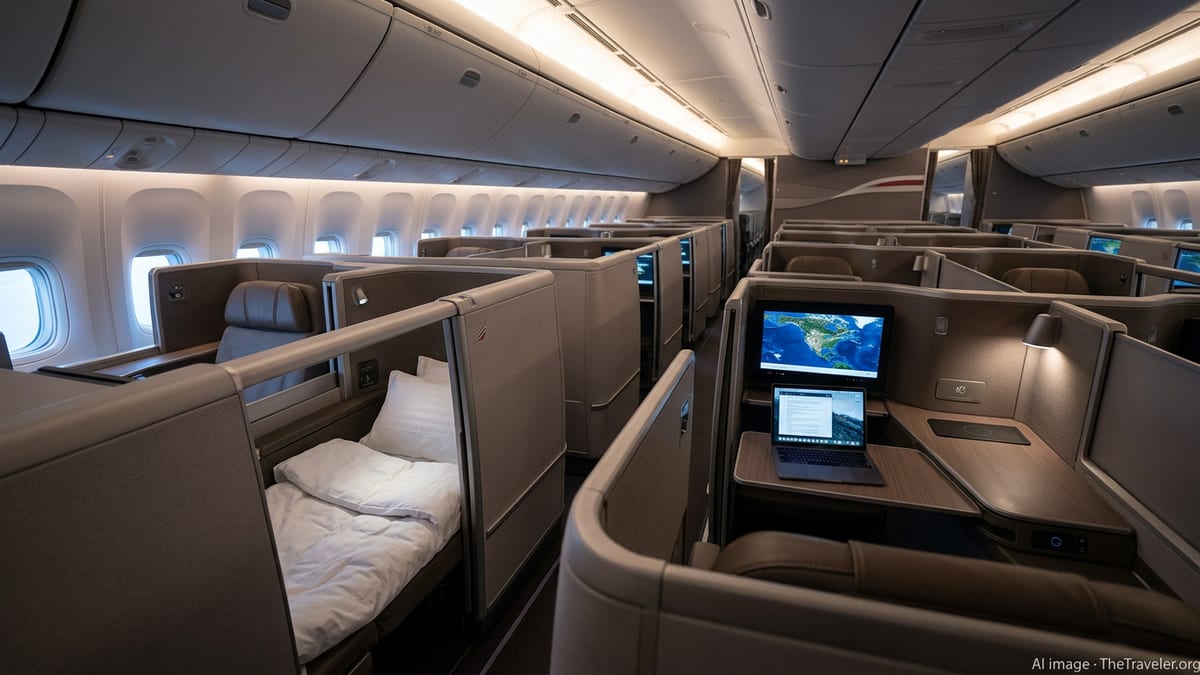
Suite-Style Business Cabins Become the New Benchmark
Across Qatar Airways, Emirates and Etihad, the traditional reclining business seat is rapidly giving way to enclosed or semi enclosed suites designed around privacy and personal space. Qatar Airways has set the pace with its Qsuite concept, which places each passenger in a staggered 1-2-1 layout with sliding doors, lie flat beds and the option to create double beds or quad “family” suites for groups. Recent coverage indicates that a next generation version of Qsuite is being prepared for the airline’s forthcoming Boeing 777-9 fleet, extending the model of door equipped business class into the next decade.
Etihad, based in Abu Dhabi, has focused on a consistent all aisle access product branded around studio and suite style seating. Its Airbus A350-1000 business cabin uses a 1-2-1 configuration with direct aisle access from every seat, high privacy dividers and a design language that emphasizes soft lighting and noise reduction. Public information on Etihad’s fleet plans shows the A350 and 787 Dreamliner forming the backbone of its long haul business product, giving the carrier a relatively uniform experience compared with older mixed cabins on some rivals.
Emirates, long known for showpiece first class suites, is pushing business class toward a similar direction through a wide ranging retrofit program on Boeing 777s and Airbus A380s. Reports on the latest 777-300ER layouts describe a 1-2-1 cabin that eliminates middle seats and introduces higher walls around each shell seat, moving away from the previous 2-3-2 arrangement that had drawn criticism from frequent travelers. Combined with refreshed business cabins on refurbished A380s, the airline is closing the gap with suite style competitors while leaning on its larger overall network and brand recognition.
For travelers choosing between the three Gulf carriers in 2026, the common thread is that direct aisle access and near full privacy have become standard expectations rather than aspirational extras on flagship routes. Where they differ is in how far they push the concept of a “mini apartment” in the sky and how consistently that product appears across their fleets.
Luxury, Privacy and Design Details Set Each Carrier Apart
Qatar Airways has positioned Qsuite as a near first class experience at a business class price point, with heavy emphasis on privacy and customization. The sliding door creates a self contained space with mood lighting, large entertainment screens and generous storage. Center pairs can turn into double beds, while facing quads allow families or business travelers to dine and work together before reconfiguring for sleep. Travel industry comparisons published in 2025 and 2026 frequently rank Qsuite as the leading business class seat globally and highlight the cabin’s ability to feel almost residential rather than purely functional.
Etihad’s approach is more subtly luxurious, relying on materials, acoustics and technology. Its latest business suites incorporate wireless device charging, Bluetooth audio pairing for the in flight entertainment system and quieter cabins on new generation aircraft such as the A350. The airline’s design language tends to favor muted tones and geometric patterns, with an emphasis on what it describes in public materials as a calmer, more restorative environment. On select long haul routes, turndown service adds a mattress topper and enhanced bedding, creating a flat sleeping surface that competes directly with Qatar and Emirates.
Emirates, by contrast, continues to lean into a more theatrical brand of luxury. In business class on the A380, travelers find a bar and social lounge at the rear of the upper deck, as well as large entertainment screens, on demand dining and the airline’s distinctive wood grain and champagne gold aesthetic. On refurbished 777s, the cabin refresh focuses on a modernized color palette, higher privacy shells and more personal storage, while preserving the airline’s reputation for abundant catering and a wide range of beverages. For some travelers, the presence of a walk up bar and larger common areas is as important as the private seat itself.
In practice, these differences in style and emphasis mean that passengers prioritizing maximum privacy often gravitate toward Qatar Airways and Etihad, while those who value social spaces and a resort like atmosphere may favor Emirates. All three, however, now market business class as an end to end experience that starts with chauffeur or priority services on the ground and continues with tailored lighting, bedding and dining in the air.
Retrofit Programs and Fleet Choices Shape Consistency
One of the critical questions for travelers is not only which carrier has the best flagship seat, but how reliably that experience appears on a given route. Qatar Airways has been progressively rolling out Qsuite across much of its long haul network from Doha, but there remain aircraft in the fleet without doors or with earlier generation seats, creating a scenario in which cabin experience can vary by aircraft swap. Reports from frequent flyer communities in 2025 and 2026 highlight the importance of checking aircraft type and seat maps when booking, particularly on secondary routes.
Emirates faces a similar consistency challenge as it retrofits a large fleet of Boeing 777-300ERs. Public information indicates that dozens of aircraft have already received the new 1-2-1 business class layout, with retrofit work continuing at a pace measured in weeks per airframe. Until the program is complete, some flights still offer the older 2-3-2 seating in business class, meaning that not every passenger is guaranteed aisle access. The airline’s A380 fleet, which continues to be refurbished with updated business cabins, tends to offer a more predictably modern experience on routes where it operates.
Etihad’s smaller size works to its advantage in this respect. With a more focused fleet of A350s, 787s and refurbished A380s, the Abu Dhabi carrier has been able to standardize much of its long haul business offering around a 1-2-1 configuration. Analysts and travel reports often note that Etihad delivers a high level of product consistency despite operating fewer destinations than its Dubai and Doha rivals. This makes it easier for travelers to know what they are booking when they see a particular aircraft type in the schedule.
Looking ahead, aircraft orders and delivery timelines will continue to shape how quickly each airline can upgrade remaining cabins. Delays to the Boeing 777-9 have pushed back timelines for both Qatar Airways and Emirates, meaning that interim retrofit programs on existing fleets will remain essential to keeping business cabins competitive until new generation widebodies arrive in greater numbers.
Soft Product: Dining, Amenities and Service on Board
Beyond the hardware of seats and suites, Qatar Airways, Emirates and Etihad are also using food, amenities and service style to differentiate their business class products. Qatar Airways promotes a restaurant style dining experience with multi course menus, made to order dishes and the ability to dine at any time rather than on a fixed schedule. Wine and champagne lists tend to skew toward premium labels, and amenity kits feature designer brands, particularly on longer overnight sectors.
Emirates emphasizes abundance and variety. Business class passengers typically find extensive menus, snack baskets and the option to visit the A380 lounge for canapés and refreshments throughout the flight. The carrier’s in flight entertainment system is widely marketed as one of the largest in the world in terms of title count, turning the suite into a cinema like space for many travelers. Amenity kits and bedding have been progressively refreshed through the retrofit program, aligning the soft product more closely with the updated seats.
Etihad focuses on a calmer, wellness oriented experience, particularly on ultra long haul flights. Publicly available information on its onboard service points to curated menus with lighter options, attention to hydration and rest and partnerships with luxury brands for amenity kits and bedding. On some routes, lounge style social spaces on the A380 give passengers an alternative to remaining in their suite for the entire flight, while still keeping the overall ambiance quieter than the more exuberant Emirates model.
In all three cabins, business class travelers can expect lie flat beds, upgraded bedding, noise cancelling headphones and multi course meals as baseline inclusions. The fine details of presentation, brand partnerships and service choreography, however, continue to be important distinguishing factors for frequent flyers who have experienced more than one of the Gulf carriers.
How to Choose Between Qatar, Emirates and Etihad in 2026
For travelers planning premium trips through Doha, Dubai or Abu Dhabi in 2026, the choice between Qatar Airways, Emirates and Etihad increasingly comes down to specific priorities. Those who value maximum privacy, door equipped suites and flexible seating arrangements often lean toward Qatar Airways on routes where Qsuite is guaranteed. Frequent comparisons by travel media and booking platforms currently describe Qsuite as the reference standard against which other business cabins are measured.
Passengers who place a premium on consistent hardware and a quieter cabin environment may find Etihad a compelling option, particularly on A350 and 787 routes from Abu Dhabi. The airline’s emphasis on modern design, noise reduction and discreet service resonates with travelers seeking a more boutique feel, even though its network is smaller than that of Emirates and Qatar Airways.
Emirates, for its part, remains a favorite for those who see the journey as part of the holiday. The combination of large A380s, an expansive hub at Dubai International, social spaces on board and a broad global network means that passengers can often find convenient schedules and added flourishes such as the onboard bar. As its 777 retrofit program progresses, more routes are beginning to offer the latest 1-2-1 business seats, reducing the historical trade off between network breadth and seat privacy.
With competition intensifying and new aircraft types still to join the fleets later in the decade, the race among Qatar Airways, Emirates and Etihad to deliver the ultimate business class experience is unlikely to slow. For travelers, that rivalry continues to translate into more spacious suites, quieter cabins and an ever more hotel like experience at 35,000 feet.