


Few cities do Christmas quite like Québec City. Snow piles on 17th century rooftops, church bells echo off stone streets and the scent of fir trees and maple taffy drifts through Old Town. Around late November and December, the walled Upper Town and riverside Lower Town become one of North America’s most atmospheric winter destinations, with a mix of historic charm, European-style markets and easy access to snowbound adventures. For travelers planning Christmas 2026 or any festive-season trip, it helps to understand how the holidays actually unfold on the ground: when the German Christmas Market runs, what winter activities cost and how much you are likely to spend on accommodation.
Get the latest updates straight to your inbox!
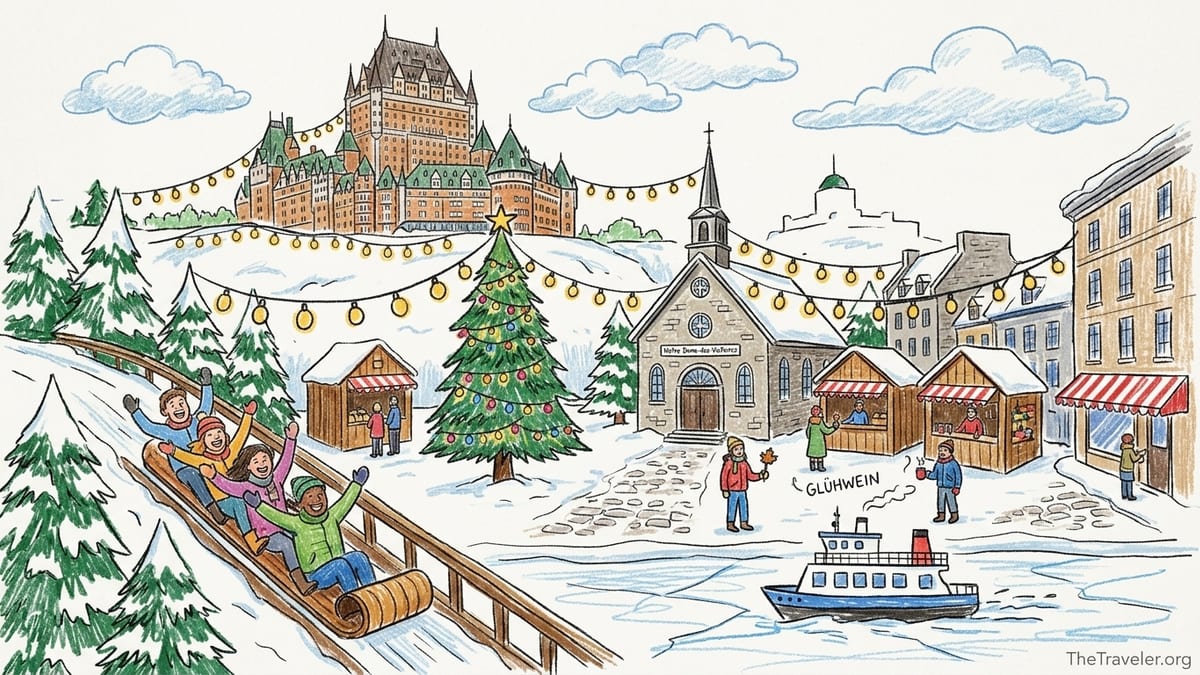
When Christmas Season Really Starts in Québec City
In Québec City, “Christmas” is less about a single day and more about a six-week season. Decorations typically appear in Old Québec from mid November, with strings of warm lights over Rue du Petit-Champlain, illuminated evergreens on Place Royale and garlands along Rue Saint-Jean. Visitors arriving any time from late November through New Year’s Day usually find the historic quarters lit up and dressed for winter, even if snow cover can still vary in late November.
The biggest anchor for early-season visits in 2026 is the Québec City German Christmas Market, which has announced it will run from November 19 to December 23, 2026. The market uses several squares in Upper Town, including the area around City Hall, to recreate a small-scale European Weihnachtsmarkt with wooden chalets, mulled wine and choral performances. Travelers who want the full “market plus snow” postcard effect should target late November or the first three weeks of December, when the chalets are open and the city is usually wintry.
One quirk that often surprises visitors is that the German Christmas Market ends before Christmas Eve. By December 24, the chalets are packed away, but the decorations stay up across Old Town and the lower Petit-Champlain district holds onto its festive look straight through New Year’s. Recent visitors report that even between December 28 and January 2, 2026, the streets of Old Québec and Lower Town were still fully decked out, with lights and trees in place and a strong “Christmas village” atmosphere even without the market stalls.
This staggered calendar means planning your trip around what matters most to you. If you want to sip glühwein while browsing Alpine-style stalls, visit between November 19 and December 23. If you care more about quiet, snowy streets and New Year festivities, late December into early January is quieter but still feels magical. Those focused on big organized events like the Québec Winter Carnival will want to come later in the season again, around early February.
Christmas in Old Québec: Streets, Churches and Seasonal Rituals
For many travelers, the heart of a Christmas trip to Québec City is simply wandering the historic districts. Upper Town, around Château Frontenac and the fortified ramparts, is the most immediately dramatic, especially in the evening. From the boardwalk of Terrasse Dufferin, you look down at the frozen St. Lawrence River, see lights twinkling across Lévis on the opposite shore and hear sleigh bells from horse-drawn carriages that circle the Old Town streets when conditions allow. Snow and ice can make the cobblestones slick, so good boots with grip and warm layers are essential.
Lower Town offers the most concentrated Christmas-card scenery. The slope of Rue du Petit-Champlain, often cited as one of the prettiest streets in North America, becomes a tunnel of lights, fir trees and shop windows stacked with Quebec-made gifts. Place Royale, the small square below the cliff where Samuel de Champlain founded the city, is dominated by a large outdoor Christmas tree, nativity scenes and the stone façade of Notre-Dame-des-Victoires church. On Christmas Eve, some travelers choose to attend a French-language Mass in historic churches around Old Québec, both for the service and the chance to hear organ music in centuries-old interiors.
Food and drink are a large part of the seasonal experience. Around the market and Rue Saint-Jean you find stands selling vin chaud or caribou, a local hot wine and spirits punch, alongside queues for maple taffy poured on snow. Cafés near City Hall and in Petit-Champlain compete to serve the most photogenic hot chocolate. While menus change seasonally, a sit-down bistro dinner in Old Town at Christmas can easily run to 35 to 50 Canadian dollars per person before drinks in 2026, especially at atmospheric spots in stone-walled buildings. Many restaurants offer multi-course Réveillon dinners on Christmas Eve, and these are often pricier and require advance reservations.
Travelers visiting right on December 24 or 25 should expect some adjustments. Local residents spend Christmas at home, and tour operators, museums and some restaurants shorten their hours or close entirely on December 25. Recent visitor reports highlight that activities like the Dufferin toboggan run and the ice rink at Place d’Youville may run on reduced schedules on Christmas Day. For that reason, it is wise to build a flexible day around simple pleasures that do not depend on opening hours, such as walks along the fortifications or through Lower Town, and to confirm the hours of any specific museum or tour you do not want to miss.
Winter Activities in and Around Old Town
One of Québec City’s strengths is that several winter activities start right at the edge of Old Town, so travelers visiting without a car can still fill their days with snow and ice. On the Upper Town side, the most famous holiday-season attraction is the historic toboggan slide on Terrasse Dufferin, sometimes branded as Au 1884. The slide has been operating in some form since the late 19th century and runs beside the Château Frontenac. In recent seasons, a ride on the toboggan slide has cost about 5 Canadian dollars per person with flexible options priced slightly higher, and children under three have sometimes been free, although it is important to double check prices and weather-related openings on the day you visit.
Ice skating is another core winter ritual. Place d’Youville, just outside the Saint-Jean Gate in Upper Town, hosts a photogenic outdoor rink with the stone ramparts and old buildings as backdrop. Skate rentals are available on site, and recent visitor accounts suggest that an adult can expect to pay roughly 10 to 15 Canadian dollars for admission and skate hire combined, depending on the exact package and season. Another skating option sometimes operates on the Plains of Abraham, a short walk from Old Town, providing a bigger space and a more open-sky feel, though schedules and operations can vary from year to year.
When temperatures drop firmly below freezing, simple walks can be as memorable as any paid activity. Dufferin Terrace itself becomes an open-air balcony over the St. Lawrence, and in mid winter the river is often choked with ice, with ferries pushing through floes. Below, in Lower Town, the narrow lanes of Quartier Petit Champlain are particularly atmospheric after fresh snowfall, and climbing the staircase to Casse-Cou, or using the Old Québec funicular, gives different perspectives on the illuminated decorations. Even in the depths of winter, cafés and bakeries throughout Old Town do brisk business in takeaway coffee and pastries, making it easy to linger outside for photos then warm up indoors.
Organized tours also adapt to the winter season. Several walking tour companies that operate in warmer months continue with winter-specific circuits, focusing on history and architecture with more frequent indoor stops. Prices for small-group walking tours around Old Québec in 2026 commonly fall somewhere between 30 and 50 Canadian dollars per adult for a two- to three-hour experience, though premium private tours cost more. Tours that include tastings of local products, such as Québec cheeses, ice cider, maple products or festive pastries, typically charge a supplement but can be a practical way to learn about local food culture without booking multiple separate restaurant meals.
Day Trips and Deeper Winter Adventures
For travelers staying four nights or more, venturing beyond Old Québec unlocks more intense winter experiences. One classic half-day trip is to Montmorency Falls, located about 15 minutes’ drive from Old Town. In winter the 83 meter waterfall partially freezes, forming the famous Pain de Sucre, or sugar loaf, of ice at its base. Public buses link Old Town to the falls, and some visitors choose to add a cable car ride or visit the suspension bridge for views. Total costs for transport and entry can be kept under 30 to 40 Canadian dollars per person with careful planning, though organized excursions that include guides and bundled attractions are priced higher.
Travelers focused on skiing often use Québec City as a base for day trips to nearby resorts. Mont-Sainte-Anne, roughly 40 minutes from the city, and Le Massif de Charlevoix, about 75 minutes away by car or shuttle, are the two most popular options. Lift tickets in 2026 vary by resort and season, but recent price grids show full-day adult passes often falling in the 90 to 130 Canadian dollar range on peak winter weekends, with discounts for children, seniors and advance online purchase. Rental packages for skis, boots and helmets usually add 50 to 70 Canadian dollars per day, so a ski day for a family of four can easily approach several hundred dollars once food is included.
Other classic Québec winter activities, such as dog sledding, snowshoeing and snowmobiling, are typically arranged with operators outside the city core. Many offer shuttle pickup from central hotels. Half-day dog-sledding experiences around Québec City have recently been advertised in the 180 to 260 Canadian dollar range per adult, often including transport, gear and a guided trail run, while snowmobile tours can cost a similar amount once machine rental, fuel and guide fees are factored in. These are not low-budget outings, but they are the kind of bucket-list experiences that many travelers build their winter trip around.
Those who prefer a softer adventure often choose snowshoeing or cross-country skiing on the Plains of Abraham or in nearby parks. Equipment rental from local outfitters or park centers can sometimes be found in the 20 to 40 Canadian dollar range for a few hours, making it one of the more affordable ways to spend a winter day. Regardless of the activity, the key logistics for winter day trips from Québec City are clothing and timing. Daylight is short in December and January, often with sunset before 4:30 p.m., and temperatures can slide well below minus 10 Celsius, with wind chills that feel significantly colder, so dressing in layers and bringing face protection is crucial.
Accommodation: Where to Stay and What You Might Pay
Québec City offers a wide spread of accommodation options at Christmas, from hostels to landmark hotels. At the top end of the scale is Fairmont Le Château Frontenac, the grand castle hotel that dominates the skyline. During the December holiday period, nightly rates there can climb well over 500 Canadian dollars before taxes and fees for a standard room, reflecting both the property’s luxury positioning and its unique setting overlooking the St. Lawrence. Signature holiday packages that include special dinners or New Year’s Eve events can be even higher, so this is very much a splurge option.
Mid-range travelers will likely focus on the numerous three and four star hotels inside or just outside the Old Town walls. Recent hotel price trend data for Québec City indicates that December is near the annual average for room rates, with one large booking platform citing around 170 Canadian dollars as a typical base rate per night for commonly viewed hotels in the city during that month before taxes and fees. Independent analyses of hotel prices show that median December rates across the greater city can vary widely, from under 100 Canadian dollars per night at budget chain properties outside the center to more than 250 Canadian dollars per night at boutique hotels inside Old Québec on peak weekends when the Christmas market is running.
Budget conscious visitors often look slightly beyond the walls. Neighborhoods such as Saint-Roch and Saint-Jean-Baptiste, which sit within a 10 to 20 minute walk of the Old Town gates, have a mix of smaller hotels and guesthouses where December rates can be meaningfully lower than comparable properties inside the walls. Recent deal trackers highlight examples where chain hotels in the broader Québec City area, such as those near Sainte-Foy or along major routes, drop below 100 Canadian dollars per night in December, although staying in these locations usually means relying on public transit or taxis to reach the Christmas atmosphere of Old Town.
Fully furnished apartments and short term rental units add another layer of choice, but winter travelers should pay close attention to heating, building access and snow clearing policies. An Old Town apartment reached by steep exterior steps can be charming on a website, but slippery after a snowstorm. For Christmas week itself, particularly from about December 22 to 26, 2026, demand from both domestic and international travelers is expected to be strong, so booking several months in advance is advisable if you want a specific district or hotel category. Many properties require nonrefundable deposits for peak holiday dates, so reading cancellation terms carefully is an important part of managing trip risk.
Sample Holiday Budget: What a Festive Week Can Cost
Because Québec City combines free seasonal atmosphere with paid attractions, total trip cost depends heavily on your accommodation choice and how many organized activities you book. As a ballpark example, consider a couple visiting for five nights in mid December 2026 while the German Christmas Market is still open. If they choose a mid-range hotel inside Old Town at around 200 Canadian dollars per night before taxes and fees, that translates to roughly 1,000 Canadian dollars in room charges, which may climb closer to 1,150 to 1,200 Canadian dollars once provincial taxes, federal taxes and common urban fees are added.
For daily expenses, a modest but comfortable food budget for two people might run around 120 to 170 Canadian dollars per day in 2026, assuming a mix of café breakfasts, casual lunches and one sit-down dinner most evenings, plus occasional treats such as hot wine at the market or maple taffy on snow. Over five days, that range would translate into 600 to 850 Canadian dollars in dining costs. Adding local transport, occasional taxi rides on very cold nights and tips for guides can add another 150 to 200 Canadian dollars over the course of the trip.
Layered on top are activity costs. If the same couple builds their week around low-cost or free experiences, they might only pay for a handful of key items: perhaps 40 Canadian dollars total for several toboggan runs and Place d’Youville skating sessions, 80 to 100 Canadian dollars for a shared walking tour and 60 to 80 Canadian dollars to visit an attraction such as Montmorency Falls on public transit. That approach keeps activity spending under about 250 Canadian dollars. At the other extreme, adding a fully organized dog-sledding excursion and a day of Alpine skiing with lift tickets and rentals could add 500 to 800 Canadian dollars or more to the total bill for two travelers.
Putting these elements together, a five night Christmas trip for two in 2026 that balances mid-range lodging, restaurant meals and a handful of paid activities could easily total between 2,000 and 3,000 Canadian dollars before flights or long distance train fares. Travelers who are willing to stay outside Old Town, cook some meals in an apartment kitchen and focus on free or low cost city experiences can trim that figure significantly. On the other hand, visitors booking luxury hotels, Christmas Eve tasting menus and high end tours should budget for a meaningfully higher overall spend.
Planning Around Weather, Crowds and Carnival
Winter in Québec City is as beautiful as the photos suggest, but conditions are serious. Climate normals for the region show average December temperatures around minus 8 degrees Celsius, with January typically colder. Cold snaps can push daytime highs to minus 15 or lower, and wind off the St. Lawrence amplifies the chill. Snowfall is common throughout late November and December, and several snow events in a single month are routine. Travelers should pack insulated boots, wool socks, base layers, a windproof outer shell, gloves, a thermal hat and face protection such as a scarf or balaclava. The right clothing can mean the difference between cutting outings short and happily walking the city after dark.
Crowd patterns shift over the season. Opening weekends of the German Christmas Market in late November bring an influx of visitors from elsewhere in Québec and nearby provinces, but weekday evenings are calmer. Early to mid December weekends are lively, with tour groups and couples filling Old Town squares and lines at the most photogenic photo spots. The period from around December 24 to 26 is busy with travelers but somewhat quieter on the streets, since many locals are with family. New Year’s Eve draws celebratory crowds again, particularly around Grande Allée and major hotels that organize special dinners and indoor events.
Winter does not end with Christmas. In 2026 the Québec Winter Carnival, one of the world’s largest winter festivals, runs from February 6 to 15. During Carnival, the city’s winter programming shifts from Christmas markets to snow sculptures, ice palaces, outdoor concerts and night parades, often centered around Bonhomme, the festival’s snowman mascot. Some nights feature ticketed zones with live music and bars, and Carnival passes are required to access certain activities. Travelers primarily interested in Christmas lights and markets should come earlier in the season, while those intrigued by large street festivals will find early February more appealing despite colder temperatures.
For both Christmas and Carnival season, advance planning pays off. Booking accommodation early allows more choice in Old Town, where properties are limited in number and historic buildings cannot simply expand capacity. Reservations are recommended for popular restaurants on December weekends and absolutely essential for Christmas Eve, New Year’s Eve and peak Carnival nights. Finally, it is wise to keep at least one flexible day in your itinerary to adapt to weather, whether that means postponing a toboggan run in high winds or pulling a museum visit forward during a snowstorm.
Making Christmas in Québec City Your Own
Québec City at Christmas is not a scripted resort experience with a single must-see show. Instead, it is a layered winter city where historic streets, local traditions and modern tourism overlap. Some visitors spend their days gliding around Place d’Youville, descending the Dufferin Terrace toboggan slide and strolling Rue du Petit-Champlain with a camera in hand. Others plan one or two big winter adventures, such as a day on the slopes at Mont-Sainte-Anne or an ice coated visit to Montmorency Falls, with evenings reserved for bistros and candlelit churches.
Your version of the trip will reflect your pace and budget. Families with young children might prioritize easy-access fun in Old Town, like short toboggan runs and early evening walks under the lights, staying in an apartment with space to dry mittens and snowsuits. Couples splurging on a romantic stay at Château Frontenac may lean into room service breakfasts, spa time and leisurely dinners, punctuated by occasional forays into the cold. Solo travelers often build their days around guided tours and café stops, using the compact scale of Old Québec to explore at their own rhythm.
Whatever your profile, the most satisfying Christmas trips to Québec City tend to combine a few fixed anchors with plenty of unscheduled time. Booking accommodation in or near Old Town, reserving any bucket-list restaurant or winter activity and choosing your travel dates in line with the German Christmas Market schedule are key pillars. The rest can be left open for discoveries, whether that ends up being a choir performing in a small church, a hidden courtyard draped in lights or an unplanned hour warming your hands around a paper cup of hot chocolate while snow falls onto 400-year-old stones.
By approaching the city with both structure and flexibility, and by budgeting realistically for accommodation, food and winter activities, you can shape a Christmas visit to Québec City that feels both festive and personal. In a world of interchangeable holiday experiences, the combination of stone fortifications, French Canadian traditions and deep winter weather still sets this destination apart, making a well planned December or early January trip a standout chapter in any traveler’s story.