


More news on this day
Chicago O’Hare International Airport experienced a brief Federal Aviation Administration ground stop on Tuesday 24 November 2026 after an equipment outage affecting a surface radar system, leading to significant evening delays for inbound flights at the start of the busy Thanksgiving travel period.
Get the latest news straight to your inbox!
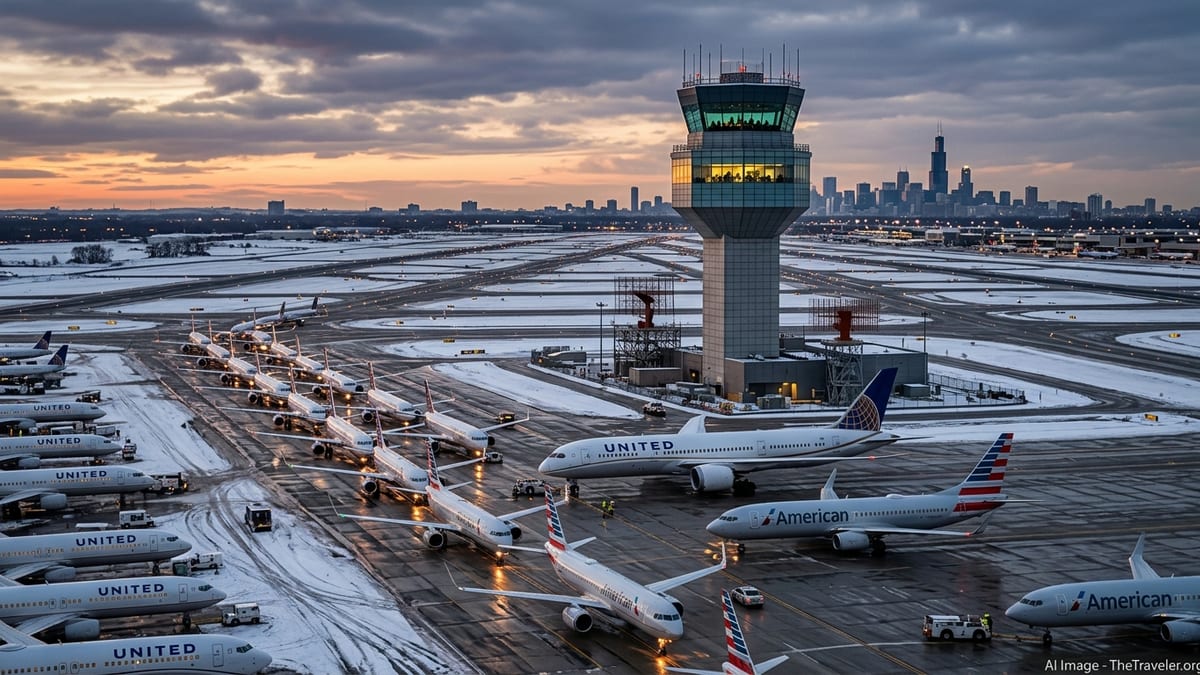
What happened at O’Hare on November 24
The Federal Aviation Administration (FAA) temporarily halted some flights bound for Chicago O’Hare International Airport on the afternoon of Tuesday 24 November 2026 after reporting an “equipment outage” that reduced the airport’s arrival capacity. According to statements cited by multiple local and national outlets, the problem was traced to a ground surveillance or surface radar system used by air traffic controllers to monitor aircraft and vehicles on certain runways and taxiways, rather than the long-range radar used to track aircraft in flight.
FAA traffic management advisories and media reports indicate that the ground stop was put in place for a short period in the late afternoon before being lifted shortly after 16:00 local time. Once the hold order ended, the agency switched to a formal ground delay program for arrivals into O’Hare, spacing inbound flights more widely while technicians continued repair work on the affected system. The FAA stressed that controllers retained radio contact with aircraft and access to other radar feeds, allowing flights already in the air to continue operating under reduced but still safe conditions.
Data compiled from the FAA National Airspace System status feed and flight-tracking services show that during the peak of the disruption, average arrival delays into O’Hare were running at roughly 45 to 90 minutes for many carriers, with some flights held at their departure airports for comparable periods. A smaller number of services were cancelled outright when it became clear that crews or aircraft would not be able to turn around in time for later segments. Most of the impact was felt between mid-afternoon and late evening Central Time on Tuesday.
Second ground stop in two days and link to earlier national outage
The radar-linked disruption on November 24 followed an earlier, separate ground stop affecting O’Hare on Monday 23 November, which local broadcasters attributed to short-term staffing issues in air traffic control. That earlier hold was lifted relatively quickly and did not involve an equipment failure, but it contributed to an overall sense of fragility around the airport’s operations as the Thanksgiving travel rush began.
Both O’Hare ground stops also came less than two weeks after a nationwide FAA-ordered ground stop on Friday 13 November 2026, when all U.S. departures were halted for several hours because of technical problems within the agency’s air traffic communications network. Official post-incident explanations describe that national disruption as stemming from newly installed network equipment that overwhelmed older systems, leading to intermittent issues with radio and radar feeds in several parts of the country. Documentation released so far indicates that communications and radar data associated with the Chicago area were among those affected during the national event, although the November 24 outage at O’Hare has been described by the FAA and airlines as a localized equipment problem rather than a continuation of the earlier network failure.
Despite the proximity of the dates, authorities have not stated that the November 24 surface radar issue shares the same root cause as the November 13 nationwide stop. Current official information frames the O’Hare event as a discrete equipment outage affecting ground surveillance at the airport. While some commentators have highlighted the sequence of incidents as an illustration of strain on aging aviation infrastructure, regulators have so far limited their remarks to the specific technical explanations and to assurances that safety margins remained intact throughout each episode.
Scope of delays and impact on airlines and passengers
By early evening on November 24, O’Hare’s arrival and departure boards showed widespread knock-on disruption to domestic and international services. Flight-tracking sites and airline status pages recorded inbound holds of up to about 90 minutes from major hubs such as New York, Washington, Dallas and Denver, as well as on shorter regional sectors from within the Midwest. Because the ground stop and subsequent delay program focused on arrivals, some outbound flights initially departed close to schedule but later faced crew and aircraft rotation issues when inbound segments reached Chicago behind time.
Carriers serving O’Hare responded by issuing travel alerts and rebooking options for affected customers, particularly those with onward connections. While specific waiver policies varied by airline, most large U.S. carriers allowed same-day or next-day changes for passengers booked to travel during the height of the disruption on November 24. Some airlines also warned that limited seat availability before the Thanksgiving holiday could restrict rebooking options on popular routes, especially during peak morning and late-afternoon departure banks.
For passengers already in the air when the outage occurred, the experience often translated into extended holding patterns near Chicago or diversion-level contingency planning that ultimately was not needed. With long-range radar and radios still available, controllers continued sequencing arrivals, albeit at a lower throughput than normal while operating without one of the surface surveillance tools used during taxi and runway movements. Travelers arriving late into O’Hare on Tuesday night reported delays in reaching gates as ground controllers worked around the missing radar coverage for some movement areas.
How surface radar fits into O’Hare’s safety systems
The system affected on November 24 is part of what the FAA describes as surface movement or ground surveillance radar, which can include equipment such as airport surface detection and tracking systems. These technologies provide controllers with a real-time view of aircraft and vehicle positions on runways and taxiways, improving situational awareness in low visibility and complex traffic situations at large hubs like O’Hare. They operate alongside, but separately from, long-range radar and satellite-based tracking that monitor aircraft in the surrounding airspace.
When a surface radar unit or its associated tracking system is taken offline, standard practice is to maintain safe operations by reducing airport throughput and reverting to procedural controls and visual observations where possible. At a busy hub with intersecting runways, any such reduction in capacity quickly translates into departure holds and arrival delays, especially during a holiday period when schedules are already dense. The FAA’s decision to combine a short ground stop with a longer ground delay program at O’Hare on November 24 aligns with these established procedures, which prioritize safety over maintaining normal traffic volumes.
Recent notifications from the National Weather Service and aviation chart updates show that radar-related maintenance in the Chicago area is not unusual, with separate weather radar work publicized earlier in November. Those notices, however, pertained to meteorological radar used for storm detection rather than to the surface movement systems at O’Hare that were implicated in Tuesday’s equipment outage. Available official information does not indicate that the earlier weather radar maintenance was directly connected to the November 24 airport disruption.
What travelers should do next and how Wednesday’s schedules may be affected
By the early hours of Wednesday 25 November 2026, the FAA confirmed through local media that the ground stop at O’Hare had been lifted and that only a limited number of flights were still facing flow-control delays while technicians completed repairs. Airlines and airport officials have not announced any ongoing structural reduction in capacity for Wednesday’s operations, and schedules for the day before Thanksgiving are expected to run largely as published, subject to normal congestion and weather-related adjustments.
Nonetheless, residual effects from Tuesday’s disruption may carry into parts of Wednesday’s schedule. Aircraft and crew that ended November 24 out of position could generate knock-on timing issues for early-morning departures, particularly on complex multi-leg routings. In addition, forecasters have signaled the potential for wintry weather in the broader Chicago region, which could introduce de-icing delays or visibility-related spacing requirements during peak departure and arrival periods.
Travelers heading to or through O’Hare on Wednesday are therefore advised to monitor their flight status closely via airline apps and official channels, rather than relying solely on printed or earlier online schedules. For those with tight connections, building in additional buffer time or considering alternative routings where feasible may reduce the risk of missed onward flights if further delays occur. Passengers whose plans were disrupted on November 24 should review their carrier’s specific rebooking and compensation policies, keeping in mind that air traffic control equipment failures are typically categorized as outside the airline’s direct control for the purposes of mandatory reimbursements, even though individual airlines may still offer vouchers or flexible changes as a matter of customer service.