


More news on this day
With U.S. air traffic over Thanksgiving 2026 forecast to reach its highest level in 16 years and a nationwide ground stop just days behind travelers, federal officials and airlines are urging passengers to check real-time airport and flight status tools before setting out for the airport, warning that crowded skies, unsettled weather and lingering operational strains could quickly magnify even local disruptions.
Get the latest news straight to your inbox!
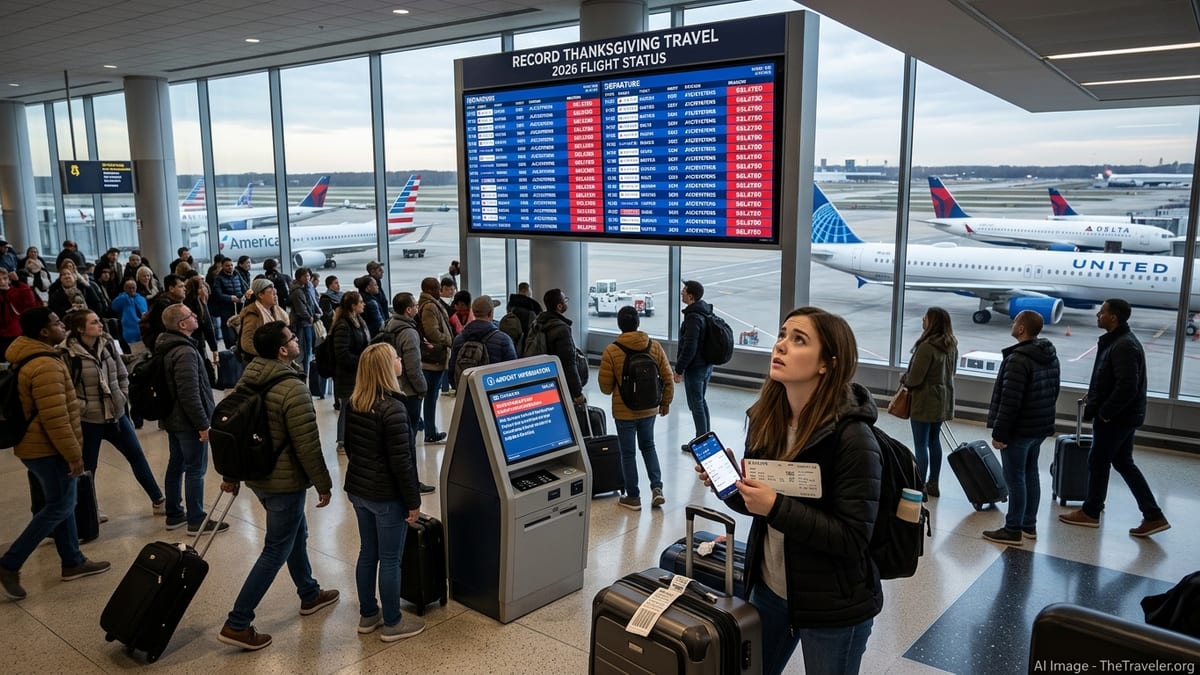
Record Holiday Flight Forecast Meets Fresh System Outages
The Federal Aviation Administration’s latest forecast, released on November 24, projects more than 417,000 commercial flights in U.S. airspace over the nine-day Thanksgiving 2026 period from November 23 through December 1, making it the busiest Thanksgiving for scheduled flights in 16 years. That outlook, based on data shared by the Department of Transportation, also anticipates more than 52,000 flights on Wednesday, November 25, the peak day in the agency’s holiday forecast.
The flight outlook comes less than two weeks after the FAA ordered a nationwide ground stop on November 13, 2026, when a router problem in the agency’s air traffic control network caused intermittent communication and radar coverage issues. Officials say the halt, which lasted more than four hours, was the longest system-wide stoppage since the aftermath of the September 11, 2001 terrorist attacks and only the second nationwide ground stop since a Notice to Air Missions system failure in January 2023.
Major airlines have also had their own technology setbacks just as Thanksgiving travel begins. Delta Air Lines reported automation problems on November 22 with the system it uses to calculate aircraft weight and balance, forcing the carrier to rely on manual workarounds and contributing to hundreds of delays as the FAA temporarily stopped some flights bound for Atlanta, one of the world’s busiest hubs. United Airlines separately experienced a systems outage earlier in November that led to additional disruption, while American Airlines is still working through residual delays and cancellations tied to the November 13 ground stop.
Those incidents follow several years of strong demand around the holiday period. Transportation Security Administration checkpoint statistics show that Thanksgiving week 2025 was the busiest on record in terms of passengers screened, with more than 18 million travelers passing through security over seven days and over 3.1 million on the Sunday after the holiday alone. Early TSA data for 2026 indicate that checkpoint volumes in the weeks leading into Thanksgiving have tracked only slightly below last year’s levels, suggesting that this year’s airports could again be close to capacity even if absolute records are not surpassed.
Weather, Congestion and Where to See Airport-Wide Delays
Weather is adding another layer of uncertainty on top of traffic volumes and technology concerns. Forecasts from the National Weather Service in the days before Thanksgiving point to a wet pattern for parts of both coasts, including rain and coastal flooding risks in sections of California and the Pacific Northwest, and a storm system expected to bring gusty winds and rain to parts of the Northeast around Thanksgiving Day itself. Although meteorologists are not predicting a single nationwide severe storm, they warn that localized heavy rain, low clouds or crosswinds at major hubs can trigger spacing requirements and runway configuration changes that ripple across airline networks.
To track how such conditions are affecting airports at a system level, the FAA directs the public to its Air Traffic Control System Command Center tools, including the National Airspace System status pages and a text-only National Airport Status feed. These dashboards indicate whether larger passenger airports are operating normally or facing arrival or departure delays, ground delay programs or ground stops, and summarize the stated reason, such as weather, volume or construction. The information is updated frequently and draws on reports from terminal facilities, which are required to notify the Command Center of delays of 15 minutes or more so they can be reflected in national traffic management decisions.
Understanding the terminology used on the FAA status site can help travelers interpret how serious a disruption may be. A ground stop means departures bound for a specified airport are held at their origin for safety or capacity reasons until the stop is lifted. A ground delay program, by contrast, meters flights into a busy airport by assigning each an Expected Departure Clearance Time, often lengthening gate holds but providing more predictable, scheduled delays. Both measures can significantly increase travel times even if conditions appear benign at the airport where a passenger starts their trip.
The Command Center tools have limitations that are important for passengers to keep in mind. They focus on mid-size and large commercial airports, do not display every smaller field served by regional operators and do not show the status of individual flights. Their value lies in flagging when an entire hub, such as Chicago O’Hare, Atlanta or New York’s major airports, is affected by systemic constraints. Around Thanksgiving, a notice of a ground delay program or low-visibility operations at a connecting hub is a signal that onward flights may be vulnerable to rolling delays and worth checking more closely with the airline.
How Airlines and Apps Provide Flight-Specific Updates
For information on a specific flight, airlines stress that their own status pages and mobile apps remain the primary sources of record. Carriers pull real-time data from internal operational systems that track aircraft routing, crews, maintenance, gate assignments and schedule adjustments. Since the November 13 ground stop, multiple U.S. airlines, including American and United, have urged customers in public advisories to confirm their flight status on the carrier’s website or app before heading to the airport, noting that recovery schedules can shift throughout the day.
Most major U.S. airlines offer same-day notifications by email, SMS and app push alert when customers provide contact details at booking or add them later using a confirmation code or frequent flyer account. These alerts can highlight boarding time changes, revised departure estimates, aircraft substitutions or gate relocations, and can sometimes reach passengers before terminal departure boards are refreshed. During congested periods such as the Wednesday before Thanksgiving and the Sunday and Monday after, when tight turnarounds and full flights limit operational flexibility, these direct messages may give the earliest practical warning that a connection is at risk.
Third-party flight-tracking platforms can complement airline tools by aggregating data and providing context on on-time performance, but they also have constraints that matter during a live disruption. Some services rely primarily on FAA feeds that may lag carrier internal updates by a few minutes. Others emphasize historical performance statistics derived from Department of Transportation on-time data, such as the widely reported finding that nearly one in four flights in November and December 2025 arrived at least 15 minutes late. Those averages can guide expectations about which routes or times of day have historically seen more delays, yet they do not account for the day’s actual weather, staffing levels or technical issues and should not be treated as predictions for a specific departure in 2026.
One practical way passengers can combine these tools is to use the FAA’s NAS status pages to see whether an airport-wide program is in place, the airline’s app to verify their own flight and any active rebooking options, and a reputable flight-tracking site to follow the inbound aircraft operating their service. If the inbound flight is still at a previous city or already significantly delayed into a hub that is itself under a ground delay program, that combination of signals can help travelers decide whether to explore later connections before they sell out.
Patterns by Day, Time and Airport That Shape Delay Risk
Historical data from TSA and the Department of Transportation suggest that not all Thanksgiving travel days carry the same disruption risk. Checkpoint figures for 2024 and 2025 show that the Sunday after the holiday has been the single busiest air travel day of the week in both years, with more than 3 million passengers screened nationwide in 2025. The Wednesday before Thanksgiving and the Monday after have also seen very high volumes. Forecasts for 2026 indicate only a small softening in totals compared with 2025, meaning terminals, security lanes and boarding areas are still likely to be crowded on those peak days even if the exact record for passengers screened is not surpassed.
Analyses of previous Novembers also indicate that flights scheduled in the early morning tend, on average, to depart and arrive closer to plan than those leaving in the late afternoon and evening. Early bank departures are less exposed to the cumulative effect of weather and congestion-related delays earlier in the day, whereas later flights are more likely to be affected by aircraft or crews arriving late from other cities. That pattern is a tendency rather than a guarantee: morning fog, low ceilings or overnight storms at some airports can still cause severe early disruptions. Nonetheless, when travelers have flexibility while booking or rebooking around Thanksgiving, choosing a morning departure can moderately lower the risk of long delays.
Local climate and airport role in airline networks also shape delay patterns. Coastal hubs in the Northeast and on the West Coast are more exposed to marine layers, wind and rain, especially in late November, while large upper Midwest airports can face early winter storms and strong crosswinds. Interior hubs that see heavy connecting traffic may be hit indirectly when weather event or volume restrictions elsewhere force flows to be rerouted. During the week before Thanksgiving in 2026, for example, a ground stop affecting flights to Chicago O’Hare was imposed for staffing and capacity reasons rather than severe local weather, illustrating how operational constraints alone can temporarily halt departures to a major hub.
For passengers facing multiple connection options, the combination of these factors matters. A tight evening connection through a hub under a ground delay program typically carries higher missed-connection risk than a mid-morning connection through an unconstrained airport. Before accepting voluntary schedule changes or reroutes offered by airlines during busy days, it can be useful to check recent and current NAS status advisories for the alternative hubs and to consider whether different times of day might offer more resilience if irregular operations continue.
Steps Travelers Can Take Before and During Thanksgiving Trips
In the 24 hours leading up to departure, officials and airlines recommend that passengers use multiple real-time sources to check for emerging problems. Monitoring the FAA’s NAS status pages for both the departure and arrival airports can reveal new ground delay programs, volume advisories or low-visibility operations, while local National Weather Service forecasts for each city on the itinerary can clarify whether expected rain, snow or low clouds are likely to coincide with the scheduled departure or arrival window. At the same time, checking the airline’s app or website can confirm whether any proactive schedule changes, such as earlier departure times, equipment swaps or waivers for free rebooking, have been introduced.
On the day of travel, verifying that the inbound aircraft and operating crew for a flight are progressing roughly on schedule is one of the most concrete ways to distinguish between minor timetable adjustments and more serious disruption. Many airline apps and third-party trackers show the tail number or flight number of the inbound service. If that aircraft has not left its previous station or is scheduled to arrive close to or after the planned departure time, especially into a hub already listed under a ground delay program, travelers with tight onward connections may want to contact the airline from home or the departure gate to ask about backup options, same-day confirmed changes or protection on later flights.
Once at the airport, officials advise relying on the airline’s digital tools and gate announcements rather than solely on static departure boards, which can lag behind operational decisions during fast-moving events. Because load factors around Thanksgiving are typically high, last-minute reaccommodation after a cancellation can be difficult, and alternate flights may involve connections through different hubs or even departures from or arrivals at secondary airports within a region. In these situations, using the FAA’s status pages to identify which hubs appear least constrained and cross-checking that information with airline inventory displays or booking engines can help passengers and airline agents identify rerouting options that are more likely to operate on time.
For upcoming seasons beyond 2026, federal regulators say they are accelerating modernization projects aimed at improving resilience during peak travel. The nationwide ground stop in mid-November has prompted renewed calls within the Department of Transportation and on Capitol Hill for additional funding to upgrade aging air traffic control infrastructure, with the FAA seeking tens of billions of dollars for its long-term modernization program. The agency has highlighted congestion-prediction tools being deployed at the Command Center and internal “tiger teams” tasked with stress-testing schedules ahead of major holiday periods. While these initiatives are expected to reduce the frequency and impact of some disruptions over time, authorities emphasize that real-time checks of official delay and status sources will remain a critical part of planning Thanksgiving trips, given the continuing influence of weather, high demand and the occasional technology failure.