


More news on this day
Delta Air Lines says it has restored a key automation system used for aircraft weight and balance calculations after a technical failure at its Atlanta hub on Sunday, November 22, 2026, caused significant delays for flights to, from and through the world’s busiest airport at the start of the U.S. Thanksgiving travel period.
Get the latest news straight to your inbox!
What happened to Delta’s systems in Atlanta
The disruption began on the morning of Sunday, November 22, when Delta reported an issue affecting one of its automated systems used to calculate aircraft weight and balance data, a safety-critical step required before departure. The problem affected operations at Hartsfield-Jackson Atlanta International Airport, Delta’s largest hub, and led the airline to request a temporary ground stop, followed by a ground delay program, for its flights bound to and from Atlanta, according to the Federal Aviation Administration. The FAA emphasized that its own air traffic systems were functioning normally, identifying the disruption as an internal Delta problem.
To keep flights moving, Delta switched to manual procedures for processing bags and generating weight-and-balance performance numbers. The airline said teams were using “manual workarounds” so flights could depart safely while engineers worked to restore automation. This meant that, even where aircraft were at the gate with crews and passengers on board, departures could not occur until ground staff and dispatchers had completed and verified manual calculations and paperwork for each flight.
Because Atlanta is Delta’s primary connecting hub, the local technical problem quickly rippled through the carrier’s nationwide network. Flight-tracking data for Sunday showed more than 1,300 Delta-operated flights delayed across the United States, with some tallies later on Sunday indicating that over half of the airline’s scheduled services experienced delays and several hundred were cancelled. Many of those disruptions were linked directly to the automation outage, while others were compounded by weather and downstream crew and aircraft positioning issues.
Scale of the disruption at Atlanta and across the network
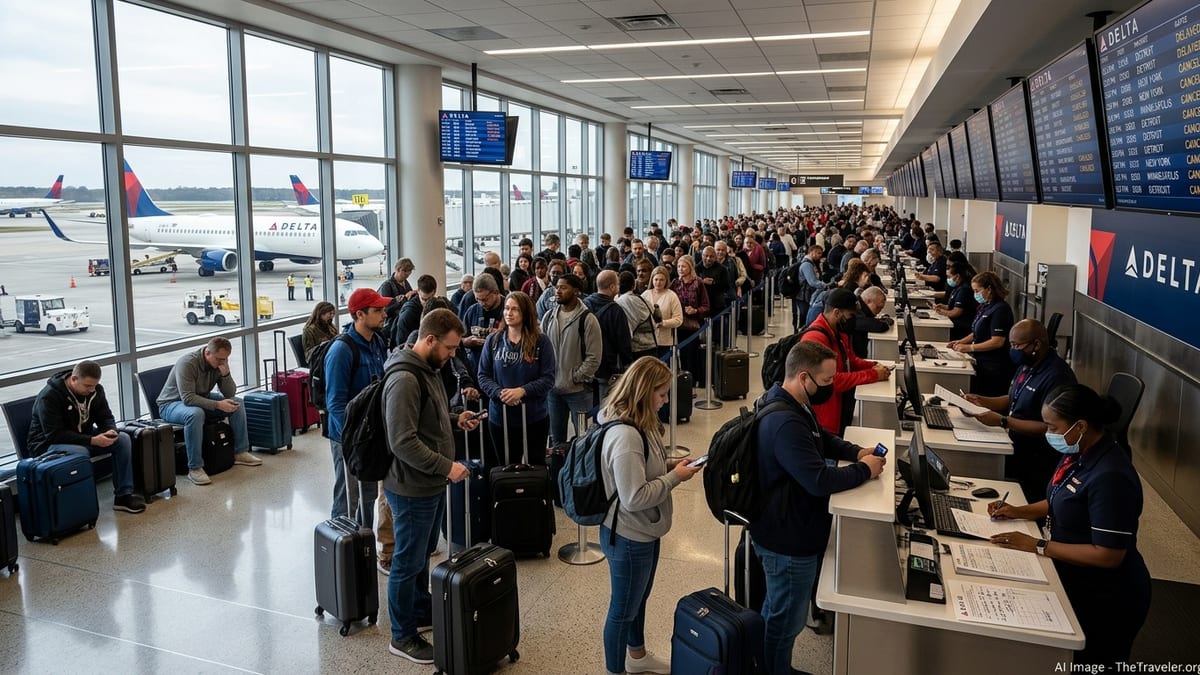
At Hartsfield-Jackson Atlanta International Airport, the immediate impact was visible on departure boards on Sunday afternoon, with hundreds of outbound and inbound Delta flights showing delays of varying lengths. Data from flight-tracking services indicated that more than 400 outbound flights from Atlanta were delayed on Sunday, with a similar number of inbound flights also affected during the peak of the disruption. As ground operations backed up, the airport used a ground delay program to meter departures and arrivals, easing congestion on ramps and taxiways while Delta dealt with the system outage.
The knock-on effects extended well beyond Georgia. Delta flights from major domestic gateways including New York, Detroit, Minneapolis–St. Paul, Los Angeles and Seattle reported departure delays attributed to the Atlanta issue, either because their aircraft or crews were coming from or heading to the hub or because baggage and performance data had to be manually coordinated with Atlanta-based dispatchers. In some cases, passengers reported sitting on board fully boarded aircraft for extended periods while crews waited for manual weight-and-balance figures to be transmitted and approved.
For travelers, delays varied widely by route and time of day. Some early morning and late evening departures outside the peak of the outage saw relatively minor disruptions of 30 to 60 minutes, while other flights in the middle of the day and early evening encountered waits of two to four hours or more. The combination of the system problem, already busy pre-Thanksgiving demand and localized weather issues at some airports meant that missed connections were common for customers relying on same-day transfers through Atlanta.
System restoration and how long the effects will linger
By Sunday afternoon and evening, Delta reported that automation for its departing flight weight-and-balance calculations and its baggage network system had been restored. The airline said the underlying system issue that prompted the move to manual workarounds had been fixed and that automation was once again supporting normal operations. The FAA ground stop and ground delay measures connected to the incident were lifted, allowing new departures to resume from Atlanta under standard procedures.
Even after Delta confirmed the technical fix, however, irregular operations continued into Sunday night and Monday, November 23, as the carrier worked through the accumulated backlog. Aircraft and crews were out of their planned positions, leading to rolling delays on subsequent flights even where no further technical issues were reported. Some passengers arriving into Atlanta on Sunday evening and Monday morning continued to see late departures on connecting flights while ground teams completed manual tasks on remaining affected services and gradually synchronized schedules across the network.
Travel industry briefings and airline communications indicated that, with the system now functioning, Delta’s schedule is expected to progressively normalize over the first half of Thanksgiving week. However, residual delays and occasional cancellations are likely to continue while the carrier rebalances aircraft, crew and baggage flows. For some travelers whose itineraries involved tight connections on Sunday or early Monday, the disruption has already required rebooking, overnight stays or rerouting through other hubs, which can lengthen the recovery period as those adjustments cascade through seat availability on subsequent flights.
How this outage fits into a broader month of aviation disruptions
The Atlanta incident occurred less than two weeks after a separate, nationwide air traffic disruption on Friday, November 13, when an equipment problem affecting U.S. air traffic control communication and radar systems prompted what officials described as the country’s longest ground stop in roughly a quarter-century. That earlier event, which was not related to Delta’s systems, caused more than 15,000 delayed or cancelled flights across all major U.S. carriers and highlighted the vulnerability of aviation infrastructure to technical failures.
Between the November 13 national air traffic control issue and the more recent Delta outage in Atlanta, U.S. travelers have experienced a series of technology-driven disruptions during one of the busiest travel periods of the year. In addition, another large carrier, United Airlines, has previously dealt with its own weight-and-balance computer system problems, including a 2025 incident that resulted in more than 1,000 delays and dozens of cancellations before that system was stabilized. While the causes of each outage differ, they underline the dependence of modern airline and airport operations on complex software and networked systems.
Transportation officials and industry analysts have pointed out that carriers typically maintain manual fallback procedures precisely for situations like the one Delta faced in Atlanta. Those procedures ensure that flights can still operate safely when automation fails, but they are slower, more labor-intensive and less scalable, which is why delays tend to grow quickly when they are used across a large hub operation. Early assessments of the Delta incident suggest that, while safety protocols functioned as intended, the combination of a localized system failure, heavy Thanksgiving demand and recent national disruptions amplified its impact on travelers.
What affected travelers can do now and what to watch next
With Delta’s weight-and-balance automation and baggage network systems now reported as restored, the focus for passengers over the coming days will be on managing residual delays and potential schedule changes rather than dealing with an active outage. Travelers booked on Delta flights into, out of or through Atlanta through at least Tuesday, November 24, should regularly monitor their flight status on the airline’s website or mobile app, as departure and arrival times may continue to shift while operations normalize. Same-day notifications from the carrier remain one of the most reliable sources of route-specific information as the network stabilizes.
Passengers with tighter connections, particularly those traveling on complex itineraries through Atlanta during peak hours, may want to build in additional buffer time in case of knock-on delays. Where connections have already been missed or rebookings are necessary, Delta is handling changes according to its standard irregular-operations policies, which can include moving travelers to later flights or, in some cases, rerouting via other hubs when seats are available. Travelers with time-sensitive plans at their destination, such as cruises, events or international connections, should consider reconfirming onward reservations and, where possible, have contingency options in mind.
Looking ahead, transportation authorities and the airline are expected to further review the causes of the automation failure in Atlanta, including how the specific weight-and-balance and baggage systems malfunctioned and what changes might reduce the risk of a similar outage. Any detailed findings or long-term technology upgrade plans have not yet been published, and no regulatory conclusions have been announced. For now, the immediate takeaway for travelers is that Sunday’s Delta disruption was limited in duration, the implicated systems have been returned to service, and the primary remaining impacts are residual delays as the busy Thanksgiving-week operation is brought back on schedule.