


More news on this day
Rail Baltica has published its first network statement, marking a significant step in preparing the future high-speed standard-gauge line between Poland and the Baltic states for commercial passenger and freight operations.
Get the latest news straight to your inbox!
Framework sets out how the new line will be used
The newly released network statement provides the initial framework describing how railway undertakings will be able to use Rail Baltica’s infrastructure once sections of the line open for traffic. According to published coverage, the document outlines the main technical characteristics of the line, the services that the future infrastructure manager intends to offer, and the general conditions for access to the network.
The first version focuses on the core north–south corridor that will connect Poland with Lithuania, Latvia and Estonia on 1435 mm standard gauge. Publicly available information indicates that it summarises key route parameters such as maximum speeds, loading gauge and train length, together with an overview of planned passenger and freight services. While it is described as an initial framework rather than a fully detailed rulebook, the release gives prospective operators enough visibility to start planning rolling stock, timetables and logistics concepts.
The document follows the general structure used for network statements elsewhere in Europe, aligning Rail Baltica with established practices on other TEN-T core corridors. This alignment is intended to make it easier for existing European operators to enter the market once the line is operational, by presenting information in a familiar format and clarifying that European Union legislation on non-discriminatory access will apply.
Reports indicate that the network statement will be updated as construction advances and more detailed operational rules are agreed. Future editions are expected to include refined capacity allocation processes, maintenance windows and more granular information on station facilities.
Key technical and operational features highlighted
Rail Baltica is being built as a high-performance mixed-traffic corridor designed for passenger trains at up to 249 km/h and freight services at up to 120 km/h. The standard-gauge alignment will run for more than 870 km through Estonia, Latvia and Lithuania before linking south into Poland, forming part of the European Union’s North Sea–Baltic Core Network Corridor.
Public information on the network statement indicates that it confirms core technical standards such as electrification at 25 kV AC, European Rail Traffic Management System signalling and modern train protection suitable for high-speed operation. The line is being designed for long freight trains and heavy axle loads, reflecting its role in shifting cargo from road to rail and improving connectivity between Baltic ports, logistics hubs and Central Europe.
The initial framework also points to an operating model where international and regional passenger services will share the corridor with freight, with dedicated passing loops and overtaking possibilities to manage traffic flows. Previously published planning documents for Rail Baltica have suggested regular-interval passenger timetables between the Baltic capitals and onward towards Warsaw, alongside overnight and daytime freight flows linking industrial areas and terminals along the route.
By setting these expectations in a formal network statement, the project team is giving train operators early guidance on performance assumptions, including typical journey times and capacity envelopes. This, in turn, supports procurement planning for rolling stock and terminal equipment across the region.
Prospective operators gain visibility for service planning
The publication of the first network statement is being closely watched by passenger and freight companies interested in running trains on the new corridor. Reports in the specialist rail press suggest that the framework will serve as a reference point for both incumbent national operators and potential new entrants considering cross-border services.
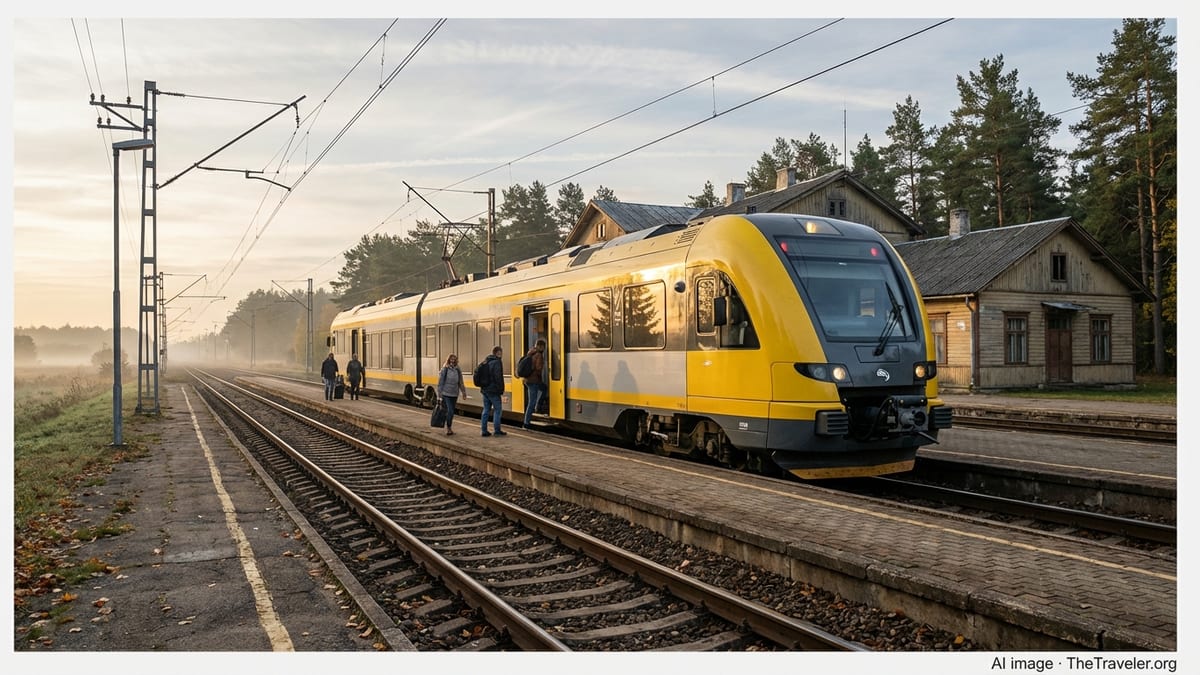
In passenger transport, Baltic regional operators are already preparing for the new line. Earlier this year, the passenger companies Elron in Estonia, Vivi in Latvia and LTG Link in Lithuania launched a joint procurement for up to 20 standard-gauge regional multiple units designed for 200 km/h operation on Rail Baltica. Publicly available information on the tender indicates that these trains are intended to serve shorter-distance and regional routes on the new corridor, complementing future long-distance international services.
Freight operators and logistics providers are also expected to use the network statement as a tool for modelling new flows between Baltic ports, intermodal terminals and destinations in Poland and further into Western Europe. With detailed information gradually emerging on loading gauge, permissible weights and terminal access, companies can begin to evaluate how existing fleets and supply chains might transition from the current broad-gauge network to the new standard-gauge infrastructure.
The framework nature of the document means that some commercial details, such as future access charges, are not yet fully defined. However, sector observers note that early publication of the technical and operational baseline is crucial for enabling investment decisions in rolling stock and terminals that often have lead times of several years.
Context of cost, timing and funding pressures
The release of the network statement comes at a time when the Rail Baltica project is facing increased scrutiny over costs and timelines. Recent reports from European-level institutions and regional media highlight that the full completion of the corridor is unlikely to meet the original 2030 target, with later dates now being discussed for final sections, particularly in Lithuania and Poland.
At the same time, construction activity along the route is intensifying, with contracts signed for major civil works, stations and systems. Industry coverage has noted large framework agreements for track components and railway equipment, as well as ongoing tenders for additional sections in both the Baltic states and Poland. The combination of rising construction prices, complex permitting and evolving defence and security requirements has added pressure to the project’s budget.
Against this backdrop, the network statement is seen by analysts as part of a broader effort to demonstrate that Rail Baltica is transitioning from planning and design to concrete preparations for operations. By clarifying how the line is intended to work in practice, project promoters aim to underline the long-term transport and economic benefits that the corridor is expected to bring to the region, even as short-term funding discussions continue.
Public discussions in the Baltics and Poland also reflect growing attention to how Rail Baltica will interact with existing networks, including connections to major cities, ports and airports. Future iterations of the network statement are expected to incorporate more detail on these junctions as designs are finalised.
What comes next for Rail Baltica’s operational planning
With the first network statement now published, attention is turning to the next steps in preparing Rail Baltica for service. According to publicly available project documentation, the development of a comprehensive operational plan is under way, covering issues such as capacity planning, timetable structure, station operations and maintenance regimes for the high-speed mixed-traffic line.
Further work will be needed to create definitive national network statements and access contracts in each of the Baltic states and Poland, reflecting local regulatory frameworks and the eventual allocation of infrastructure management responsibilities. Sector analysts expect that these national documents will build on the common framework released for the cross-border corridor, helping to ensure consistent rules along the entire route.
In parallel, regulatory authorities in the region are preparing for applications from railway undertakings seeking safety certificates and licences to operate on the new infrastructure. The clarity offered by the network statement on technical and operational standards is likely to inform those processes, while also guiding manufacturers and service providers that plan to support operations on Rail Baltica.
As construction progresses and more elements of the future operating model are finalised, further revisions of the network statement are anticipated. Each update will give the market a more detailed picture of how one of Europe’s most ambitious new rail corridors will function once trains begin to run between the Baltic capitals and Poland.