


More news on this day
Spain’s high-speed rail network, long promoted as a model of fast and sustainable mobility, is facing a sharp drop in passenger confidence after a string of serious accidents and mounting service disruptions that have cut demand on key corridors by around one fifth.
Get the latest news straight to your inbox!
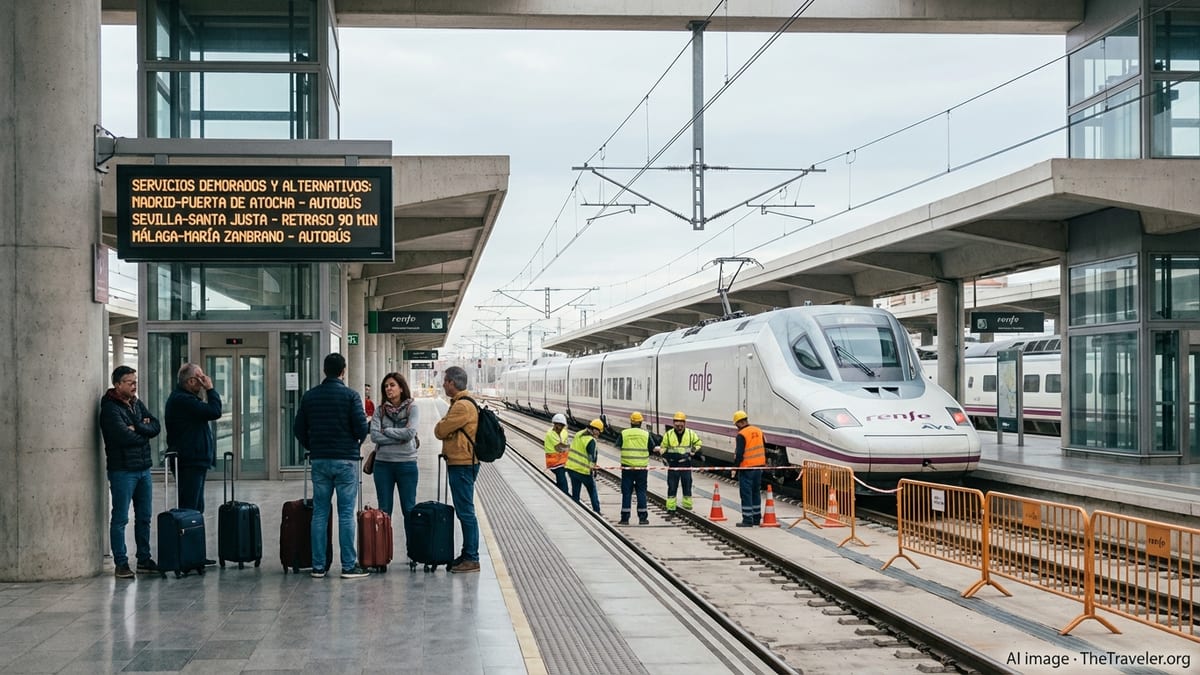
From showcase network to shaken confidence
In recent years, Spain’s liberalised high-speed rail market had been held up as a success story, with record passenger numbers and growing competition between Renfe, Ouigo and Iryo on main corridors such as Madrid to Barcelona, Valencia and Málaga. Publicly available competition authority data indicated that nearly 40 million passengers used high-speed services in 2024, almost double pre-pandemic levels, helping rail overtake air travel on several domestic routes.
That upward trajectory has been abruptly interrupted in the wake of the Adamuz disaster on 18 January 2026, when an Iryo service derailed in Córdoba province and was struck by a Renfe Alvia train. The collision, which left 46 people dead and hundreds injured according to official tallies cited in multiple reports, is described in local coverage as Spain’s worst rail tragedy since the Santiago de Compostela crash in 2013.
Newly released traffic statistics for the high-speed network show that volumes on some affected stretches fell by close to one third in the weeks after the crash, with overall high-speed ridership dropping by roughly 20 percent compared with the same period a year earlier. Regional media have reported notable declines around Córdoba and in Andalusia, where the accident occurred, but the impact has rippled across the wider network as travellers reassess safety and reliability.
The sudden reversal has unsettled an industry that had been banking on continued growth, driven by lower fares, new rolling stock and expanded routes. It has also sharpened scrutiny of how infrastructure is inspected and maintained amid rising train frequencies and intense price competition.
Adamuz crash puts maintenance and oversight under the microscope
Investigations into the Adamuz derailment are still under way, but early findings highlighted in rail specialist publications point to a fractured rail section on the high-speed line as a key factor. A detailed report by Spain’s Civil Guard, cited in specialist rail media, describes how a voltage anomaly consistent with a rail break was detected on the track circuit many hours before the accident, raising questions about follow-up procedures and the chain of responsibility.
The case has intensified an already heated debate over whether spending on maintenance and renewals has kept pace with the rapid growth of Spain’s high-speed network. Coverage synthesising data from the national rail accident investigation commission shows more than 500 rail incidents of various types over the last decade, including derailments, collisions with obstacles, level crossing accidents and incidents involving people on the tracks.
While high-speed lines in Spain remain statistically safer than conventional roads and continue to carry tens of millions of passengers with relatively few serious incidents, the concentration of recent high-profile crashes has heightened public sensitivity. Commentators in national outlets note that the psychological impact of a single catastrophic event can be enough to shift travel behaviour, particularly for discretionary leisure trips where passengers can switch back to cars or short-haul flights.
Regulators and policymakers are now facing calls from consumer advocates and transport analysts to prioritise preventive maintenance and digital monitoring systems, even if that means postponing some planned extensions of the high-speed map. Industry observers warn that any perception of cost-cutting on safety-critical work could further undermine trust at a time when ridership is already under pressure.
Operational disruptions test passenger patience
Beyond headline-making accidents, Spain’s rail users have been dealing with a steady drumbeat of operational problems that erode confidence in day-to-day service. Business media reports drawing on internal performance data indicate that in 2024 as many as 600 trains a day across the network experienced some form of delay or incident, ranging from infrastructure failures and rolling-stock breakdowns to signalling glitches.
Missed connections have become a particular flashpoint. One widely cited assessment notes that the share of trains affected by lost connections jumped from well under 1 percent in 2023 to more than 5 percent in 2024, amounting to several thousand disrupted journeys. For passengers using high-speed services to link into regional or commuter trains, a missed connection can mean hours of additional travel or an unplanned overnight stay.
Several specific breakdowns on new high-speed rolling stock have drawn attention. Coverage of an August 2024 incident described how an Avlo service equipped with Talgo Avril trains stalled in a Madrid tunnel due to a power failure, stranding hundreds of passengers and forcing the temporary withdrawal of multiple trainsets. While no one was injured, the episode fuelled concerns that cutting-edge equipment was entering service without sufficient time for testing and fine-tuning.
These operational strains have practical consequences for ridership. Industry analysts note that while many commuters remain captive users, high-speed leisure and business travellers are more sensitive to reliability. Survey-based reporting from Spanish outlets shows a clear deterioration in passenger perceptions of service quality, even as some punctuality indicators remain relatively high by European standards.
Competitive market faces its first major stress test
The turbulence is unfolding in a liberalised market that only recently settled into a new competitive equilibrium. Since 2021, France’s Ouigo and Italy-backed Iryo have joined Renfe on Spain’s core high-speed corridors, offering lower fares and more frequencies. The competition authority has highlighted how this opening boosted ridership and trimmed average ticket prices, particularly on the Madrid to Barcelona and Madrid to Levante routes.
Now, the same market is grappling with how to maintain standards under financial pressure. Lower fares and higher frequencies have thinned margins, limiting the financial room that operators and the infrastructure manager have for major upgrades and redundancy. Analysts quoted in specialist rail and business publications argue that, while competition has delivered clear benefits to passengers, it also creates strong incentives to maximise asset utilisation, which can increase wear on infrastructure and fleets.
For Renfe, the state-backed incumbent, the current period is doubly challenging. On one hand, the company has invested heavily in new high-speed trains and is under political pressure to keep expanding services into new regions. On the other, it faces critical scrutiny over its role in network reliability and safety, even on lines it shares with rivals. Private operators, too, are being asked how they monitor rolling stock conditions and coordinate with infrastructure managers in disrupted situations.
Despite these tensions, there is little indication that competition itself is under threat. Policy discussions in Madrid reported in national media continue to emphasise open access and modal shift from air and road, but with a growing focus on enforcing maintenance standards, real-time information sharing and clear passenger rights in the event of disruption.
Passengers weigh safety perceptions against climate goals
The crisis in confidence comes at a sensitive moment for Spain’s climate strategy. High-speed rail is a central pillar of plans to cut short-haul aviation and long-distance car use, as it offers significant emissions savings per passenger kilometre. Recent modelling cited by transport-focused outlets suggests that high-speed rail’s dominance over air on key routes has already avoided hundreds of thousands of tonnes of carbon dioxide annually.
If a sustained one-in-five drop in high-speed ridership were to persist, analysts warn that a portion of that traffic would likely shift back to private cars and domestic flights, potentially undermining progress on emissions. Early anecdotal reporting from travel agencies and airline booking platforms already points to a modest rebound in domestic air demand on some routes parallel to high-speed lines.
For many travellers, the decision now hinges on how convincingly Spain’s rail sector can demonstrate that lessons are being learned from recent incidents. Publicly available documentation shows that operators are reviewing inspection regimes, accelerating the deployment of track monitoring systems and considering revised contingency plans for detected defects. As formal accident investigations proceed, further recommendations on speed limits, inspection intervals and contractor oversight are expected.
In the meantime, Spain’s once-unquestioned high-speed success story has entered a more complicated chapter. The coming months will show whether a combination of technical fixes, transparent communication and consistent performance can win back the one in five passengers who have drifted away, and reassure those still on board that high-speed rail remains one of the safest and most sustainable ways to cross the country.