


Your flight was delayed for hours, the kids were exhausted, you paid for an unexpected hotel, and now the airline is ignoring your emails. In that moment, companies like AirClaim promise to turn your bad day into cash compensation, often under Europe’s EU261 rules. But should you trust AirClaim with your flight compensation claim, or are you better off going directly to the airline or choosing another provider?
Get the latest updates straight to your inbox!
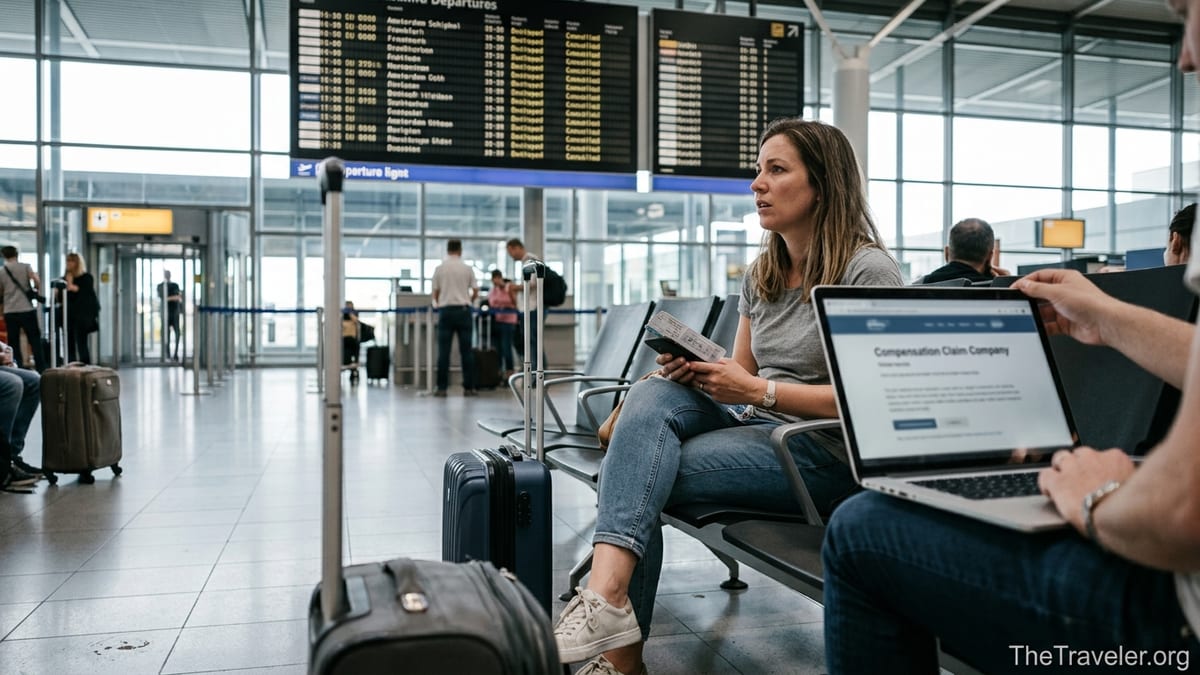
Who Is AirClaim and What Does It Actually Do?
AirClaim is a Romania-based company that specializes in helping air passengers claim compensation after disrupted flights, particularly under EU Regulation 261/2004, often called EU261. The company focuses on common problems such as long delays, cancellations, overbooking, and denied boarding. In practice, this means that if your Paris to Madrid flight with an EU airline arrived more than three hours late without extraordinary circumstances like severe weather, AirClaim may be able to pursue a claim on your behalf.
Rather than you trading emails with an airline’s customer service department for months, AirClaim positions itself as a middleman and legal representative. You provide your flight details, upload boarding passes or e‑tickets, and sign a mandate allowing the company to negotiate and, if needed, escalate legally in your name. If the airline pays, AirClaim deducts a fee and passes the rest of the money on to you. If the claim fails, in principle you owe nothing, which is why this is often described as a “no win, no fee” model.
AirClaim operates in a crowded space. Well-known competitors include AirHelp, AirAdvisor, MyflyRight and a long list of national and regional specialists. What sets AirClaim apart is its strong focus on southern and eastern European markets and its heavy marketing on social platforms and search engines, where travelers encounter quick “Check your compensation for free” tools right after a bad flight experience.
For travelers, the central question is not whether AirClaim exists, but whether its service is competent, reasonably priced, and transparent enough to entrust with what may be several hundred euros per person in compensation.
How AirClaim’s Process Works in Real Life
In practical terms, using AirClaim looks similar for most travelers. Imagine you were flying from London to Athens on an EU airline, and your flight arrived more than four hours late due to a technical problem discovered after boarding. Under EU261, this type of disruption often qualifies for compensation of around 400 euros per person for that route distance. Instead of filling out the airline’s online form, you land on AirClaim’s website and start their claim process.
AirClaim typically asks for your flight number, date, booking reference, and basic contact details. Once the system checks the disruption against internal databases and public information about delays, you may see a quick estimate of your potential compensation. You are then asked to upload supporting documents such as boarding passes or e‑tickets and to sign a digital power of attorney or mandate so the company can act on your behalf. From there, AirClaim prepares and submits the claim to the airline.
The next stage is the least visible to travelers: negotiation and escalation. Some claims settle quickly when airlines see a clearly valid EU261 case. In others, the airline argues that extraordinary circumstances like air traffic control restrictions or severe weather apply, which would remove their obligation to pay. AirClaim’s legal team may send counter-arguments, cite case law, or escalate to national enforcement bodies or in some cases local courts. This is where the service can save you many hours of research and correspondence, especially across languages and jurisdictions.
Travelers should also understand that timeframes are not instant. Although marketing messages may emphasize “quick” or “fast” payouts, real-world experience shows that claims can take several weeks to several months, particularly when the airline resists or when additional documentation is required. The trade-off is that you avoid dealing with those delays personally, but your compensation may not appear in your bank account for some time.
What Real Travelers Say About AirClaim
Recent customer reviews across multiple languages paint a nuanced picture of AirClaim’s performance. On major review platforms, AirClaim generally holds a strong average score, with many travelers describing positive experiences where long-delayed flights finally resulted in money in their bank accounts. For instance, several passengers report that after Wizz Air or Ryanair delays of five hours or more, AirClaim secured compensation they had not been able to obtain themselves. Typical comments praise the process as “simple,” “professional,” and “stress-free,” with some travelers saying they received their compensation earlier than expected.
One traveler described an eight-hour delay that caused them to miss two connecting flights on a separate itinerary. Feeling overwhelmed by the complexity of claiming for both the main disruption and the knock-on consequences, they turned to AirClaim and eventually received compensation under EU261. For passengers not familiar with EU regulations or who are unsure how to calculate their rights when multiple tickets are involved, this type of guidance can be invaluable.
However, not all experiences are positive. Some reviewers complain that AirClaim’s communication becomes sparse once a claim is submitted, with long stretches of silence and little proactive updating. Others express frustration that payments took one or two months to reach their bank accounts after the airline had already agreed to compensate. One customer recounted that a claim they had easily settled directly with an airline in five days took several weeks via AirClaim for a similar situation, leading them to conclude they would handle future claims themselves.
There are also a smaller number of complaints from customers who believed AirClaim could have fought harder when airlines refused to pay, or who felt the company simply forwarded the airline’s rejection without adding substantive legal arguments. As with most claims companies, experiences vary depending on the complexity of the case and expectations about communication speed and transparency.
Fees, Fine Print, and How Much You Actually Receive
One of the most important questions for any traveler is how much of the eventual compensation actually lands in their account. EU261 sets fixed compensation amounts based largely on flight distance and delay length. For example, a long-haul flight arriving more than four hours late can trigger compensation of around 600 euros per passenger, while shorter intra-European flights may result in approximately 250 euros per person. This is the gross amount the airline pays before any claims company takes its share.
Across the industry, commission rates for EU261 claim services frequently cluster around one third of the compensation, rising to about half if court action is required. Some recent comparisons of European claims firms show service fees from roughly 15 percent at low-cost app-based services up to about 35 percent plus tax for full-service legal handling, with higher effective rates when external lawyers and court fees are involved. While AirClaim’s exact fee structure may vary by case and market, traveler reports suggest it aligns broadly with this industry pattern.
To understand the real impact, consider a family of four whose long-haul flight from Barcelona to New York, operated by an EU carrier, arrived over four hours late for a reason within the airline’s control. Under EU261, they might be entitled to roughly 600 euros each, or 2,400 euros in total. If AirClaim pursued the case and charged around 30 to 35 percent upon success, the family might receive between 1,560 and 1,680 euros after fees, with the rest covering legal and administrative work. If the case needed to go to court, the effective commission might climb closer to half, bringing their net share down to around 1,200 euros.
These numbers illustrate why reading the fee terms matters. For a single passenger on a short-haul delay who could receive about 250 euros, handing over around 75 to 90 euros in commission might be a reasonable price for avoiding a bureaucratic battle. For larger groups or very long flights, the absolute amount paid in fees can be significant. If you are comfortable writing formal emails, keeping records, and potentially escalating to a national enforcement body, handling a straightforward claim yourself may be more cost-effective.
Can You Do It Yourself Instead of Using AirClaim?
Many travelers are surprised to learn that you do not need any third-party company to claim EU261 compensation. Airlines are required to provide information about your rights, and most major carriers, from British Airways and Lufthansa to Ryanair and easyJet, maintain web forms dedicated to EU261 or UK261 claims. A typical do-it-yourself process involves submitting booking references, explaining the delay or cancellation, and uploading proof such as boarding passes and receipts.
In relatively clear situations, such as a mechanical problem on a European Union airline departing from an EU airport that leads to a delay well over three hours, some passengers have reported receiving 250 to 600 euros per person within a couple of weeks directly from the airline, with no commission taken. For example, a traveler recently described how an American Airlines flight departing from Europe arrived more than twelve hours late. By citing EU261 in a concise email and providing documentation, they received full compensation within two weeks, plus reimbursement for hotel and transport.
However, “easy” cases are not always the norm. Airlines often argue that bad weather, air traffic control restrictions, strikes by non-airline staff, or bird strikes count as extraordinary circumstances. In such cases, they may deny compensation, even when passengers feel the situation remains ambiguous. Others simply fail to respond, forcing passengers to follow up repeatedly or escalate to civil aviation authorities or alternative dispute resolution bodies. For a traveler unfamiliar with European regulatory systems or who does not speak the relevant language, this can be intimidating.
The decision to use AirClaim or go the DIY route therefore depends on your appetite for administrative effort and risk. If your claim is clearly eligible, you are comfortable challenging an airline’s denial, and you have time to follow procedures, you can potentially keep 100 percent of your compensation. If you are dealing with a complex itinerary, a non-EU airline on a multi-leg ticket, or an airline that has already rejected your claim, then outsourcing to a service like AirClaim or another reputable company can significantly improve your chances without upfront cost.
Key Risks and Red Flags to Consider Before Using AirClaim
Trusting any intermediary with a legal claim involves risk, and travelers should approach AirClaim with the same level of scrutiny they would apply to an online bank or insurance company. One primary concern is transparency about the status of your case. Some negative reviews mention minimal updates over long stretches of time, leaving passengers unsure whether their claim is actively being pursued or simply waiting in a queue. Before signing, it is sensible to check whether AirClaim offers an online dashboard or regular email updates and to note how quickly they responded to your initial inquiries.
Another issue is payout timing. Even once an airline agrees to pay compensation, the money must first arrive in AirClaim’s own accounts, after which it is transferred to you. A number of travelers report that this second step took several additional weeks. While some delay is reasonable due to bank processing and internal checks, extended holding of funds can understandably cause anxiety. Clarifying in advance how soon after receipt from the airline AirClaim commits to paying you can help set realistic expectations.
Travelers should also examine contract terms relating to exclusivity and withdrawal. Once you sign a mandate, you may not be able to pursue the same claim independently or through another company without risking dual representation problems or fees. If you later decide to drop AirClaim and negotiate directly with the airline, there may be provisions covering costs or commissions if their work significantly contributed to the outcome. Reading the terms carefully before clicking “accept” is essential.
Finally, as with any online claims service, there is the broader industry risk of impersonation and copycat websites. The flight compensation sector is full of near-identical brands with similar names, color schemes, and promises. Travelers should ensure they are dealing with the correct AirClaim entity and not a similarly named site by verifying corporate details, checking consistent company addresses in official documents, and confirming that communication channels match those described in formal correspondence.
How AirClaim Compares With Other Flight Compensation Companies
When deciding whether to trust AirClaim, context matters. Comparing it to other flight compensation companies helps clarify where it stands. Well-established players like AirHelp, AirAdvisor, MyflyRight, and various national firms typically charge comparable commission rates, often around one third of any compensation won, with higher percentages if legal proceedings are needed. Many offer multilingual support and detailed web resources explaining EU261, UK261, and similar regulations in plain language.
Some rivals focus heavily on technology. For instance, certain companies use AI tools to cross-check your flight against databases of delays, published reasons, and historical weather data to quickly assess whether an airline’s explanation is likely to hold up. Others specialize by region, concentrating on routes involving particular airlines or countries where they have deep local legal expertise. In this landscape, AirClaim’s strengths are its strong review scores in markets like Spain, Italy, and Poland and its focus on mainstream EU261 cases rather than a broader bundle of travel insurance-style services.
However, AirClaim is not consistently rated as highly as the top-tier global brands in every country. Some competitors, including more niche regional firms, achieve slightly higher average scores for communication and speed, according to recent consumer review aggregations. On the other hand, there are also claims companies with notably worse reputations, featuring frequent complaints about total silence, unclear fees, or aggressive marketing tactics.
For travelers, the comparison often comes down to three questions: fee level, communication quality, and legal persistence. Does the company clearly state its commission and any extra charges? Are they responsive to emails and able to explain complex eligibility rules in simple terms? And do they appear willing to escalate when an airline’s refusal seems questionable? AirClaim is broadly competitive on the first point, mixed but generally acceptable on the second according to most recent reviews, and variable on the third depending on the complexity of the case.
The Takeaway
So, should you trust AirClaim with your flight compensation claim? For many travelers whose priority is convenience over maximizing every euro, the answer is a cautious yes. AirClaim is a real company with a multi-year track record, generally strong review scores, and hundreds of documented cases where passengers finally received compensation after stressful delays or cancellations. If you are overwhelmed by the idea of arguing EU261 rules with an airline, lack time to chase responses, or are dealing with a complex itinerary, AirClaim can be a useful ally.
That said, trust should never be automatic. Before handing over your claim, read AirClaim’s fee structure closely, understand that you may effectively give up a third or more of your eventual compensation, and set realistic expectations about timelines. Be aware that communication may not always be as frequent as you would like and that in some cases, a determined do-it-yourself approach with the airline and, if necessary, national enforcement bodies can yield the same financial result more quickly and with no commission.
If your claim is straightforward, such as a clear-cut long delay departing from the European Union on an EU carrier, consider submitting it yourself first using the airline’s official form or customer service channels. Keep copies of all correspondence and official notices, and give the airline a reasonable window to respond. If they refuse without persuasive justification or simply ignore you, then revisiting the option of AirClaim or another reputable claims company may make sense.
Ultimately, trusting AirClaim is less about believing marketing promises and more about making an informed trade-off: you pay in the form of commission and some loss of control in exchange for expertise, persistence, and time saved. For many busy travelers juggling work, family, and complex trips, that can be a fair deal. For others who are comfortable pushing back against airlines and navigating bureaucracy, keeping the full amount of compensation by going it alone will be the better route.
FAQ
Q1. Is AirClaim a legitimate company or a scam?
AirClaim is a legitimate flight compensation service provider that has operated for several years and has handled hundreds of documented claims. It is not a scam in the sense of disappearing with customers’ data or money, but, as with any claims company, service quality and speed can vary case by case.
Q2. How much does AirClaim charge for handling a flight compensation claim?
AirClaim generally follows the industry model of taking a percentage of the compensation only if the claim succeeds, with total commission often in the range of roughly one third of the payout and potentially higher if formal legal proceedings are needed. You should always read the specific fee terms shown before signing your mandate.
Q3. How long does it take to get my money if I use AirClaim?
Timelines vary widely. Simple cases where airlines quickly accept liability can resolve within a few weeks, while more complex disputes may take several months. Some travelers also report an additional delay between the airline paying AirClaim and AirClaim transferring the money to the passenger, so patience is often required.
Q4. Can I claim EU261 compensation on my own without using AirClaim?
Yes. You can submit a claim directly to the airline through its official EU261 or UK261 form or via customer service. Many passengers successfully secure 250 to 600 euros per person this way, keeping the full amount. The trade-off is that you must invest your own time, be prepared to argue your case, and sometimes escalate to national authorities.
Q5. What types of flight problems can AirClaim help with?
AirClaim focuses mainly on disruptions covered by EU261, including long delays on eligible flights, cancellations notified late, overbooking that leads to denied boarding, and certain missed connections. It may also assist with related issues, but its core business is cash compensation claims rather than general travel insurance or baggage disputes.
Q6. Does using AirClaim reduce my chances of getting compensation?
In most straightforward cases, using AirClaim should not reduce your chances and may improve them if the airline is initially unresponsive or combative. However, no company can guarantee success, and some passengers report achieving faster results by claiming directly with airlines in very clear-cut situations.
Q7. What happens if the airline already rejected my claim before I contact AirClaim?
If an airline has refused your claim, AirClaim may still be able to review the case and decide whether to challenge the decision. They may look at flight data, legal precedents, and the airline’s stated reasons. If they believe the rejection was unjustified, they can attempt to reopen negotiations or escalate to authorities or courts, often at a higher commission rate if legal action is required.
Q8. Is it safe to share my passport and booking details with AirClaim?
Providing documents like boarding passes, booking confirmations, and sometimes ID copies is standard in this industry because they are needed to prove your claim. AirClaim has operated for years without widespread reports of data misuse, but no online service is risk-free. You should ensure you are on the correct official site, review the privacy policy, and avoid sending unnecessary additional documents.
Q9. Can I switch to another company after I have already signed with AirClaim?
Once you sign a mandate with AirClaim, you may be contractually bound to let them handle that specific claim. Switching to another provider or going directly to the airline can create complications and may lead to disputes over who is entitled to any commission. If you think you might want to change course later, read AirClaim’s terms carefully before committing.
Q10. When is it worth paying AirClaim’s commission instead of doing it myself?
It is often worth paying a commission when your case is complex, the airline is resisting, you lack time or confidence to navigate regulations, or you live outside the relevant jurisdiction and would struggle to pursue legal escalation. If your situation is simple, clearly eligible, and you are willing to follow up firmly with the airline, handling the claim yourself and keeping the full compensation may be the better option.