


More news on this day
Rail passengers are facing days of disruption after a substation fire knocked out a key part of the power supply network, prompting emergency timetable changes, diversions and the rapid rollout of replacement buses across affected routes.
Get the latest news straight to your inbox!
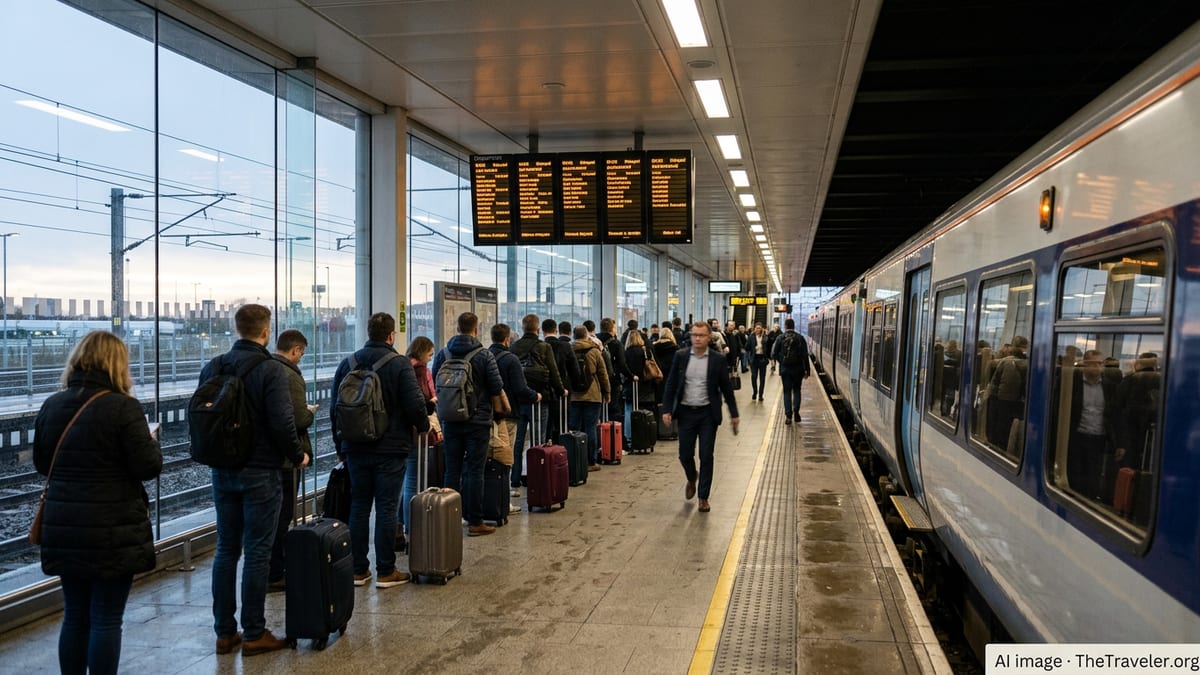
Power failure triggers cascading timetable changes
The fire, reported at a traction power substation serving a busy rail corridor, led to an immediate loss of power on several electrified tracks. Publicly available information indicates that signalling and overhead line equipment in the vicinity were temporarily taken out of service while engineers assessed damage and began safety checks.
To keep a basic level of service running, operators shifted quickly to a reduced timetable. Electric services were thinned out or suspended on the most heavily affected sections, with priority paths reserved for essential commuter and intercity trains. Some trains were capped short of their usual termini, while others skipped intermediate stops to preserve space in congested junctions.
Where diesel fleets were available, operators redeployed locomotives and multiple units to cover high demand flows. This allowed a patchwork of services to continue, but at lower frequencies than normal. Timetabling teams were forced to compress services into the remaining powered sections of track, accepting longer gaps between trains in order to avoid gridlock.
Rail industry planning documents show that even modest infrastructure failures can reverberate through the timetable, as train paths are tightly interwoven across shared corridors. The substation fire added a sudden constraint that existing schedules were never designed to absorb, making on-the-fly rescheduling unavoidable.
Reduced frequencies, bus replacement and diversions
In the immediate aftermath, the most visible change for passengers has been the combination of fewer trains and more buses. Replacement bus services have been drafted in for corridors where power remains unavailable or trackside equipment is still being inspected. These buses connect with surviving rail services at larger hub stations, adding extra journey time and introducing capacity constraints at peak hours.
Timetable summaries released by operators highlight a mix of half-hourly or hourly services replacing previous high-frequency patterns on key commuter routes. Some regional trains are making additional stops to help compensate for local service gaps, while others have been rerouted onto alternative lines that still have available power capacity. Journey planners show longer journey times on many flows as trains weave around the affected infrastructure.
On long distance routes, published coverage indicates that certain services are being diverted over slower secondary lines, in some cases requiring changes of direction or extended layovers for crew and rolling stock. These diversions protect connectivity between major cities but often lengthen travel times and limit the number of daily departures that can be operated.
Passengers are being advised in public notices to check journey planners close to departure, as short notice alterations and cancellations remain possible while the emergency timetable beds in. Operators are also warning that trains which do run may be busier than usual, particularly in peak commuting periods and on weekends with major events.
Operational challenges behind the scenes
Behind the scenes, the substation fire has triggered an intensive exercise in real time railway operations management. Once power was lost, control rooms had to identify which trains could still move under their own power, which would need towing or evacuation, and which sections of line had to be closed entirely to traffic while firefighters and engineers worked.
Restructuring a timetable in such conditions involves balancing safety, rolling stock availability, crew diagrams and infrastructure limits. Public documentation on rail disruption planning notes that traction power failures are particularly complex, as they can affect long stretches of route at once and leave pockets of the network isolated from depots and maintenance facilities.
In this case, operators have been reshuffling trainsets to keep maintenance cycles within safe limits, sometimes laying up units away from their home depots if access is restricted. Crew rosters are being rewritten to reflect new start and end points, with additional time built in for route learning on diverted paths and for briefings on altered stopping patterns.
Industry research into disruption management suggests that digital tools and simulation models are increasingly used to test alternative timetables under stress. By adjusting train paths and turnaround times virtually, planners aim to find patterns that maximise throughput on the remaining powered infrastructure without creating knock-on delays elsewhere on the network.
Passenger impact and travel advice
For travellers, the most immediate impact is uncertainty. Many regular commuters rely on clockface timetables that change little from day to day, and the abrupt switch to a reduced and restructured schedule can complicate connections with local transport, flights or onward rail journeys. Published guidance from passenger groups recommends allowing extra time for transfers and avoiding tight margins between services.
The emergency timetables mean that some early morning and late evening trains have been withdrawn, limiting options for shift workers and travellers heading to or from airports. Weekend leisure trips are also affected where engineering work already planned for the same corridors must now share track access with diverted services and replacement buses.
Passenger watchdogs are drawing attention to accessibility concerns on substitute buses and at stations where step free routes may be more crowded than usual due to platform changes. Publicly available feedback highlights frustrations over last minute changes to departure platforms and the difficulty of finding accurate, real time information during busy periods.
Despite these challenges, reports indicate that many passengers are adapting by using alternative stations, switching to earlier trains, or combining rail with other modes such as regional coaches or shared rides. Rail operators are using social media and station announcements to highlight less crowded trains and revised interchange options where available.
Repair timeline and prospects for full restoration
Engineering teams are now focused on inspecting and repairing the damaged substation equipment, a process that typically involves detailed testing of transformers, switchgear and control systems. According to technical briefings from previous incidents, replacement of high voltage components can take days or weeks depending on supply chains and the complexity of the site.
Until the affected substation is safely brought back online, the emergency timetable is expected to remain in force, though minor adjustments may be introduced as more precise capacity figures become available. Operators are indicating through public updates that they intend to restore services in phases, with the busiest commuter flows targeted first for increased frequencies.
Once repairs are complete and power margins improve, planners will begin the task of migrating back toward the full timetable. That process is unlikely to be instantaneous: rolling stock and crews must be rebalanced, and diverted services returned to their normal routes. In some cases, temporary calling patterns that prove popular may be retained, requiring further fine tuning of the schedule.
Analysts note that incidents of this type often prompt a wider review of network resilience, including the placement of additional substations, improved isolation arrangements and better real time monitoring of power assets. For passengers, the priority remains clear and timely information on which trains are running and how long the revised timetables will stay in place.