


I arrived in Trenton expecting a box to tick off a list of state capitals. On paper, it sounded like one of those places you pass through on the train between New York and Philadelphia, a city better known for its weary “Trenton Makes, The World Takes” bridge than for anything you might actually want to linger over. Yet within a day of walking its streets, the city’s history began to argue back. Trenton was not just a waypoint. It was a turning point, and the traces of that moment are still written into its brick, stone, and riverfront.
Get the latest updates straight to your inbox!
First Impressions on the Train Line
Trenton’s reputation precedes it, and not kindly. From the Northeast Corridor rail line, the first view is a blur of warehouses, rail yards, and the steel span of the Lower Trenton Bridge, its giant red letters spelling out “TRENTON MAKES THE WORLD TAKES.” Many travelers never see more than that sign stretched over the Delaware River, installed in the 1930s as a boast of the city’s industrial might. It can feel like a punchline, especially for a place that no longer hums with factory whistles and molten steel.
Stepping off at Trenton Transit Center, there is no grand plaza to soften that impression. The station opens to a busy roadway, bus bays, and low-slung commercial buildings. It feels functional rather than inviting, a crossroads of Amtrak, New Jersey Transit, SEPTA, and the River Line light rail that shuttles commuters rather than courting tourists. If you arrive expecting stately boulevards, you will not find them at the curb.
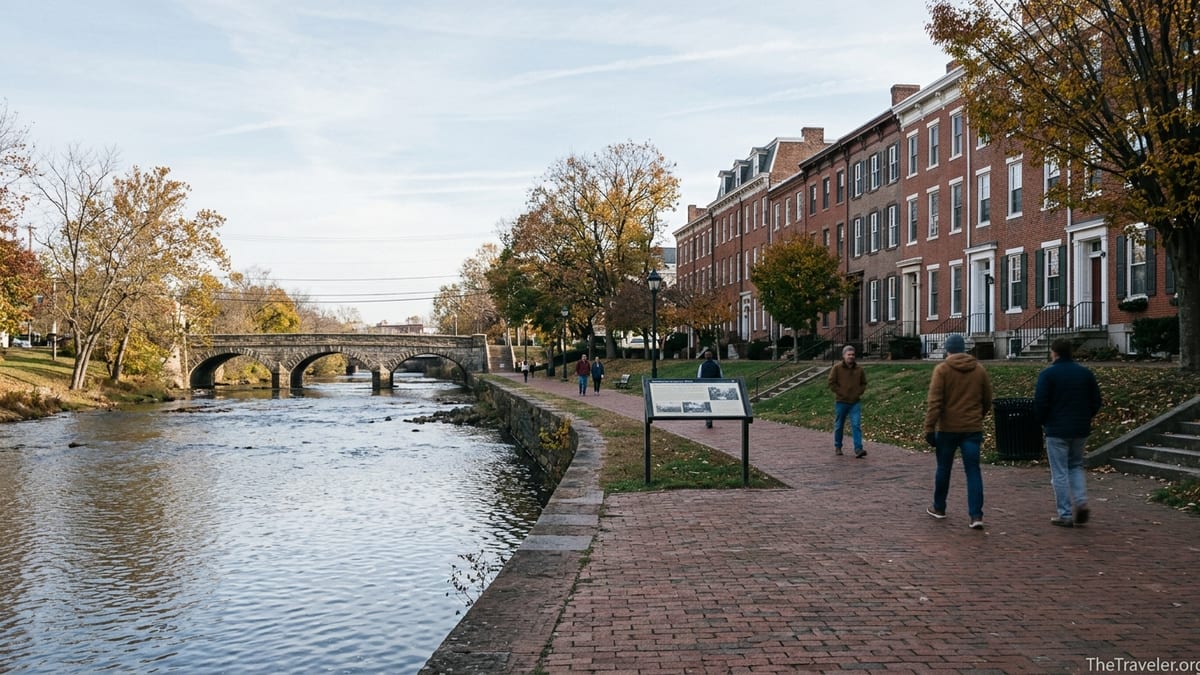
Yet Trenton reveals itself gradually if you walk instead of waiting for a car. Within fifteen minutes on foot you can be standing at the edge of Mill Hill Park, watching Assunpink Creek flow under stone arches, or turning onto a narrow brick lane lined with 19th century rowhouses. The city does not announce its charms with a skyline. You have to go looking, and that search is where its story begins to shift.
For travelers used to polished destinations, this humility can be disorienting. Trenton asks you to hold two truths at once: that it struggles with poverty and vacancy, and that it also holds some of the most consequential ground in the early United States. The former is what you see from the train window. The latter is what emerges when you give the city a little time.
Walking Across a Battlefield You Can’t See
The depth of Trenton’s history became clear on a Battle of Trenton walking tour that began at the Trenton Battle Monument in the North Ward and wound its way toward Assunpink Creek. The monument, a 150-foot column capped with a statue of George Washington, rises above rowhouses and corner stores. It commemorates the morning of December 26, 1776, when Washington’s army surprised Hessian troops garrisoned in the town in a fight that lifted a fledgling nation’s fortunes after a string of defeats.
Today, that battlefield is overlaid with a dense urban grid. On the tour, a guide pointed to an intersection where convenience stores and bus stops now occupy corners once crowded with Hessian barracks and artillery. Without the narration, it would be almost impossible to imagine cannon smoke drifting through what is now a modern state capital. That is precisely what makes Trenton so striking: the Revolutionary War did not happen on some distant rural field. It unfolded in streets still walked every day by office workers, schoolchildren, and visitors on their lunch breaks.
The route down to Mill Hill Park follows the contours of the second engagement, often called the Second Battle of Trenton or the Battle of the Assunpink. Here Washington’s army held a defensive line along the creek on January 2, 1777, repelling British assaults before slipping away overnight toward Princeton. Today families picnic on the grassy banks and office workers cut through the park on their way to the courts and state office buildings nearby. Minimal signage hints at the desperate winter fighting that once churned this ground into mud.
For a traveler, joining one of these guided walks is the clearest way to feel the tension between the visible city and its buried story. Tours are often scheduled during Patriots Week at the end of December, when reenactors in wool coats and tricorn hats retrace the battles, but smaller walking tours also appear on local calendars through the year. They cost less than a museum ticket in a larger city and provide something more unusual: the ability to stand between parked cars and apartment blocks and understand why this unassuming corner of New Jersey mattered to the fate of a revolution.
The Old Barracks: A Rare Survivor of Empire
Just a short walk from the modern State House complex, the Old Barracks Museum anchors Trenton’s historical landscape. Built in 1758 to house British troops during the French and Indian War, it is the only surviving colonial military barracks in New Jersey and one of the last of its kind in the United States. The complex encloses a central courtyard, reached through a heavy wooden gate that muffles the noise of traffic outside.
Inside, costumed interpreters guide visitors through low-ceilinged rooms with wide plank floors, iron bedsteads, and simple fireplaces. In one chamber, you step into the world of British regulars stationed far from home; in another, you confront the story of smallpox inoculation and medical experimentation that took place here as the Continental Army grappled with disease. The building also served as a field hospital and prison during the Revolutionary War, its thick stone walls bearing silent witness to those years.
The Old Barracks does not present history as static displays behind glass. During school visits and public programs, staff load replica muskets, demonstrate 18th century drills in the courtyard, and invite questions about everything from rations to pay. On a weekday afternoon, I watched a group of local fourth-graders march in uneven lines under barking commands, then crowd around a guide explaining how Washington’s tired troops moved through Trenton’s streets.
For travelers, admission is modest compared with major East Coast museums, and the experience is concentrated. You can tour the entire complex in about an hour, which makes it an easy stop between other sites downtown. Pairing the Old Barracks with a walk to nearby Mill Hill Park or the New Jersey State Museum creates a half day that speaks to both war and statehood, empire and the making of a republic, all within a compact area of the city.
Mill Hill: A Neighborhood That Refused to Fade
South of the government core, Trenton’s Mill Hill Historic District shows another side of the city’s past: the 19th century boomtown of mills, canal commerce, and middle-class rowhouses. Once threatened by disinvestment and demolition, Mill Hill has become a case study in grassroots preservation. Its narrow streets, like Mercer and Jackson, are lined with brick and clapboard homes dating from the early to late 1800s, many restored with painstaking attention to original cornices, doorways, and shutters.
Walking here feels very different from the broad avenues around the State House. Brick sidewalks ripple underfoot, and small front gardens spill with hostas and hydrangeas in summer. Some houses carry plaques noting their dates and former owners. At one corner, the Mercer Street Friends Center occupies a historic Quaker meeting house, its simple façade speaking to an early community that prized quiet worship and civic engagement.
The neighborhood’s residents have turned preservation into an annual invitation. Each December, Mill Hill opens its doors for a holiday house tour, when visitors with event tickets can step inside private homes to see how 21st century life fits within 19th century walls. Volunteers share renovation stories, from uncovering original brick under layers of stucco to finding period-appropriate lighting at salvage shops. On a separate weekend in warmer weather, the Mill Hill Garden Tour offers a peek into backyards that range from postage-stamp herb plots to lush, shaded patios.
For a traveler, spending an afternoon wandering Mill Hill is a reminder that Trenton is more than institutions and monuments. It is a lived-in city where people invest in old buildings because they believe the neighborhood’s story is not finished. While visitors should stay street-aware and stick to well-trafficked routes, especially after dark, Mill Hill’s compact size and engaged community make it one of the most welcoming corners of Trenton to explore on foot.
From Factory Town to Cultural Crossroads
Outside its Revolutionary core, Trenton’s 19th and early 20th century history is written in brick factories, industrial lofts, and civic buildings like the Trenton War Memorial, whose main auditorium is now known as Patriots Theater. In the era when “Trenton Makes, The World Takes” was coined, this city manufactured everything from wire rope and steel cable to ceramics and rubber goods that traveled around the globe. Today, much of that industry has gone, but the architecture remains as a backdrop for a cultural life that surprises first-time visitors.
On many weekends, the old manufacturing and warehouse district near the river fills with open studios and gallery events. Spaces like Artworks, located a short walk from Mill Hill, host exhibitions, classes, and citywide events such as Art All Day, when artists and cultural organizations across Trenton throw open their doors. For a traveler, these events are an easy way to see both contemporary creativity and the industrial shells it inhabits.
Elsewhere downtown, the New Jersey State Museum combines art, history, and science under one roof, with galleries that range from Lenape artifacts to midcentury paintings and a planetarium that sometimes ties shows to Patriots Week programming. Nearby, the Trenton City Museum in Ellarslie Mansion, set within Cadwalader Park, focuses on regional art and local history in a 19th century Italianate villa. Both institutions are modest in scale compared with big city museums, but their collections ground Trenton firmly in the story of New Jersey as a whole.
The shift from factory town to cultural crossroads is ongoing and uneven. Not every historic structure has found a new use, and vacant lots still puncture the streetscape. Yet for visitors, this in-between moment creates opportunities that fully polished destinations cannot offer, from pop-up exhibitions in former machine shops to experimental theater in repurposed halls. Trenton’s history is not only something to look back on; it is also something being negotiated in real time, building by building.
Patriots Week: When History Steps Back Into the Streets
If you want to see Trenton’s Revolutionary story come fully alive, time your visit for Patriots Week, held each year between December 26 and 31. The city leans into its 1776 and 1777 battles with a packed schedule of events that spread across downtown. Crowds gather at the Trenton Battle Monument to watch reenactors in Continental and Hessian uniforms stage the Battle of Trenton, then follow the action through streets humming with modern traffic.
Beyond the battlefield reenactments, Patriots Week turns much of the historic core into an open classroom. The Old Barracks Museum stages special programs, neighboring churches host lectures and concerts, and the planetarium at the New Jersey State Museum has offered shows interpreting the winter night sky that Washington’s troops would have seen on their famous crossing of the Delaware River. Walking tours focus on everything from colonial taverns to the city’s later industrial evolution, often for the price of a modest ticket or donation.
The mood is festive without being theme-park artificial. You might attend an author talk on Revolutionary strategy in a historic sanctuary, then step outside into a pub crawl that winds between modern bars housed in old commercial buildings. Families queue for the “Trouble with Trenton” puppet show, which turns the battles into an accessible story for children using oversized puppets and live music. As evening falls on New Year’s Eve, the War Memorial hosts performances ranging from classical concerts to community events, bringing the week full circle from war to reflection.
For travelers, Patriots Week offers a structured way to explore Trenton with plenty of other visitors around, something that can make the city feel more approachable for those unfamiliar with it. Hotels in downtown and nearby suburbs fill with history buffs and reenactors, and even casual travelers find themselves swept into conversations with locals proud to recite details of the campaign that unfolded on their streets. What might have been a quick stop between larger destinations becomes a multi-day immersion in living history.
Trenton Today: Candid Realities and Practical Tips
Any honest portrait of Trenton must acknowledge its challenges alongside its history. The city has faced decades of economic decline, population loss, and underinvestment. Some neighborhoods experience high rates of poverty, and vacant properties are not uncommon outside the most stable districts. Travelers who only know Trenton from crime rankings or headlines might hesitate to explore on foot, and some online commenters still describe parts of the city as intimidating even in daylight.
On the ground, the reality is more nuanced. The blocks around the State House, Old Barracks, and Mill Hill form a compact core that sees regular foot traffic from state workers, residents, and visitors. During the day, especially when events or legislative sessions are in full swing, these areas feel active rather than deserted. Sensible precautions apply, as they would in any small city: stay aware of your surroundings, avoid wandering alone into unfamiliar residential areas after dark, and use main routes between the transit center and downtown instead of cutting through isolated back streets.
For those arriving without a car, the walk from Trenton Transit Center to the historic core is roughly 15 to 20 minutes at a moderate pace. Some travelers feel more comfortable using a taxi or rideshare for this stretch, particularly with luggage or in the evening. Once in the downtown and Mill Hill area, most historic sites sit within a ten-minute walk of one another, which makes it easy to string together a visit to the Old Barracks, the State House, Mill Hill Park, and local cafes without relying heavily on transit.
Food and lodging options in central Trenton are more limited than in larger cities, so many visitors stay in nearby communities such as Princeton, Hamilton, or suburban stretches along the highway and drive or take the train in for the day. This approach pairs well with a broader regional trip that might also include Washington Crossing, Princeton Battlefield, or the Delaware River towns just upstream. For travelers willing to plan a bit and approach the city with an open mind, Trenton delivers more than a single bridge slogan suggests.
The Takeaway
Trenton did not conform to the easy narrative I carried in with my overnight bag. I expected rusting industry and a tired capital that history had passed by. What I found instead was a city where history still actively shapes daily life, from schoolchildren learning to march in the Old Barracks courtyard to neighbors in Mill Hill repainting 19th century trim according to preservation guidelines. The Revolutionary battles that turn up in textbooks as a few paragraphs of military detail become startlingly vivid when you stand on the sidewalks where they were fought.
This is not to say that Trenton is a polished destination. Its difficulties are visible, and it requires more intentional exploration than places that have long been packaged for tourism. Yet that very roughness preserves a sense of authenticity that is increasingly rare on the well-beaten East Coast circuit. There are no long lines here, no overbooked tours snapping photos at predetermined angles. Instead, there are knowledgeable guides who might recognize repeat visitors by name, small museums where you can ask detailed questions, and residents ready to tell you why they stayed when others left.
For the traveler willing to look past first impressions, Trenton offers a layered experience: a chance to trace the footsteps of an army that changed the course of a war, to glimpse the city’s industrial rise and fall, and to see how committed communities keep their blocks alive today. It may never draw crowds like Boston or Philadelphia, but its role in the nation’s story is disproportionate to its size. Far from forgettable, Trenton is the kind of place that lingers in the mind precisely because you did not expect it to.
FAQ
Q1. Is Trenton safe for visitors who want to explore on foot?
Trenton’s safety varies by neighborhood and time of day. The historic core around the State House, Old Barracks, and Mill Hill generally sees regular foot traffic during business hours and events, and many visitors walk comfortably there using normal city precautions. It is wise to stay on well-traveled streets, be cautious after dark, and consider taxis or rideshares for late-night returns or unfamiliar areas.
Q2. How much time do I need to see Trenton’s main historic sites?
A focused half day allows time for the Old Barracks Museum, a walk past the State House, and a stroll through Mill Hill Park and the surrounding historic district. With a full day, you can add the New Jersey State Museum, the Trenton Battle Monument area, and perhaps a cultural event or gallery visit. During Patriots Week or major festivals, many visitors stay two days to experience more tours and reenactments.
Q3. When is the best time of year to visit Trenton for history-focused travel?
Late spring and early fall offer comfortable walking weather and regular programming at historic sites. For an immersive Revolutionary experience, the period between December 26 and 31, when Patriots Week takes place, is especially rewarding, with battle reenactments, special tours, and lectures. Winter visits outside that week can still be worthwhile but may require closer attention to opening hours.
Q4. Do I need a car to visit Trenton’s historic areas?
No, a car is not strictly necessary. Trenton Transit Center is served by Amtrak, New Jersey Transit, SEPTA, and the River Line, and the main historic attractions downtown are within a roughly 15 to 20 minute walk of the station. That said, a car can be useful if you plan to combine Trenton with nearby sites like Washington Crossing or Princeton Battlefield, or if you prefer not to walk between the station and downtown.
Q5. What should I prioritize if I only have a few hours in Trenton?
If time is short, prioritize the Old Barracks Museum for its rare colonial barracks and engaging interpretation, then walk to Mill Hill Park to stand along Assunpink Creek where the second battle unfolded. If possible, wander a few blocks into the Mill Hill Historic District to see 19th century rowhouses and get a feel for the city’s residential history. This combination delivers a compact but powerful introduction to Trenton’s past.
Q6. Are there guided tours available, or should I explore on my own?
Trenton offers both. During Patriots Week and on select dates, organizations sponsor guided walking tours of the Battle of Trenton sites, colonial churches, and historic neighborhoods like Mill Hill. At other times, self-guided exploration works well with the help of maps and on-site signage. Many visitors combine a guided tour for context with independent wandering afterward to revisit places at their own pace.
Q7. Can I visit the New Jersey State House while I am in Trenton?
Yes, the New Jersey State House typically offers public tours that cover the building’s architecture, legislative chambers, and art. Schedules can vary with the legislative calendar and security protocols, so it is advisable to check tour times in advance and allow time for security screening. The State House stands within easy walking distance of the Old Barracks and Mill Hill Park, making it a convenient addition to a history-themed visit.
Q8. What events besides Patriots Week showcase Trenton’s culture and history?
Throughout the year, Trenton hosts events that highlight its arts and heritage, such as gallery openings at Artworks, citywide open-studio days like Art All Day, holiday and garden tours in the Mill Hill Historic District, and concerts or performances at venues like Patriots Theater in the War Memorial. These events vary from year to year, so checking local calendars before your trip can help you align your visit with something special.
Q9. Where should I stay if I want easy access to Trenton but more lodging options?
While Trenton has some accommodations, many visitors choose to stay in nearby towns with a wider range of hotels, such as Princeton, Hamilton, or suburbs along main highway corridors. From these bases, it is a short drive or train ride into Trenton for day visits. This arrangement works particularly well if you are combining Trenton’s historic sites with other regional destinations.
Q10. How does Trenton compare to other Revolutionary War destinations on the East Coast?
Trenton is smaller and less polished than destinations like Boston, Philadelphia, or Yorktown, but its Revolutionary War sites are unusually integrated into a living city. Instead of visiting preserved battlefields in open countryside, you walk across intersections and parks where fighting took place amid what is now a modern capital. For travelers who appreciate history woven into everyday urban life, this contrast makes Trenton a distinctive and memorable stop.