


Most travelers who glimpse Trenton from an Amtrak window or across the Delaware River see a small capital city with a famous neon sign and a tangle of rail lines and highways. Yet this unassuming place has helped decide the fate of the United States more than once. From George Washington’s desperate winter gamble in 1776 to the steel that holds up the Brooklyn and Golden Gate bridges, Trenton’s story runs straight through some of the country’s most important turning points. Walk its streets today and you move through a compact landscape where battlefield, factory floor, and statehouse corridor all lie within a short stroll of one another.
Get the latest updates straight to your inbox!
The Winter When Trenton Helped Save the Revolution
If Trenton mattered only for one thing, it would be the morning of December 26, 1776. After months of defeat, George Washington led about 2,400 Continental soldiers across an ice clogged Delaware River on Christmas night and marched them toward the Hessian garrison at Trenton. At dawn, they struck in a driving winter storm and won a surprise victory that captured hundreds of enemy soldiers and almost the entire Hessian force in town.
For travelers standing today on the streets around Mill Hill Park or the Old Barracks Museum, it is hard to picture how desperate the American cause was that week. Enlistments were about to expire, morale was low, and many in London and Philadelphia assumed the rebellion would soon collapse. Washington’s win at Trenton, followed by success at Princeton a few days later, did more than clear a small town of enemy troops. It showed that the Continental Army could strike back and survive.
The battle also reshaped public opinion. News of the victory ran through colonial newspapers and letters, convincing wavering patriots to stay in the fight and persuading many soldiers to reenlist. When modern historians describe Trenton as a small battle with enormous consequences, they are pointing to this psychological turnaround that began in the snow covered streets by the Assunpink Creek.
Visitors can still trace that turning point on the ground. A typical morning might start at the Old Barracks Museum, where costumed interpreters explain how British and Hessian troops used the stone barracks as winter quarters, then continue with a short walk past period row houses in the Mill Hill neighborhood to the bridge over the creek where Washington’s men pressed the attack. It is one of the few American battlefields where you can cover so much of the original ground on foot in less than an hour.
Walking a Compact Revolutionary Landscape
What makes Trenton especially revealing for travelers is how much Revolutionary War history remains concentrated in a few city blocks. While sprawling fields at places like Saratoga or Yorktown can be hard to interpret without a car and a guide, Trenton’s battlefield sits inside a walkable downtown lined with cafes, state offices, and row houses. The city’s small scale lets you read history and present day life in a single glance.
A visitor might step out of the New Jersey State House complex and within minutes reach the stone Old Barracks, then continue to the narrow streets of Mill Hill. Interpretive markers explain where American artillery unlimbered at dawn, where Hessian troops tried to rally, and how Washington’s columns closed in from different directions. Because the town has remained a capital rather than a large commercial center, key streets from the 1770s still follow their original paths even if the buildings have changed.
Each December, Patriots Week brings this landscape even more vividly to life. Between December 26 and New Year’s Eve, the city hosts battle reenactments, lectures, walking tours, and open houses at historic sites. For travelers, it is one of the easiest ways to understand why the battle mattered. You might stand in a modern crowd on Warren Street watching Continental soldiers in wool coats wheel a cannon into position while office workers on lunch break look on from across the way. That blend of ordinary city life and ceremonial remembrance captures Trenton’s role as both historic symbol and living place.
Because most events are free or low cost, a couple visiting from New York or Philadelphia can fill a full day with tours and talks without spending much more than the price of coffee and lunch. It is a reminder that some of the most pivotal sites in American history are not behind ticketed gates but embedded in day to day urban spaces like Trenton’s downtown grid.
“Trenton Makes, the World Takes”: An Industrial Powerhouse
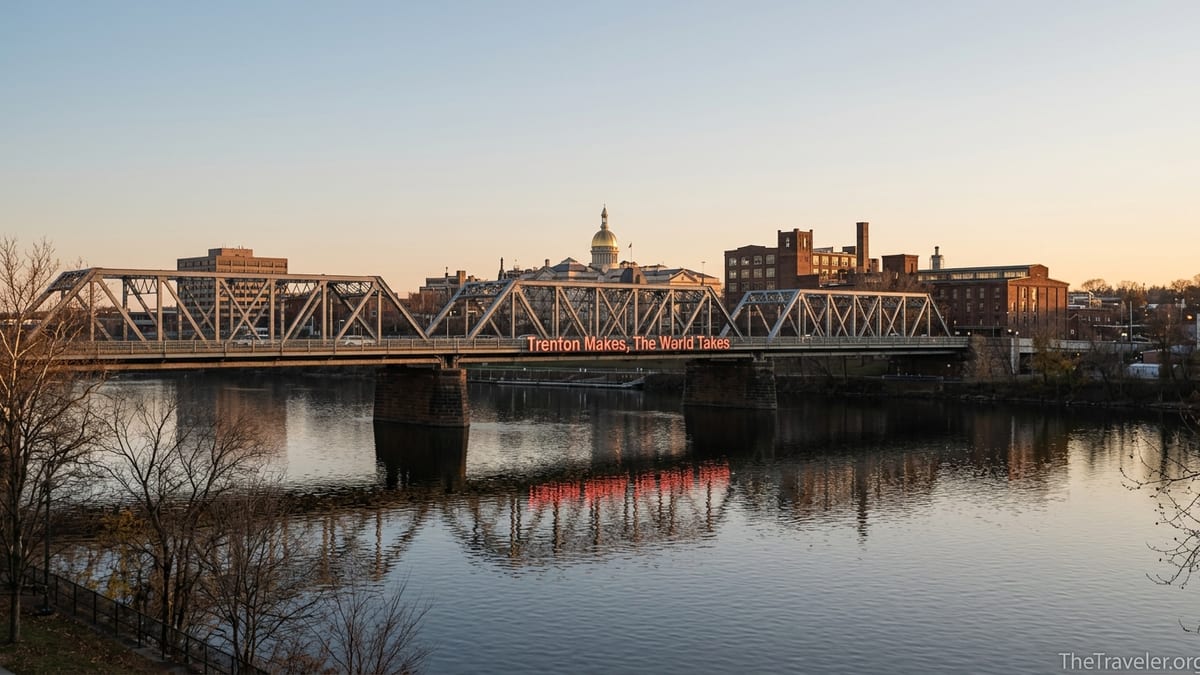
Long after soldiers left the streets, Trenton helped build the physical United States. In the nineteenth and early twentieth centuries, the city became an industrial center known for iron, steel, wire rope, ceramics, rubber, and bricks. The slogan that still blazes in red letters on the Lower Trenton Bridge, “Trenton Makes, The World Takes,” dates to this era, when products stamped with the city’s name traveled to markets around the globe.
The Roebling wire rope works were at the heart of that story. In 1848 engineer John A. Roebling moved his wire rope operation to Trenton, drawn by canal and rail connections and access to regional coal and iron. Over time, his company and related mills turned out the steel wire that would hang some of the world’s great suspension bridges. The same city whose streets had once echoed with Washington’s soldiers later supplied cable for projects like the Brooklyn Bridge and what would become the Golden Gate Bridge, tying Trenton directly into the infrastructure that defines American skylines.
Other factories filled the city with smoke and jobs. Iron and steel companies cast rails and structural beams, while ceramic plants produced tiles and sanitary ware that found their way into homes and public buildings across the country. Travelers today still see echoes of that industrial landscape in brick factory buildings along the rail lines and in neighborhoods built to house generations of workers.
For modern visitors, the former Roebling works near the train station are particularly striking. Parts of the sprawling complex have stood silent for decades even as redevelopment slowly takes hold. Walking past the tall brick walls and rusted windows, it is easy to picture the roar of machinery that once rolled out wires thick enough to carry the weight of a suspension bridge deck. Few American cities offer such a tangible link between industrial know how and national landmarks hundreds or thousands of miles away.
From Factory Floors to Today’s Urban Revival
Like many industrial centers, Trenton suffered in the later twentieth century as factories closed or moved and highway construction cut through existing neighborhoods. Yet the same compact geography that made it a battlefield and a factory town now supports a different kind of revival centered on arts, heritage, and state government.
For travelers, that revival shows up in the mix of new uses for old spaces. Portions of the Roebling complex host events and creative businesses. Former warehouses along the river and tracks are being reconsidered as mixed use developments. The Old Barracks Museum and the New Jersey State Museum anchor a small cultural district that can fill an afternoon for families with school age children, who move from exhibits on the Revolution to dinosaur fossils and regional art.
This layering of eras is part of what makes Trenton matter in the wider American story. The city illustrates the arc from colonial outpost to industrial hub to postindustrial capital trying to reinvent itself. Stand on the bridge with the “Trenton Makes” sign glowing at dusk and you see river, rail, and roadway converging. It is the physical diagram of how American goods and people have moved for two centuries and how cities along those routes have had to adapt as the economy changes.
Travelers who spend a night in Trenton rather than hurrying on to New York or Philadelphia experience this transition up close. A day might include a morning tour at the State House, lunch at a small café near Warren Street, an afternoon walk through Mill Hill’s restored row houses, and an evening event in a converted industrial space at the Roebling site. Each stop quietly underscores how much of the American twentieth century passed through this small city’s loading docks and legislative chambers.
Capital of a State at the Heart of National Politics
Trenton’s role as New Jersey’s capital has also given it outsized influence in national life. New Jersey has long sat at the center of major economic corridors, from early turnpikes and canals to today’s interstate highways and rail lines. Laws made in Trenton have shaped issues from environmental protection around the Delaware and Raritan Canal to insurance regulation and public education standards that affect millions.
For visitors, the New Jersey State House complex is a concrete entry point into this political story. Guided tours, typically free and available on weekdays, take you through the marble corridors, legislative chambers, and rotunda where governors have signed bills and lawmakers have debated everything from industrial labor rules to modern public health measures. Standing beneath the gilded dome, you are only a short walk from streets where Washington’s men marched and from the later factories that powered the state’s economy.
The combination of capital city and former factory town sets Trenton apart from many other state capitals that grew primarily as administrative or college centers. In Trenton, public policy often grew out of close proximity between lawmakers, industrial employers, and organized labor. When twentieth century debates over workplace safety, wages, or environmental cleanup unfolded, they did so in a place that literally looked out over the smokestacks and shop floors affected by each vote.
Even today, when heavy industry has largely departed, decisions made in Trenton ripple outward along the Northeast Corridor. Travelers who pass through on a weekday may notice clusters of school groups in the State House or advocacy organizations gathering on the steps. These everyday scenes echo larger national questions about how states regulate business, protect natural resources, and invest in transportation and housing, all issues that have long run through New Jersey’s capital.
Experiencing Trenton’s History as a Traveler
One reason Trenton remains underappreciated is that many people encounter it only from a distance, glimpsing the “Trenton Makes, The World Takes” sign from a car or train window while heading somewhere else. Those who step off and spend even a few hours often find a very different city, one where major themes in American history become tactile and walkable.
A practical itinerary for first time visitors might start at the Old Barracks Museum, where admission is typically modest compared with larger big city institutions. Guided tours explain how soldiers ate, slept, and fought here, and galleries provide context on New Jersey’s role in the Revolution. From there, a ten minute walk brings you to the New Jersey State House for a tour that reveals how state level politics still shape life from the shore to the Delaware Water Gap.
In the afternoon, a stroll through Mill Hill lets you see how nineteenth century row houses and twentieth century preservation efforts have turned a once neglected neighborhood into a residential district with brick sidewalks and pocket parks. Interpretive signs point out where fighting took place during the battles and how later residents adapted the old housing stock. Depending on the season, you might finish your day at an event in the Roebling complex, where food trucks, art installations, or markets occasionally set up against a backdrop of towering factory walls.
None of these experiences require a large budget or extensive planning. Trenton’s attractions sit close to each other, many within a fifteen minute walk of the train station. Cafes and small restaurants near downtown government buildings cater to weekday workers but are increasingly welcoming to visitors as well. For travelers interested in understanding the United States beyond postcard skylines and national parks, Trenton offers a compact, affordable look at how war, industry, and state politics have shaped the country.
The Takeaway
Trenton matters more in American history than most people realize because it concentrates so many decisive stories in a small space. Here, a risky winter attack helped keep the Revolution alive. Here, factories turned out the wire and steel that made possible bridges and buildings across the continent. Here, state government has long grappled with the practical details of how Americans live, work, and move through one of the country’s most densely settled regions.
For modern travelers, that significance is not just something to read about in a textbook. It is built into the street grid you walk, the river crossings you glimpse from a train window, and the brick industrial shells that still line the tracks. Spend a day in Trenton and the familiar narrative of American history becomes more grounded and complex, revealing how much of the national story unfolded in places that rarely make it onto standard tourist itineraries.
In the end, understanding Trenton is a way of understanding how the United States actually works. It reminds you that turning points are not always grand, isolated events, but often the result of decisions made in small capitals, gritty factory yards, and modest streets where ordinary people live. That is why this city on a bend in the Delaware deserves a place on more travelers’ maps.
FAQ
Q1. Why is the Battle of Trenton considered so important if it was a small engagement?
The Battle of Trenton involved relatively few troops compared with later campaigns, but it came at a moment when the American cause seemed on the verge of collapse. Washington’s surprise victory over the Hessian garrison boosted morale, encouraged soldiers to reenlist, and set up further successes at Princeton, helping keep the Revolutionary War alive.
Q2. What can visitors see today related to the Revolutionary War in Trenton?
Visitors can tour the Old Barracks Museum, walk through Mill Hill and along the Assunpink Creek where fighting occurred, and read interpretive markers that trace troop movements. During Patriots Week in late December, reenactments and special tours bring the Revolutionary landscape to life across downtown streets and parks.
Q3. What does the “Trenton Makes, The World Takes” sign refer to?
The famous slogan on the bridge over the Delaware River refers to Trenton’s era as a major industrial center. Local factories produced iron, steel, wire rope, ceramics, and other goods that were shipped across the United States and overseas, symbolizing how products made in this relatively small city helped build infrastructure and everyday life far beyond New Jersey.
Q4. How did Trenton’s factories influence American infrastructure?
Trenton’s iron and steel works, especially the Roebling wire rope company, supplied cable and structural materials for some of the country’s best known suspension bridges and other projects. By providing key components for crossings like the Brooklyn Bridge and later ventures, Trenton’s mills played a behind the scenes role in shaping American transportation networks.
Q5. Is Trenton an easy city to explore on foot?
Yes. Many of Trenton’s main historic sites sit within a relatively small downtown area. Travelers can walk from the train station to the State House, Old Barracks Museum, Mill Hill neighborhood, and portions of the former Roebling works in a series of short walks, making it convenient for day trips without a car.
Q6. What is Patriots Week and when does it take place?
Patriots Week is an annual series of events in Trenton that commemorates the Battles of Trenton and Princeton. It typically runs from December 26 through the end of the year and includes reenactments, lectures, walking tours, and museum programs that highlight the city’s Revolutionary War history.
Q7. Besides Revolutionary War sites, what else should travelers see in Trenton?
In addition to battle related locations, visitors often tour the New Jersey State House, explore the New Jersey State Museum’s exhibits on natural history and regional culture, and walk through the historic Mill Hill neighborhood. The former Roebling industrial complex and riverfront areas also offer a glimpse into the city’s industrial and transportation heritage.
Q8. How does Trenton’s role as state capital affect its importance?
As New Jersey’s capital, Trenton has long been a center for decisions on transportation, industry, education, and environmental policy in one of the nation’s most populous states. Laws and regulations shaped in its legislative chambers influence not just local residents but commuters, businesses, and travelers throughout the broader Northeast Corridor.
Q9. Is Trenton a good base for exploring other Revolutionary War sites?
Trenton sits within easy reach of several major Revolutionary War locations in New Jersey and Pennsylvania. Travelers can use it as a starting point for visiting Princeton, the Delaware River crossing area, and additional sites along the corridor between Philadelphia and New York while grounding their trip in the pivotal events that took place in the city itself.
Q10. Why should modern travelers include Trenton on their itineraries?
Trenton offers an unusually dense mix of Revolutionary landmarks, industrial heritage, and active state government within a compact, walkable setting. For travelers interested in how the United States actually developed, from battlefield decisions to bridge cables and statehouse debates, a visit to Trenton provides a clear, accessible window into the forces that shaped the nation.