


For many travelers, Trenton barely registers as more than a name on a green highway sign or a punchline about New Jersey politics. Commuters grumble about Route 29, residents elsewhere in the state warn about crime, and even locals sometimes talk about the capital as if it were only office towers, protests and traffic. Spend a day on the streets instead of the message boards, though, and a different city appears: one of narrow brick lanes and 19th century row houses, of Revolutionary War battlefields tucked beside playgrounds, of taco trucks and tomato pies, and of a riverfront city slowly trying to turn a highway back into a neighborhood.
Get the latest updates straight to your inbox!
Beyond the Statehouse: A Walkable Capital City
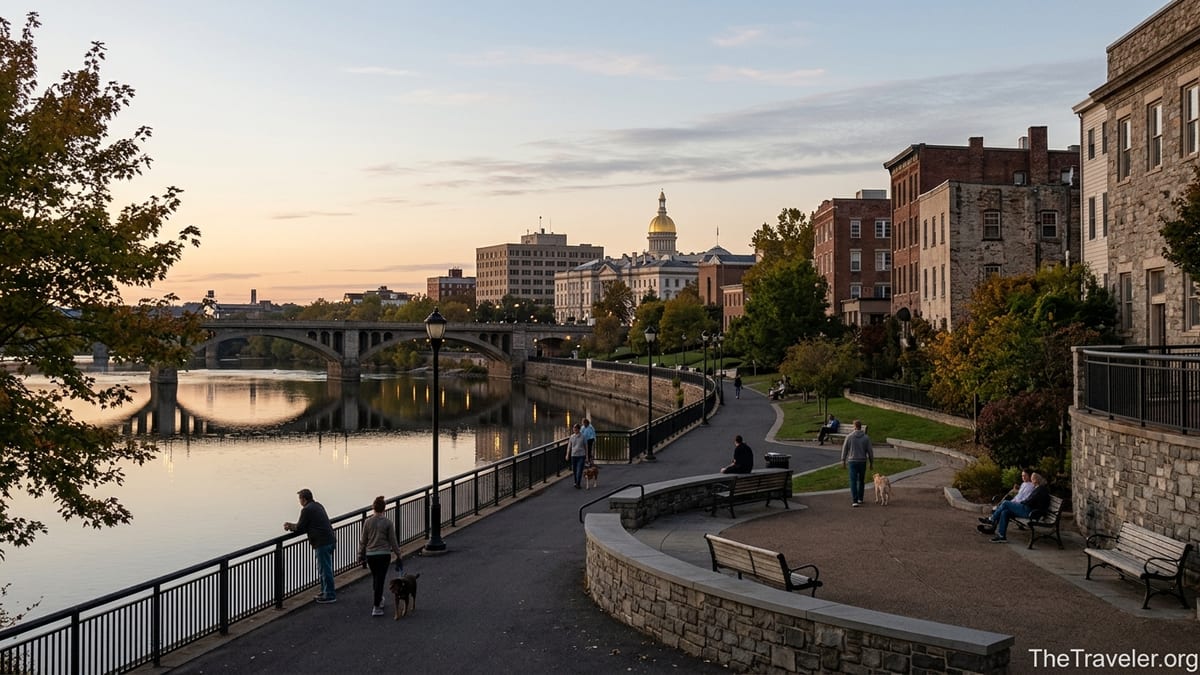
The iconic gold dome of the New Jersey State House looms large in most images of Trenton, but it can also overshadow what surrounds it. Step out from the government complex on a weekday and you will quickly see that this is a compact, walkable city rather than a faceless office park. Within a 10 to 15 minute stroll of the State House are the Old Barracks Museum interpreting the 1776 Battle of Trenton, the New Jersey State Museum with its planetarium and galleries, and residential streets where people sit on stoops while kids ride scooters down the sidewalk.
For travelers used to capitals like Albany or Harrisburg, the first surprise is how close everything sits together. You can tour the Old Barracks in the morning, then walk a few blocks to the State Museum’s exhibits on New Jersey’s Indigenous history and natural science, then be in line at a small Dominican lunch spot by early afternoon without getting back in your car. Even the Trenton Transit Center, with direct trains to New York City, Philadelphia and Newark Liberty International Airport, is close enough that some state workers simply walk the fifteen or so minutes to the office.
Much of Trenton’s weekday energy still revolves around government schedules. Cafes and food trucks near the capitol building do their briskest business between 11:30 a.m. and 1:30 p.m., and streets can feel quieter after 5 p.m. than many travelers expect from an East Coast city. But this rhythm benefits visitors: outside rush hour, downtown streets are relatively calm, and you can cross from the government district into residential neighborhoods or riverfront parks in a few minutes without battling constant traffic.
The other surprise, especially if you are used to images of busy capitol grounds, is how quickly you can leave politics behind. Walk south from the State House and you are soon looking at the broad curve of the Delaware River or the grassy expanse of South Riverwalk Park. Walk east and you enter Mill Hill, where 18th and 19th century brick homes frame the Assunpink Creek. Trenton might be the seat of New Jersey’s state government, but at street level it is closer in feeling to a small, older river town than to a sprawling political machine.
Mill Hill and the Historic Core: Trenton at Human Scale
Most stereotypes of Trenton come from highway glimpses of warehouses, ramps and concrete. Mill Hill, the compact historic district just southeast of downtown, is an antidote. Centered around narrow Mercer, Jackson and Market Streets, the neighborhood is packed with restored Federal and Victorian row houses in brick and stone. Many were once boarded up; today, their polished brass door knockers and carefully tended window boxes hint at a quietly committed community of residents who host annual garden and holiday house tours.
Mill Hill Park, threading along the Assunpink Creek, is where Revolutionary War history and everyday leisure literally share the same ground. Interpretive signs recall the First Battle of Trenton and the Hessian surrender along the creek bank, but on any given summer afternoon you are just as likely to see office workers eating sandwiches at a shaded bench, teenagers practicing dance routines on the amphitheater stage, or a small farmers market selling Jersey tomatoes and strawberries. Renovated playground equipment, a rehabilitated basketball court and landscaped lawns make it feel less like a solemn monument and more like the city’s living backyard.
On the edge of the neighborhood, the Mill Hill Playhouse occupies a former 19th century church that was rescued after a devastating fire. Today it houses Passage Theatre Company, a small professional troupe known for socially engaged new plays and community storytelling projects. For a visitor, catching a performance here can be a way to hear Trentonians speak for themselves about topics like immigration, youth violence or neighborhood pride, rather than absorbing the city only through crime statistics and legislative hearings.
Staying near Mill Hill also puts you within an easy walk of several of Trenton’s major heritage sites. The Trenton Battle Monument rises a short distance uphill, marking the American victory over Hessian troops in 1776. The William Trent House Museum, in a restored early 18th century home near the river, offers a rare look at colonial life in what was then a growing trading town. Linking these sites on foot instead of driving between them connects the dots between the compact colonial city and the walkable grid that survives underneath modern Trenton.
The Delaware Riverfront: From Highway Barrier to Gathering Place
The biggest physical stereotype about Trenton is that the city turns its back on the Delaware River. For decades, Route 29 has run like a concrete wall between downtown streets and the water, speeding cars toward the I-295 interchange while pedestrians pick their way along narrow sidewalks. Locals have long complained that the highway destroyed the city’s link to the riverfront and cut neighborhoods off from green space and breezes.
Yet even with that barrier, the riverfront is more accessible than a quick glance from your car suggests. South Riverwalk Park, a 6.5 acre green space built on top of the Route 29 tunnel, stretches along the water’s edge near the State House. Its landscaped paths, public art and overlooks give visitors a chance to watch rowers and tugboats move along the Delaware, or to see the lights of Morrisville, Pennsylvania, blink on at dusk. Families come to ride bikes, office workers walk laps on lunch breaks, and in good weather you may find small festivals or fitness classes taking over the lawn.
More recently, city and county planners have been studying how to tame the highway itself. A multi-year study launched in late 2024 is examining whether Route 29 could be converted from a high-speed limited-access road into a boulevard with crosswalks, traffic lights, new riverfront parks and mixed-use development. The details are still being debated, but the underlying idea is simple: reconnect Trenton to the Delaware, open up land now used for parking lots, and make the waterfront a destination for residents and visitors rather than just a corridor for commuters.
For travelers, the practical takeaway is that the riverfront is already a worthwhile stop, and likely to become more so. You can combine a tour of the State House with a picnic in South Riverwalk Park, or use the riverfront paths as a scenic connection between downtown and the residential streets of the West Ward. Even incremental improvements, like new crosswalks and lighting, are gradually making it easier to treat the shoreline as part of the city rather than something you have to drive past at 55 miles per hour.
Parks, Museums and Low-Key Culture
Trenton’s cultural assets rarely make glossy magazine roundups, but they are surprisingly rich for a city its size. Cadwalader Park, designed in the late 19th century by Frederick Law Olmsted, the landscape architect behind New York’s Central Park, sprawls over rolling hills in the northwest corner of the city. Walking its wooded paths and open lawns today, you can see why Olmsted’s work remains influential: curved drives reveal sudden views of ponds and meadows, and the Ellarslie Mansion at the park’s center, now home to the Trenton City Museum, hosts rotating exhibits on local art and history.
Near the capitol complex, the New Jersey State Museum offers four distinct collections under one roof: art, archaeology and ethnography, cultural history and natural history. Travelers visiting with children often gravitate to the planetarium shows, which run several times a day on weekends and school holidays, as well as to interactive exhibits about dinosaurs and the state’s geology. Adults might spend more time with the fine art galleries and special exhibitions, then step outside to the adjacent memorials and sculptures that anchor the complex.
Beyond the flagship institutions, Trenton has a patchwork of smaller arts and heritage spaces that reward curiosity. Annual events like “Art All Day” open dozens of artist studios, galleries and maker spaces across the city, complete with bike tours and trolley loops. Murals by local collectives brighten underpasses and brick walls near the transit center and in South Trenton, while community theaters, church halls and school auditoriums host everything from salsa nights to youth poetry slams. These are not blockbuster, ticketed experiences, but they are real windows into how people live in the city right now.
One of the underappreciated cultural experiences in Trenton is simply sitting in a park or on the steps outside a museum and striking up conversation. Because the city is small, repeat encounters are common; the ranger who stamps your ticket at the Old Barracks might reappear as a volunteer at a downtown concert, and the barista who makes your morning coffee might be rehearsing with a local band playing that evening. For visitors willing to slow down, it is easy to thread these informal encounters into a larger understanding of the place.
Food, Neighborhood Flavor and Everyday Trenton
If you ask New Jersey residents what is worth a trip to Trenton, many will mention food before they talk about history. The city has a long tradition of distinctive pizza called tomato pie, where a thin crust is topped first with cheese, then with pools of tomato sauce baked on top. Long-running institutions in and around the city draw weekend crowds from the suburbs, and a typical medium pie might cost around 15 to 20 dollars, depending on toppings and whether you are eating in or taking out.
South Trenton, sometimes called Chambersburg, reflects waves of immigration: once known as the city’s Italian neighborhood, it is now also home to strong Mexican, Central American and Caribbean communities. For travelers, that means tamales and pupusas alongside classic Italian bakeries and delis. Small family-run restaurants offer plates of arroz con pollo, birria tacos or Dominican stews for roughly 12 to 18 dollars, and many double as informal community centers where news and gossip circulate as quickly as plates of food.
Street food is another part of the city’s everyday flavor. Food trucks line up near the State House and downtown offices on weekdays, selling everything from cheesesteaks and gyros to halal platters and empanadas. A hearty lunch from a truck, including a drink, typically runs 10 to 15 dollars, and regulars know which vendors move from site to site on different days. Visitors who plan a weekday trip can treat sampling a couple of these trucks as a rolling food tour that doubles as a lesson in Trenton’s diversity.
These dining scenes also complicate common stories about the city. For every boarded-up storefront along a commercial strip, there might be a crowd spilling out of a busy bakery early on Saturday mornings, or a line for water ice on a hot July evening. Walking or biking between neighborhoods reveals this contrast quickly: a block that looks quiet from your car window might hide a beloved corner bar, a Polish grocery or a backyard barbecue restaurant that never bothered with a website but lives on word of mouth.
Safety, Reality and How to Visit Smart
Trenton does face real challenges with poverty and violent crime, and residents are frank about those issues. Citywide statistics are often worse than state and national averages, and some neighborhoods struggle with vacant properties and underfunded services. For travelers, the important question is not whether those problems exist, but what they actually mean for a day trip or overnight stay.
Most visitors who come for museums, historic sites and events spend their time in and around downtown, the capitol complex, Mill Hill, Cadwalader Park and the riverfront. These areas see regular foot traffic, security patrols and a mix of residents, workers and tourists. Daytime visits here are generally comparable to other small Northeast cities: you should be aware of your surroundings, avoid flashing valuables and lock your car, but you are unlikely to encounter more than the occasional panhandler or loud argument.
The city becomes noticeably quieter at night, especially on weekdays, which can make some blocks feel deserted rather than dangerous. If you are unfamiliar with the area, it is wise to plan evening activities around well-used venues and to drive or use reputable ride-hailing services after dark instead of walking long distances through unfamiliar residential streets. Ask staff at your hotel, museum or restaurant which routes they recommend; their advice is often more specific and practical than generalized warnings from people who rarely visit.
Travelers who approach Trenton with the same common-sense precautions they would use in parts of Philadelphia, Newark or Baltimore usually report positive experiences: friendly conversations in parks, engaging tours at the Old Barracks or State House when available, relaxed afternoons in Cadwalader Park. Acknowledging the city’s struggles while supporting its cultural institutions and small businesses is one concrete way visitors can contribute to a more resilient future for the capital.
Day Trips, Trains and the Regional Web
Another truth about Trenton that rarely fits preconceptions is how central it is to the broader Northeast Corridor. The Trenton Transit Center is served by NJ Transit commuter trains, Amtrak’s Northeast Regional and Keystone services, and SEPTA regional rail from Philadelphia. In practical terms, that means you can have breakfast in Manhattan, ride a train of about an hour and twenty minutes to Trenton, spend the day exploring, then continue on to Philadelphia for the evening without ever renting a car.
For road travelers, Trenton sits close to several major highways but does not require you to stay on them. Interstate 295 and US 1 skirt the city, while smaller roads lead into leafy neighborhoods and across the Delaware into Pennsylvania. Drivers heading to the Jersey Shore or the Poconos often pass within a few miles without stopping. With a bit of planning, you can turn what would have been a gas-station break into a two- or three-hour detour: stretch your legs at Mill Hill Park, grab lunch in South Trenton, then continue your journey with a more rounded picture of the state’s capital.
Trenton also pairs well with other destinations. Princeton, with its collegiate architecture and newly renovated art museum, lies roughly 8 miles to the north and is reachable by car, bus or a short commuter rail ride. To the south, the small river towns of Bordentown and Burlington offer antiques shops and waterfront promenades. Seeing these places alongside Trenton highlights the region’s contrasts: elite university town, quaint historic main street and working-class capital city, all within a half hour of one another.
For budget-conscious travelers, Trenton’s lodging and parking costs can be lower than in larger cities nearby, although options are more limited. Some visitors choose to stay in chain hotels near highway interchanges in adjacent townships, using Trenton as a daytime destination. Others base themselves in Philadelphia or New York and treat Trenton as a focused day trip around Revolutionary War history or a specific event at the arena, museum or theater.
The Takeaway
Trenton will probably never be a polished tourist magnet, and that is part of its appeal. The city is messy and in flux, with real problems that no amount of branding can erase. But it is also a place where you can stand on a bridge and picture Washington’s troops crossing an ice-choked Delaware, then walk a few minutes to watch middle school students spills out of a planetarium show or skateboarders practicing tricks under a mural.
Looking beyond politics, traffic and stereotypes means accepting that Trenton is a working capital city with limited resources, uneven development and a patchwork of strong and struggling blocks. It also means noticing the people and institutions that keep showing up: neighborhood associations restoring row houses, artists filling old factories with studios, historians preserving battlefields, park stewards maintaining Olmsted-designed landscapes, and small entrepreneurs ladling out soup or sliding tomato pies into ovens.
If you give Trenton a day, or even a long afternoon, you are unlikely to leave with the same one-note image you arrived with. You might still see the flaws, but they will sit alongside concrete memories: the sound of church bells over Mill Hill, the smell of garlic and frying onions on a Chambersburg corner, the unexpected quiet of the river at sunset. The truth about Trenton is not that it is secretly perfect, but that it is far more layered, human and interesting than its reputation suggests.
FAQ
Q1. Is Trenton safe for a day trip?
Most visitors who stick to the main attractions downtown, Mill Hill, the capitol complex, Cadwalader Park and the riverfront during daylight hours report feeling comfortable. Use standard city precautions, stay aware of your surroundings and ask locals for advice on routes after dark.
Q2. What are the must-see sights in Trenton?
Top stops include the Old Barracks Museum, the New Jersey State Museum and planetarium, the New Jersey State House when tours are available, Mill Hill Park and neighborhood, Cadwalader Park with Ellarslie Mansion, and the Delaware riverfront around South Riverwalk Park.
Q3. How do I get to Trenton without a car?
The Trenton Transit Center is served by NJ Transit, Amtrak and SEPTA trains, making it easy to reach from New York City, Newark, Philadelphia and other Northeast Corridor cities. From the station you can walk, use local buses or take a short taxi or ride-hail to most central attractions.
Q4. Is there anything to do in Trenton with kids?
Yes. Families often enjoy the New Jersey State Museum’s hands-on exhibits and planetarium, open green space and playgrounds in Mill Hill Park and Cadwalader Park, and seasonal events like outdoor concerts, festivals and farmers markets.
Q5. Where should I eat in Trenton?
Trenton is known for its thin-crust tomato pies and diverse neighborhood food in South Trenton, including Italian bakeries and Mexican, Central American and Caribbean restaurants. Weekday visitors can also try a variety of food trucks near the State House and downtown offices.
Q6. Can I walk between Trenton’s main attractions?
Many key sights are within a 10 to 20 minute walk of each other, especially around downtown, the capitol complex and Mill Hill. Good walking shoes and a simple map or smartphone navigation make it easy to connect museums, historic sites and parks on foot.
Q7. What is the best time of year to visit Trenton?
Spring and fall offer comfortable temperatures for walking and enjoying parks and riverfront areas. Summer brings outdoor events and farmers markets but can be hot and humid, while winter is quieter and best suited for museum visits and short walks.
Q8. Are there good parks or green spaces in the city?
Cadwalader Park is Trenton’s largest historic park, with rolling lawns and wooded trails, while Mill Hill Park offers a smaller creekside setting downtown. South Riverwalk Park along the Delaware provides river views and walking paths near the State House.
Q9. Can Trenton be combined with other nearby destinations?
Yes. Many visitors pair a Trenton visit with time in Princeton, about 8 miles to the north, or with Philadelphia or New York City via direct train connections. It also works well as a stop between the Jersey Shore, the Poconos or other regional road trip targets.
Q10. Is Trenton worth a stop if I am just passing through New Jersey?
If you are interested in American Revolution history, local food or getting a fuller picture of New Jersey beyond the shore and suburbs, Trenton is worth at least a few hours. Even a short detour for a museum visit, walk in Mill Hill and a meal can challenge common stereotypes about the capital.