


More news on this day
A newly released investigation into a recent train crash concludes that the collision could likely have been avoided if the driver had correctly activated and relied on the train’s built-in emergency safety system, drawing renewed scrutiny to how such technology is used in daily operations.
Get the latest news straight to your inbox!
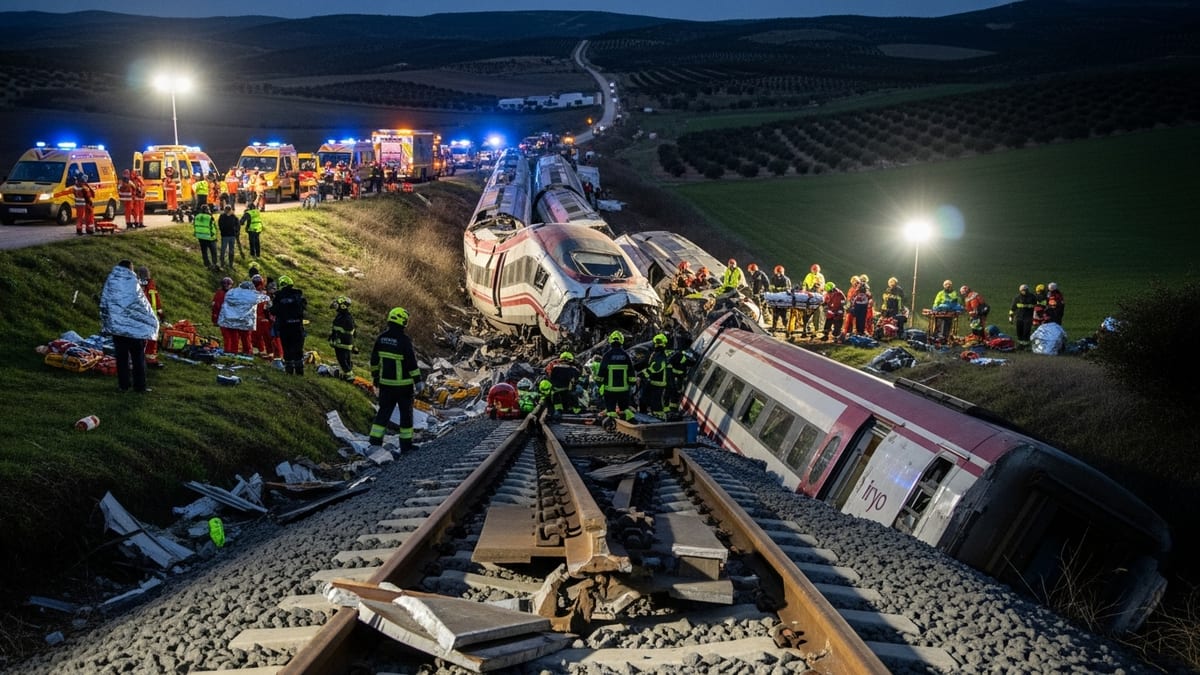
Findings Point to Missed Use of Emergency Technology
According to publicly available investigation documents and media coverage, the report states that the train involved was equipped with an emergency system designed to either automatically apply brakes in critical situations or allow the driver to trigger a rapid stop. The safety technology functioned as intended in testing and post-crash examination, but investigators found no evidence it was used in time to prevent the impact.
The analysis concludes that the driver had enough time and distance to deploy the emergency function once the developing hazard became apparent. Instead, the train continued at a speed that left too little margin to stop. This sequence, the report indicates, turned a recoverable situation into a serious crash.
Investigators emphasize that the emergency system was not at fault mechanically or electronically. Rather, it was the absence of timely use, combined with human factors on the footplate, that allowed the collision risk to escalate. The crash has therefore been categorized as technically preventable, had the available safeguards been fully applied.
Human Factors and Situational Awareness Under Scrutiny
The report highlights several human-factor issues that likely contributed to the driver’s failure to use the emergency system. These include workload in the minutes before the collision, possible distraction within the cab, and the challenge of maintaining situational awareness when signals, gradients, or other visual cues change rapidly.
Publicly accessible summaries indicate that the driver may have misjudged either the severity of the situation or the time remaining to act. In similar past cases, rail safety investigations in Europe and North America have cited “loss of situational awareness” and “delayed recognition of risk” as recurring themes when train crews fail to brake in time, even when technical protections are available.
Experts referenced in media analysis note that emergency systems are designed to be a final layer of defense when routine operating practices have already begun to break down. For that to work, crews must be trained not only in how the equipment functions but also in when to prioritize its use over attempting to recover using standard braking alone.
Questions Raised Over Training and Safety Culture
The findings have intensified discussion about how drivers are trained to use emergency braking and other protective features. The report points out that while the driver was certified and familiar with the route, training records left open questions about how often realistic emergency scenarios were practiced and how strongly staff were encouraged to treat use of the emergency system as an acceptable option rather than a last resort to be avoided.
In previous rail accidents examined by national safety boards, investigations have sometimes found that drivers were reluctant to apply emergency brakes because of perceived expectations around passenger comfort, timetable adherence, or concerns over being blamed for triggering false alarms. The latest report alludes to this broader industry context, noting that organizational culture can subtly shape how quickly a driver moves from normal braking to full emergency intervention.
Analysts following the case say the report will likely add momentum to calls for more frequent simulator-based training, where drivers can rehearse high-stress situations that demand immediate use of emergency functions. Such exercises are viewed as particularly important on busy mixed-traffic corridors and heavily used passenger lines, where small delays in decision-making can have major consequences.
Technology Promises More Protection but Needs Proper Use
The crash is the latest example cited by rail safety specialists who argue that technology alone cannot prevent all incidents. Systems that monitor speed, supervise adherence to signals and automatically apply brakes have been credited in past investigations with averting or mitigating accidents, yet there remain instances where equipment is overridden, underused, or not fully integrated into daily operating practices.
The report underscores that the emergency system on the crashed train was designed as one layer in a multi-tiered defense that also includes signaling rules, operational procedures, and ongoing monitoring from control centers. When one layer fails or is not used, the others are expected to compensate. In this case, the chain broke at the point where decisive activation of the emergency function should have occurred.
Rail analysts note that, for travelers, the incident highlights both the progress and the limitations of modern safety tools. While serious train crashes in many countries have become relatively rare compared with road accidents, investigations repeatedly show that the greatest safety gains tend to come when technology, training, and culture align to support clear, timely decisions in the cab.
Implications for Passengers and Future Rail Operations
For passengers, the report may raise questions about how rail operators ensure that drivers are fully prepared to act in fast-moving emergencies. Travel industry observers point out that most major rail networks now promote the presence of onboard safety technology as a reassurance to travelers, but that confidence ultimately rests on human crews feeling empowered and expected to use every tool at their disposal.
In response to similar investigations in the past, operators have introduced measures such as revised driver manuals, refresher courses focused on emergency braking, and clearer internal guidance that prioritizes safety over schedule adherence whenever a potential conflict is detected. Analysts suggest that comparable steps are likely to follow in this case as companies and regulators review the report’s recommendations.
More broadly, the findings may influence how future rail corridors are planned and managed, especially on routes experiencing higher traffic or greater speed differentials between freight and passenger services. Integrating advanced train control, automatic braking, and consistent training on emergency system use is increasingly seen as essential to maintaining public trust in rail as a safe and reliable way to travel.