


For many travelers, South Jersey is just a blur of toll plazas between New York and Washington, a quick casino detour in Atlantic City, or a childhood memory of a boardwalk somewhere near Wildwood. Yet this corner of New Jersey hides one of the largest wild landscapes on the East Coast, some of the region’s most characterful small towns, and a string of classic beach resorts that still feel defiantly local. The question is not only whether South Jersey is worth visiting, but whether you can afford to keep overlooking it.
Get the latest updates straight to your inbox!
Why South Jersey Gets Overlooked in the First Place
South Jersey’s first hurdle is reputation. Mention New Jersey and many outsiders picture traffic on the Turnpike or reality TV caricatures, not cedar-scented forests and Victorian seaside towns. Travelers rushing from Philadelphia to New York treat it as a through-corridor, while international visitors zero in on Manhattan or Washington and never consider adding an extra two or three days just across the Delaware River.
There is also a branding problem. The state promotes the "Jersey Shore" and Atlantic City by name, but the phrase "South Jersey" rarely appears on bucket lists the way "Cape Cod" or "Outer Banks" does. The region is officially sliced into tourism districts like the Southern Shore Region, Greater Atlantic City, and the Delaware River Region, which may be useful for planners but does little to help casual travelers grasp that this is one coherent, explorable area filled with very different coastal and inland experiences.
Logistics play a part too. If you do not have a car, it is relatively easy to get from Philadelphia to Atlantic City by train, but much harder to reach the Pine Barrens trailheads, the Delaware Bayshore, or small walkable towns like Collingswood and Haddonfield. As a result, many people stay on the well-trodden boardwalks, never realizing that less than an hour’s drive away there are dark rivers to kayak, historic villages like Batsto to wander, and quiet marshes where you might be the only visitor at sunset.
Yet those who do slow down discover a region with a very different feel to North Jersey. The accents soften, the landscape flattens into scrub pine and marsh, and the tempo takes on something closer to small-town coastal Carolina than metropolitan New York. For the right kind of traveler, that shift alone makes South Jersey worth a dedicated trip rather than a rushed detour.
The Wild Heart: Pinelands, Batsto Village and Cedar-Colored Rivers
Most first-time visitors are surprised to learn that just inland from the shore sprawls the New Jersey Pinelands National Reserve, about 1.1 million acres of scrub pine forest, wetlands, and sandy trails. This is one of the largest green spaces on the Eastern Seaboard, laced with tea-colored rivers like the Batsto and Mullica that draw kayakers and canoeists from across the Mid-Atlantic. It feels worlds away from the casinos and condos that dominate many people’s mental map of New Jersey.
A natural gateway into this landscape is Batsto Village in Wharton State Forest, a preserved 19th-century ironworks and glassmaking community surrounded by pitch pines and cranberry bogs. Today the restored mansion, worker’s cottages, and gristmill sit beside Batsto Lake, where paddlers glide out of the narrow Batsto River onto a broad, quiet expanse of water before coming ashore. Outfitters such as Pinelands Adventures run seasonal trips like the Quaker Bridge to Batsto Lake paddle, typically a four-hour journey where you might see herons, turtles, and dragonflies but very few buildings along the banks.
For hikers, the Batona Trail links some of the Pinelands’ best state forests over roughly 50 miles, passing near Batsto, Bass River State Forest, and Brendan T. Byrne State Forest. You do not have to thru-hike it to appreciate the landscape. A day hiker might start at Batsto, follow a segment of the Batona through sandy, mostly flat woodland for three to six miles, and return via a loop route. In spring you will notice carpets of blueberry shrubs and the sweet smell of pine; in winter, the forest opens up, and the low sun throws long shadows across the pale sand roads.
Campsites in Wharton State Forest range from family-oriented spots near Atsion Lake, with guarded swimming areas in summer, to primitive riverfront sites like Lower Forge that are reachable only by boat or on foot. These are not wilderness camps in the Rocky Mountain sense, but they are secluded enough that you will hear barred owls at night and wake to mist rising from the river. For travelers used to dense East Coast development, this degree of solitude so close to major cities can be a revelation and is one of the strongest arguments for giving South Jersey more than a casual visit.
Classic Shore Towns: From Wildwood’s Neon to Cape May’s Gingerbread
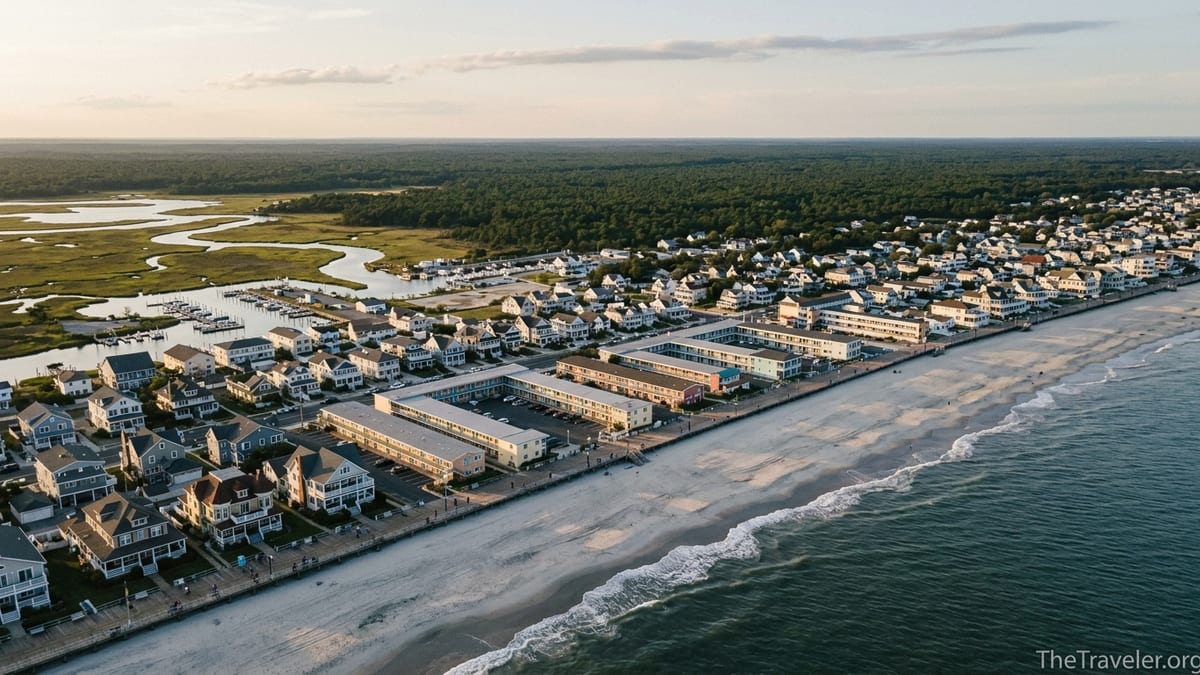
Most travelers who encounter South Jersey do so on the coast, yet even here many underestimate how varied the experience can be from town to town. The Wildwoods, a cluster of communities on a five-mile barrier island, are known for their huge free beaches and retro boardwalk lined with amusement piers and classic motels in a mid-century "doo-wop" style. On a July evening, the boardwalk fills with families from Philadelphia and Quebec eating funnel cake, riding roller coasters over the ocean, and listening to oldies bands near the piers.
Because the Wildwoods are often portrayed as loud and kitschy, some travelers dismiss them outright. That can be a mistake if you are after a nostalgic, full-throttle boardwalk experience: long, wide beaches that easily absorb summer crowds, free access to the sand, and plenty of affordable motels a short walk from the ocean. A couple might stay in quieter Wildwood Crest, which is a dry town with a more relaxed vibe, then stroll or bike up to the livelier boardwalk in the evenings.
Forty minutes further south by car, Cape May offers a very different atmosphere. The town is famous for its streets of restored Victorian "gingerbread" houses painted in soft pastels, a compact pedestrian shopping district on Washington Street, and a long promenade that runs behind the beach. Travelers who are not especially interested in boardwalk rides or casino floors often find Cape May more appealing: you can spend a day browsing independent boutiques, tour the Cape May Lighthouse, join a dolphin or whale-watching cruise, and end with sunset at the point where the Delaware Bay meets the Atlantic.
Prices naturally vary by season, but as a rough guide, in high summer a mid-range motel near the beach in Wildwood might cost noticeably less than a comparable place in Cape May. By contrast, visiting in late September or early October can be a sweet spot across the South Jersey shore: ocean temperatures are still comfortable for swimming, crowds have thinned, and rates drop from peak levels. Whether that represents good value depends on your expectations, but if you are comparing South Jersey to more famous Northeast beach areas, you will often find that a similar budget stretches further here, especially outside school holidays.
Beyond Casinos: Atlantic City and Quiet Coastal Alternatives
Atlantic City dominates South Jersey tourism brochures, yet its appeal is narrower than the region as a whole. If you enjoy casino gaming, restaurant splurges, and nightlife, it is easy to fill a weekend moving between the casino-resorts along the Boardwalk and the Marina District. You can arrive car-free from Philadelphia or New York, check in at a resort with pools and spas, and rarely step outside except for a walk on the wooden planks with saltwater taffy in hand.
For travelers who are indifferent to casinos, Atlantic City can feel like a missed opportunity if treated as the only stop. The city does have assets beyond the gaming floors, including a long oceanfront boardwalk, a wide free beach, seasonal beach bars, and nearby sights like the historic Lucy the Elephant attraction in Margate. But many visitors would get more out of the region by using Atlantic City as a transit hub or a single overnight instead of the main event, then exploring smaller coastal communities within a 30 to 60 minute drive.
Ocean City, for instance, markets itself as a family-friendly, dry town with a classic boardwalk and a focus on mini-golf, bike rentals, and ice cream rather than nightlife. Farther south, Strathmere and Sea Isle City offer quieter stretches of sand with a mix of summer houses and low-rise condos. To the north of Atlantic City, Brigantine Island provides a more low-key feel, with a long beach, residential neighborhoods, and easy access back into the city for a show or dinner.
If your goal is to understand whether South Jersey is "worth it," the key is not to let Atlantic City stand in for the whole. Think of it instead as one option on a spectrum that ranges from neon-lit casino floors to marsh-fringed bays and Victorian streets. A balanced itinerary might involve one night in Atlantic City for a concert and dinner, followed by two nights in Cape May or Ocean City and a side trip into the Pinelands for a half-day paddle.
Small Towns, Bayshore Quiet and Local Food Culture
Another side of South Jersey, often completely missed by beach-focused visitors, lies along the Delaware Bayshore and in the string of historic small towns just east of the Delaware River. These communities are not glossy resorts, but they offer glimpses of working waterfronts, marshes buzzing with birdlife, and main streets where locals still greet each other by name in diners and coffee shops.
In Cumberland County, East Point Lighthouse stands at the edge of the Delaware Bay, an 1849 brick structure that still operates as an active aid to navigation. The surrounding Bayshore has a long connection to oyster and shipbuilding industries, and at low tide the wetlands unfurl into a patchwork of mudflats and grass where shorebirds feed. Towns like Fortescue and Bivalve are modest, but for birders and photographers the combination of rustic docks, old seafood shacks, and big skies over the water can be compelling, especially at sunrise or sunset.
Closer to the Philadelphia side, small communities such as Collingswood, Haddonfield, and Pitman have slowly built reputations as walkable, food-forward towns. A visitor might spend a Saturday wandering Collingswood’s main avenue, sampling coffee at a local roaster, browsing independent bookstores, and dining at a BYO restaurant where you can bring a bottle of South Jersey wine from a nearby vineyard. These towns make easy day trips from the city but are also logical stopovers for road trippers who want a break from highway chains in favor of human-scale streets.
Food is one of South Jersey’s quiet strengths. In summer, roadside farm stands sell Jersey corn, tomatoes, and peaches grown in the sandy soil around Hammonton and Mullica Hill. Wineries across Gloucester and Salem counties host weekend tastings and outdoor concerts, while craft breweries tucked behind strip malls or barns experiment with IPAs and sours. On the coast, clam shacks and seafood houses serve local blue claw crabs, flounder, and, in some spots, oysters from the Delaware Bay. None of this is unique on a global scale, but combined, it gives the region a flavor distinct from the pizza-slice-and-casino stereotype many outsiders carry.
Who Will Love South Jersey, and Who Might Skip It
South Jersey is not for everyone, and that is precisely why many travelers race past it. If your dream trip revolves around iconic urban sightseeing, you will likely get more out of New York, Philadelphia, or Washington than from a week in the Pine Barrens and on the beach. Similarly, if you crave dramatic mountain scenery or Caribbean-style turquoise waters, the region’s flat pine forests and mid-Atlantic surf may feel underwhelming.
Where South Jersey shines is for travelers who appreciate subtlety and contrast: those who like the idea of breakfast in a Victorian cafe, a mid-day hike among scrub pines, and sunset on a nearly empty bay beach, all within a compact radius. Outdoor enthusiasts who enjoy kayaking, birding, and day hiking will find plenty to do in the Pinelands and along the Bayshore. Families looking for a traditional boardwalk vacation with rides and arcades will likely be happy in Wildwood or Ocean City, especially when free beaches and accessible motels keep costs manageable.
Time is another factor. If you are on a dense East Coast itinerary with only five or six days between New York and Washington, it may make more sense to prioritize the big cities and slot in a single night by the ocean rather than trying to do everything. But if you have a full week or more, devoting three or four days to South Jersey can deepen your understanding of the region’s ecology, history, and contemporary culture in a way that city-hopping alone cannot.
Ultimately, deciding whether South Jersey is "worth it" comes down to expectations. Those who arrive expecting a polished resort strip or a wilderness on par with national parks may leave puzzled. Travelers who come looking for a blend of low-key nature, lived-in seaside towns, and easy-going small cities often find themselves planning a return visit, especially after discovering how close this diversity lies to urban centers like Philadelphia.
Planning a Realistic South Jersey Itinerary
To make South Jersey feel like a destination instead of a drive-through, it helps to anchor your trip around a few contrasting hubs. One practical approach is to choose a base on the coast, such as Cape May, Wildwood, or Ocean City, and another inland near the Pinelands, for example in Hammonton or a campground in Wharton State Forest. This way, you can alternate between beach days and forest or river exploration without excessive backtracking.
A three-night trip might look like this in practice. On day one, arrive in Atlantic City by train or car, walk the Boardwalk, and enjoy a seafood dinner or a show, then stay overnight. The next morning, drive 45 minutes south along the coast to Cape May, stopping briefly at the small resort towns along the way to compare their atmospheres. Spend the afternoon exploring Cape May’s historic district and beach, then stay two nights there, using your full day for a lighthouse visit, a nature walk, or a boat tour.
On a longer five or six night trip, you could add the Pinelands and Bayshore. After the coast, drive inland to Batsto Village, tour the historic site, and launch on a half-day paddle or hike a loop section of the Batona Trail. Camp overnight at a forest campground or stay in a motel in Hammonton, then spend the next day exploring small towns or vineyards, wrapping up with sunset at East Point Lighthouse on the Delaware Bay if time allows. This type of itinerary does involve driving, but distances are short; many destinations lie within an hour of each other.
Costs will depend heavily on season and accommodation choices. In July and August, expect to pay summer premiums for anything near the beach and to book well ahead, especially on weekends. Travel in shoulder seasons like late May, June, September, and early October typically offers better value, quieter trails, and more flexible booking. For budget-conscious travelers, inland motels and forest campgrounds can stretch a trip that would be short and expensive if confined to peak-season oceanfront rooms.
The Takeaway
So, is South Jersey worth visiting, or are most travelers right to skip past it? If all you want is a famous skyline selfie or a quick casino fix, you may indeed be satisfied treating the region as a brief stopover. But if you are drawn to less obvious landscapes, enjoy mixing outdoor time with unfussy coastal towns, and appreciate places that still feel primarily built for locals, South Jersey repays anyone willing to slow down.
From the dark, tannin-rich rivers of the Pinelands and the preserved streets of Batsto Village to the neon of Wildwood’s boardwalk and the Victorian porches of Cape May, this corner of New Jersey offers more variety than its reputation suggests. It is not a blockbuster destination, but a layered one, revealing new facets with each visit. Give it a few unhurried days, and South Jersey shifts from a place you drive through to a landscape you remember in sensory detail: the crunch of sand underfoot on a pine trail, the cry of gulls over the Delaware Bay, and the glow of boardwalk lights in the salt air after dark.
FAQ
Q1. Is South Jersey worth visiting if I only have a weekend?
Yes, if you focus your plans. A weekend is enough for a taste of the region by combining one night in Atlantic City or Wildwood with another in Cape May or a Pinelands campground, giving you both shore and forest without spreading yourself too thin.
Q2. How does the South Jersey shore compare to more famous East Coast beach destinations?
South Jersey’s beaches are broad, sandy, and generally less expensive than some New England or Mid-Atlantic resorts, especially outside peak weeks. Towns like Cape May offer charm comparable to parts of Cape Cod, while Wildwood delivers one of the East Coast’s most energetic classic boardwalk experiences.
Q3. Is South Jersey a good destination for outdoor activities?
Yes. The Pinelands provide extensive opportunities for hiking, kayaking, canoeing, birding, and camping, with tea-colored rivers and miles of mostly flat trails. Coupled with coastal wetlands and bayfront wildlife areas, it is a strong option for nature-focused trips within easy reach of major cities.
Q4. Can I visit South Jersey without a car?
It is possible but limiting. You can reach Atlantic City and some shore towns by train or bus from Philadelphia and New York, then rely on rideshares and local transit. However, accessing the Pinelands, smaller bayshore communities, and inland towns is much easier with a car.
Q5. When is the best time of year to visit South Jersey?
Late May through early October is generally best, with peak beach weather from late June to early September. Shoulder seasons like June and September balance pleasant temperatures with fewer crowds and more manageable prices along the coast.
Q6. Is Atlantic City worth visiting if I am not into casinos?
It can be, but probably not as your only stop. The boardwalk, beach, and restaurant scene add interest, yet you will likely get more out of your trip by pairing Atlantic City with quieter shore towns or a Pinelands excursion.
Q7. Are South Jersey beaches family-friendly?
Yes. Towns such as Ocean City and Wildwood are geared toward families, with boardwalk rides, mini-golf, and lifeguarded beaches. Many stretches of sand are wide and gently sloping, suitable for children under supervision.
Q8. How many days should I spend in South Jersey to see the highlights?
Three to five days is a comfortable range. That allows for at least one day at the beach, one day exploring Cape May or another town, and one day in the Pinelands or along the Delaware Bayshore without rushing.
Q9. Is South Jersey safe for travelers?
Most resort areas, small towns, and natural sites are as safe as comparable destinations along the East Coast, especially if you use standard precautions. Some urban neighborhoods require the same street awareness you would exercise in any small city, but issues rarely affect typical visitor areas.
Q10. What kind of traveler is most likely to enjoy South Jersey?
Travelers who appreciate a mix of understated nature, authentic small-town life, and classic American seaside culture will get the most from South Jersey. It particularly suits road trippers, families, outdoor enthusiasts, and East Coast residents looking for a nearby escape that feels different from city life.