


More news on this day
A newly released investigation into a recent rail collision concludes that the crash could likely have been avoided if the train driver had fully used an available emergency protection system, reigniting debate over how consistently such technologies are understood and applied on busy passenger and freight routes.
Get the latest news straight to your inbox!
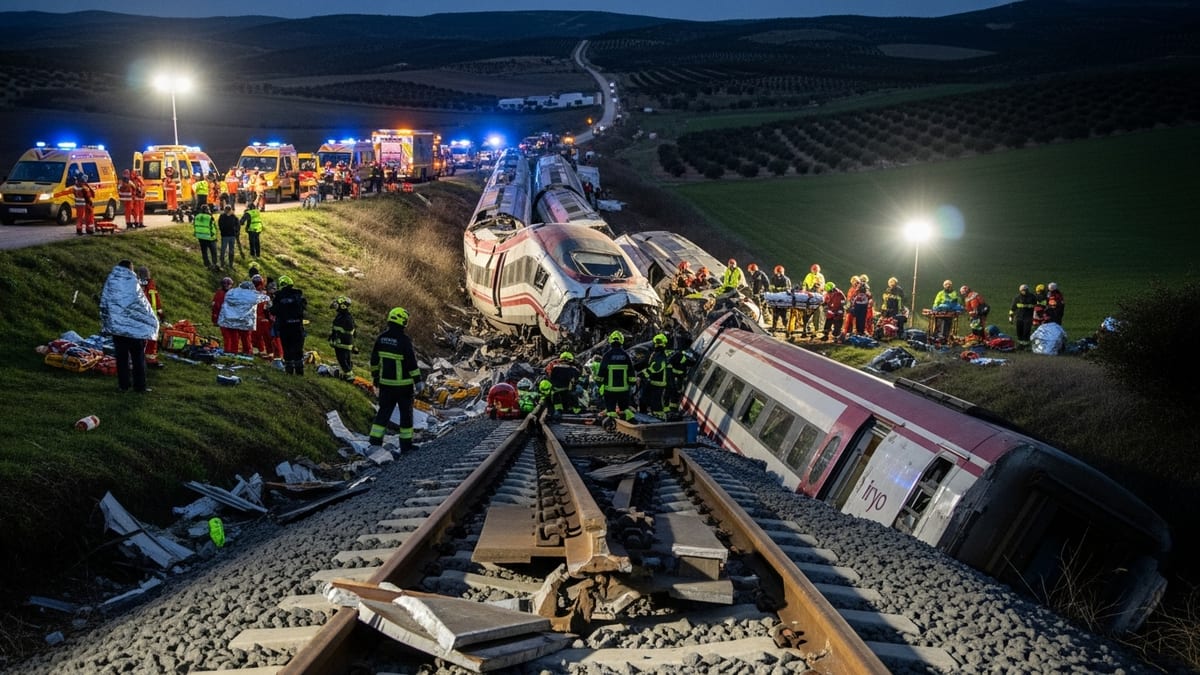
Findings Point to Missed Use of Emergency Protection
According to publicly available investigative material, the report reconstructs the final seconds before impact and focuses on how the driver responded as the train approached danger signals at speed. The analysis indicates that the train continued moving when it should have been slowing significantly, despite the presence of an onboard emergency intervention system designed to stop or sharply reduce speed in critical situations.
The investigators’ narrative suggests that the driver either delayed or did not fully engage the system’s emergency functionality, allowing the train to enter a conflict zone where a collision became unavoidable. The report describes the technology as capable of overriding normal operations and bringing the train to a halt if properly activated with enough distance to spare.
Data from the train’s onboard recorders, combined with signal system logs, underpin the conclusion that earlier and decisive use of the emergency intervention would likely have prevented the impact. While the equipment itself appeared to function within design parameters, its protective potential was never fully realized in the moments that mattered most.
The findings echo earlier international cases where investigations concluded that positive train control, automatic braking, or other fail-safe systems could have averted deadly crashes but were not engaged in time or not relied upon as a primary layer of protection.
How the Emergency System Was Supposed to Work
The emergency protection equipment scrutinized in the report belongs to a family of systems increasingly common across major rail networks, combining onboard sensors, lineside signals, and centralized traffic control. Under normal conditions, these systems monitor train speed and signal aspects, issuing warnings and, when necessary, triggering automatic braking to prevent overruns.
In this case, the system included an emergency mode that the driver could manually initiate once it became clear that the train risked entering a restricted section of track. When engaged in sufficient time, that mode is designed to apply maximum braking effort, giving the best chance of stopping short of a danger point or significantly reducing impact energy if a full stop is impossible.
The report suggests that the train entered the danger zone without this maximum emergency capability having been fully applied, depriving the crew of the strongest available safeguard. While standard braking was used, it did not achieve the deceleration that the emergency setting could provide, especially given the train’s speed and the distance remaining.
Investigators also note that modern systems are intended to complement, not replace, human decision-making. Drivers retain responsibility to recognize deteriorating conditions early and to call upon the highest level of protection available. The missed or delayed use of that protection, the report concludes, was a critical factor in how events unfolded.
Training, Culture and Human Factors Under Scrutiny
Beyond the technical details, the report highlights questions about training, operational culture, and how well front-line staff understand the capabilities and limitations of emergency systems. It indicates that, while the driver was certified on the route and qualified to operate the equipment, routine practice may not have reinforced when and how to use the most aggressive safety modes.
Similar investigations in other countries have found that drivers sometimes hesitate to employ full emergency braking out of concern for passenger comfort, equipment wear, or the perceived stigma of triggering a severe intervention. In some historical cases, crews have been found to rely on experience and judgment instead of immediately turning to automated protection, with tragic consequences when conditions deteriorate faster than expected.
The new report suggests that such attitudes may still influence behavior in the cab. It points to a need for recurrent training that emphasizes the primacy of safety over schedule adherence or ride quality, and that treats the emergency system not as a last-resort embarrassment but as a standard, necessary tool when risk thresholds are crossed.
Investigators also discuss the role of distraction, workload, and situational awareness, noting that high-speed operations through complex junctions can tax even experienced drivers. In such environments, robust use of automated safeguards and clear, memorable procedures for activating them are seen as crucial for preventing errors from escalating into disasters.
Implications for Rail Safety Policy and Technology
The report’s conclusion that the crash was likely avoidable is expected to add urgency to long-running discussions about automated train protection and the consistency of safety practices across networks. Regulators and rail operators have, over the past decade, promoted broader deployment of systems that can enforce speed limits, prevent signal overruns, and intervene when human performance degrades.
However, the investigation underscores that installing advanced equipment is only one part of the solution. To achieve meaningful risk reduction, operators must ensure that crews are confident using emergency features at the earliest sign of danger and that company policies explicitly support such actions, even if they cause delays.
The findings may also influence decisions on future technology, including whether more functions should be fully automatic rather than dependent on the driver’s initiative. Some rail safety specialists argue that critical interventions, such as stopping a train heading toward a clearly defined conflict point, should not rely on manual activation once specific risk criteria are met.
Others caution that over-automation can create new vulnerabilities if it weakens crews’ skills or leads to complacency. The report hints at this tension, noting that while an emergency system could have prevented this particular crash, a balanced approach that combines reliable automation with strong human performance remains essential.
Travelers Face Ongoing Questions About Rail Reliability
For passengers and freight customers, the investigation will likely raise fresh questions about how safe modern rail travel really is and how quickly lessons from one incident are applied across the broader network. High-profile crashes often prompt calls for immediate upgrades and reforms, yet implementation can lag for years due to cost, complexity, and competing priorities.
Recent international experience shows a gradual but uneven trend toward more comprehensive train control systems, tougher oversight, and better sharing of safety data between operators. Nonetheless, as this latest report makes clear, gaps still exist in how protective technologies are used at crucial moments, particularly when human judgment and automation must work together under intense time pressure.
For now, the line involved in the collision remains under close scrutiny as improvements are introduced and monitored. Travelers passing through the affected corridor are likely to see visible signs of heightened caution, from revised speed limits to additional staff presence and more frequent safety briefings for operating crews.
Whether those measures translate into lasting change may depend on how fully the rail industry internalizes the report’s central message: when an emergency system exists specifically to avert catastrophe, failure to use it decisively can turn a manageable incident into a major crash.