


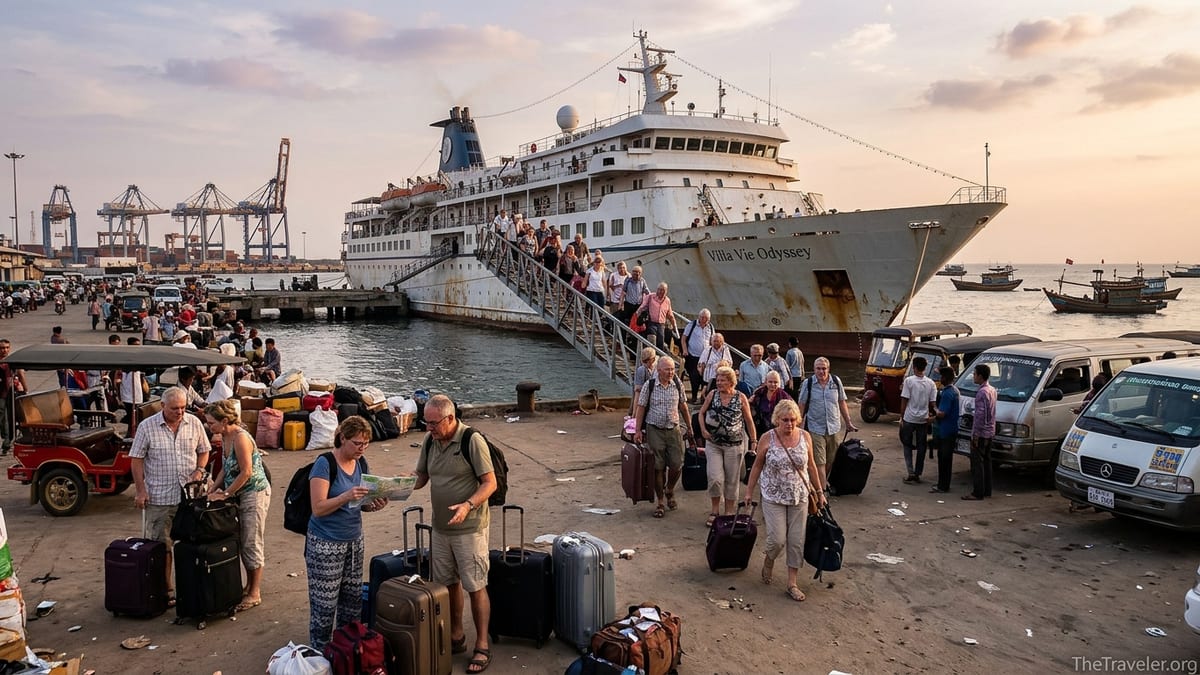
When Villa Vie’s much hyped Odyssey pulled into Sihanoukville, Cambodia in late October 2026, residents expected another stop on a three and a half year journey. Instead, around 200 people were told the “never ending” voyage was over, fuel bills could not be paid and they needed to leave with their belongings. Overnight, the dream of selling up and living at sea turned into a scramble for hotel rooms, flights and answers about what would happen to six and seven figure investments. The crisis has forced a hard look at residential world cruises and the real risks of treating a privately run ship as a permanent home.
Get the latest updates straight to your inbox!
From Dream Voyage to Sudden Disembarkation
Villa Vie Odyssey launched as a relatively affordable way to live at sea for years at a time. Residents could buy or long lease a cabin, marketed as a “lifetime” or multi decade right to occupy, with starting purchase prices publicly reported in the low to mid six figures and monthly fees pitched as comparable to maintaining a condo on land. The ship itself was an older vessel, built in the early 1990s and acquired out of layup after the pandemic. By late 2026 it had been sailing for more than two years on a rolling global itinerary.
On October 27, 2026, the company announced that sharply higher fuel prices in parts of Asia had pushed operating costs far beyond projections. Residents and passengers received notice in Cambodia that fuel suppliers would not extend more credit and that the ship’s three year itinerary was suspended. Independent reports from onboard described a same day deadline to pack and disembark in Sihanoukville, a port city without the international air connections of Bangkok or Singapore, leaving residents scrambling to book buses, regional flights and emergency accommodation out of pocket.
Public statements from Villa Vie Residences referred to a 60 day restructuring and recapitalization effort and cited fuel costs that had risen several times above previous legs of the voyage. Residents described a pattern of last minute calls for additional “fuel contributions” and itinerary slowdowns to save money in the months before the halt. Questions about refunds, future voyages and whether the ship would ever sail again went largely unanswered in the first week after the suspension, underlining just how exposed residents were once the operator’s business model failed.
The Cambodia episode did not occur in isolation. It followed earlier signs of financial strain, including reported emergency fundraising offers and legal disputes involving Villa Vie entities. For travelers attracted to the romance of endless cruising, the lesson is that residential world voyages sit at the intersection of hospitality, real estate and high cost maritime operations, and they can unravel quickly when financing or fuel budgets prove optimistic.
How Residential Cruise Contracts Really Work
Residential cruise products are marketed in language that sounds like home ownership. Prospective residents are invited to “buy a home at sea” or “own your floating apartment.” In reality, most contracts are highly specialized occupancy or use agreements layered on top of a ship that remains owned and controlled by a corporate entity. In court filings and sample purchase agreements connected to projects such as Villa Vie Odyssey and Storylines’ planned MV Narrative, buyers are typically granted an exclusive right to use a specific cabin for a set number of years, sometimes coupled with options to extend, transfer or resell under certain conditions.
These contracts usually clarify that buyers do not hold a maritime lien or traditional real estate title and that the operator can change itineraries, adjust service offerings, enter dry dock or even sell or scrap the vessel, often with limited compensation triggers. For example, Storylines marketing materials around MV Narrative described a multi decade “perpetual use license” model rather than a deeded apartment. Villa Vie documentation, according to complaints filed in U.S. courts, similarly used language of lifetime or long term occupancy while reserving wide discretion for the company to alter routes and schedules.
By contrast, the long running ship The World is structured more like a condominium at sea. Its 165 residences are owned by individuals through a corporate ownership structure, and the residents collectively own the vessel. Resale listings reported in 2026 suggest prices from roughly 3.5 million to well over 10 million dollars, with owners paying substantial annual assessments. That cost buys more formal governance: an owners’ association, elected board and the ability to hire or fire the ship management company. Even then, owners do not have the same protections as on land, but they exert more control than residents on a chartered or leased vessel like Odyssey.
For would be sea residents, the crucial step is to obtain and read the full contract, not just marketing brochures. Look for specific language about what you actually own, how long your rights last, under what conditions the company can terminate or suspend operations and what happens if the ship is sold, arrested by creditors or unable to sail for an extended period. Having a maritime or international real estate lawyer review the agreement is a cost many buyers skip but can be inexpensive compared with a six or seven figure commitment.
Following the Money: Operator Finances and Business Models
Residential world cruises combine volatile costs with long term promises. Fuel prices, port fees, crew wages, insurance premiums and regulatory compliance can change quickly. Villa Vie’s own statement cited fuel expenditure in parts of Asia that was several times higher than on other segments of its route. In a business that sells fixed price cabins or lifetime packages, large jumps in variable costs can quickly turn a modest margin into a sustained loss, especially for a single ship operator without deep reserves.
The Odyssey model depended on selling enough lifetime or long duration cabins to fund the acquisition and refit of an aging ship and to cover ongoing costs over years. Delays in refurbishments, slower than expected sales, or higher than budgeted maintenance on a thirty year old vessel all eroded the financial cushion. Media coverage in 2026 pointed to earlier emergency fundraising offers pitched to residents as “loan investments,” as well as lawsuits from business partners, suggesting that the company was already under pressure before the final fuel price shock in Cambodia.
Newer projects on paper, such as Storylines’ MV Narrative or other proposed residence ships, require even more capital. Building a large new vessel can easily run into the hundreds of millions of dollars, often financed through a mix of pre sales, private equity and shipyard credit. Construction delays or disputes, like those that have affected some residential ship projects in Europe, can push delivery dates back by years, leaving deposit paying buyers in limbo while still paying rent or mortgages on land.
At the other end of the spectrum, The World has operated since the early 2000s with a resident owned model, a high minimum net worth requirement and annual fees reportedly in the range of 8 to 10 percent of a residence’s value. If a two bedroom apartment resells for, say, 5 million dollars, that implies yearly ownership charges of several hundred thousand dollars, reflecting the true cost of running a small luxury ship. That level of contribution from wealthy owners helps explain why The World has survived the 2008 financial crisis, pandemic shutdowns and fuel spikes, while lower priced, thinly capitalized ventures have struggled.
Refunds, Credits and What Happens When the Music Stops
One of the most painful aspects of the Villa Vie Odyssey suspension has been the uncertainty around refunds and compensation. Residents who paid six figures for lifetime or long term rights suddenly faced additional hotel bills in Cambodia and last minute airfares home, while not knowing whether they would ever be made whole for the unused portion of their contracts. Initial communication from the operator focused on the need to restructure, with no clear promises on cash refunds. Some residents reported that local lodging and short term transportation were being covered, but onward international travel and the value of their cabin rights remained unresolved.
The lack of clarity reflects how most residential cruise contracts are drafted. Unlike mainstream cruise tickets, which in some jurisdictions must be backed by financial protection schemes or bonded escrow for package holidays, occupancy purchase agreements for residential ships often place buyers squarely in the position of unsecured creditors if the operator cannot continue. If the company enters insolvency, cabin buyers may find themselves in line with other creditors, competing for whatever value can be recovered from selling or chartering the vessel.
Insurance carried by the operator usually protects the ship and its liability to third parties, not residents’ investments. Travel insurance bought individually tends to cover trip cancellation, medical care and lost luggage for discrete voyages. It rarely covers the loss of a multi year or lifetime residential interest if the company fails. Extended stay riders or “cruise frequent traveler” policies, where available, still rely on the cruise line remaining solvent. As a result, residents disembarking in Cambodia found that neither their travel policies nor the line’s corporate policies offered a clear avenue to reclaim their capital payment for the cabins.
By contrast, in a resident owned structure such as The World, the vessel itself and onboard cash reserves are controlled by an owners’ association. If the community ever chose to wind down, the ship and its assets would in theory be sold for the benefit of owners after paying creditors. Owners might still lose value if the ship sold for less than they had invested, but the process and priorities are typically more transparent than in a purely corporate model. That does not eliminate risk, yet it does alter who holds the keys if operations become unsustainable.
Insurance Gaps and Legal Gray Areas for Life at Sea
Moving full time onto a ship raises insurance and legal questions many buyers underestimate. Standard home insurance on land does not apply to a cabin on a vessel, and most mainstream health insurance policies, including Medicare for U.S. retirees, have strict limits on foreign care. While cruise ships have medical centers, these are designed for short term stabilization, not chronic care, and serious cases are routinely evacuated to shore hospitals at significant cost. Long stay residents therefore need robust international health insurance and clear plans for what happens in a medical emergency when the ship is days from a major port.
Liability and property coverage can also be patchy. The operator’s insurance typically covers the hull, machinery and general liability for incidents like onboard injuries or pollution. Personal belongings in a cabin may be covered only up to relatively low limits, similar to baggage coverage, and may exclude high value items like art or jewelry. A resident who keeps their life’s possessions in a cabin may need a specialized marine personal property policy, something that requires working with a broker experienced in yacht and maritime risks rather than a standard home insurance agent.
Beyond insurance, jurisdictional issues complicate disputes. A residential ship may be registered in one country, operated by a company incorporated in another, and spend most of its time in international waters or visiting ports under yet more legal systems. Many contracts require arbitration in a specific venue, such as London, Miami or a small island jurisdiction, and they often limit class actions or collective redress. Residents of Villa Vie Odyssey now weighing their options will have to navigate this patchwork if they pursue legal claims, potentially facing long, expensive processes in unfamiliar courts or arbitration forums.
For prospective residents, a practical step is to ask blunt questions about every layer of insurance: the ship’s coverage, your own health and property policies and any group schemes offered through the operator. Request confirmation in writing of what is and is not covered, and consider commissioning an independent insurance review alongside legal due diligence before committing to live at sea.
What Life Really Costs: Monthly Budgets on Residential Ships
Marketing for residential cruises often compares life at sea to the cost of a condo in an expensive city. Villa Vie Odyssey’s sales materials highlighted low six figure purchase prices and suggested that ongoing monthly fees could rival a mortgage plus condo dues in places like Miami or Vancouver while including food, housekeeping and utilities. Some early residents speaking publicly mentioned cabin purchase prices around 100,000 dollars with additional monthly assessments, figures that undercut luxury land based retirement communities charging 4,000 dollars or more per month for a small apartment and services.
Those comparisons rarely capture the full picture. On legacy ships like The World, public information indicates that annual ownership fees alone can run from roughly 60,000 to 300,000 dollars, depending on residence size. Spread over twelve months, that translates to 5,000 to 25,000 dollars a month in community charges before any personal spending. On top of that come optional dining, excursions by helicopter or private tender, and the cost of flying in and out to meet the ship. That price point aligns with the wealth of owners who often maintain multiple homes on land.
Newer projects targeting a broader middle or upper middle market aim for substantially lower monthly outlays, but the underlying economics of operating a cruise ship do not scale down easily. Fuel price spikes, like those that hit Villa Vie in Asia, drive per cabin costs into the thousands of dollars per month even on older, fully depreciated ships. Port fees in marquee destinations such as Sydney, Barcelona or New York are measured in tens of thousands of dollars per call. Crew salaries, food, maintenance and regulatory compliance must all be covered by the resident base.
Anyone considering a residential cabin should build a detailed monthly budget that includes not only advertised fees but also realistic travel costs to and from the ship, visa runs to meet immigration rules, private medical expenses when outside home insurance networks and a contingency fund for sudden itinerary changes. The Cambodia episode demonstrated that a single operational decision can generate unplanned hotel bills and long haul flights for every resident on board.
Due Diligence for Prospective Sea Residents
In light of the Villa Vie Odyssey crisis, careful due diligence is no longer optional for would be full time cruisers. Start by investigating the operator’s history. How long has the company existed, and what is its track record in cruising or ship management. A project launched in the last few years with a single older vessel is very different from a resident owned ship with two decades of continuous operation or a multi ship line backed by a major cruise conglomerate.
Next, try to understand the capital structure. If the ship is being built new, ask what percentage of the construction cost is already funded and whether deposits are held in escrow with protections if the ship is delayed or never delivered. If the ship is an older conversion, request information on the survey, planned dry dock work and how overruns will be handled. Where possible, consult independent maritime analysts or marine surveyors rather than relying solely on the operator’s glossy presentations.
Speaking directly with current or former residents can be invaluable. Online forums, private social media groups and independent blogs often host candid discussions of life aboard specific ships. Before the Cambodia halt, residents on Odyssey had already shared concerns about repeated itinerary changes, last minute calls for additional funding and communication gaps. Taking the time to read such reports before buying can reveal patterns that sales staff are unlikely to highlight.
Finally, consider building your own “stress test” of the operator’s model. Ask what happens if fuel prices rise by 200 percent, if a pandemic forces the ship into layup for a year, or if a major mechanical failure requires months in dry dock. Request written clarification on whether monthly fees can be increased, by how much, and whether you can exit the program or resell your cabin if fees rise beyond your means. Operators who welcome these questions and provide clear documentation are generally less risky than those who respond with vague assurances.
Should You Ever Make the Ocean Your Only Home
The allure of waking up each morning to a new horizon is powerful. For some, like the multimillionaire residents of The World, residential cruising has delivered exactly that for more than twenty years, backed by deep pockets and a robust governance model. For others, including many on Villa Vie Odyssey, the dream has been shaken by the reality that a single corporate decision, fuel price spike or financing shortfall can upend their entire way of life overnight.
The key question for prospective residents is not simply whether life at sea appeals, but whether they can afford the financial and logistical risks. Treating a residential cruise as one component of a diversified life, with a maintained foothold on land, substantial liquid savings and flexible plans, is far safer than selling everything to move aboard a single ship. Several Odyssey residents interviewed after the halt described being grateful they had kept a small apartment or family home ashore, even if they had not used it for years.
For many travelers, extended ordinary cruises or back to back voyages on mainstream lines may deliver much of the same lifestyle with less long term exposure. It is entirely possible to spend months each year at sea by stringing together repositioning cruises, world cruise segments and off season sailings, keeping your primary residence on land. This approach usually offers clearer consumer protections, easier cancellation terms and the ability to change lines or itineraries without being tied to the fortunes of a single residential ship project.
Residential world cruises will likely survive the Villa Vie Odyssey saga in some form. New ships are already on drawing boards from Europe to Asia, and the concept of “owning at sea” still attracts both capital and curiosity. Yet the Cambodia crisis has exposed fault lines that anyone contemplating life aboard must confront. The ocean remains a beautiful place to visit, and for a fortunate few, to partly call home. Making it your only address, however, requires a level of financial resilience, legal awareness and appetite for risk that goes far beyond a typical cruise vacation.